




Abstract
Abstract
The Generalized Pathological Internet Use Scale (GPIUS2) assesses cognitive behavioral aspects of problematic Internet use. To date, the 15-item scale has only been available in English, and the aim of this study was to translate and validate a German version. An online sample (ON, n=1,041, age 24.2±7.2 years, 46.7% men) completed an Internet version of the translated GPIUS2, and a student sample (OF, n=841, age 23.5±3.0 years, 46.8% men) filled in a pencil and paper version. A third sample of 108 students (21.5±2.0 years, 25.7% men) completed the questionnaire twice to determine the 14-day retest reliability. Participants also answered questions regarding their Internet use habits (OF, ON) and depression, loneliness, and social anxiety (ON). The internal consistencies were α=0.91 (ON) and α=0.86 (OF). Item-whole correlations ranged from r=0.53 to r=0.69 (ON) and from r=0.39 to r=0.63 (OF). The 2 week retest reliability was rtt=0.85. Confirmatory factor analyses found a satisfactory fit for the factorial model proposed by Caplan for the original version. The GPIUS2 score correlated moderately with time spent on the Internet for private purposes in a typical week (ON: r=0.40; OF: r=0.36). Loneliness, depression, and social anxiety explained 46% of the variance in GPIUS2 scores. The German version of the GPIUS2 has good psychometric properties in a pencil and paper version as well as in a web-based format, and the observations regarding loneliness, depression, and social anxiety support the underlying model.
Introduction
T
There is still disagreement about the exact conceptualization of the phenomenon and the terminology 9 with descriptions such as compulsive use,10,11 pathological Internet use, 12 Internet dependency, 13 Internet addiction,14,15 or problematic Internet use. 16 However, there is a common core to these concepts: the individual concerned uses the Internet excessively, often at the expense of other areas of life (e.g., work, personal relationships, or sleep); he or she continues to overuse the Internet despite negative consequences, and experiences negative emotions, including tension, anger, or sadness if unable to go online.
Estimates of the number of people affected by problematic Internet use vary from 1.2%17,18 to 15–20%,19,20 with a recent systematic review reporting a range of 0–26.3% for U.S. students. 21 A major theoretical advance was the development of a cognitive behavioral model by Davis, 12 who distinguished between specific and generalized pathological Internet use (PIU). Specific PIU is characterized by the use of the Internet for specific purposes, such as online gaming, sexual gratification, or chatting, 12 whereas generalized PIU is a general overuse of the Internet independent of specific applications. According to the proposed diathesis-stress model, a pre-existing psychopathology such as depression or social anxiety renders an individual vulnerable to developing generalized PIU. If maladaptive cognitions concerning the Internet and the self, for example “I am a failure when I am offline,” 12 are also present, generalized PIU may develop. According to Davis, an important factor in generalized PIU is social isolation or a lack of social support.12,16
Caplan developed the Generalized Pathological Internet Use Scale (GPIUS) as an instrument to capture those characteristic maladaptive cognitions and behaviors. 16 The revised version, GPIUS2, 22 consists of 15 items organized into five subscales: Preference for Online Social Interaction (POSI), Mood Regulation (MR), Cognitive Preoccupation (CP), Compulsive Use (CU), and Negative Outcome (NO). POSI captures the tendency to prefer Internet-based communication to face-to-face interaction (e.g., “Online social interaction is more comfortable for me than face-to-face communication”). NO measures the adverse consequences of excessive Internet use (e.g., “My Internet use has made it difficult for me to manage my life”). MR assesses the tendency to use the Internet to change unpleasant emotional states (e.g., “I have used the Internet to make myself feel better when I've felt upset”). CP (e.g., “When I haven't been online for some time, I become preoccupied with the thought of going online”) and CU (e.g., “I find it difficult to control my Internet use”) were shown to be aspects of “deficient self-regulation,” 22 the tendency to experience a state of reduced self-monitoring in which conscious self-control is relatively diminished due to mechanisms such as an increase in habit strength formed on the basis of previous usage. 23
With the aforementioned close ties to cognitive behavioral models, the GPIUS2 differs from other available instruments whose main goal is the diagnosis of Internet addiction and fills a gap in the assessment of cognitive, emotional, and behavioral aspects of excessive Internet use. This prompted us to translate the GPIUS2 into German and investigate the psychometric properties and factor structure of the German version in an offline sample (pencil and paper version) and an Internet sample (online version), and to examine its retest reliability and factor structure. Further, we investigated whether the association between the GPIUS2 and depression, loneliness, and social anxiety predicted by Davis's cognitive model of PIU is present in the German sample.
Method
Recruitment and participants
Offline sample (study A)
An offline sample (OF) of 916 students of Göttingen University, Germany, filled in a pencil and paper version of the GPIUS2. They were approached on public spaces on campus (cafeterias, libraries) by final-year psychology students and asked whether they would be willing to fill in the questionnaire. No formal count was made, but the vast majority of those approached agreed to fill in the questionnaire. Of the collected 916 questionnaires, 68 were excluded because German was not the respondent's native language, and seven were excluded because less than 50% of the items had been answered. The final sample consisted of 841 questionnaires from participants with a mean age of 23.5±3.0 years (394 women and 447 men) that were entered into the analyses.
Online sample (study B)
For the online study (ON), the questionnaire was posted on the Internet in general forums and computer-related message boards. A total of 1,412 respondents followed the link; 263 of these left without completing the relevant sections. Of the remaining 1,149 respondents, 59 were excluded because German was not their native language and 14 because they were younger than 14 years of age. A further 35 questionnaires were discarded because the respondents had made obviously false statements. The final sample consisted of 1,041 questionnaires from participants with a mean age of 24.2±7.2 years (555 women and 486 men).
Retest sample (study C)
For the retest sample (RS), questionnaires were distributed during lectures at Göttingen University. The same lectures were visited 2 weeks later to collect retest data. A total of 108 students completed both questionnaires; three had to be excluded because of missing data. The final sample consisted of 105 participants with a mean age of 21.5±2.0 years (77 women and 27 men).
Instruments
In all studies, the GPIUS2 and the Internet Addiction Test (IAT 15 ) were administered, and demographic data were collected. In studies A and B, the participants provided self-reports about hours spent online in a typical week, frequency of Internet use in a typical week, and the duration of individual online sessions. The questions asked specifically about Internet use for private (i.e., nonwork/nonacademic) purposes. In study B, the participants also completed questionnaires on depression, loneliness, and social anxiety.
The GPIUS2 consists of 15 items to be rated on a 5-point scale ranging from 1=“never” to 5=“always,” 22 and was translated by one of the authors (A.B.) and retranslated by a bilingual speaker. See Appendix for the German version.
In order to assess concordance with the GPIUS2, the IAT 15 was administered in all studies. The IAT measures Internet addiction and consists of 20 items, formulated to mirror the criteria for gambling addiction, which are rated on a 5-point scale where 1=“not at all” and 5=“always.” The German version of the IAT 24 was validated and shown to possess good psychometric characteristics. 25
The UCLA-Loneliness Scale (UCLA-LS26,27) is an established instrument for the assessment of loneliness. It consists of 20 items to be answered on a 5-point scale.
Depression was measured using the state version of the State–Trait Depression Scale (STDS28–30 ). The STDS consists of 10 items describing depressive states (e.g., “I am sad”) to be rated on a 4-point scale from 1=“not at all” to 4=“very,” and was constructed for use in nonclinical populations.
Social anxiety was measured with the Brief Fear of Negative Evaluations Scale (FNE-B31,32), which consists of 12 statements to be rated on a 4-point scale from 1=“almost never” to 4=“almost always.”
Statistical analysis
Item analyses to determine mean item scores and standard deviations, item difficulty, and item-total correlations were carried out for the offline and the online samples independently. Mean inter-item correlations, mean item difficulty, and internal consistency (standardized Cronbach's α) were computed for the whole scale and for each subscale. Missing data were excluded on a case-wise basis. In order to calculate the retest reliability (study C), the GPIUS2 scores at t1 were correlated with those at t2 (2 weeks later).
Confirmatory factor analyses were carried out independently for the offline sample and the online sample in order to test how well the German translation fits the model suggested by Caplan for the original version. 22 Goodness of fit was assessed with the chi-square test, the root mean square error of approximation (RMSEA), the standardized root mean squared residual (SRMR), and the comparative fit index (CFI).
For both samples, Pearson correlations between the GPIUS2 sum score, the GPIUS2 subscales and age, time online in a typical week, duration of online sessions, and the IAT were calculated. For the online sample correlations of the GPIUS2 and its subscales with the UCLS-LS, the STDS and the FNE-B were also computed. The point biserial correlation coefficient was calculated for sex and GPIUS2 score. Bonferroni corrections were applied where appropriate.
For the online sample, a linear regression (method: Enter) was calculated with the criterion GPIUS2 score and the predictors STDS, UCLA-LS, and FNE-B in order to ascertain how much variance is explained by a combination of these vulnerability factors.
Results
Comparison of the online and the offline sample
The online sample (24.2±7.2 years) was slightly older than the offline sample (23.5±3.0 years), t(1462.26)=3.04, p=0.002, d=0.14, adjusted for unequal variances; the sex ratio of the samples did not differ (χ2=0.005, df=1, p=0.94).
The majority of the participants used the Internet on a daily basis (ON: 86.55%; OF: 71.94%) or five to six times per week (ON: 9.32%; OF: 18.07%). In a typical week, the participants from the online sample spent more time online (21.0±17.8 hours) than those of the offline sample (11.2±9.9 hours), t(1880)=14.28, p<0.001, d=0.68, and their individual online sessions lasted longer (2.8±2.6 hours) than those of the offline sample (2.4±1.4 hours), t(1880)=15.06, p<0.001, d=0.72.
Item analyses
In the offline sample, item difficulties ranged from pi=0.06 (item 14) to pi=0.32 (items 2, 11) with a mean item difficulty of pi=0.20; in the online sample, the difficulties ranged from pi=0.06 (item 14) to pi=0.37 (item 10) with a mean item difficulty of pi=0.21. The item-whole correlations varied in the offline sample from ritc=0.39 (items 5, 12) to ritc=0.63 (item 7), and in the online sample from ritc=0.53 (items 10, 15) to ritc=0.69 (item 3). The mean inter-item correlations were ritc=0.50 (OF) and ritc=0.61 (ON). For item difficulties and item-whole correlations, see Table 1.
For the GPIUS2 sum score, an independent t test showed that the ON sample scored higher than the OF sample. After Bonferroni corrections, the comparisons of the subscales showed that the ON sample achieved higher scores for POSI and NO than the OF sample. For detailed results, see Table 2.
Note. *p<0.05; **p<0.01; ***p<0.001. The Bonferroni corrected threshold was p<0.01. All t values marked with two or three asterisks were significant after the Bonferroni correction. †Levene's test indicated a difference in variance between the two samples, so the Welch test was used.
Reliability
The internal consistency for the whole scale resulted in a Cronbach's alpha of 0.86 for the ON sample and 0.91 for the OF sample; the 14-day retest reliability was rtt=0.85. The internal consistencies of the subscales ranged from α=0.62 (OF) and α=0.67 (ON) for CP to α=0.77 (OF) and α=0.82 (ON) for MR. The retest reliabilities ranged from rtt=0.71 (POSI and CP) to rtt=0.83 (MR). For a summary of the psychometric properties for all samples and subscales, see Table 3.
Validity
Factor structure
Confirmatory factor analyses were carried out for the online and the offline samples separately, testing the factor structure suggested by Caplan. 22 For the detailed results for the offline sample, see Figure 1; for the detailed results for the online sample, see Figure 2. The model fit parameters were χ2=420.8, df=82, p<0.0001, SRMR=0.0553, RMSEA=0.071 [CI 0.065–0.078], and CFI=0.917 for the offline sample, and χ2=674.2, df=82, p<0.0001, SRMR=0.0584, RMSEA=0.084 [CI 0.079–0.090], and CFI=0.927 for the online sample.
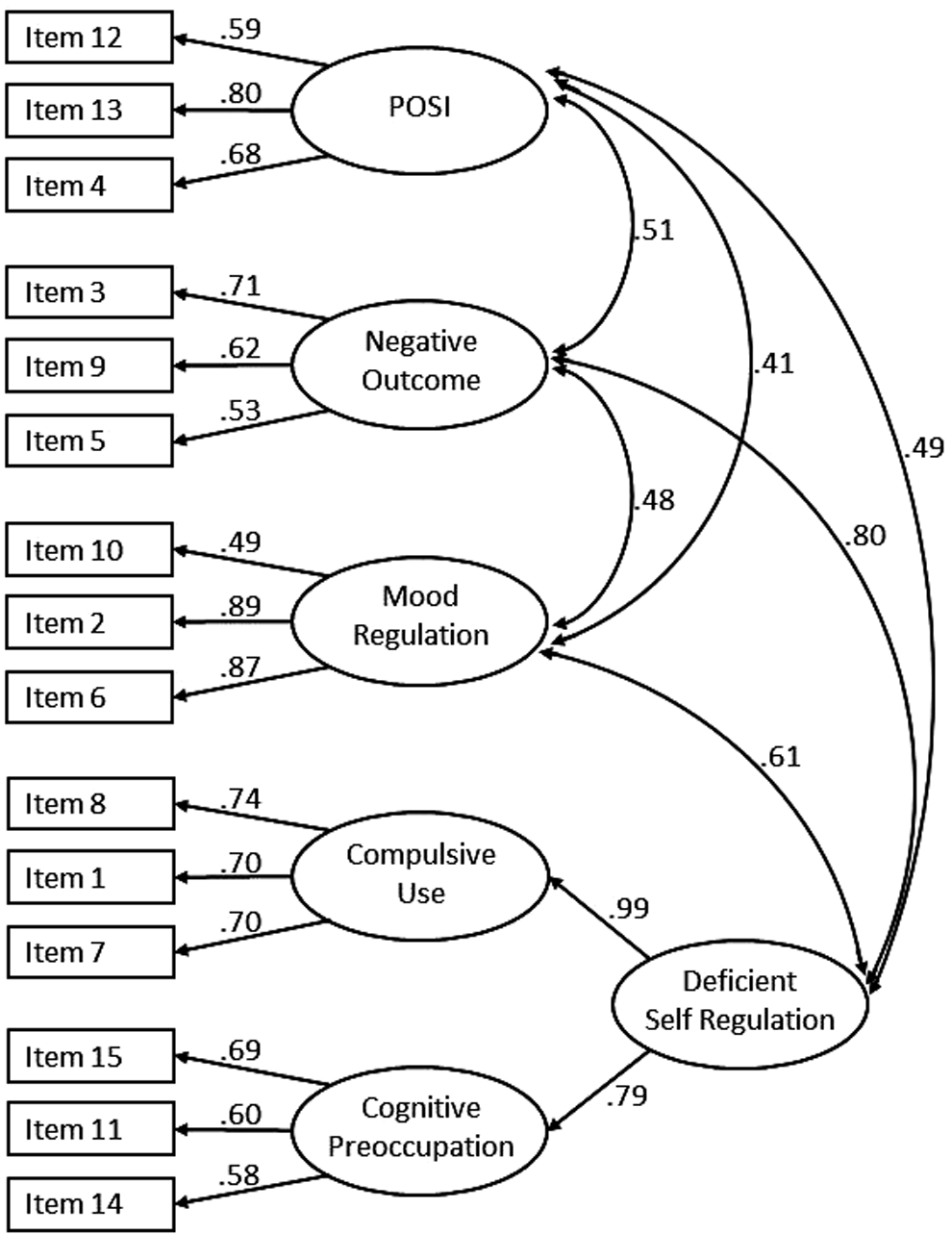
Path diagram for the confirmatory factor analysis for the offline sample.
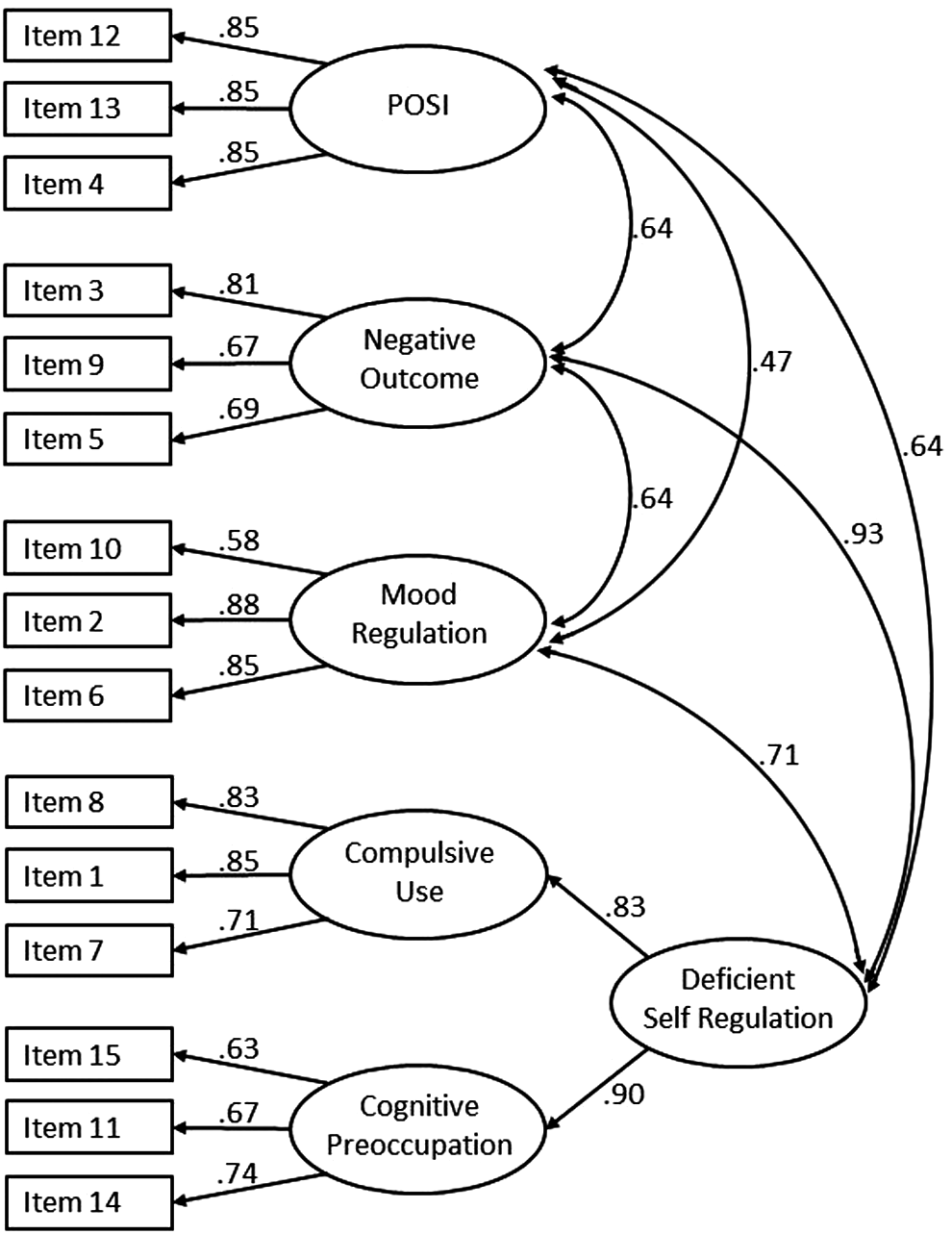
Path diagram for the confirmatory factor analysis for the online sample.
Convergent validity
In both samples, the GPIUS2 score correlated highly with the IAT score (OF: r=0.78; ON: r=0.82). Of the GPIUS2 subscales, the highest correlations were found for the CU subscale (OF: r=0.65; ON: r=0.76), the lowest for POSI (OF: r=0.47; ON: r=0.55). For details, see Tables 4 and 5.
Note. *p<0.001. All correlations marked with an asterisk were significant after Bonferroni correction.
Note. *p<0.001. All correlations marked with an asterisk were significant after Bonferroni correction.
Correlation with Internet use parameters
The time spent online in a typical week correlated with the GPIUS2 score with r=0.40 (ON) and r=0.36 (OF). We also found correlations with the duration of individual online sessions of r=0.35 (ON) and r=0.34 (OF). In the online sample, the subscale that correlated most strongly with both measures of Internet use was the NO subscale (online hours per week r=0.41; duration of individual sessions r=0.36). In the offline sample, NO was also the subscale that correlated most strongly with the duration of the individual sessions (r=0.27), but time online per week achieved the highest correlation with CP (r=0.33). For the correlations of all subscales with indicators of Internet use, see Tables 4 and 5.
Correlation with sex and age
In both samples, the GPIUS2 score and the subscales were not correlated with age.
Also in both samples, a small correlation with sex was observed: male participants had higher GPIUS2 scores (OF: r=0.10; ON: r=0.13). The subscale most strongly correlated with sex was NO in both samples (OF: r=0.24; ON: r=0.20).
Correlation with depression, loneliness, and social anxiety
For the online sample, data on depression (STDS) and loneliness (UCLA-LS) were obtained. The GPIUS2 scores correlated strongly with depression (r=0.54); the correlation was observed in all subscales (r≥0.40). They also correlated strongly with loneliness (r=0.63), again with correlations in all subscales (r≥0.40). The strongest correlations were obtained for POSI (r=0.64) and NO (r=0.55). For details, refer to Table 6. Social anxiety (FNE-B score) correlated most strongly with the GPIUS2 sum score (r=0.44).
Note. Adjusted R2=0.46, F(3, 847)=243.99, p<0.0001; *p<0.001.
In order to calculate the combined effect of these vulnerability factors, we entered them into a linear regression (method: Enter) with the criterion GPIUS2 score. All three predictors contributed significantly to the model (for details, see Table 6), and together STDS, UCLA-LS, and FNE-B scores explained 46% of the variance of the GPIUS2 score, adjusted R 2 =0.46, F(3, 847)=243.99, p<0.0001.
Discussion
The reliability and validity of the German version of the GPIUS2 was investigated in an online and an offline sample and its 2 week retest reliability examined in a further sample. The German version of the GPIUS2 was shown to have good to satisfactory psychometric properties. The GPIUS2 score was associated with depression, loneliness, and social anxiety.
Item analyses
Item analyses showed medium to high item difficulty, which in the context of the assessment of attitudes is tantamount to a medium to low endorsement. In both samples, the same eight items (3, 4, 5, 7, 9, 12, 13, 14) evoked low (pi<0.20) endorsement; the others showed medium endorsement. It was to be expected that in a general sample the items would, on average, engender low endorsement given that the GPIUS2 is aimed at the identification of pathological aspects of Internet use that will be present only in a small percentage of the population.
In the online sample, all item-whole correlations were high (ritc>0.50); in the offline sample, seven items showed high item-whole correlations, and the remainder medium ones (ritc=0.30 to ritc=0.50).
Reliability
The German version of the GPIUS2 possessed good reliability. With Cronbach's alphas of 0.86 (OF) and 091 (ON), its internal consistency was high and in the same range as the internal consistency of the English original (α=0.91). 22 The internal consistency of the German version's subscales varied (α=0.62–0.89). In all samples, the lowest internal consistency was observed for the CP subscale (α=0.62–0.71). Internal consistencies where Cronbach's alphas are greater than 0.70 can be regarded as acceptable. 33 In judging the subscales' internal consistency, one should take into account the extreme brevity of the subscales and the concomitant difficulty of attaining high reliability scores.
Generally, it appeared that the online version achieved better consistencies than the offline versions; in the online version, all subscales except CP were found to have internal consistencies of α=0.76 and higher. On the whole, the internal consistencies were satisfactory, even if somewhat below those of the English original. 22
The German version also demonstrated a good 2 week retest reliability of rtt=0.85. To the best of our knowledge, this was the first time the retest reliability of the GPIUS2 has been investigated. The retest reliability of the subscales also reached satisfactory levels (all retest coefficients were rtt>0.70).
Validity
Regarding the factor structure, the confirmatory factor analyses overall showed an acceptable fit for the model proposed by Caplan. 22 The model showed a slightly better fit in the offline sample. The difference in fit between the online and the offline sample may, however, simply reflect the differences in sample size (n=841 vs. n=1,041), as the sensitivity of the fit measures for detecting a model's deviation from reality increases with sample size.
Although it has been argued that problematic Internet use cannot be equated with the amount of time spent online,6,34 it is nevertheless an important indicator. We explicitly asked for private, that is, nonacademic or work-related, Internet use and found medium correlations (OF: r=0.36; ON: r=0.40) with the GPIUS2 score for the German version. For the English version, no such correlations were reported, but the strength of the association is broadly in line with those found for other instruments assessing problematic Internet use and time spent online, such as the IAT, 25 and points to the instrument's validity. The subscale most strongly associated with the time spent on the Internet was NO. Given the nature of the subscale, this seems an indication of its validity in that individuals who spent a lot of time on the Internet might plausibly be expected to experience more interference or conflict with other areas of life, such as their social and family life or their work and studies. This subscale also correlated most strongly with the duration of individual online sessions—possibly pointing to a difficulty in disengaging from the Internet once the individual is online.
Correlations with loneliness, depression, and social anxiety
The GPIUS2 score showed a strong correlation with loneliness and depression and a medium correlation with social anxiety. Combined, these three factors explained 46% of the variance in the GPIUS2 scores. With a coefficient of β=0.45, loneliness emerged as the strongest predictor. This fits well with Davis's cognitive model of PIU 12 and points to psychosocial factors associated with generalized excessive Internet use. In the subscale analyses, loneliness was most strongly associated with POSI and NO, linking social isolation and a lack of close personal relationships with a preference for online social interaction, as well as with negative consequences of excessive Internet use. The second strongest predictor was depression. The association of PIU and psychosocial impairment is consistent with Davis's 12 and Caplan's models, 22 in which factors such as depression and social isolation increase vulnerability to generalized problematic Internet use.
The strengths of the associations of depression, loneliness, and social anxiety with GPIUS2 were higher than those reported in the meta-analyses by Tokunaga and Rains 35 and Huang. 36 On the basis of a large body of studies, Tokunaga and Rains estimated the correlations between PIU and depression at r=0.37 (23 studies), with social anxiety at r=0.27 (13 studies) and loneliness at r=0.33 (19 studies). Huang et al.'s meta-analysis included mainly studies investigating loneliness and depression and investigated Internet use as time spent on the Internet rather than PIU. They found a small negative association between Internet use and overall well-being. A possible explanation for the higher correlations found in our study may be that the studies in the meta-analysis of Tokunaga and Rains were heterogeneous with regard to the way PIU was operationalized. Considering only those studies included in the meta-analysis that used validated questionnaires for the assessment of PIU and depression, correlation coefficients ranged from r=0.32 23 to r=0.50. 37 Taking further into account that the GPIUS2 is constructed on the basis of Davis's model, one would expect the use of this instrument to yield higher correlations. However, we cannot rule out that this is a peculiarity of the German version of the GPIUS2 or the German Internet users. To sum up, Caplan's model assumes that depression, loneliness, and social anxiety are vulnerability factors for PIU. The results presented here are consistent with this model. However, due to the correlational design, causal relationships cannot be elucidated from our study, and prospective studies are badly needed.
Differences between the online and offline samples
The online sample used the Internet for a greater number of hours per week, and once online, they stayed online longer than the offline sample. Both effects were medium to large effects according to Cohen. 38 The online sample also reported a stronger preference for online social interaction, an effect of medium size. These differences appear plausible in view of the underlying model, which links problematic use to a preference for online social interaction; using the Internet for a larger proportion of one's social life might partially account for the greater amount of time spent online in the online sample, especially given that the correlation between POSI and time online is stronger in the online sample than in the offline sample. Similar differences between online and offline samples have been observed previously. 39 A possible explanation for this effect could be that people may be more inclined to disclose potentially embarrassing behavior in a setting perceived to be more anonymous, such as the Internet. This phenomenon was recognized in other contexts. 40 The observed differences could also be due to a sampling effect. When people are recruited via the Internet, those who spend the most time online are most likely to come across the questionnaire; they may also be more willing to fill it in because its topic may appear more personally relevant to them.
Conclusion
In conclusion, the German version of the GPIUS2 showed good psychometric properties in an online and an offline version. In our view, its particular usefulness lies in the model-driven subscales, which have a potential role in therapy settings based on cognitive behavioral methods. The subscale MR can be used to assess dysfunctional emotional self-regulation that overly relies on the Internet to escape unpleasant feelings—a behavior that leads to a negative reinforcement of Internet use. In addition, in the context of the recent advance of Internet communication through social networking, a scale measuring the preference for online communication appears timely. In the future, it may be useful to include a time frame (such as last week) in the instruction and open the way for a use as a measure of psychological change in relevant cognitive areas during therapy.
Footnotes
Acknowledgment
The authors gratefully acknowledge the generosity of Scott E. Caplan who allowed us to use the GPIUS2 prior to its final publication.
We would also like to acknowledge the help of Bettina Adamietz, Sarah Alhabbo, Anna Gast, Christine Hofheinz, Katharina Kube, and Tatiana Katzeishvili for their help with data collection in the offline sample; Katharina Müller for help with the data collection for the online sample; and Inga Meyhöfer and Lars Reichler for their help with collecting the retest data. Finally, we thank Elisabeth Vögtle for her help with data consolidation.
Author Disclosure Statement
No competing financial interests exist.