




Abstract
Abstract
The aim of this study was to evaluate the effects of a four-session school-based media literacy curriculum on adolescent computer gaming and Internet use behavior. The study comprised a cluster randomized controlled trial with three assessments (baseline, posttest, and 12-month follow-up). At baseline, a total of 2,303 sixth and seventh grade adolescents from 27 secondary schools were assessed. Of these, 1,843 (80%) could be reached at all three assessments (Mage=12.0 years; SD=0.83). Students of the intervention group received the media literacy program Vernetzte
Introduction
T
Given the risks associated with the use of digital screen media and given the ubiquitous nature of media in general, the question arises how children and adolescents can be protected from harmful media effects. There seems to be consensus that a complete ban of adolescent media use cannot be a realistic or adequate preventive effort, as media are an inevitable part of children and adolescents' life today. Existing prevention approaches can be classified into reduction and immunization approaches. Reduction approaches are based on a dose–response media effect model, and assume that less exposure is better than more. Immunization approaches assume that adolescents can be protected against the risks of harmful media effects by enhancing their (and their parents') media literacy, that is, they can be trained to use media and to process media contents in a healthier way. 17 These two approaches are not mutually exclusive. Enhancing media literacy can also lead to a reduction in exposure, for example by changing parental media behavior or by changing social norms regarding media use. Such interventions can be an effective way to improve media knowledge and critical thinking, as well as to change health-related problematic attitudes and behaviors.18–24 However, primary outcomes of previous studies were specific health behaviors not excessive screen times or proxies of addictive use patterns. 25 The aim of the present study was to close this gap by developing and testing a short school-based curriculum on media literacy that focuses on problematic use of the Internet and computer games.
Materials and Methods
Study design
A two-arm cluster randomized control trial with three assessments (baseline/posttest/follow-up) was conducted.
Intervention
Vernetzte
Unit 1 starts with a self-reflection of the students' own use patterns, including a discussion about which kinds of use pattern could already be viewed as problematic. Subsequent activities deal with the validity of online content, aiming at adolescents' critical perception and interpretation of different types of online information (e.g., Wikisystems, personal Web sites, and advertisements). Unit 2 also starts with a self-reflection and a discussion of the students' online communication behavior. It deals with potential risks of different types and situations of online communication (e.g., data protection). The gaming unit contains activities to reflect gaming preferences, motives, and gaming times. Also, the age restriction of video games is explained. On the basis of a comic strip about a dog becoming addicted to video gaming, the concept of gaming addiction is discussed in detail. The program also contains a booklet for parents that provides recommendations on adolescent media times, and encourages the exchange of media-related views and experiences with their children. The program materials are freely available at
Study procedure
In August 2010, 80 randomly selected secondary schools from the German Federal State of Schleswig-Holstein were invited to participate with all their 6th and 7th grade classes in a study on media literacy. Nineteen schools agreed to join the study. Blockwise randomization was performed at school level, stratified by school type (more detailed information regarding the randomization procedure is given elsewhere). 26 After randomization, schools were informed about their group status (intervention/control) and were requested to register all participating classes. Because schools from the intervention group registered more classes than schools from the control group, 39 additional schools were invited for the control condition to counteract this sample size bias (Fig. 1). Eight of these schools agreed to participate. Parents received written information about the study with the opportunity to refuse their child's participation. Between December 2010 and February 2011, the program was implemented in the intervention group by trained teachers. Post-test and follow-up data were collected in May 2011 and 2012 respectively. All data were collected through self-completion questionnaires. To link individual data of all assessments without violating anonymity, each questionnaire was labeled with a seven-digit code self-generated by each student. 27 Design and procedure were approved by the Ethics Committee of the Medical Faculty of the University of Kiel, the Ministry of Education, and the Data Protection Commissioner of Schleswig-Holstein.
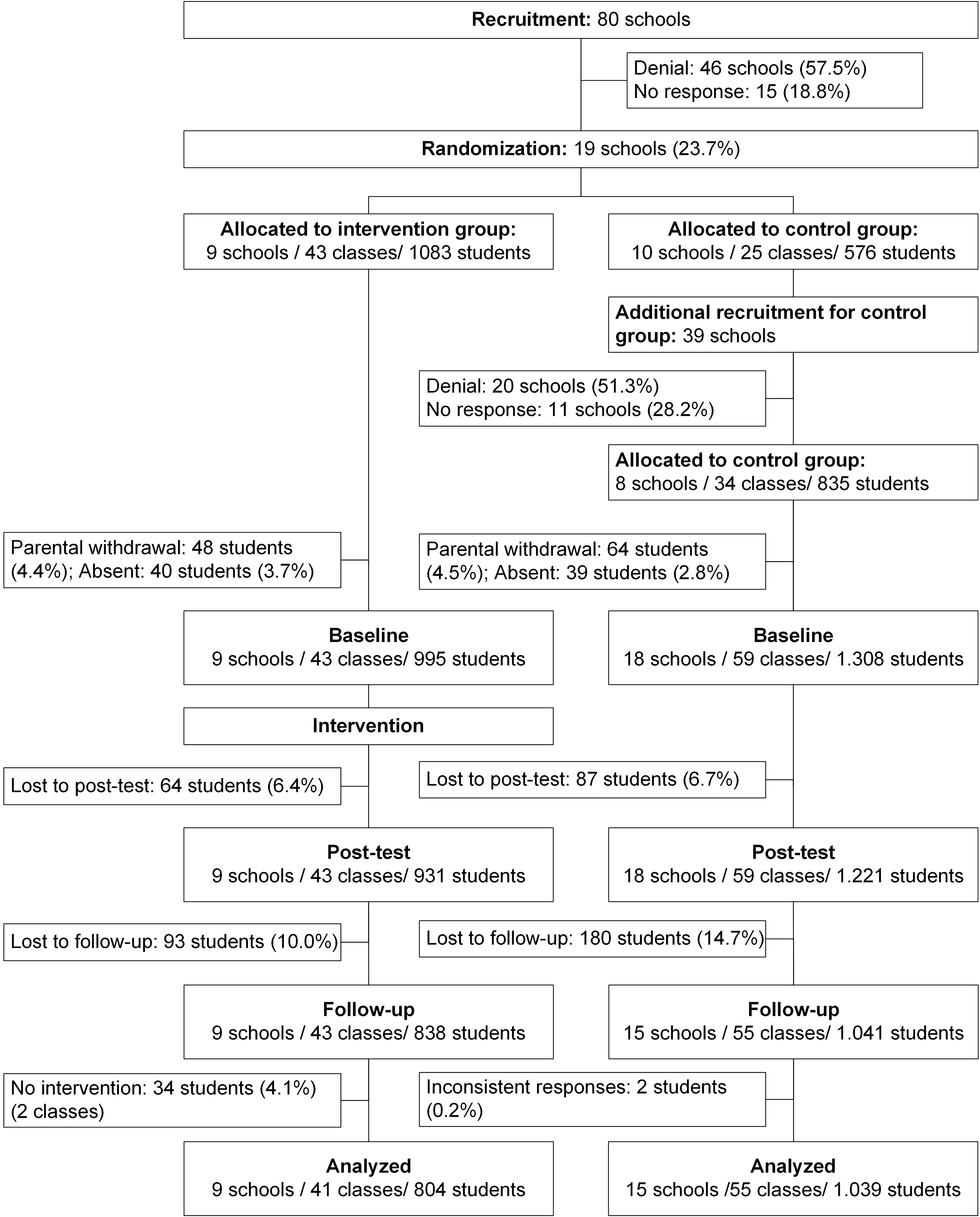
Study flow chart.
Sample
Twenty-seven schools (22.7%) agreed to join the study and registered 102 classes with a total of 2,494 students. From all eligible students, 4.5% (n=112) were withdrawn by their parents, and 3.2% (n=79) were absent on the day of the baseline data collection. The retention rate at posttest was 93.4% (n=2,154). Of these, 87.2% (n=1,879) could be reached again at follow-up (see Fig. 1). Thirty-six cases were excluded from the analyses because two intervention classes (n=34) did not implement the program and two students gave inconsistent responses. The final sample consisted of 1,843 students with complete data at all three measurements (total dropout rate: 20.0%).
Measures
Gaming behavior
Adolescents were asked how often they usually play computer, video, or online games (never/less than once per month/once per month/several times per month/once per week/daily) and how long they usually play for (none/0.5/1/2/2–4/4–8/ >8 hours). Addictive gaming was approached with six items of the German Computer Gaming Addiction Scale (KFN-CSAS-II): 28 “My thoughts continually circle around playing video games, even when I'm not playing”; “At certain times or in certain situations, I actually always play: That has almost become a routine for me”; “My school achievement suffers from my gaming habits”; “People important to me complain that I spend too much time playing”; “I have a feeling that video games are getting more and more important for me”; “If I can't play, I am irritable and dissatisfied” (4-point rating scale). A scale mean was calculated across all items (range 0–3; α=0.82).
Internet use
Frequency of Internet use was measured with “How many days per week do you use the Internet?” (none/1/2/3/4/5/6/7 days). Students also had to estimate how long they usually stay online on a weekday (response options: none/0.5/1/2/2–4/4–8/ >8 hours). Addictive Internet use was measured by six items of the German Internet Addiction Scale (ISS): 29 “When surfing the Internet, I often catch myself saying: Just another few minutes. And then, however, I cannot stop”; “My thoughts continually circle around the Internet, even when I'm not online”; “If I'm not online for quite a while, I become restless and nervous”; “Online activities do increasingly influence my everyday life”; “People important to me complain that I spend too much time online”; and “My school achievement suffers under my online habits” (4-point rating scale). Responses were again summed up and divided by the number of items (range 0–3; α=0.79).
Parental monitoring and rules at home
Adolescents were asked how much their parents know about their online activities and about the games they play (5-point rating scale). Further, adolescents had to estimate how often they talked with their parents about time and content of their media use in the past 3 months (never/once/more than once/more than four times). Media rules at home were assessed by: “Are there rules regarding the use of Internet and computer games at your home?” (yes/no) and “How much do your parents care that these rules are met?” (not at all/little/strong/very strong/there are no rules).
Covariates
The following covariates were assessed, as these have been frequently reported to be associated with media use: age, gender, migration background, socioeconomic status (SES), and access to a computer and the Internet at home. The SES was measured by two items of the Family Affluence Scale 30 (“Does your family own a car?” [no/ yes, one/ yes, two or more] and “During the past 12 months, how many times did you travel away on holiday with your family?” [not at all/once/twice/more than twice]). An unweighted mean score (range 0–2.5) was calculated, with higher scores indicating a higher SES. Migration background of the students was approximated by asking for the father's and mother's country of birth (Germany/any other). For the analyses, the migration variable was dichotomized into “both parents born in Germany” versus “else.” Access to a computer, laptop, and the Internet was measured with three items (not available/shared use with parents or siblings/I have my own). An unweighted mean score (range 0–2) was calculated across all three items, with a higher score indicating higher access.
Statistical analyses
All analyses were conducted with Stata 13. Baseline differences between the control group and the intervention group were tested using chi square and t tests. To test intervention effects over time, multilevel growth-curve models with maximum likelihood estimation were applied. For dichotomous outcomes, logistic models were used. All models included random intercepts for class and individual to account for the nonindependence of observations. Frequency of gaming and Internet use were transferred into days per month (continuous) and daily users (dichotomous). Time/duration of gaming and Internet use were transferred into hours per day (continuous) and excessive users (≥4 hours per day, dichotomous). Because of differences between the intervention and control group in terms of age, gender, school type, socioeconomic status, and access to a computer and the Internet, these variables were included as fixed effects in the analyses.
Results
Attrition analyses
We compared the baseline characteristics of those who dropped out of the study or did not implement the intervention (n=460) with those who completed the survey on all three occasions (n=1,843). Lost students were significantly older, of lower SES, had a higher average computer gaming time, and were less often recruited in Gymnasiums (p<0.001). The drop-out rate was not significantly different in the control (20.4%) and the intervention group (19.4%), and we found also no attrition–group interaction for any of the assessed variables, indicating that there was no differential attrition.
Baseline equivalence between intervention and control group
The mean age of the final study sample was 12.0 years (SD=0.83) with a range of 10 to 14 years. About half of the sample (50.5%) was female. The two conditions were tested for baseline differences on all measured variables. Despite randomization, there was evidence for inequality between the control and the intervention group with regard to four measures. Compared to the control condition, students in the intervention group reported slightly lower age, lower SES, less access to a computer and the Internet, and more often visited the Haupt- or Realschule (see Table 1).
Gymnasium is a German school type finishing with a university-entrance diploma after grade 12 or 13. Hauptschule, Realschule, and Regionalschule focus on students with lower academic skills finishing after grade 9 or 10. At Gemeinschaftsschule and Gesamtschule, students with varying skills are taught together offering all kinds of degrees.
Gaming, Internet use, and parental behavior
Table 2 presents the unadjusted frequencies and means for all primary endpoints of the study, dependent on group condition and time of data assessment. At this descriptive level, it can be seen that there was a decrease in gaming frequency and duration from baseline (time 1) to posttest (time 2) in the intervention group and an increase in gaming frequency from posttest (time 2) to the follow-up (time 3) assessment in both groups.
The crude numbers suggest that the increase in the gaming measures from time 2 to time 3 was less pronounced in the intervention group. There were also small changes over time in the gaming addiction scale means, displaying a similar time pattern in terms of a higher decrease in the intervention group from time 1 to time 2, followed by a lower increase from time 2 to time 3. Generally, low means on the gaming addiction scale indicate that zero (rejection of the items) was by far the most common response on this scale.
Use of the Internet also increased over time, with the proportion of daily Internet users almost doubling within the study interval (15 months). However, except for excessive Internet use (≥4 hours per day) and the ISS means, there was no visible difference in the development of frequency and duration between the two groups in the crude numbers.
At baseline, 42.3% of the students reported that their parents know “very much” about the computer games they play, and 28.5% reported “very high” parental knowledge about their use of the Internet. These numbers decreased over time, with 36.1% reporting “very much” knowledge of parents regarding computer games and 18.3% regarding Internet content. This development was the same in both study groups. Three-fourths of the students confirmed that they have rules at home regarding computer and Internet use. This percentage also decreased over time (at follow-up: 62.3%), but again there was no visible difference in numbers between the intervention and control group.
Multivariate test of program effects
Adjusted multilevel analyses confirmed a differential development of the two groups' gaming behavior over time (see Table 3). The repeated measures regressions revealed significant time–group interactions for all gaming measures, indicating that the lower or nondecrease of gaming in the control group at time 2 and the higher increase of gaming at time 3 were above chance level. No program effect could be detected for Internet use frequency and duration (Table 4). But there was a significant time–group interaction on the ISS, showing a pronounced increase on the scale mean for the control group.
Significant at p<0.05. Statistically controlled for gender, age, SES, school type, and access to a computer and the Internet.
Control group coded “0” and intervention group coded “1.”
Significant at p<0.05. Statistically controlled for gender, age, SES, school type and access to a computer and the Internet.
Control group coded “0” and intervention group coded “1.”
No systematic intervention effect was found for the student reports on parental media monitoring and rules at home.
Discussion
This study examined the effects of a brief school-based media literacy intervention. Analyses showed evidence for intervention control differences in the 15 month development of computer gaming frequency and gaming time per day, with intervention students indicating a lower increase in both absolute gaming days and hours, as well as proportions of daily and excessive gaming sessions. In addition, we also found differential developments in mean responses on items of two scales assessing addictive media use: the KFN-CSAS and ISS. No intervention effects were found for frequency and duration of Internet use or for students' reports of parental monitoring or rules about media behavior at home.
To our knowledge, this is the first study on a school-based media literacy program targeting actual computer gaming and Internet use behavior. The present findings are promising, given the shortness and economy of the program, even though the positive effects were only found for computer gaming and not for Internet use times. This lack of finding for Internet behavior was not hypothesized and is not obvious from the content of the intervention. One explanation is that it is a measurement issue. While computer gaming is a well-defined activity that can easily be reported, Internet use is much more multifaceted. “To be online” could mean to surf the Internet for information, to listen to Internet radio, to watch television, to use social media, or even just having a smartphone in the pocket that is connected. Thus, quantifying ones Internet use might be a difficult task, and the assessment is therefore more error-prone. 31 Another possible explanation is that Internet use is such a routine in the daily lives of today's adolescents that reducing its frequency or duration is just harder to accomplish than for computer gaming.
Differences in the problematic/addictive media use measures might need some further consideration, as one can question if these small differences in scale means, even if significant, have any clinical significance. Translated into raw numbers of “addicted gamers,” the results indicate an increase from 9 to 25 “addicted gamers” in the control group, compared to a decrease from 11 to 7 in the intervention group. Comparable numbers for “addicted Internet use” (according to ISS cutoffs) were a net increase of 14 (from 8 to 22) addicted users among controls compared to a net increase of 6 (from 8 to 14) “addicted users” in the intervention condition. Hence, even if the relative proportional differences are very small, the absolute difference seems relevant, given the low prevalence of addictive gaming and addicted Internet use in the German youth population.28,32 However, there always remains the alternative explanation that changes in responses on clinical scales reflect changes in knowledge about “addictive use” rather than changes in actual “addictive use.” This is especially true for adolescent samples.
Another question is related to the mediators of the intervention effect. In theory, we assume that a media literacy intervention enhances media literacy, which is, in turn, also the mediating variable. However, we do not have valid data to test this assumption. One problem of the concept “media literacy” is that it is very broad and ambiguous, and hence there is no agreed-upon way of how it is best measured. 33 Especially knowledge-based measures of media literacy face the difficulty that adolescents with high media use usually also have higher media knowledge, making it an unlikely mediating variable in a media reduction intervention study. However, after looking at the sheer contents of the four sessions, there is support for the idea that one successful prevention effort might be the change of social norms regarding media use frequency. 1 There was no indication that the found results were only based on structural changes such as changes in parental rule setting.
There are further limitations of the current study. First, despite randomization, there were baseline differences between the two groups on several measures. It cannot be excluded that there were additional differences between the groups that were not assessed, a fact that reduces internal validity of the study. Second, there was a self-selection process on school level in advance of the randomization, which impairs the external validity of the study.
Nevertheless, this study is one of the few trials on the effectiveness of a media literacy intervention and the first to address the prevention of excessive computer and Internet use in adolescents. Results show that changes in media use behavior are possible with comparatively little effort. Future research will be needed to validate these data and to shed further light on mediating and moderating variables.
Footnotes
Acknowledgments
This research was supported by the Ministry of Social Affaires, Health, Family and Equal Opportunities of the Land Schleswig-Holstein. We would like to thank Uli Tondorf for his advice and support in the development of the intervention. We also thank Nadia El Bouhayati, Svenja Cleve, Lars Grabbe, Andre Lischick, Serdar Peker, and Wiebke Pustal for assessing the data.
Author Disclosure Statement
No competing financial interests exist.