




Abstract
Abstract
Studies have shown that self-resembling avatars in health games and other applications can heighten exercise intentions, but objective self-awareness (OSA) theory suggests that this effect is likely to be true only for those who believe in the ideal of a healthy self. How can avatars be used to motivate those who do not hold this ideal and may not be motivated by avatars to pursue healthy activities? One possibility is to afford individuals the ability to customize their avatar, so they are not only more self-aware but also feel in control of their persona, both of which are necessary conditions for behavior change according to OSA. In order to test this prediction, participants in an online virtual environment created an avatar of the same sex or opposite sex by choosing among a small or large number of possible traits, then completed a series of items measuring self-awareness, sense of control, health-focused behavior, and ideal internalization. Results show that customizing a same-sex avatar can overcome differences in health intentions and behaviors between individuals with high and low levels of prior health-ideal internalization.
Introduction
T
One domain where OSA theory has been widely studied is exercise and health, finding that changes in self-awareness induced by exposure to one's own reflection can affect individuals' attitudes following exercise behavior.3–5 An online avatar has proven to be a convenient method for continually offering online users a reflection of themselves,5,6 with past research finding that self-resembling avatars can heighten individuals' level of self-awareness.7,8 However, as OSA theory explains, self-awareness is only motivational if an individual has internalized the standard in question and believes they have the necessary sense of control over their life to address the discrepancy.1,2 In other words, avatars may only be an effective tool for promoting exercise behaviors among individuals who have already internalized ideals related to exercise (which may limit their possible utility as a tool for health promotion among populations typically uninterested in exercise and related health-fostering behaviors). Moreover, the avatar somehow has to bolster an individual's sense of control over ideal-self/current-self discrepancies in order to motivate a change in behavior.
All this suggests that the avatar should not only offer users a sense of self but also a sense of control. Both these could be achieved by allowing users to tailor their avatars to resemble themselves rather than to resemble others. The agency model of customization 9 predicts that customization activities, such as avatar creation, can heighten individuals' sense of control in their everyday life. Avatar customization (to resemble oneself over others) may therefore be likely to heighten health behaviors because avatar customization both induces a self-aware state7,8 and imbues individuals with a heightened sense of control. 9 However, given the tenets of OSA theory, this effect of customization may only be effective for those who have already internalized health ideals, unless the greater sense of control imbued by avatar customization can overcome differences among individuals who vary in pre-existing health ideal internalization.
Thus, based on the assumptions of OSA theory1,2 and prior work on avatar-mediated communication,7,8 the current study tests whether customization of self-resembling avatars can heighten exercise intentions and behaviors among individuals both low and high in health ideal internalization. In order to test this prediction, a 3 (type of avatar customization: same-sex avatar customization vs. camera-assisted same-sex avatar customization vs. opposite-sex avatar customization) × 2 (level of avatar customization: low vs. high) × 2 (health ideal internalization: low vs. high) between-subjects design was conducted. In the following sections, the method of the study is outlined, followed by a report of results and a discussion of the study's theoretical and practical implications.
Method
Participants
One hundred and thirty-two undergraduate students from a large U.S. university participated in the study in exchange for extra credit. Participants' mean age was 20.42 years, and the sex distribution was 64% female.
Stimuli
Participants were asked to customize an avatar in the virtual environment Second Life, which affords users with a three-dimensional avatar that is customizable along a range of characteristics. The goal of the experimental task was to induce self-awareness and a sense of control without priming participants about the health focus of the study.
Experimental manipulations
Type of avatar customization
Participants were assigned to one of three possible types of avatar customization: same-sex avatar customization, camera-assisted same-sex avatar customization, or opposite-sex avatar customization. Participants in the same-sex condition were directed to customize an avatar that resembled their physical appearance as closely as possible. Participants in the camera-assisted same-sex condition were directed to customize an avatar that resembled their own appearance while their reflection was visible in a separate, 5-inch window on the screen. Exposing participants to their own reflection is a common manipulation of self-awareness.1,2 Participants in the opposite-sex condition were directed to create an avatar of the opposite sex. Customization of a same-sex avatar, either assisted or unassisted by a camera, was expected to elicit greater levels of self-awareness than customization of an opposite-sex avatar, given that self-resembling avatars have been found to heighten self-awareness in prior research.7,8
Level of avatar customization
Participants were asked to customize the appearance of their avatar using the avatar creation tool provided by the virtual environment, Second Life. In the low customization condition, participants customized their avatars' skin color, height, body thickness, and hairstyle. In the high customization condition, participants chose all of the traits requested in the low customization condition plus an additional nine traits, including eye size, muscularity, shoulder width, pectoral/breast size, hip width, stomach size, obliques, jaw shape, and lip fullness. A greater degree of avatar customization was expected to heighten individuals' sense of control, given the predictions of the agency model of customization. 9
Manipulation checks
Self-awareness
In order to verify the efficacy of the self-awareness manipulation, participants completed the Wegner and Giuliano 10 self-focus task. Participants were asked to complete five short sentences using one of three possible words (e.g., “please don't do this to ‘me’/‘her’/‘us’, it is just not fair”). An index was formed by adding the total number of first-person pronouns used, with higher scores indicating greater self-awareness (M = 2.02, SD = 0.99), per the assumptions of OSA theory.11,12 A one-way analysis of variance with avatar customization type as the independent variable and the self-focus index as the dependent variable confirmed the efficacy of the manipulation, F(2, 129) = 4.96, p = 0.01, η2p = 0.07. However, only the difference between the two same-sex conditions and the opposite-sex avatar condition was significant (p < 0.05). Therefore, avatar customization type was dichotomized (same-sex avatar customization vs. opposite-sex avatar customization) for subsequent analyses.
Sense of control
In order to measure the effect of avatar customization on participants' sense of control, one Likert-type item (1 = “strongly disagree,” 7 = “strongly agree”) asked participants to indicate the extent to which “I feel like I have control over my life” (M = 5.30, SD = 1.27). A one-tailed t test with level of avatar customization as the independent variable and sense of control as the dependent variable confirmed the efficacy of the manipulation, t(130) = 2.63, p = 0.005, d = 0.46, with sense of control being greater in the high level of customization condition (M = 5.58, SD = 1.16) than in the low level of customization condition (M = 5.01, SD = 1.32).
Moderating variables
Health ideal internalization
An adapted version of the Selves Questionnaire 11 asked participants to list three attributes they would ideally like to possess. Participants were coded as internalizing health as a standard for the ideal self if they listed attributes related to wellness or the body (e.g., “in shape,” health conscious,” and “physical health”).
Dependent variables
Exercise intentions
Three Likert-type items (1 = “strongly disagree,” 7 = “strongly agree”) adapted from prior research 12 asked participants how much they intended to exercise in the next 6 weeks (M = 4.66, SD = 1.45, Cronbach's α = 0.94).
Health behavior
Participants were asked to choose two coupons from a selection of six that they would like to receive if chosen by a random lottery. The coupons were of equal monetary value ($5 of a service), but varied in their value for health (e.g., nutrition store voucher vs. fast-food voucher). The number of unhealthy options were subtracted from the total number of healthy options to form a health behavior index (M = −0.077, SD = 1.15), per the protocol used in prior research. 13
Control variables
Weekly exercise frequency
In order to control for participants' prior exercise habits statistically, a single Likert-type item asked participants to report how many days a week they typically exercised (M = 3.26, SD = 2.21).
Results
Despite the absence of a health-related intervention, the simple act of customizing a same-sex avatar was found to affect both exercise intentions and health behaviors among individuals high and low in health ideal internalization, as detailed below.
Exercise intentions
A three-way analysis of covariance (ANCOVA) with type of avatar customization, level of avatar customization, and health ideal internalization as the independent variables and weekly exercise frequency as a covariate found a significant two-way interaction between avatar similarity/self-awareness and health ideal internalization, F(1, 123) = 4.13, p = 0.04, η2p = 0.03. As shown in Figure 1, post hoc comparisons using the Sidak correction show individuals in the same-sex avatar customization condition reported similar levels of exercise intentions regardless of high (M = 4.68, SD = 0.96) or low (M = 4.74, SD = 0.93) health ideal internalization, while individuals in the opposite-sex avatar customization condition with internalized health ideals (M = 5.05, SD = 0.99) reported higher exercise intentions than individuals who did not internalize health ideals (M = 4.32, SD = 0.98 p = 0.03). All other main and interaction effects between customization type, customization level, and health ideal internalization were non-significant.

Type of avatar customization × health ideal internalization on exercise intention.
Health behavior
The same ANCOVA found a significant two-way interaction between type of avatar customization and health ideal internalization, F(1, 123) = 5.07, p = 0.03, η2p = 0.04. As shown in Figure 2, post hoc comparisons using the Sidak correction show individuals in the same-sex avatar customization condition reported similar levels of health behavior regardless of high (M = −0.73, SD = 1.08) or low (M = −0.70, SD = 1.08) health ideal internalization. By comparison, individuals in the opposite-sex avatar customization condition who internalized health ideals (M = −0.19, SD = 0.71) scored higher on the health behavior index than individuals who did not internalize health ideals (M = −1.20, SD = 1.58, p = 0.007). All other main and interaction effects between customization type, customization level, and health ideal internalization were not significant.
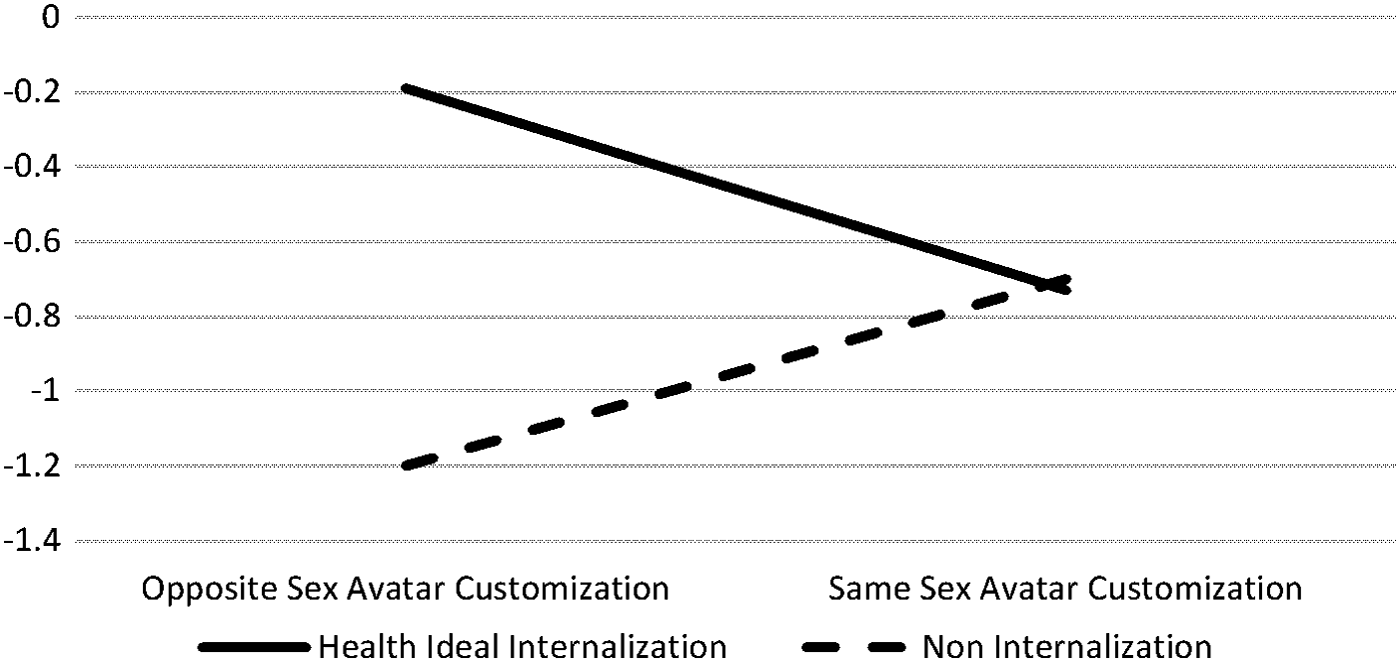
Type of avatar customization × health ideal internalization on health behavior.
Discussion
It appears that creation of self-resembling avatars moderates the effect of health ideal internalization, such that the difference in exercise intentions and behaviors typically observed between individuals who internalize health ideals and those who do not is reduced by creation of avatars that resemble the self, especially in terms of sex. Therefore, creation of similar avatars appears to heighten exercise and health behaviors among individuals who have not internalized health ideals, which may hold particular utility for practitioners hoping to encourage health behaviors among certain sedentary populations. For those who have internalized health ideals, however, the self-awareness generated by creating a similar avatar seems to dampen the effect somewhat rather than amplifying it, probably because they are reminded of their current healthy state and do not perceive a great need for exercise. On the other hand, those who have not internalized health ideals are clearly motivated by a self-resembling avatar, which probably reminds them of their current unhealthy state.
Although customizing the sex of the avatar showed the potential for overcoming individual differences in health ideal internalization, no evidence was found to suggest that increasing the amount of avatar customization affects exercise intentions or health behaviors. Thus, while objective self-awareness theory would predict that efficacy should moderate the effects of self-awareness, this study did not find that the sense of control induced by the amount of customization interacts with avatar-induced self-awareness to affect exercise intentions. Participants were given specific instructions regarding the characteristics of their avatars to customize, which may have hindered the sense of control and subsequent intrinsic motivation otherwise elicited by the customization activity. 14 The results should also be contextualized according to several other limitations, including the lack of a true control condition that did not involve any act of customization and the use of a sample of young adults, which may not be generalizable to other populations. Nonetheless, these results add to prior work which suggests that avatars may be a viable tool for fostering health-promoting behaviors.
Footnotes
Author Disclosure Statement
No competing financial interests exist.