




Abstract
Abstract
The popularity of online recreational activities, such as social networking, has dramatically increased the amount of time spent on the Internet. Excessive or inappropriate use of the Internet can result in serious adverse consequences. The current study used a behavioral economic task to determine if the amount of time spent online by problematic and nonproblematic users can be modified by price. The Internet Purchase Task was used to determine how much time undergraduate students (N=233) would spend online at 13 different prices. Despite high demand for Internet access when access was free, time spent online by both problematic and nonproblematic users decreased dramatically, even at low prices. These results suggest that the amount of time spent online may be modified by having a tangible cost associated with use, whereas having free access to the Internet may encourage excessive, problematic use.
Introduction
U
Recent studies within the drug addiction literature suggest that behavioral economic measures are valuable tools that can be used to assess the strength of addictive behavior, and predict treatment outcomes, by measuring the relative reinforcing efficacy (RRE) of drugs (i.e., how much an individual wants a drug or prefers it compared with other reinforcers).12–15 RRE is determined by the amount of resources (i.e., time, money, effort) that are devoted to obtaining the drug, and it is reflected in demand for the commodity when it is free of charge (intensity of demand), the maximal amount individuals are willing to pay for the commodity (Omax), the price at which maximal expenditure occurs (Pmax), and breakpoint—the first price at which demand for the commodity is zero (i.e., the first price at which there is no consumption). 12 A strong RRE is indicated by high demand, Omax, Pmax, and breakpoint values.
While an inverse relationship is typically seen between price and consumption of a commodity (i.e., consumption is elastic in that consumption decreases as price increases), addicted individuals exhibit high RRE for their preferred drug, as well as decreased elasticity. 13 Most importantly, RRE provides unique and perhaps more accurate information regarding addiction severity compared with measures such as consumption, which can be altered by a number of factors (e.g., the availability of alternate reinforcers). 16 In addition, RRE is sensitive to factors that are associated with increased drug use such as stress and exposure to drug cues.17–20 Hence, behavioral economic measures have been used to assess addiction severity to a wide variety of drugs, including alcohol, marijuana, nicotine, and opiates.12,15,21,22
Although excessive Internet use has been characterized as an addiction, behavioral economic measures have not been used to examine this issue. One would predict that if recreational use of the Internet were problematic and difficult for the individual to control, this would be reflected in a high RRE and high levels of use despite increases in price. In contrast, if changing the price of access can easily modify Internet use, this would suggest Internet use has a weak RRE and that its use can be controlled.
Behavioral economic measures may also provide valuable information regarding recreational Internet use because unlike drug use, which has a tangible cost associated with each bout of drug use, Internet users are not immediately charged each time they access the Internet; most data plans charge a fixed price for monthly use. Consequently, how much time is spent online, and its associated cost, is not readily apparent to the user. Moreover, access is often provided through shared data plans that are paid for by someone other than the user, especially when the user is a young adult. Young adults therefore have few economic constraints on their Internet use, which may promote excessive use. Behavioral economic procedures that place a tangible price on Internet access can be used to determine if the amount of time online can be modified or if demand is resistant to modification, which would indicate addictive behavior.
The current study had two goals: to measure the RRE of recreational Internet use in a population of students, and to determine if RRE is greater in individuals who exhibit problematic Internet use. A hypothetical scenario, the Internet Purchase Task (IPT), was devised specifically for this study based on the Alcohol Purchase Task (APT).12,23 The APT, which determines how many drinks participants will purchase at different prices, has been used successfully to assess the RRE of alcohol.12,23 Two validated and reliable instruments, the Internet Addiction Test (IAT) and the Internet Related Problem Scale (IRPS), were used to determine problematic Internet use.8,24,25 It was hypothesized that RRE would be stronger for problematic users and that demand for Internet use would be more resistant to changes based on price.
Method
Participants
Participants recruited from introductory psychology classes (N=253) at a university in the United States received class credit for completing an online survey administered via the Web site Qualtrics between April and December 2013. Participants had to be at least 18 years old. The university's Institutional Review Board approved all procedures, and informed consent was obtained from participants. Twenty incomplete surveys were discarded, leaving a total of 233. The majority of participants were white (70%), male (54.9%), with a mean age of 20.5 years (SD=4.02 years), and a yearly income of ≤$4,999 (56.7%).
Measures
Behavioral economic task
Following a number of questions regarding current Internet use, the RRE of Internet use was determined using the IPT. Questions on the IPT showed a high internal consistency (Cronbach's α=0.944). The IPT asked participants to consider the following hypothetical scenario:
You are on a 5 hour flight. The airline offers access to the Internet but charges by the hour to get access. For each of the prices below, please move the sliding bar to indicate how many hours of Internet access you would buy at each price for recreational purposes (i.e., to check your e-mail, social networking sites, movies, music etc. rather than using the Internet for school work etc.).
Each participant was then presented with 13 different prices per hour—free, $0.50, $1, $1.50, $2, $2.50, $3, $4, $5, $7.50, $10, $15, and $25—and asked how much time on the Internet they would purchase at each price from 0 to 5 hours. Demand curves (time purchased at each price) were plotted and expenditure calculated at each price. Several other indices of RRE were derived from the data. Intensity of demand was the amount of time participants stated they would spend on the Internet when access was free. Omax was the maximum amount of money a participant was willing to spend to access the Internet (i.e., the greatest expenditure when price per hour was multiplied by the amount of time purchased). Pmax was the price at which Omax occurred (i.e., the price at which maximum expenditure occurred), and breakpoint was the first price at which participants refused to pay to access the Internet. Participants who purchased time at the highest price of $25 were assigned $25 as their breakpoint.
Problematic Internet use scales
The IAT consists of 20 questions scored from 0 (not applicable) to 5 (often).7,24 The IRPS also consists of 20 questions scored from 0 (not true at all) to 10 (extremely true). 8 Total scores on the IAT and IRPS categorized participants as problematic or nonproblematic users. Participants with IAT scores <40 were categorized as nonproblematic users (n=163), whereas those with scores of ≥40 were categorized as problematic users (n=70) based on criteria used by Young (1998) 7 and several other studies.24–29 Higher scores on the IRPS indicate problematic Internet use. Therefore, participants with total scores in the top and bottom quartiles on the IRPS were categorized as problematic and nonproblematic, respectively. 8
Data analyses
Initial analyses of the behavioral economic data (SPSS Statistics for Windows v20; IBM Corp., Armonk, NY) revealed that the data were positively skewed with skew values >2 in several cases. Hence, except where noted, median values are reported, and nonparametric inferential statistical tests (Spearman correlation coefficients and median tests) were conducted.30,31 Alpha levels were corrected to p<0.005 to account for increased type I family wise error rates 32 when multiple median tests were used to compare time purchased at each price by problematic and nonproblematic users.
Results
Current Internet use
Participants gained access to the Internet mainly through personal computers (46.8%) or cell phones (49.4%). Many participants accessed the Internet more than six times per day (39.5%) and spent 1–3 hours per day online (43.3%). Interestingly, many participants did not pay for access to the Internet (60.1%); someone other than the participant paid for Internet fees. Most participants (58.8%) accessed the Internet in order to use social networking sites.
Behavioral economic measures: all participants
Intensity of demand was high in the IPT (median time used when access was free was 4 hours). Moreover, 42.1% of participants chose to spend all 5 hours online when access was free. Intensity of demand was significantly correlated with the number of times participants reported accessing the Internet per day and the number of hours they spent online in their daily lives (r=0.22 and 0.40, respectively; p<0.001).
Despite high intensity of demand, once participants had to pay for access, consumption decreased rapidly (Fig. 1). Breakpoint (the first price at which participants refused to pay for Internet access) occurred at $4.00 per hour. Maximal expenditure was also relatively low (Omax=$4.00) and was reached at $2.00 per hour (i.e., Pmax [price at maximal expenditure]=2.00). Income level of participants was not significantly associated with breakpoint or Pmax but was modestly associated with Omax (r=0.16, p<0.05).
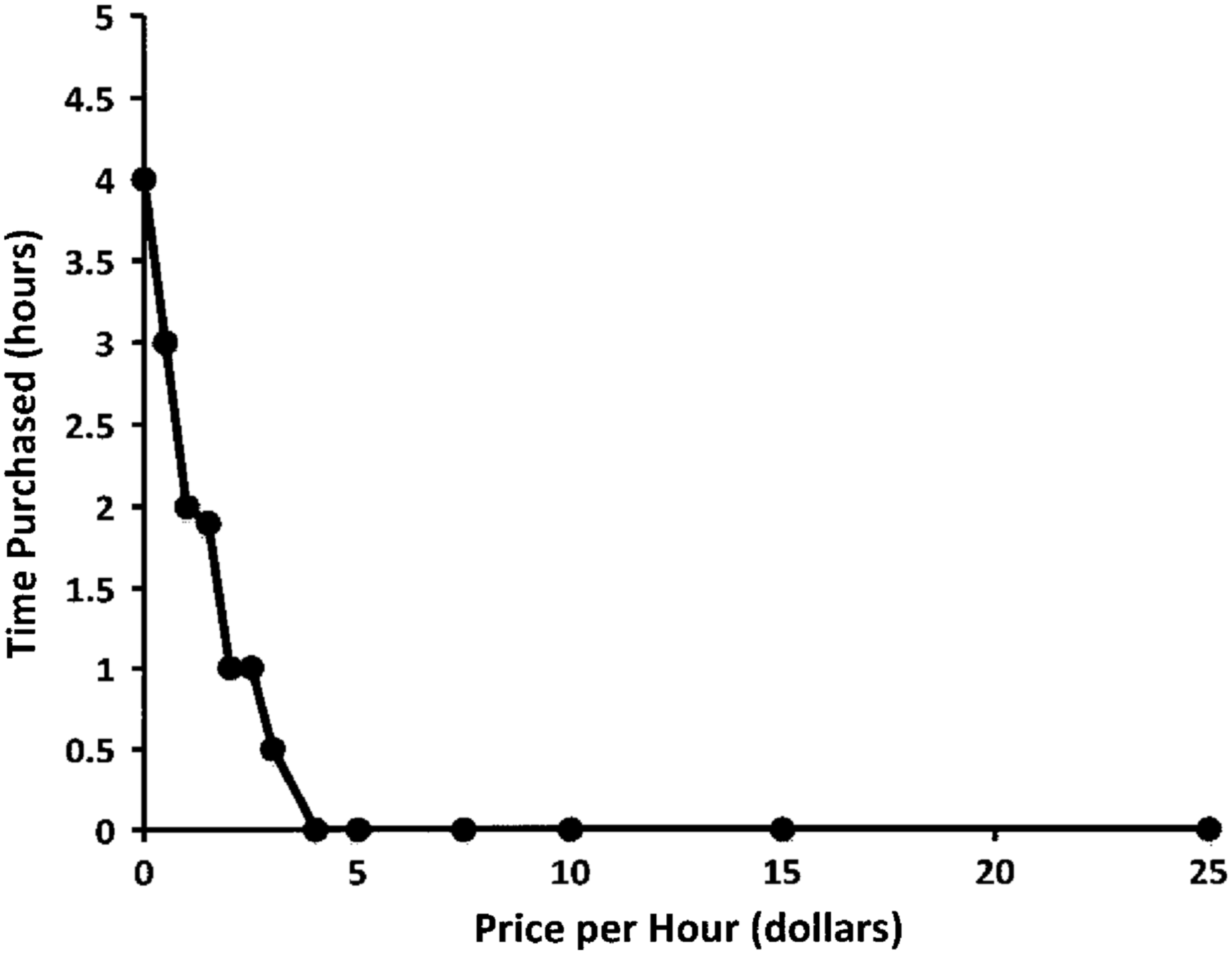
Median time purchased at each price for all participants in the sample (N=233).
IAT and IRPS scores: all participants
Mean scores on the IAT and IRPS scales were 31.5 (SD=16.71) and 68.61 (SD=35.40), respectively. Scores on the IAT and IRPS were highly correlated (r=0.85, p<0.01). Intensity of demand was significantly correlated with both IAT and IRPS scores (r=0.270, p<0.001 and r=0.185, p<0.01, respectively). Omax, Pmax, and breakpoint were also significantly correlated with IAT and IRPS scores (Omax r=0.319 and 0.269, respectively; p<0.001; Pmax r=0.248 and 0.198, respectively; p<0.01; breakpoint r=0.229 and 0.211, respectively; p<0.01).
Behavioral economic measures: problematic versus nonproblematic users
Additional analyses were conducted to determine if RRE differed between problematic and nonproblematic users. A shift to the right in the demand curve was observed for participants categorized as problematic users based on their IAT (Fig. 2) or IRPS (Fig. 3) scores. Median tests revealed that all behavioral economic indices were significantly higher (p<0.05) for IAT problematic users (intensity of demand=5.0, Omax=6.00, Pmax=2.50, and breakpoint=5.00) versus nonproblematic users (intensity of demand=3.5, Omax=3.00, Pmax=1.50, and breakpoint=3.00). Problematic users purchased significantly more time compared to nonproblematic users at $1, $2, and $4 an hour (p<0.005), while trends toward increased time were noted at $1.50 and $2.50 (p<0.01).
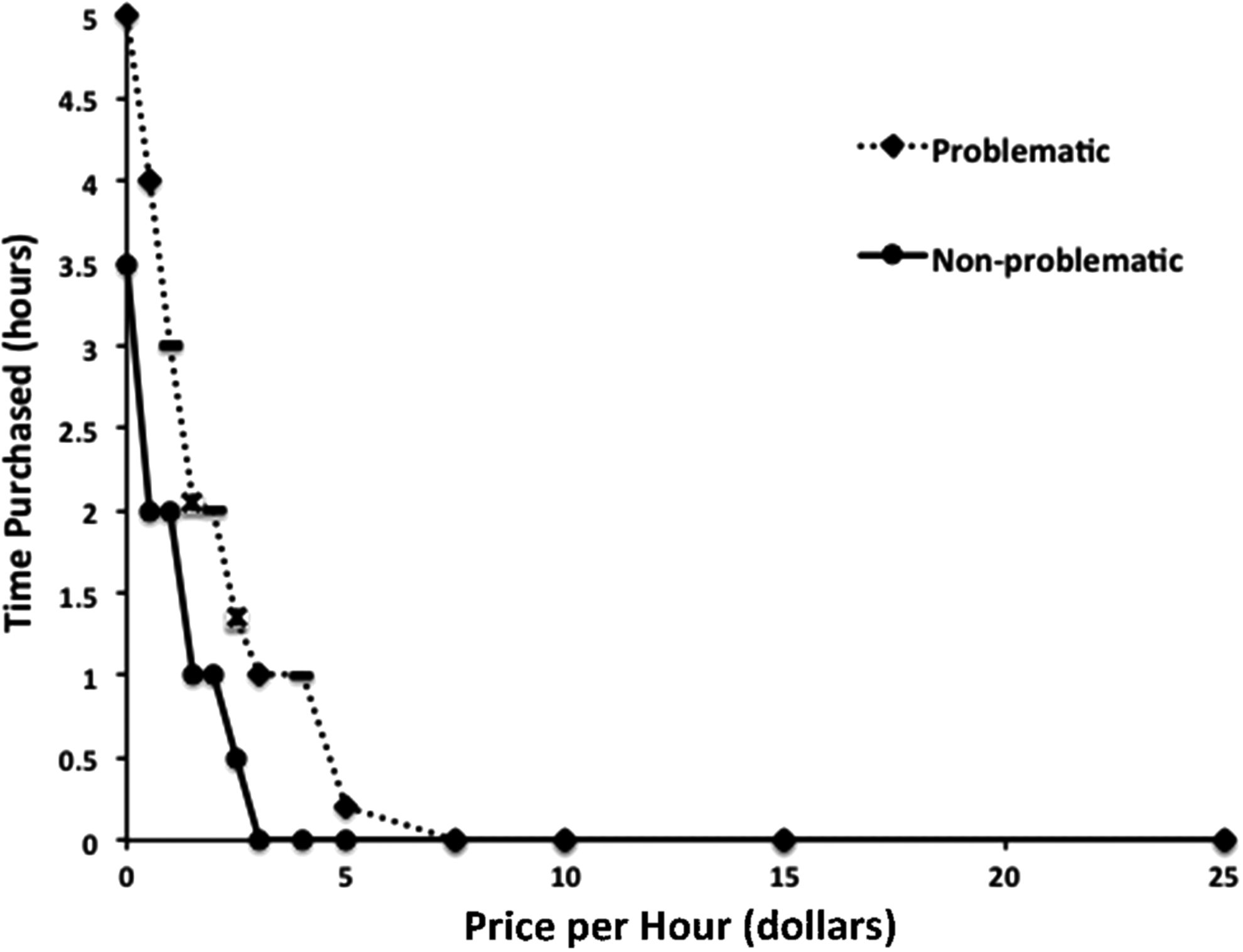
Median time purchased at each price by users categorized as problematic (n=70) or nonproblematic (n=163) by total Internet Addiction Test scores. “–” and “×” symbols in the problematic user curve indicate differences in time purchased at that price by problematic and nonproblematic users (p<0.005 and p<0.01, respectively).
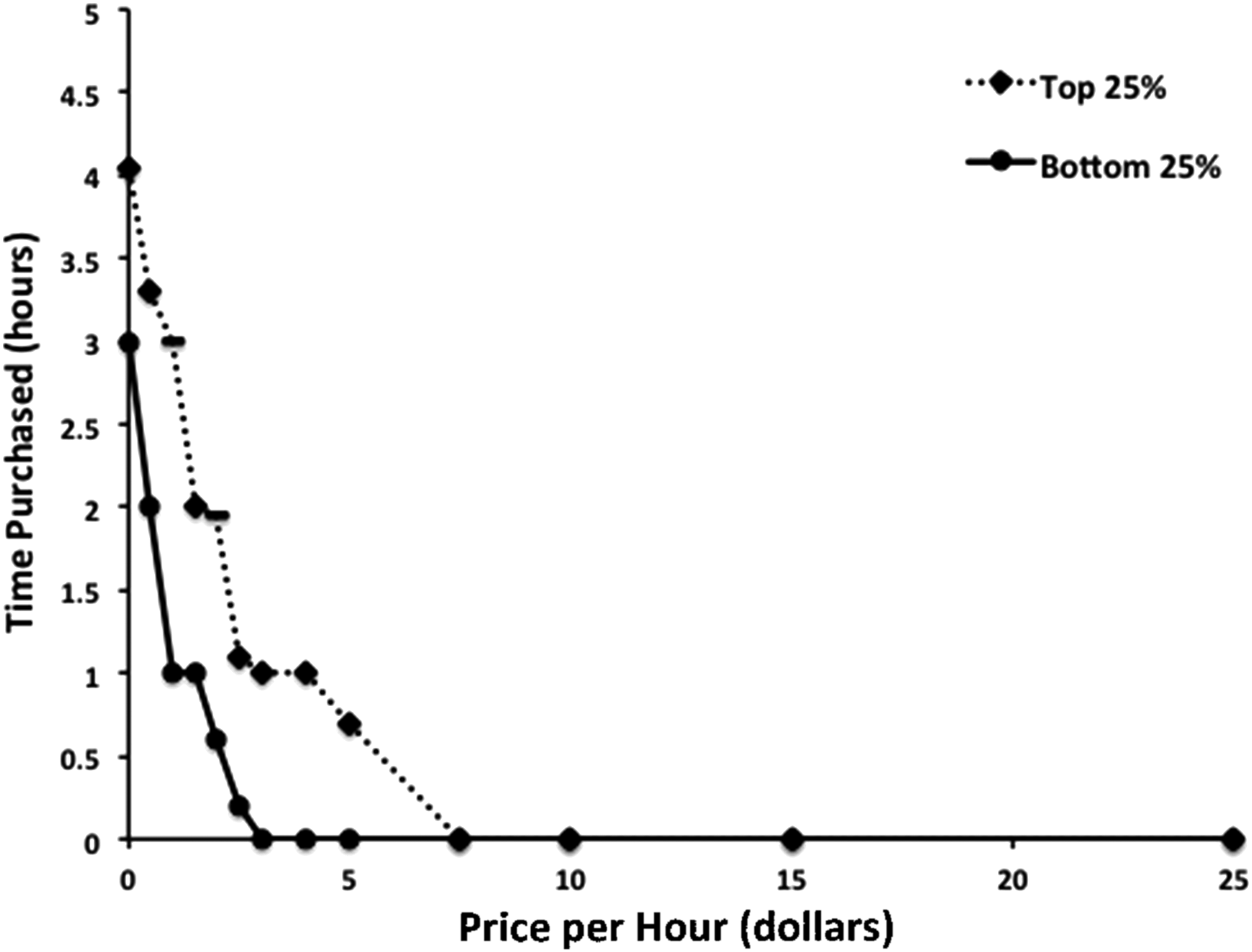
Median time purchased at each price by users who had total Internet Related Problem Scale scores in the top and bottom quartile. Significant differences in time purchased at a price by problematic and nonproblematic users are denoted by the symbol “–” on the problematic user curve (p<0.005).
Behavioral economic indices were also higher for participants who had scores in the top 25% of the IRPS (intensity of demand=4.05, Omax=6.25, Pmax=2.75, breakpoint=7.50) compared with those in the bottom 25% (intensity of demand=3.00, Omax=2.50, Pmax=1.50, breakpoint=2.50). However, a significant difference was only noted for Omax (p<0.05). The difference between breakpoint just failed to reach significance (p=0.056). Problematic users purchased significantly more time than nonproblematic users at $1 and $2 an hour (p<0.005). Current income level did not differ between subgroups on the IAT or IRPS.
Discussion
The current study measured the RRE of recreational Internet use in undergraduate students. Despite high intensity of demand, the amount of time purchased decreased dramatically as price increased. This decrease in demand at low prices suggests that the RRE of Internet use is relatively weak, even in problematic users. Although problematic use of the Internet has been characterized as a behavioral addiction by some authors, the rapid decline in Internet use once participants had to pay for Internet access suggests they may be able to control their Internet use easily, at least over short periods. While participants met the criterion for problematic Internet use used by a number of authors,7,24–29 it is possible that participants with IAT scores of ≥70, who are categorized as the most severely affected, may exhibit more inelastic behavior. Unfortunately, only five participants had scores that fell into that category. Another possibility is that the hypothetical flight was too short to show inelastic demand. However, the amount of time participants reported spending online in their daily lives (which corresponds with previous studies3,4,6), and the high intensity of demand in the IPT, suggest that 5 hours should have been sufficient to observe inelastic behavior at the lowest prices.
Most participants had low yearly incomes and may have felt they could not afford to pay a high price for Internet access. However, demand of problematic users decreased sharply even at very low prices. Moreover, income level did not differ between problematic and nonproblematic users, was not associated with breakpoint or Pmax, and was only modestly associated with Omax, suggesting income level had little influence on Internet use. This is perhaps not surprising, as many participants reported that someone else paid for their Internet access. Most likely, these participants had Internet access through a family plan and had few financial restrictions on the amount of time they could spend online. Impulsivity is strongly associated with problematic Internet use, and having unrestricted access may permit uncontrolled impulsive use of the Internet.33,34 The current results suggest that imposing a tangible cost for Internet use could provide a cognitive control on impulsive use.
The current study used a hypothetical scenario to assess RRE. While similar scenarios have been reported to accurately predict behavior measured in laboratory experiments,12,18,19,22,23,35,36 and intensity of demand in the current study was significantly associated with the participants' Internet use in their daily lives, laboratory-based studies should be conducted to verify the present findings. Laboratory studies will also provide further evidence of the validity of the IPT. Initial evidence of the validity of the IPT is evident in the significant correlations observed between intensity of demand, the actual number of hours participants reported being online, and two validated scales of problematic Internet use. The relatively modest correlations observed between intensity of demand and scores on the IAT and IRPS are not surprising given that the IAT and IRPS measure not only level of Internet use but also problems associated with use, whereas intensity of demand only reflects level of use.
Several recent imaging studies have reported some commonalities in the neural bases of drug and behavioral addictions. For example, both drug and Internet addiction are associated with variation in the serotonin transporter, structural differences in gray and white matter in the prefrontal cortex, and differences in dopaminergic systems in the dorsal striatum and other regions.37–39 Comparisons between Internet addiction and alcohol use disorder in response inhibition tasks have also revealed similar activity in frontal, central, and parietal regions. 40 While these studies suggest some overlap in the neurobiological processes underlying drug and behavioral addictions, it is important to note that many Internet addiction studies focus on excessive video gaming, and different types of problematic Internet use may be associated with discrete neurobiological processes.37,40 Indeed, in light of the current results that suggest, unlike addictive drugs, recreational Internet use primarily associated with the use of social networking sites has a weak RRE, one may expect to observe differences in the neural processes underlying this specific use of the Internet and drug addiction.
In summary, although a large number of people are choosing to spend an excessive amount of time online, the current results suggest that imposing a tangible cost on Internet use may deter the use of even high demand users, at least over short periods. Limiting recreational use of the Internet may be advantageous in light of the detrimental effects of excessive use, or use in dangerous situations.10,41–43
Footnotes
Acknowledgments
The authors thank Dr. Terrence Horgan, Devin Adams, and Jennifer Heaton for providing constructive feedback on the study or on the manuscript.
Author Disclosure Statement
No competing financial interests exist.