




Abstract
Abstract
Pathological Internet use (PIU) occurs when excessive Internet use results in addictive symptoms that exert detrimental consequences on one's overall functioning and well-being. Poor family functioning has been found to be associated with youths' addictive Internet use, and parental use of active and restrictive mediation has been found to reduce online risk. The current study aims to test if parental active and restrictive mediation strategies are negatively associated with youths' PIU. Additionally, it also tests the effectiveness of these strategies as a function of the broader family environment with measures of parent–child attachment, family communication, and the youth's comfort with living at home. The data of 3,079 students in Singapore were analyzed through a series of logistic regressions. The results revealed that the family environment for students with PIU was significantly less positive. Only restrictive mediation was found to be negatively associated with PIU. This relation was stronger for higher levels of attachment, communication, and comfort at home, implying that the effectiveness of restrictive mediation varies with the degree of warmth and support in the general family environment. The implications are discussed.
Introduction
T
Excessive Internet use can develop into a pathological addiction with serious negative consequences for one's functioning and overall well-being. Similar to other forms of addictive behaviors in the Diagnostic and Statistical Manual of Mental Disorders IV (DSM-IV), previous studies have measured pathological Internet use (PIU)4,5 based on symptoms taken from Brown's core facets of addictions 6 : salience (the activity dominates the person's life, either cognitively or behaviorally), euphoria/relief (the activity provides a “high” or relief of unpleasant feelings), tolerance (greater activity is needed achieve the same “high”), withdrawal symptoms (the experience of unpleasant physical effects or negative emotions when unable to engage in the activity), conflict (the activity leads to conflict with others, work, obligations, or the self), and relapse and reinstatement (the activity is continued despite attempts to abstain from it). Therefore, inherent in PIU is an uncontrollable urge and a constant preoccupation with the Internet despite the harm it causes to the individual's social, occupational, family, school, and psychological functioning.4,7,8
Empirical data on the family in relation to PIU are scarce, but a synthesis of findings from various studies suggests a reciprocal effect of poor family functioning and Internet addiction for adolescents. A poor perception of family functioning is significantly predictive of Internet addiction,9,10 while excessive Internet use significantly decreases adolescents' interaction time with peers and family and participation in other activities,11,12 resulting in higher conflicts and poorer relations. 13 Adolescents who perceive their home environment to be less conducive to live in may use the Internet as a form of escapism, 14 and the positive feedback and sense of connectedness they receive from their online contacts can reinforce the negative perceptions they have of their families. 9 Parents play a key role in protecting their children from online risks, but parental monitoring and regulation of children's online access is becoming increasingly difficult, as children not only often possess higher technological confidence and expertise as compared to their parents, 15 they are also able to obtain online access with a variety of private technological devices.
Parental mediation theory postulates that parents use a variety of direct and indirect social and/or technical strategies in mediating children's online access and consumption.16,17 The current study focuses on the parental strategies of restrictive and active mediation. 18 Restrictive mediation refers to parental regulation and rules on children's media use in terms of time, location of use, and content. As a result, children's Internet use is decreased. 19 In contrast, a lack of household rules regarding Internet surfing is significantly predictive of excessive Internet use. 2 Additionally, the positive link between online participation and risks weakens when children have more restrictive mediation. 20 Active mediation, on the other hand, refers to having parents discuss, comment, interpret, and evaluate media use with their children in order to increase an understanding of the messages that the media try to convey. Active communication regarding Internet use has been found to be a preventive factor for Internet addiction. 15 Children become more critical of online content 21 and are more conscious of Internet safety. 22
Past studies have indicated that contextual variables such as parental warmth or hostility are important factors in the parent–child relationship. When the parent–child relationship is characterized by high warmth, responsiveness, support, and bidirectional communication, a child is found to be more willing and open to be socialized. 23 This openness is aligned with attachment theory, 24 whereby securely attached children are most responsive to parental input and show a range of well-adjusted psychosocial outcomes. 25 Social control theory also postulates that strong parental attachment bonds serve to diminish the likelihood of the child engaging in deviant behaviors, as children are more able to practice restraint in their obligation to act in favorable ways aligned with these social bonds. 26 With regard to Internet use, Siomas et al. 27 found that better parental bonding, characterized by more emotional warmth and affection and less intrusive control, is significantly predictive of lower Internet addiction. In contrast, a poor parent–child relationship is associated with higher Internet addiction and also has indirect effects through its negative impact on interpersonal relationships and elevated social anxiety. 28 Additionally, Lei and Wu 29 demonstrated a negative association between paternal attachment and problematic Internet use.
The current study aims to investigate if parents' active and restrictive mediations are negatively associated with youths' PIU. In addition, the effectiveness of these strategies is tested as a function of the parent–child attachment, communication, and the youth's comfort at home. It is hypothesized that the effects of parental Internet mediation may be enhanced in a warm and responsive parent–child relationship, whereby a child has formed secure attachment bonds, communicates well with his/her parents, and is generally comfortable with being at home. However, these effects may be attenuated in the presence of a hostile or cold parent–child relationship in which the child or adolescent will be more resistant and rejecting of parental guidance in the online world.
Method
Procedure
Data collection for this study was obtained in 2010 via the first wave of a large longitudinal project. The study was approved by the Institutional Review Board of Nanyang Technological University, Singapore. In order to explore what Internet activities Singaporean youths were engaged in, a stratified two-stage cluster sampling method was used in order to obtain a nationally representative sample. The final sample consisted of 28 schools. Schools were randomly assigned data collection from the lower/upper primary and lower/upper secondary school levels according to a stratified percentage. Informed consents were sought from the parents through the schools. Assent was obtained from the students through informing them that participation in the survey was voluntary and that they could withdraw at any time. The online questionnaires were administered by teachers to participants during school sessions with a set of standardized instructions. Participants made their responses on school computers, and the privacy of their responses was assured by the confidential nature of the online response format.
Participants
Participants were 3,079 students, ranging in age from 8 to 19 years (M=13.01, SD=2.40, Mdn=13.28), with 1,553 (50.4%) boys and 1,526 (49.6%) girls. They came from 14 primary and 14 secondary schools, with 1,210 (39.3%) being primary school students and 1,869 (60.7%) secondary school students.
Instruments
The active and restrictive mediation scales were adapted from the EU Kids Online Project. 30 Active mediation was measured by five items that demonstrated parental guidance and advice on Internet activities, such as whether parents have spoken with children about disclosing personal information online and dealing with cyberbullies. The scale demonstrated good reliability (α=0.78). The restrictive mediation scale consisted of nine items for content monitoring, six items for restrictions on time and money, and two items for software use. The scale also showed good reliability (α=0.72). Children were asked about the online content and activities that their parents allowed them to access, such as whether they were allowed to view sexual content or chat with strangers online. They were also asked about parental rules with regard to the time and money they spend on media. Parental use of filtering and monitoring software was also measured. For both active and restrictive mediation scales, participants responded “yes” or “no” to each item.
Participants were also asked to rate their level of comfort at home. 31 The scale consisted of five items, such as “It is pleasant living with my parents and family,” and had high reliability (α=0.84). Family communication was measured with the Child–Parent Apprehension Scale, 32 which consisted of 12 items that demonstrated high reliability (α=0.81). A high score indicated that children felt at ease and open in communicating with their parents, such as “I am comfortable about talking frankly with my father/mother,” while a low score indicated that children experienced high apprehension with parent–child communication. To measure participants' attachment to parents, a sub-scale of the Inventory of Parent and Child Attachment (IPPA-R) 33 was used. The scale had 12 items with high reliability (α=0.80). Responses to the living at home, communication, and attachment scales were made on 4-point Likert scales, ranging from “strongly disagree” to “strongly agree.”
The Pathological Internet Use scale was a measure of behavioral addiction to the Internet based on the Pathological Video Gaming Scale, which had demonstrated positive construct validity for use for clinical screening. 4 The scale is comprised of 10 items measuring symptoms based on DSM-IV criteria such as “In the past year, have you become restless or irritable when trying to cut down or stop your online activities?” The instrument had previously been used with American 5 and Singaporean youth, 4 and had a Cronbach's alpha of 0.79. Participants could respond “no,” “yes,” and “sometimes.” In scoring, “sometimes” was treated as half of a yes (yes=1, no=0, sometimes=0.5). Following DSM-IV criteria, respondents were considered to be pathological if they exhibited at least half of the symptoms. Thus, respondents who scored 5 and above were considered as pathological Internet users.
Results
In this sample, 491 (15.9%) were identified as pathological Internet users. Of these, 66.4% (326) were male, and 63.7% (313) were secondary school students. In comparison, 47% (1,226) of the nonpathological Internet users were males, and 60.1% (1,555) were secondary school students.
Correlations and descriptive statistics of the study variables are reported in Table 1. An examination of correlations revealed that all variables were significantly and positively correlated. Active mediation had a positive relation with restrictive mediation (r=0.25). Both mediation strategies had small positive correlations with the family variables of living at home, communication, and parental attachment, with a range of r=0.13–0.30. The family variables had high positive correlations with each other (r=0.61–0.68).
RM, restrictive mediation; AM, active mediation; LH, living at home; CO, communication; PA, parental attachment.
p<0.01.
t-Test analyses revealed that the differences in the means of all variables in this study were statistically significant between the two groups of pathological and nonpathological Internet users. Pathological Internet users had lower means compared to nonpathological Internet users in restrictive mediation, t(3,076)=6.15, p<0.01, active mediation, t(3,076)=3.68, p<0.01, living at home, t(2,792)=10.55, p<0.01, communication, t(750)=7.23, p<0.01,a and parental attachment, t(745)=10.73, p<0.01. 1 The mean differences in the two groups across the variables can be found in Table 2.
Three logistic regressions were conducted with PIU as the dependent variable and active and restrictive mediation as the independent variables. In each regression, one family variable was tested as the moderator, and the results are presented in Table 3. Variables were centered to exclude multicollinearity. Educational level and gender were entered as controls.
A test of the full model against a constant only model was statistically significant, indicating that the predictors had significant effects in reliably distinguishing between pathological Internet users and those who were not, χ2(7)=180.63, p<0.01. The Homer–Lemeshow test statistic was not statistically significant at 0.43, indicating that the models achieved good fit. Explained variance (Nagelkerke's R 2 ) was 11%.
From Table 3, the Wald criterion showed that restrictive mediation exerted a significant negative effect on PIU (β=−0.11). Youths whose parents practiced restrictive mediation were less likely to become pathological Internet users. However, active mediation was not a significant predictor. With regard to moderation effects, the youth's comfort with living at home was a significant moderator of restrictive but not active mediation.
The simple slopes test for the association between restrictive mediation and PIU level was tested for low (–1 SD) and high (+1 SD) comfort with living at home (see Fig. 1). This test revealed a significant negative association between restrictive mediation and PIU, but restrictive mediation was more strongly related to PIU levels for high levels of comfort with living at home, β=−0.15, odds ratio (OR)=0.860, p<0.001, than for lower levels of comfort with living at home, β=−0.05, OR=0.948, p<0.05.

Moderating effects of restrictive mediation on pathological Internet use (PIU) by living at home.
Next, parent–child communication was tested as a moderator, and the results can be found in Table 4. A test of the full model against a constant-only model was statistically significant, χ2(7)=137.99, p<0.01. The Homer–Lemeshow test statistic was not statistically significant at 0.66, and Nagelkerke's R 2 was 8%.
From Table 4, the Wald criterion showed that once again restrictive mediation was a significant negative predictor of PIU (β=−0.10) but not active mediation. With regard to moderation effects, the parent–child communication was a significant moderator of restrictive but not active mediation.
The simple slopes test for the association between restrictive mediation and PIU level was tested for low (–1 SD) and high (+1 SD) levels of communication (see Fig. 2). This test revealed a significant negative association between restrictive mediation and PIU, but restrictive mediation was more strongly related to PIU levels for high levels of communication, β=−0.135, OR=0.874, p<0.001, than for lower levels of communication, β=−0.058, OR=0.943, p<0.01.

Moderating effects of restrictive mediation on PIU by communication.
Lastly, the moderating effect of parental attachment was tested, and the results are presented in Table 5. A test of the full model against a constant-only model was statistically significant, χ2(7)=184.31, p<0.01. The Homer–Lemeshow test statistic was not statistically significant at 0.97, and Nagelkerke's R 2 was 10%.
From Table 5, the Wald criterion showed that restrictive mediation was a significant negative predictor of PIU (β=−0.10) but not active mediation. With regard to moderation effects, parental attachment was found to be a significant moderator of restrictive but not active mediation.
The simple slopes test for the association between restrictive mediation and PIU level was tested for low (–1 SD) and high (+1 SD) levels of parental attachment (see Fig. 3). This test revealed a significant negative association between restrictive mediation and PIU, but restrictive mediation was more strongly related to PIU levels for high levels of attachment, β=−0.124, exp(B)=0.883, p<0.001, than for lower levels of attachment, β=−0.052, exp(B)=0.950, p<0.05.
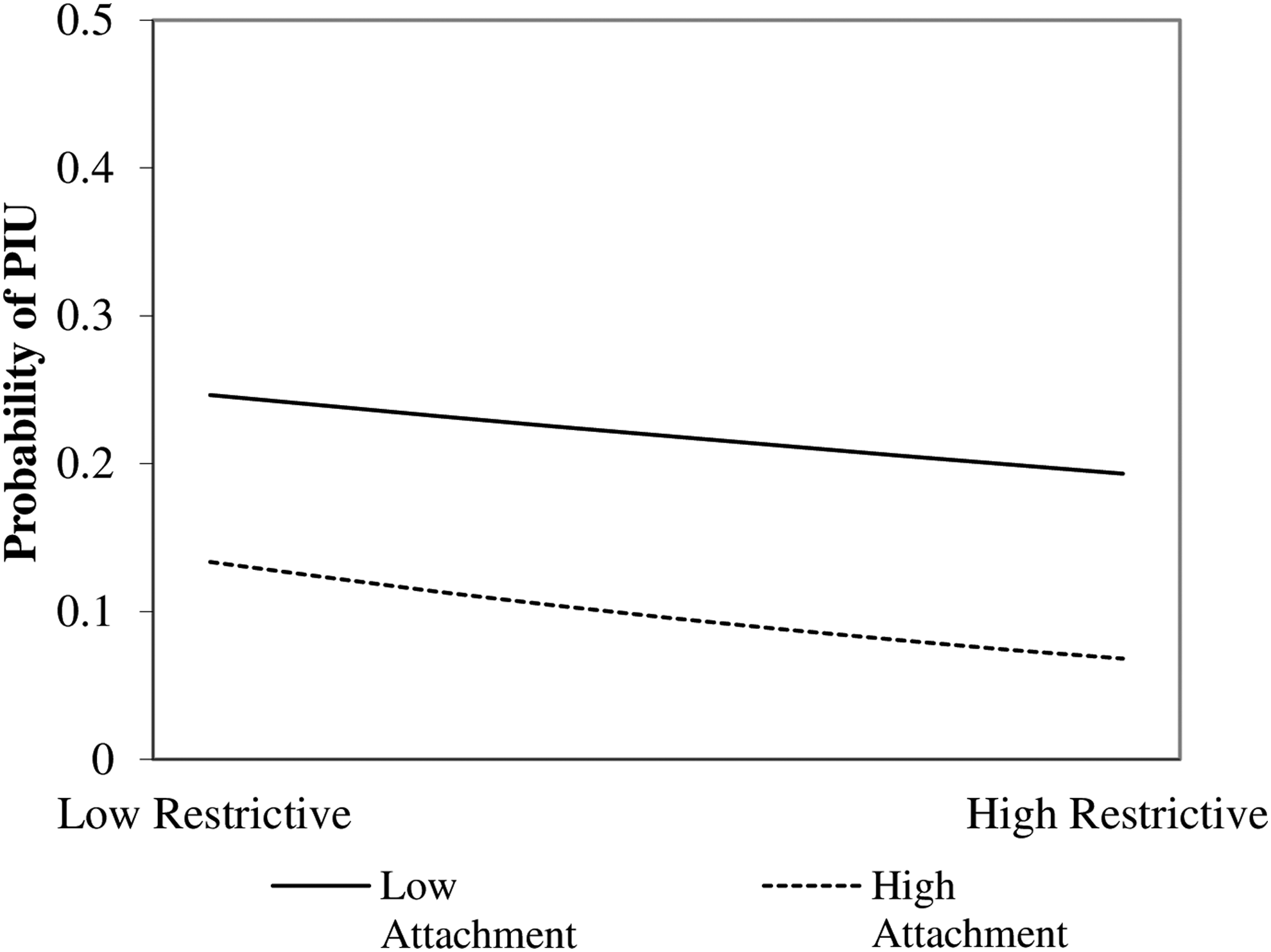
Moderating effects of restrictive mediation on PIU by parental attachment.
Discussion
The results indicate that students with PIU scored lower in both mediation strategies, had lower comfort being at home, and had poorer attachment and communication with their parents. The cross-sectional nature of the data makes it not possible to infer if these poorer family relations are causal or consequential factors of PIU. However, the differences reinforce the previous finding that those who have PIU often have to cope with a less positive family environment and lower parental involvement.9,10
In multivariate analyses, restrictive mediation was found to be negatively associated with PIU. The regulations imposed on online time and content may result in decreased online access and opportunities, thus preventing use from become pathological. However, restrictive mediation should also be exercised with caution, as Van den Eijnden et al. found that stricter rules can lead to more problematic Internet usage. 15 A possible explanation could be that the relation between restrictive mediation and PIU may be quadratic, but a longitudinal data set is needed to confirm this suggestion.
Unexpectedly, in multivariate analyses, active mediation was not found to be a significant predictor of PIU in this study. Some studies have found that more parental mediation does not necessarily result in a reduction of online risk,18,34,35 but it may be that active mediation in terms of broad communication on a range of online matters was not targeted enough for the discouragement of PIU in this study. A parental focus on more specific aspects directly relating to Internet use may be more effective in regulating online access, such as active discussions on the negative consequences of Internet reliance and emphasizing the importance of healthy Internet use in other areas of child development.
As hypothesized, the negative relation of restrictive mediation and PIU was found to be stronger for lower levels of comfort with living at home, poorer communication, and attachment. This implies that the effectiveness of restrictive mediation varies with the degree that children feel comfortable with their parents and in their homes. Thus, a warm and responsive home environment with a reciprocal and communicative parent–child relationship has to be fostered in order for youths to be open to parental instructions. Parental restrictions are necessary for the inculcation of good Internet practices and values, but when these restrictions are not applied in environments where the youth feels secure and open to parental guidance, the effectiveness of having these restrictions in place may be negated.
Limitations
The current study was solely based on self-reports from one source of informants. Thus, some relations might be overestimated due to common source and method variance. Additionally, this study used cross-sectional data. Longitudinal data from different sources would provide a more comprehensive understanding of changes in parenting mediation strategies over time and how these changes might also be reciprocal effects of child behaviors. The effects of gender and educational levels should also be further examined. Mythily et al. found that males are twice as likely compared to females to be excessive Internet users, 2 and males are more likely to use the Internet to fuel other addictions such as gambling and gaming. 36 Restrictive mediation has been found to be used more with younger children19,37 as its benefits appear to decrease in adolescence where parental regulations may be increasingly perceived as a lack of trust. 38 Additionally, other family factors in relation to Internet addiction should also be examined, such as parenting attitudes, family cohesion, and family violence exposure. 39
Implications and conclusion
The findings of this study indicate that preventive measures can be taken in families in order to prevent the development of problematic Internet behaviors. In their 2 year longitudinal study, Siomos et al. found that there was an increase in Internet addiction when no preventive attempts were made to combat the phenomenon from the initial time of survey. 27 The current study demonstrates that parental restrictive mediation is a significant protective factor for PIU, but without a supportive and loving family environment, the effectiveness of this strategy cannot be ensured. Parents have to be informed on the importance of limit settings for youths' online practices, and they should be provided with suitable courses to equip them with the knowledge and skills to implement these boundaries effectively and to sustain good relations. Lastly, further research should more closely examine the low family functioning of students with PIU, as this group is in greater need of extra provision and support for the improvement of family relations.
Notes
a. Levene's Test for Equality of Variances is significant. Thus, test statistics are under the assumption of unequal variances.
Footnotes
Acknowledgments
The authors would like to thank the Inter-Ministry Cyber Wellness Steering Committee for funding the research project.
Author Disclosure Statement
No competing financial interests exist.