




Abstract
Abstract
Problematic online game use (POGU) has become a serious global public health concern among adolescents. However, its influencing factors and mediating mechanisms remain largely unknown. This study provides the first longitudinal design to test stage–environment fit theory empirically in POGU. A total of 356 Chinese students reported on teacher autonomy support, basic psychological needs satisfaction, school engagement, and POGU in the autumn of their 7th–9th grade years. Path analyses supported the proposed pathway: 7th grade teacher autonomy support increased 8th grade basic psychological needs satisfaction, which in turn increased 9th grade school engagement, which ultimately decreased 9th grade POGU. Furthermore, 7th grade teacher autonomy support directly increased 9th grade school engagement, which in turn decreased 9th grade POGU. These findings suggest that teacher autonomy support is an important protective predictor of adolescent POGU, and basic psychological needs satisfaction and school engagement are the primary mediators in this association.
Introduction
P
Dissatisfaction with autonomy in daily life and the search for sense of control through online games are major causes for POGU. Teacher autonomy support is particularly meaningful in satisfying adolescents' increasing demands for autonomy.8,9 Teacher autonomy support refers to a student's perceived opportunities that teachers provide and the support in decision making with regard to his/her school life. 10 Considerable evidence indicates that teacher autonomy support can effectively fulfill students' demand for autonomy and subsequently promote their academic, mental, and behavioral adaptation.11–13 Adolescents are motivated to thrive and achieve goals when they feel self-determined and autonomous. In contrast, low teacher autonomy support weakens adolescent motivation and engagement in school, which in turn leads to maladjustment (e.g., poor academic achievement, depression, and problem behaviors). 11 Therefore, in the present study, it was expected that teacher autonomy support would negatively predict adolescent POGU.
The stage–environment fit theory proposed by Eccles and Midgley11,14 is the primary theoretical framework for understanding how and why the school context alters adolescent development. This theory has guided research on the influence of school transitions on youths' academic, mental, and behavioral development. According to this theory, a mismatch between the psychological needs of adolescents and the opportunities granted by their school environment will give rise to negative outcomes. Adolescents are motivated to engage and enjoy school (school engagement) when the school context (such as teacher autonomy support) responds to their increasing basic psychological needs of autonomy, competence, and relatedness, which in turn promotes adaptation. In contrast, adolescents are more likely to experience maladjustment in a school environment that does not respond to their needs. Therefore, teacher autonomy support may increase basic psychological needs satisfaction, which in turn enhance school engagement, and will ultimately promote optimal adolescent development. Although this theory has been tested in the academic domain,12,15 empirical investigation has yet to determine whether this theory could be applied to adolescent POGU.
School engagement is the primary pathway in understanding the effect of teacher autonomy support on adolescent POGU. When adolescents feel autonomous in school life, they display intrinsic motivation and high engagement in school activities, which in turn reduces the likelihood of maladaptive behaviors such as POGU. 11 Autonomous adolescents will strive to achieve the school's conventional goal, and they are also supported by their teachers and classmates. Empirical evidence has demonstrated that school engagement can significantly reduce adolescent POGU. 16 Given that previous research has confirmed the role of teacher autonomy support in promoting adolescent school engagement,12,17 it is hypothesized that school engagement may mediate the association between teacher autonomy support and adolescent POGU.
Moreover, basic psychological needs satisfaction is the motivational mechanism that explains how teacher autonomy support promotes adolescent school engagement. Adolescents show affective response toward their school experiences (emotional engagement), have a positive attitude toward education, show a willingness to invest in learning (cognitive engagement), and actively participate in school activities (behavioral engagement) when their basic psychological needs for autonomy, competence, and relatedness are met. In addition, teacher autonomy support not only fulfills the need for autonomy, but also provides sufficient opportunities for self-expression and competence development and promotes positive interpersonal interactions with teachers and classmates, 18 which might potentially reduce the risk of POGU. Empirical studies have supported the mediation role of basic psychological needs satisfaction between teacher autonomy support and school engagement.15,19 Although not yet tested, it is plausible to expect the following path: teacher autonomy support→basic psychological needs satisfaction→school engagement→POGU.
In essence, the current understanding of the environmental source of influence on adolescent POGU is limited. No empirical study to date has examined the mediation effects of basic psychological needs satisfaction and school engagement in the etiology of POGU. Most of the few existing studies used a cross-sectional design. A year-to-year longitudinal design would allow a finer-grained analysis of how school contextual factors (teacher autonomy support) alter adolescent POGU than a cross-sectional study would. Resting on the stage–environment fit theoretical framework,11,14 the current study utilized a 2 year longitudinal design to investigate the following hypothesis:
Methods
Participants
After Institutional Review Board approval, participants were recruited from two junior high schools in southern China. At time 1 (October 2011), 431 7th grade students participated in the study. Of these, 407 returned at time 2 (October 2012), and 356 students completed the final assessment at time 3 (October 2013). The mean age of the 356 final participants was 14.83 years (SD=0.49, range 13.83–16.17 years) in the 9th grade; 58.99% were female. Chi-square and t tests showed that there were no differences between students who fully completed the study and the 75 students lost to attrition.
Measures
Teacher autonomy support
In the 7th grade, adolescents reported perceived teacher autonomy support using a 5-item questionnaire developed by Jia et al. 10 Adolescents rated how often each statement (e.g., “Teachers ask students what they want to learn”) pertained to them on a 4-point scale ranging from 1=“never” to 4=“always.” The mean of the five items was calculated, with higher scores reflecting higher levels of teacher autonomy support.
Basic psychological needs satisfaction
In the 8th grade, adolescents reported their basic psychological needs satisfaction using Gagné's 20 21-item general need satisfaction scale. Three items (items 4, 7, and 9) that exhibited ambiguity or low factor loadings were removed based on previous findings.21–23 Ultimately, six items tapping into the dimension of autonomy (e.g., “There is not much opportunity for me to decide for myself how to do things in my daily life”), six items tapping into competence (e.g., “People I know tell me I am good at what I do”), and six items tapping into relatedness (e.g., “People in my life care about me”) were used for the study. Participants indicated how closely each statement reflected their life on a 5-point scale ranging from 1=“not at all true” to 5=“very true.” The mean of each subscale was calculated, with higher scores reflecting higher levels of needs satisfaction.
School engagement
In the 9th grade, adolescents reported their school engagement using Zhang et al.'s 24 scale that assesses three dimensions: behavioral engagement (5 items; e.g., “I actively participate in classroom group discussions”), emotional engagement (5 items; e.g., “I feel happy to be at my school”), and cognitive engagement (5 items; e.g., “I think the things I learn at school are useful”). The response format of behavioral engagement ranged from 1=“never” to 5=“always,” and that of emotional and cognitive engagement ranged from 1=“completely disagree” to 5=“completely agree.” The mean of each subscale was calculated, with higher scores reflecting higher levels of school engagement.
POGU
In the 7th and 9th grades, POGU was measured with 11 items adapted from Gentile's 25 Pathological Video-Game Use Questionnaire. Good reliability and validity has been demonstrated in Chinese adolescent samples by previous studies.26,27 Adolescents indicated how often each instance occurred during the last 6 months (e.g., “Have you tried to play online games less often or for shorter periods, but are unsuccessful?”) on a 3-point scale: 0=“never,” 1=“sometimes,” and 2=“yes.” The answers were recoded into 0=“never,” 0.5=“sometimes,” and 1=“yes.” This mode of scoring is more accurate because it allows participants who “sometimes” experienced symptoms to be considered. 26 The total score of the 11 items was calculated, with higher scores representing greater severity of POGU.
Control variables
Given that prior studies have shown that teenagers' gender, age, sensation seeking, and self-esteem were associated with POGU,2,3 these factors were included as control variables in the statistical models. Sensation seeking was assessed by the Chinese version of the Sensation Seeking Scale. 28 Self-esteem was assessed by the Rosenberg Self-Esteem Scale. 29 For both scales, a higher score represents higher levels of sensation seeking or self-esteem.
Results
Prevalence of POGU
As noted, an adolescent who exhibited at least 5 of the 11 criteria on the POGU questionnaire was considered a problematic gamer. 3 In the current sample, 5.80% and 4.78% of the participants displayed POGU in the 7th and 9th grades, respectively; these rates are consistent with national Chinese adolescent data. 7
Descriptive analyses
Table 1 presents the means, standard deviations, internal reliabilities, and the bivariate correlations between the variables in this study. The internal reliabilities of all measures were acceptable. Teacher autonomy support in the 7th grade was significantly negatively correlated with POGU in the 9th grade. Moreover, all subscales of basic psychological needs satisfaction and school engagement were significantly negatively correlated with POGU.
Gender was dummy coded by 1=male and 0=female. T1, time 1 (7th grade); T2, time 2 (8th grade); T3, time 3 (9th grade).
SS, sensation seeking; SE, self-esteem; PTAS, perceived teacher autonomy support; AN, autonomy need; CN, competence need; RN, relatedness need; BE, behavioral engagement; EE, emotional engagement; CE, cognitive engagement; POGU, problematic online game use.
p<0.05; **p<0.01; ***p<0.001.
Testing mediation effects
The hypothetical models were tested using structural equation modeling (SEM) in Mplus v7.1 with maximum likelihood estimation. 30 Given that POGU was not normally distributed, bias-corrected bootstrap confidence intervals (CIs) with 1,000 re-samples were computed to estimate the statistical significance of the paths. 31 CIs not overlapping with zero indicated significance at α=0.05. 31 In addition, acceptable model fit was determined by examining a combination of indices such as: a χ2/df ratio of <5, a comparative fit index (CFI) value >0.95, and a root mean square error of approximation (RMSEA) value <0.06. 32
Test of the measurement model
The measurement model featured one indicator for teacher autonomy support, three indicators of basic psychological needs satisfaction, three indicators of school engagement, and one indicator for POGU in both the 7th and 9th grades. The initial test fit the data well: χ2(20)=25.96, χ2/df=1.30, CFI=1.00, and RMSEA=0.029. Furthermore, all standardized factor loadings for the indicators on the latent variables exceeded the threshold of 0.70, and the residual variances of all indicators were low, indicating that all the latent constructs were well represented by their indicators. 33
Test of the structural model
In order to find the best model, four alternative models (models 1–4) were assessed. First, a partially mediated model (model 1) with two mediators and a direct path from 7th grade teacher autonomy support to 9th grade POGU revealed an insufficient fit to the data: χ2(29)=104.323, χ2/df=3.597, CFI=0.952, and RMSEA=0.085. In addition, the path coefficients from autonomy support to POGU (β=0.01, p=0.885) and from basic psychological needs satisfaction to POGU (β=−0.03, p=0.505) were nonsignificant. Second, model 2 (path removed: 7th grade teacher autonomy support→9th grade POGU) and model 3 (path removed: 8th grade basic psychological needs satisfaction→9th grade POGU) were tested. The results revealed that model 2—χ2(30)=104.345, χ2/df=3.478, CFI=0.953, RMSEA=0.083—and model 3—χ2(30)=104.324, χ2/df=3.365, CFI=0.953, RMSEA=0.083—did not improve the model, and the two paths could be dropped. Finally, model 4 (path added: 8th grade basic psychological needs satisfaction→9th grade school engagement) showed a satisfactory fit to the data—χ2(30)=65.266, χ2/df=2.076, CFI=0.978, RMSEA=0.057—indicating that this additional path significantly contributed to the model. Based on these findings, model 4 was selected as the final model (Fig. 1).
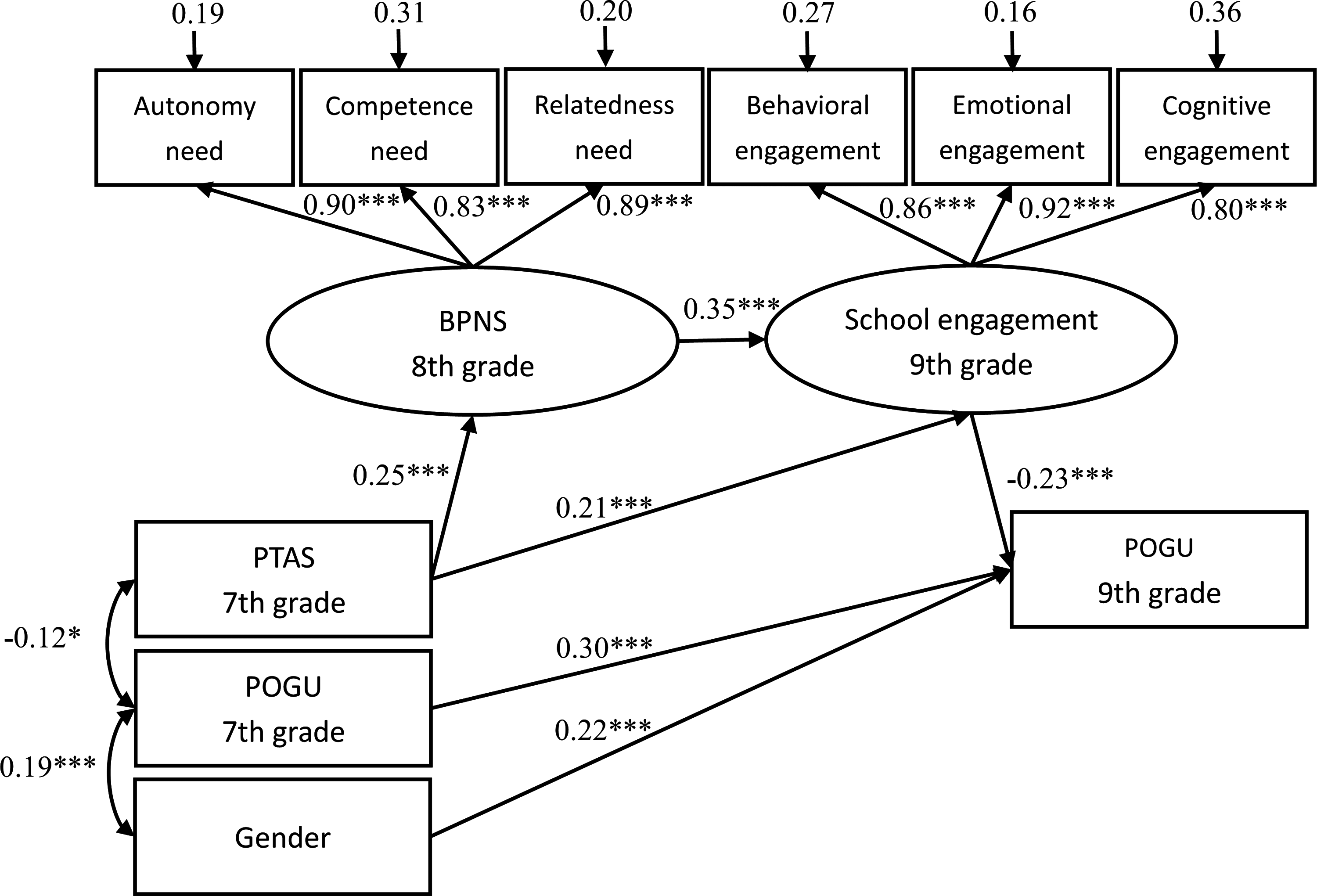
Path model results with standardized coefficients (N=356). The paths from age, sensation seeking, and self-esteem to POGU, and the relationship between gender and PTAS were not significant. PTAS, perceived teacher autonomy support; BPNS, basic psychological needs satisfaction; POGU, problematic online game use. *p<0.05; **p<0.01; ***p<0.001.
Moreover, the bootstrap test confirmed the hypothesized indirect effect (IE): 7th grade teacher autonomy support→8th grade basic psychological needs satisfaction→9th grade school engagement→9th grade POGU (standardized IE=−0.020, 95% CI=−0.036 to −0.005). In addition, the indirect effect of 7th grade teacher autonomy support on 9th grade school engagement via 8th grade basic psychological needs satisfaction was also significant (standardized IE=−0.048, 95% CI=−0.083 to −0.013).
Discussion
The current study examined the predictive effects of teacher autonomy support, basic psychological needs satisfaction, and school engagement on adolescent POGU with a 2 year longitudinal design. Consistent with predictions derived from stage–environment fit theory,11,14 this study demonstrated an unfolding trajectory from 7th grade teacher autonomy support to 8th grade satisfaction of basic psychological needs, which in turn enhanced 9th grade school engagement and ultimately decreased 9th grade POGU. Specifically, adolescents with higher teacher autonomy support and basic psychological needs satisfaction were intrinsically motivated to put more effort into schoolwork (cognitive engagement), to enjoy school life (emotional engagement), and to get more involved in school activities (behavioral engagement). Subsequently, the enhanced school experiences and reinforced positive conventional goal pursuit protected these adolescents from indulgence in online games for stress coping or escapism. On the other hand, adolescents whose basic psychological needs were not met tended to dislike school (school disengagement), which subsequently weakened their motivation for learning and school social activities. Thus, they were more likely to be addicted to online games because they found a sense of control and autonomy from the games.9,34 These findings are in line with studies showing that basic psychological needs satisfaction and school engagement are important mediation mechanisms that explain how teacher autonomy support alters adolescents' academic achievement.12,15 Concurrently, this study also found that teacher autonomy support increased school engagement, which in turn decreased POGU. More specifically, teacher autonomy support directly increased adolescent school engagement, and also indirectly increased school engagement through satisfying basic psychological needs.
Most previous studies have focused on how teacher autonomy support alters adolescent academic performance,12,15 giving far less consideration to its impact on behavioral outcomes (such as POGU). Given the high prevalence of adolescent POGU,2,3 the present results make an important contribution to the literature by being the first study to investigate the effect of teacher autonomy support on adolescent POGU. Furthermore, this study extends previously applied designs by adjusting for earlier effects of adolescents' POGU and examining changes over time (2 years) in a longitudinal design. The findings suggest that stage–environment fit theory is not only valid in the academic domain but also applicable in POGU. More specifically, basic needs satisfaction and school engagement are the primary mechanisms for explaining how and why teacher autonomy support reduces adolescent POGU.
Implications
The current study has several important practical implications. First, the findings suggest that promoting adolescent perceived teacher autonomy support is an effective strategy for reducing the risk of POGU. Therefore, it is beneficial for schools and teachers to appreciate and incorporate the Western concept of autonomy, and then to transform their daily practices from a controlling to a more autonomy-supportive teaching style (i.e., providing choice, valuing adolescent voice, and encouraging adolescent self-initiation and self-management). 35 This is particularly important in China, as the traditional Chinese school culture is characterized by instilling a controlling teaching style, thus giving students very limited opportunities for developing autonomy in school life. 10 Second, the results suggest that basic psychological needs satisfaction and school engagement are important mediators between teacher autonomy support and POGU. Thus, teachers, parents, and clinical practitioners may prevent or intervene with adolescent POGU by satisfying the students' psychological needs, as well as using diverse strategies to enhance school engagement. For example, teachers and parents can grant adolescents more autonomy, involve them in decision making of important school and family events, encourage their self-expression and independence, communicate with clear rules and expectations so that adolescents can feel autonomous and self-determined, develop efficacy in meeting expectations and achieving goals, feeling closer to teachers and parents, and being confident and active when participating in school activities.13,36
Limitations
Several limitations should be noted in this study. First, all measures were based on adolescents' self-report. Thus, common method biases (variance attributable to the measurement method rather than to the measured construct 37 ) might exist. Therefore, future research should use multiple sources and methods of data collection. Second, both school engagement and POGU were measured in the 9th grade, thus preventing causal inference between the two variables. Third, this study only controlled the covariates of gender, age, sensation seeking, and self-esteem. Future research should include other relevant control variables, such as family dynamics, 38 aggression, and neuroticism. 2 Finally, although the generalization of the findings may be restricted as the participants were Chinese adolescents, future research should recruit larger samples from wider cultural backgrounds in order to clarify the relationships between the variables in this study.
Footnotes
Acknowledgments
This research was supported by the national natural science foundation of China (31170998) and the natural science foundation of Guangdong province, China (10151063101000045). We would like to thank Shuyi Guan for her feedback on an early draft of the article.
Author Disclosure Statement
No competing financial interests exist.