




Abstract
Abstract
The present study aimed to investigate how online and offline social behavior interact with each other ultimately to affect the well-being of socially anxious adolescents. Based on previous studies, it was assumed that there might be three-way interactive effects among online social behavior, offline social behavior, and social anxiety regarding the relationship with well-being. To measure social anxiety, online and offline social behavior, and mental well-being, self-report questionnaires such as the Korean-Social Avoidance and Distress Scale, Korean version of the Relational Maintenance Behavior Questionnaire, and Korean version of Mental Health Continuum Short Form were administered to 656 Korean adolescents. Hierarchical regression analysis revealed that the three-way interaction of online social behavior, offline social behavior, and social anxiety was indeed significant. First, online social behavior was associated with lower well-being of adolescents with higher social anxiety under conditions of low engagement in offline social behavior. In contrast, a higher level of online social behavior predicted greater well-being for individuals with high social anxiety under conditions of more engagement in offline social behavior. Second, online social behavior was not significantly related to well-being in youths with low social anxiety under conditions of both high and low engagement in offline social behavior. Implications and limitations of this study were discussed.
Introduction
I
On the other hand, the recent introduction of online social space seems to have changed the relationship patterns between traditional offline social interactions and well-being. More specifically, the introduction of online social space seems to provide socially vulnerable youths with new and different opportunities to express prosocial behavior and relationship formation. The properties of online space, such as the absence of physical presence, permission for delayed feedback, and greater abilities for both editing text prior to sending messages and manipulating information, which is impossible in face-to-face interactions, 9 can help socially anxious youths perceive online space as a viable, safe, and efficient context to meet friends,10,11 thus enabling them to engage more in online than face-to-face interactions. 12 In line with these expectations, several researchers13–16 have argued that online space can provide more opportunities for social interactions and thus improve the well-being of socially vulnerable youths. This is referred to as the “compensatory hypothesis,” which states that communication on the Internet primarily helps individuals who feel uncomfortable communicating face-to-face compensate for their poor social relationships. 17
However, contrary to this proposition, the positive effects of the online social engagement of socially anxious youths on their well-being have not been consistently supported. Several studies18–20 have contradicted the compensatory hypothesis, insisting on the “richer-get-richer hypothesis”, in which socially anxious ones would participate in online interactions less, and thus less likely develop intimate relationships and well-being.
Why, then, are the positive effects of the online social engagement of socially anxious youths on well-being not consistently supported? This may result from the fact that the majority of previous studies on social engagement in online space did not consider the context of social interactions in offline space as well.18,19,21 In other words, these previous studies neglected the effects of interrelationships between online and offline social interactions and well-being. According to some authors, 22 the compensatory effect of online social behaviors disappeared under the condition of controlling for offline effects, which suggests that there might be complex interactive dynamics between online and offline social behaviors. It would be particularly important to investigate the beneficial effects of the online social interactions of socially anxious individuals with consideration of the offline interaction contexts because the seeking of alternative and additional online social engagement by socially anxious individuals is often driven by the motivation to avoid offline social interactions.9,11,12 Thus, examining the interactive dynamics of online and offline social interactions would help to clarify the inconsistent findings on the effect of the online social interaction of socially anxious individuals on well-being.
In this regard, this study aimed to investigate how online and offline social behaviors would interact with each other ultimately to affect the well-being of socially anxious adolescents. Specifically, online and offline social behaviors were considered as two possible candidate moderators of the relationship between social anxiety and well-being. It was expected that there would be three-way interactive effects among online social behaviors, offline social behaviors, and social anxiety when examining the relationship with well-being.
First, it was assumed that the online social behaviors of youths with high social anxiety would be associated with higher well-being only when they also demonstrated offline social behaviors. This hypothesis was based on the previous findings that compensatory Internet use combined with high motivation to avoid face-to-face interactions was associated with poorer well-being in individuals with higher social anxiety, and that Internet use combined with low motivation for avoidance was associated with greater well-being. This study suggested that engagement in online social behaviors, motivated by the avoidance of offline social interactions, would not modify the tendency for automatic vigilance and reactivity to perceived threats, 24 potentially resulting in less satisfying interpersonal experiences in online space. The second ground for this hypothesis came from the negative effect of discrepancy in self-presentation on well-being in socially anxious individuals. Socially anxious individuals tend to present themselves in a way that is different from their own self-perceptions. 25 This tendency of self-discrepancy in socially anxious youths tends to be prominent in online interactions because such youths would perceive online space as being safe and controllable, allowing ideal self-presentation 26 and expression of certain aspects of themselves (e.g., sociability, affinity, kindness, or assertiveness that socially anxious youths want to express, but feel unable to do so in offline contexts25,27). This enlarged discrepancy between the actual-self (offline) and ideal-self (online) could lead to more concerns and anxiety28,29 and, subsequently, deterioration in well-being. Furthermore, the interaction experience in online space may be devalued because it is perceived by users to be based on exaggerated and deceptive online self-presentation. In summary, online social engagement by socially anxious youths, which was not supported by offline social engagement, would ultimately cause deterioration of well-being.
Second, it was hypothesized that unlike socially anxious youths, those who were less socially anxious would show a positive relationship between online social interaction and well-being, regardless of the level of offline social behaviors. This second hypothesis is based on the suggestion that the positive effects of alternative online social space are not devaluated in less anxious youths, thus allowing them to take advantage of the well-being enhancement effects of online activities, since those with low social anxiety are not immediately concerned with the evaluative reactions of others, and have no high impression-related outcome expectancies. 30
Materials and Methods
Participants and procedure
A total of 700 adolescents were recruited from middle and high schools in Seoul and two provinces in Korea (Gyeonggi-do and Jeollanam-do) through snowballing sampling between January and August, 2012, resulting in 656 valid data samples (93.3%). Those who did not have any experience of using SNS and Internet (1%) were excluded, leaving 653 valid samples in the final analysis. Of them, 316 (48.4%) were male. The mean age of the participants was 15.86 years (SD= 0.55). They had used the Internet for a mean of 4.5 years (SD=0.73), with an average daily use of 2 hours (SD=0.88). Approval for the study was obtained from the Institutional Review Board of Korea University. A letter providing information about the study and the rights of participants was distributed to the participants, after which informed consent was obtained from all subjects. Participants were told that they were free to accept or reject participation in the study, and were assured of anonymity and of the confidentiality of their responses. Finally, survey packs were sent to the participants by mail. All subjects received $10 for participation.
Measures
Social anxiety
Social anxiety was assessed using the Korean-Social Avoidance and Distress Scale 31 (K-SADS), which was originally developed by Watson and Friend. 32 The K-SADS consists of 26 items, half of which assess social anxiety and the other half of which assess social avoidance. Participants rated each item on a 5-point scale ranging from 1=“strongly disagree” to 5=“strongly agree.” Higher scores reflected more social anxiety and distress. Although the SADS yields a total score, as well as separate scores for anxiety and avoidance of social interaction and situations, only the total score was utilized, since the hypotheses of the present study were not related to the distinction between anxiety and avoidance. Example items include “I often find social occasions upsetting” and “I try to avoid situations which force me to be sociable.” In this study, the Cronbach's alpha of K-SADS was 0.89.
Online and offline relational maintenance behaviors
Online and offline social behaviors were assessed using the Korean version of the Relational Maintenance Behavior Questionnaire (K-RMBQ), 33 which is a self-report questionnaire originally developed by Canary and Stafford. 34 This measure was used to identify the following five broad relational maintenance behaviors: (a) showing positivity or efforts to make interactions pleasant, doing favors, or showing affection; (b) exhibiting openness or making an effort to keep communication open by engaging in self-disclosure, giving advice, and showing empathy; (c) providing assurance or communication expressing validation or unconditional support; (d) joining in activities, such as spending time together in routine or spontaneous ways; and (e) sharing tasks. The fifth subscale was not included because sharing tasks was unrelated to the goal of the current study. The RMBQ is an 8-item self-report questionnaire that employs a five-point Likert scale ranging from 0=“never” to 4=“very often.” Participants were asked to indicate the extent to which relational maintenance behavior was used with online and offline partners. The original and K-RMBQ scales were shown to possess adequate internal consistency (coefficient >0.76). The Cronbach's alphas of the online and offline K-RMBQ employed herein were between 0.71 and 0.88.
Well-being
Well-being was measured using the Korean validated Mental Health Continuum Short Form (K-MHC-SF), 35 which was originally developed and validated by Keyes et al. 36 This measure assesses well-being on three dimensions: emotional well-being (three items), social well-being (five items), and psychological well-being (six items). Example items include “During the past month, how often did you feel happy?,” “The way our society works makes sense to you?” and “Did you have experiences that challenged you to grow and become a better person?” Each of these 14 items was assessed using a 6-point Likert scale, ranging from 0=“never” to 5=“every day.” This measure demonstrated high internal consistency (0.88) in a Korean validation study, 35 and achieved the internal consistency (Cronbach's alpha) of 0.93 in the present study.
Statistical analysis
Correlations, means, and standard deviations were determined using SPSS Statistics for Windows v20.0 (IBM Corp, Armonk, NY). The measurement model was tested using AMOS 18. A number of fit indices were employed, such as the Tucker–Lewis Index (TLI), comparative fit index (CFI), and root mean square error of approximation (RMSEA). Models were considered adequate when the value was >0.90 in the TLI and CFI, and <0.10 in the case of RMSEA. 37 The interactions between offline social behavior, online social behavior, and social anxiety were analyzed by hierarchical regression analysis with the stepwise method in SPSS. Interaction effects were probed using the PROCESS utility for SPSS. 38
Results
The means, standard deviations, and zero-order correlations of all variables are listed in Table 1. Social anxiety was found to be negatively correlated with online social behavior (r=−0.13, p<0.01), offline social behavior (r=−0.29, p<0.01), and well-being (r=−0.33, p<0.01). Online and offline social behaviors were also positively correlated with well-being (r=0.12, p<0.01; r=0.29, p<0.01, respectively), as well as with each other (r=0.38, p<0.01).
p<0.01.
Before conducting the hierarchical regression analysis, structural equation modeling (SEM) was used to test the measurement model for each scale. Results indicated modest fit indices for the SEM model for all scales (SADS: TLI=0.963, CFI=0.985, RMSEA=0.087; RMBQ online: TLI=0.972 CFI=0.991, RMSEA=0.103; RMBQ offline: TLI=0.989, CFI=0.996, RMSEA=0.054; MHC-SF: TLI=0.901, CFI=0.920, RMSEA=0.096). Factor loadings for each observation variables exceed the cutoff value of 0.50 (SADS: 0.62–0.80; RMBQ online: 0.82–0.92; RMBQ offline: 0.73–0.88; MHC-SF: 0.75–0.89), suggesting that there is some evidence of convergent validity. Average variance extracted (AVE) of each of the latent variables was larger than the correlation coefficients among the latent variable (SADS: 0.55; RMBQ online: 0.74; RMBQ offline: 0.64; MHC-SF: 0.70). This provides some evidence of discriminant validity. The composite reliability (CR) of each latent variable exceeds the suggested cutoff value of 0.7 (SADS: 0.88; RMBQ online: 0.96; RMBQ offline: 0.93; MHC-SF: 0.870, indicating that the reliability of all constructs was good. 39
Hierarchical regression analysis was then conducted to test the hypotheses. Independent variables were centered around their grand means to facilitate interpretation of the main effects in models containing interaction terms. 40 Predictors were entered into the regression in four steps: (a) age, sex, years of Internet experience, and daily Internet use as control variables; (b) social anxiety, online social behavior, and offline social behavior; (c) the two-way interaction; and (d) the three-way interaction. Well-being was defined as the dependent variable. The results of the regression analyses are displayed in Table 2. In the first step, only daily Internet use was found to be significant (β=−0.10, p<0.05) among the control variables, accounting for 1% of the variance (ΔF=1.75, p>0.05) in Well-being. In the second step, social anxiety (β= −0.28, p<0.01) and offline relational maintenance behavior (β=0.22, p<0.01) were significant, accounting for an additional 16% of the variance (ΔF=35.25, p<0.001) in Well-being. In the third step, the three two-way interactions did not significantly predict Well-being, and the model changes were not significant (ΔF=1.27, p>0.05). Focus was instead given to the three-way interactions, which were central to this study. With well-being as the dependent variable, the three-way interaction of online relational maintenance behavior, offline relational maintenance behavior, and social anxiety (fourth step) was significant (β=0.14, p<0.01), and explained an additional 1 % of the variance (ΔF=6.66, p<0.01).
p<0.05; **p<0.01; ***p<0.001.
In order to grasp the three-way interaction more clearly, the statistical results were presented in Figures 1 and 2 by entering each variable of the +1 SD and −1 SD, plus the means of dependent variables. For youths with high social anxiety, online social behaviors were negatively related to well-being under conditions of low engagement in offline social behaviors (B=−2.38, p=0.032). In contrast, online social behaviors were positively related to well-being under conditions of high engagement in offline social behaviors (B=2.09, p=0.062; see Fig. 1). Therefore, hypotheses 1a and 1b were supported.

Interactions between online and offline relational maintenance behavior predicting well-being for youths with high social anxiety.
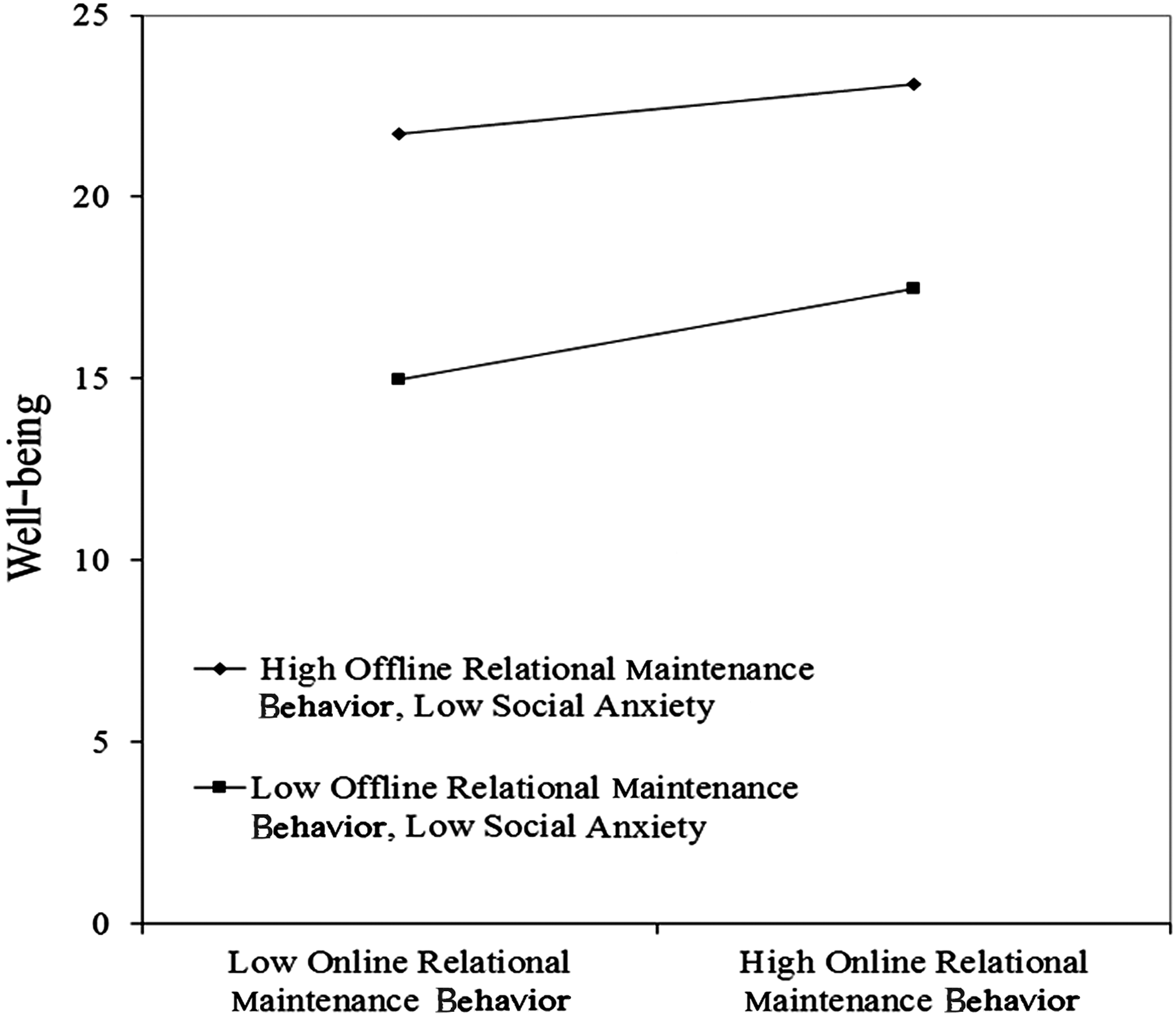
Interactions between online and offline relational maintenance behavior predicting well-being for youths with low social anxiety.
On the other hand, for youths with low social anxiety, online social behaviors displayed a positive but nonsignificant relationship with well-being under both conditions of high (B=0.60, p=0.692) and low engagement (B=0.63, p=0.394) in offline social behaviors (see Fig. 2). Accordingly, hypothesis 2 was not supported.
Discussion
The present study provided an integrative and systematic understanding of engagement in online social contexts among adolescents with high and low social anxiety. The results confirmed the hypotheses that the relationships between social anxiety and well-being are moderated by engagement in online and offline social behavior.
First, online social behaviors were found to be associated with lower well-being under conditions of low engagement in offline social behaviors for the adolescents with higher social anxiety. In contrast, higher levels of online social behavior predicted greater well-being in individuals with high social anxiety under conditions of higher engagement in offline social behaviors. The former result was consistent with previous findings that Internet use by socially anxious youths as an alternative to face-to-face communication results in poorer well-being. 23 This observation also supports Caplan's proposition 41 that those who attempt to obtain social benefit or social control via online space to compensate for their lack of offline relationships are likely to experience negative outcomes from such use. There could be several reasons why socially anxious individuals do not benefit from online social behavior under conditions of low offline social engagement. For example, self-discrepancy between online and offline relational engagements might exacerbate anxiety, further decreasing the level of well-being. In addition, cognitive traits, such as devaluations concerning personal effort or a partner's feedback, might lead them to devaluate social outcomes in online space.
Conversely, socially anxious youths could benefit from online social behavior under conditions of high offline social engagement. Altogether, these results imply that not only communicating online with peers but also simultaneously engaging in social interactions offline allows socially anxious youths to gain the most benefit from online interactions. This finding is consistent with the stimulation hypothesis, in which online interaction is conducive for maintaining and developing relationships.42–44 However, the results obtained herein also provided further clarification that it would be determined by their offline social behavior whether the online social behavior of socially vulnerable youths would predict positive or negative effects on well-being.
On the other hand, the final hypothesis was not supported by the observation that online social behaviors were not significantly related to greater well-being in youths with low social anxiety under conditions of both high and low engagement in offline social behaviors. In other words, additional beneficial effect of online social behavior on well-being was not so large in less socially anxious youths as expected, regardless of participation in offline social behavior. This implies that online social behaviors did not lead to an impressive increase or dramatic change in well-being in less socially anxious youths who have no strong social motivation toward online social space and are not in urgent need of online social space. In conclusion, the compensatory effects of online social behavior reported in previous research18,20,45 were found not to be applied to less socially anxious youth but only to highly socially anxious youths with high social motivation toward online social space as well as back-up of high offline social engagement effort.
This study has several limitations. First, the results were based on cross-sectional data, and should be confirmed with longitudinal data. Second, we did not consider with whom individuals initiated behaviors to maintain relationships. According to Valkenburg and Peter, 44 intimacy development depends on the people with whom individuals tried to maintain relationships. An important focus of future research will be to explore the differential effects of social behaviors according to the intimacy levels of relationship partners (e.g., close friends, acquaintances, and strangers). Third, the relational maintenance behavior measured in this study was validated in an offline context, which raises questions regarding the validity of assessing online behaviors in the same manner as offline behaviors. Therefore, there is a need to identify online-specific relationship maintenance behaviors, and to develop methods by which to measure such behaviors. Finally, this study was based only on self-report questionnaires. Therefore, interviews, experimental methods, or other methods should be adopted in future studies to confirm the observed associations.
Despite these limitations, this study has several implications. First, it is the first study to investigate simultaneously the complex interactions among online context, offline context, and personality. Second, this study contributes to our understanding of the social consequences of the online context in youths. Finally, the results of the current study might provide counselors and educational advisors with therapeutic information, and youths with practical skills and information helpful for enhancing well-being by online usage. In particular, the results suggest the following. First, preventive interventions for socially anxious youths need to include information regarding the specific conditions that can enable online prosocial behaviors to positively enhance well-being. Second, it might be helpful to encourage socially anxious youths to engage in offline relationships as well as relationships with peers online in order to ensure the beneficial effects of online social activities. Specifically, it might be important to encourage socially anxious individuals who prefer online space over offline space to reduce the discrepancy between online and offline social interactions, and not to neglect the importance of engagements in offline social relationships. Third, it might be helpful to recommend to socially anxious youths that they should modify their cognitive distortions, such as those involving self-discrepancies or devaluation about their effort and partner's positive feedback, before jumping into online space, as such obstacles could hinder youths with high social anxiety from enjoying the social benefits of online social space.
Footnotes
Acknowledgments
This research was supported by grants from the National Research Foundation of Korea, funded by the Korean Government (NRF-2011-330-B00240).
Author Disclosure Statement
No competing financial interests exist.