




Abstract
Abstract
The long- versus short-term effectiveness of empathy activation on reducing bystander behavior reinforcing cyberbullying was tested. The focus was on limiting the frequency of forwarding a message ridiculing a peer. Experimental research on adolescent students was conducted in conditions simulating online contact. The results confirmed the significance of cognitive empathy activated immediately prior to decision making on limiting involvement in reinforcing cyberbullying behavior. The long-term impact of empathy was markedly limited.
Introduction
Y
A body of evidence clearly shows the relationship between empathy and lower rates of bullying 8 and cyberbullying 10 in the context of cyberbystanders as well.5,7,8 However, while traditional bullying is associated mainly with low affective empathy, 10 cyberbullying is related to both affective and cognitive empathy. 11 Cognitive empathy is the ability to understand the beliefs, feelings, and intentions of others. 12 It is based on cognitive representations of other people paired with the intentionally controlled ability to anticipate the consequences of one's behavior for others and perceive the perspective of another person. 13 Active teaching of “perspective taking” has become an effective component of school violence prevention programs. 14 Studies show that such forms of empathy activation are effective in reducing both offline and online negative bystander behavior.4,5,8
Eliciting cognitive empathy may be particularly adequate in the cyberspace context, which is naturally devoid of emotional signals.5,8 Complex mechanisms activating this kind of empathy can significantly expand the scope of empathy beyond direct interaction, increasing its effectiveness over time, irrespective of prior priming. 15 This refers to separating empathy-triggered responses from provisional and direct cues priming concentration on the situation of the other.
Most studies on cyberbystander reactions confirm the short-term impact of empathy in reducing cyberbystander behavior reinforcing bullying.5,7,8 The current research focuses on whether the impact of activating cognitive empathy on limiting cyberbystander pro-bullying behavior can have long-term effects.
Materials and Methods
The aim of the study was to examine, using experimental methods, the effects of cognitive empathy activation on bystander behavior toward cyberbullying acts. Hypotheses were tested concerning (a) cognitive empathy activation (taking of the perspective of another person by focusing on the negative consequences of cybervictimization) as a factor reducing the odds of cyberbystander behavior reinforcing bullying, and (b) short- versus long-term effectiveness of empathy activation on reducing pro-bullying behavior.
Participants, study design, and procedures
The sample consisted of 442 pupils (227 boys) aged 12–17 years (Mage=14.72 ears; SDage=1.52 years). The study was conducted in groups in school computer labs with random assignment to either the experimental or the control group. Data were collected online using unique passwords assuring participant anonymity. A web application— simulation of an instant messenger as part of a social networking site—was used. The study followed a simple between-participant, two-by-two design with empathy and time gap manipulation as factors.
The opening task was the cognitive empathy manipulation. A short movie was presented showing a case of cyberbullying, the victim's feelings, and the impact on her behavior. Its effectiveness has been previously established, showing that watching the movie changed the emotional state according to the valence of the emotions displayed: strengthening the experience of negative emotions and decreasing the experience of positive emotions—symptoms of empathy. 5
An instruction activating conscious and reflective empathy processes preceded the video. In the experimental condition, the participants were instructed to identify with the situation depicted in the video and to focus on those aspects that reflected the victim's emotions and behavior. Then, from a list of emotions and behaviors, participants selected those that appeared in the video. In the control condition, the focus was on the elements of the background and selecting scenes that appeared in the video from a longer list.
Next, participants made a decision concerning their behavior as bystanders to a cyberbullying act in the “message from a peer” task. Its main element was a picture showing a boy's face on the body of a dog with the following comment: “Hi, this is my classmate, he looks like a total fool.” The task was to make a decision about whether to forward the message. This was the indicator of cyberbystander behavior: reinforcing bullying (forwarding the content) versus neutral (deleting the message).
A time gap manipulation was introduced between the empathy activation task and the “message from a peer” task. In the short-term condition, participants were given the message immediately after the empathy activation (no time gap), and in the long-term condition there was a 1 week gap between the empathy activation and the decision-making task.
Results
In order to test the hypotheses, hierarchical logistic regression analyses were conducted (see Table 1). In the first step, control variables (age and gender) were entered into the model. In the second step, the cognitive empathy manipulation (0 for control group, 1 for experimental condition) was entered into model. In the third step, the time gap manipulation (short- vs. long-term condition) was entered into the model (0 for short term, 1 for long term). Finally, in the fourth step, an interaction between the empathy activation and the time gap manipulation condition was entered into the model.
p<0.06; *p<0.05; **p<0.01; ***p<0.001.
Step 1: Cox & Snell R2=0.002; Nagelkerke R2=0.004.
Step 2: Cox & Snell R2=0.01; Nagelkerke R2=0.02.
Step 3: Cox & Snell R2=0.03; Nagelkerke R2=0.05.
Step 4: Cox & Snell R2=0.05; Nagelkerke R2=0.08.
OR, odds ratio; CI, confidence interval.
The analysis shows that age and gender had no impact on cyberbystander behavior in the presented study. Including empathy activation into the model in the second step revealed a slight improvement in the model (model chi square is marginally significant). The coefficient for empathy indicates a slightly lower likelihood of cyberbystander behavior reinforcing bullying in the empathy activation condition. The third model with the time gap manipulation substantially improves the overall model fit. Including the time gap significantly increases the probability of pro-cyberbullying behavior. Finally, in the last step, a significant interaction term between the two experimental conditions (see Fig. 1) shows that the odds of cyberbystander behavior reinforcing bullying drop after empathy activation but only in the short-term condition.
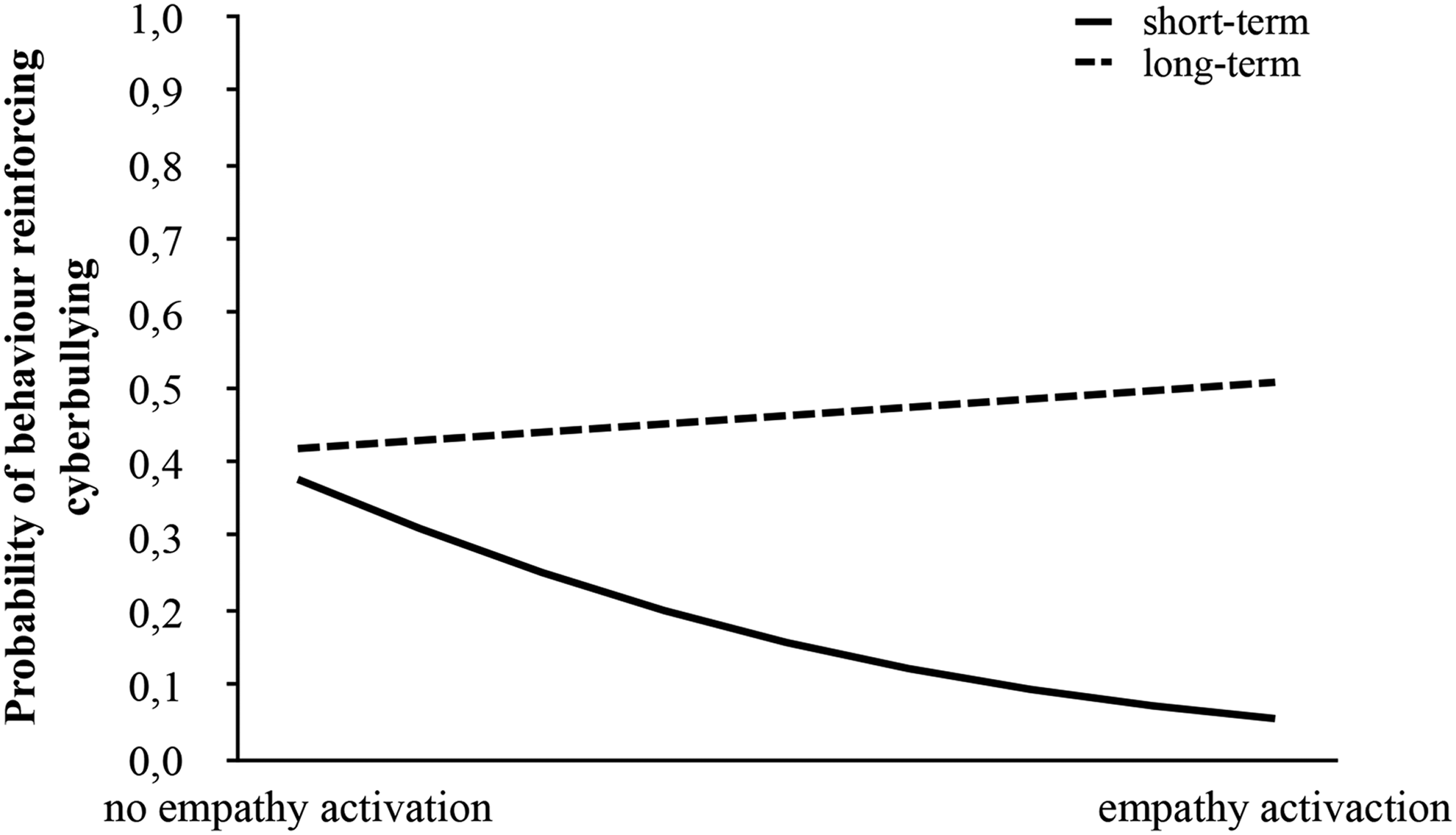
Interaction of time gap and cognitive empathy manipulation on cyberbystander behavior reinforcing cyberbullying.
Discussion
The results of this study confirmed previous findings indicating that cognitive empathy is a significant factor in preventing cyberbystander behavior reinforcing bullying. 5 Actively taking on the perspective of a cybervictim reduces the probability of pro-cyberbullying behavior of bystanders. These findings are in line with several previous studies on the relationship of empathy to bullying,7,8,10 especially with data showing that adolescents in pro-bullying roles seem to lack empathy for victims. 3 Staying away from bullying situations, on the other hand, is positively associated with empathy,3,8 which was also demonstrated in the present study.
These results are consistent with those of other studies on the role of perspective taking.13,15 They also extend current knowledge of the associations of cyberbullying and empathy, showing that situational activation of empathy may limit behavior supporting online aggression, which is in line with some recent findings.5,7,8 Cognitive empathy priming increases the availability of the other person's perspective.12,13 This encourages a deeper understanding of the other person's situation and prevents pro-cyberbullying activities.
However, modification of cyberbullying behavior was observed only when the stimulus was applied immediately prior to such activity. Future research should continue exploring underlying reasons for low long-term effectiveness of empathy activation on cyberbystander behavior and ways for improving it.
This study has some limitations. The investigated behavior is only one of many possible bystander reactions toward cyberbullying measured in only one type of online setting. Nevertheless, several specific implications for the prevention of cyberbullying follow the results of this study. First, they underline the importance of cyberbystanders as a powerful social influence in creating positive antibullying behavioral models. Second, they demonstrate the significance of cognitive empathy activation in preventing cyberbystander behavior reinforcing bullying. Third, they highlight the limited effectiveness of empathy in the long term. If these findings are replicated, it will show that external empathy induction is one way to prevent behavior reinforcing cyberbullying.
Footnotes
Author Disclosure Statement
No competing financial interests exist.