




Abstract
Abstract
The aim of the present study was to develop a new approach–avoidance task in a virtual environment that could be used to assess the response to virtual alcohol-related situations by heavy social drinkers (HSDs) and light social drinkers (LSDs). Thirty-six male undergraduates (18 HSDs, 18 LSDs) responded to signals when they pulled or pushed a joystick after watching scenes of alcohol- or nonalcohol-related situations in a virtual environment. The HSD group spent more time on moving away from alcohol-related situations than nonalcohol-related situations. We found that the HSD group had difficulty in avoiding alcohol-related situations in the virtual environment. The Virtual Approach–Avoidance Task might more accurately measure the levels of social drinkers' craving to drink as it provides realistic situations and allows individuals to be immersed in virtual environments.
Introduction
A
One of the measurements of action tendencies might be performance in a response time task, which measures a reaction or latency time to respond to a stimulus, 4 such as the emotional Stroop test, 5 the implicit association test, 6 and the Approach-–Avoidance Task (AAT). 7 The AAT might have an advantage, in that it more accurately reflects the levels of the approach or avoid tendency in comparison with the other tasks because it can be used to directly measure the action tendencies.
The sensitivity of the AAT might be affected by a measuring method. 8 Previous studies have used variants of the AAT using a manikin and a joystick. In a study using a manikin, 9 participants were instructed to move a small figure on the screen toward or away from a stimulus by pressing buttons on the keyboard. Another variant is the AAT using a joystick, 10 in which joystick responses (pulling and pushing) give individuals the visual impression of the stimulus moving toward or away from them. 11 A recent study suggested that the sensitivity and effect size of the task using a manikin were higher than that using a joystick. The AAT using a joystick has a lower sensitivity because the stimulus comes toward individuals, but they cannot approach the stimulus. 8
The virtual environment, however, allows us to engage with realistic stimuli or situations and provides realistic movement toward the stimulus.12,13 In real life, alcohol drinking behaviors are affected by both environmental stimuli (e.g., drinking situations) and a simple substance stimuli (e.g., alcohol). 14 According to the incentive sensitization theory, 15 an addiction-related stimulus or environment becomes an incentive through a repeated association between an addictive stimulus or environment and a biologically relevant unconditioned response. The conditioned stimulus or environment, as an incentive, then grabs the person's attention and increases a craving for the substance cue. Previous studies showed that participants experienced higher subjective feelings of craving for the addictive stimulus in virtual conditions compared with cues from pictogram stimuli.16,17 However, in such studies, cravings were measured only through self-reports, not through reactivity toward addictive cues, and self-reports had high vulnerability to exaggeration and exposure to social desirability bias. 18 In the present study, therefore, we expected to measure the action tendency of social drinkers more accurately by combining the virtual environment and AAT.
The aim of the present study was to demonstrate the use of the Virtual AAT (VAAT) for assessing alcohol craving in males with heavy and light social drinking habits. HSDs are vulnerable to disorders of alcohol use when exposed to a repeated alcohol stimulus or consumption of drinking. 19 Males tend to show higher rates of drinking problems or behaviors than females due to biological and psychosocial risk factors. 20 Individuals with alcohol problem behavior also have comorbidity with depression. 2 The craving for alcohol might be affected by factors, including the environment, stimulus, and emotional state. 21 People who have depression in particular tend to use drinking as their emotional coping strategy. Therefore, we controlled for both gender and the severity of depression to investigate approach tendencies toward alcohol in the virtual environment in HSDs and light social drinkers (LSDs).
We hypothesized that the HSD group would exhibit a significantly shorter duration when approaching the alcohol-related situation in the VAAT than the LSD group. On the other hand, the HSD group would show a longer duration than the LSD group while approaching the nonalcohol-related situation. We expect that the VAAT could reflect the action tendencies because participants can make themselves feel like they are approaching or avoiding the stimulus.
Methods
Participants
Thirty-six male participants were divided into two groups depending on their mean scores on the Alcohol Use Disorders Identification Test (AUDIT): 18 HSDs (M = 21.94, SD = 3.23) and 18 LSDs (M = 2.33, SD = 1.60). Participants were placed in the HSD group if their AUDIT score was above the cutoff score of 8, and participants were placed in the LSD group if their AUDIT score was below the cutoff score of 8. 22 The AUDIT score was measured in the screening phase (1 or 2 weeks prior) to prevent a priming effect. A significant difference was found between the AUDIT scores of the HSD and LSD groups, t(34) = 23.08, p < 0.001. There was no significant difference between the age of the participants in the HSD (M = 22.28, SD = 2.52) and the LSD groups (M = 22.39, SD = 2.06), t(34) = −0.15, nonsignificant.
Materials
Questionnaires
The level of current alcohol use was assessed by the AUDIT scale, 23 which contains 10 items with a 4-point Likert scale. It is divided into three subcategories: alcohol intake, dependence, and adverse consequences. The adequate reliability of the AUDIT was established in this study (Cronbach's α = 0.80).
The Beck Depression Inventory (BDI) was used to assess the level of depressive symptoms; it contains 21 items with a 4-point Likert scale. The reliability of the BDI was at an acceptable level in this study (Cronbach's α = 0.89).
The Virtual Approach–Avoidance Task
The VAAT consists of two blocks with 16 trials (total 32 trials): 2 instructions (push, pull) ×2 situations (alcohol, nonalcohol) ×4 stimuli types. The alcohol/nonalcohol-related situations were presented as a video clip on the screen for ∼5,000 ms in the virtual environment. Participants were presented the situations randomly, which consisted of four alcohol types (e.g., scenes of drinking beer with friends in a pub) and four nonalcohol types (e.g., scenes of drinking juice with friends in a café). After presenting the video clip, the red or green dot was presented at the center of the screen as a signal. Participants were instructed as follows: “Respond to the signal, irrespective of the background situation that appeared. Push your joystick as soon as possible when a red dot appears, and pull your joystick as soon as possible when a green dot appears.” In the push condition, participants approached the alcohol/nonalcohol-related situations in the virtual environment by pushing the joystick. In the pull condition, participants moved away from the situations by pulling the joystick. The duration between the appearance of the alcohol/nonalcohol-related situations and the participants' push or pull response was the dependent variable.
Data analysis
The approach–avoidance tendencies between the two groups were analyzed by employing a 2 (Group: HSD, LSD) ×2 (Situation: Alcohol, NonAlcohol) ×2 (Instruction: push, pull) three-way repeated-measures analysis of covariance (ANCOVA). The BDI score was used as a covariate to control for the effects of the severity of depression on the effect of automatic approach tendencies toward alcohol.
Results
The result of the BDI score showed a significant difference between the HSD (M = 9.67, SD = 7.28) and the LSD group (M = 4.33, SD = 3.73), t(34) = 2.27, p < 0.01. Therefore, we used the BDI score as a covariate variable (Table 1).
SD, standard deviation; BDI, Beck Depression Inventory; HSD, heavy social drinker; LSD, light social drinker.
Results of the three-way repeated-measures ANCOVA revealed a significant three-way interaction among groups, situations, and instructions [F(1, 32) = 5.37, p < 0.05, η2 = 0.14] and an interaction between situation and instruction [F(1, 32) = 6.50, p < 0.05, η2 = 0.17] (Table 1). Interactions between group and situation and between group and instruction, however, were not significant. A main effect of group, situation, and instruction also did not show a statistical significance.
A two-way repeated-measures ANCOVA was conducted to investigate the interaction of duration of time between the situation and instruction in each group. For the HSD group, the interaction of situation and instruction was significant [F(1, 16) = 15.55, p = 0.001, η2 = 0.49] (Fig. 1). In the followup test, the HSD group showed a main effect of situation in the pull condition [F(1, 16) = 14.01, p < .01, η2 = 0.47]. These results indicated that the HSD group had more difficulty in moving away from an alcohol-related situation than a nonalcohol-related situation. In the LSD group, however, an interaction between situation and instruction and the main effect of situation and instruction were not significant.
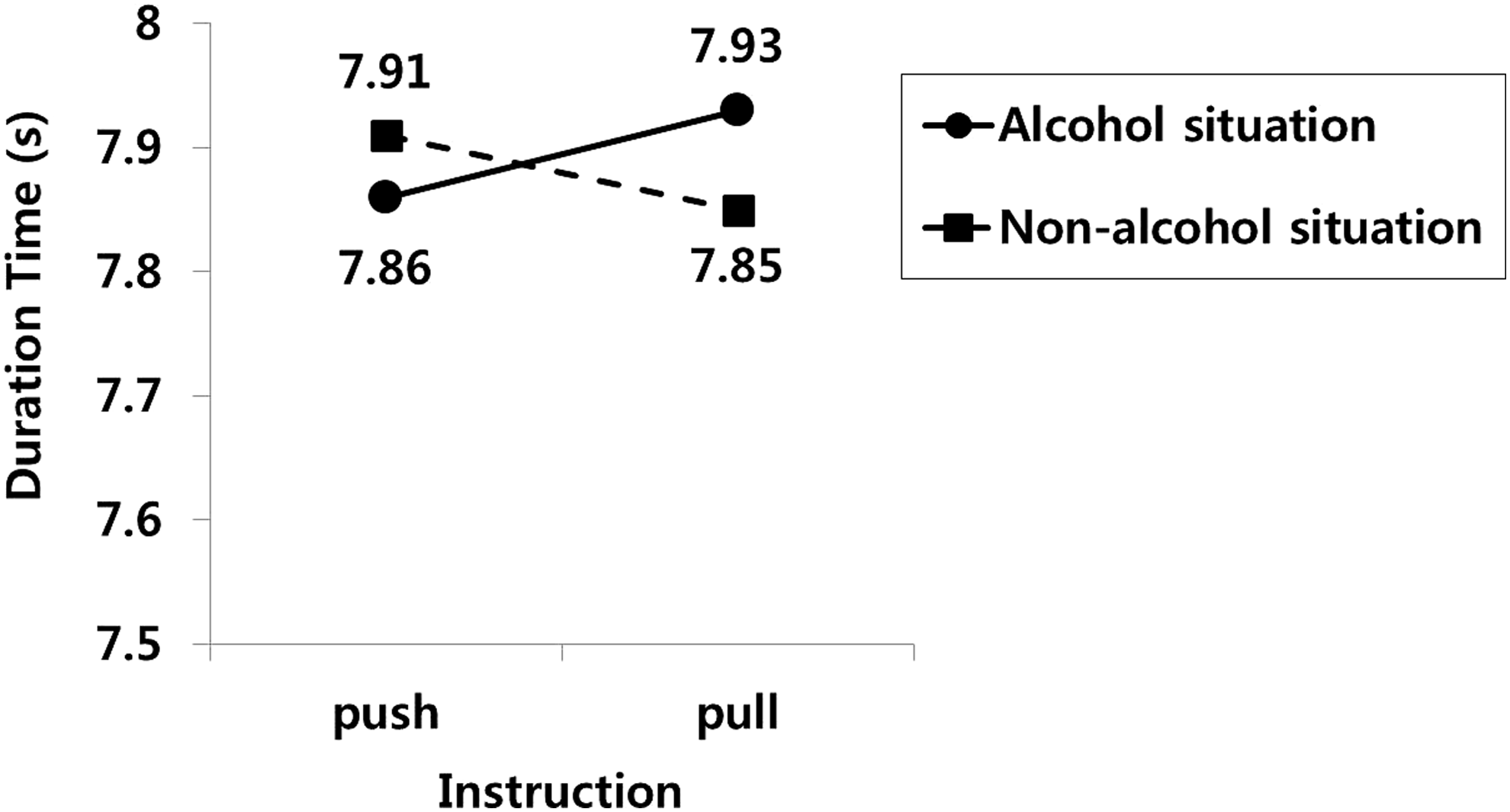
The difference in duration time for different instructions in the heavy social drinker group.
Discussion
The aim of the present study was to demonstrate the use of the VAAT, to assess levels of craving in HSDs and LSDs. The VAAT was expected to demonstrate a difference between the cravings experienced by the HSD and LSD groups using the characteristics of action tendency, such as approaching or avoiding an alcohol situation. In this study, it seemed that the virtual environment allowed participants to engage with the realistic stimulus or situation related to alcohol. In the previous study, the stimuli in the virtual environment increased the cravings for a cigarette. 17 The VAAT may be a more engaging or realistic tool in which the participants are more likely to perceive that they were physically moving toward an alcohol-related situation through a short video clip. Therefore, we expect that the VAAT would help assess the craving of a substance abuser.
Analyses revealed that the HSD group pulled for a longer duration when the alcohol-related situation was presented than when the nonalcohol-related situation was presented; however, there was no significant difference between the situations. This result indicated that it could have been difficult for the HSD group to avoid alcohol-related situations because the alcohol-related situation might have grabbed the attention of the HSD group. These findings are consistent with a previous study about attentional biases for alcohol cues in HSDs and LSDs. 24 In the previous study, HSDs showed attentional bias for alcohol pictures in the longer exposure duration condition, but not in the shorter exposure duration using visual probe tasks. These results revealed that the HSD group might have a tendency to maintain their position rather than approach in the alcohol-related situations (e.g., scenes of drinking alcohol or beer with friends). The HSDs or individuals with alcohol problem behaviors eventually might be prone to the maintenance or relapse of an alcohol problem.
In addition, the HSD group showed more severity in the BDI score than the LSD group. The severity of depression might influence the approach tendency of drinkers toward alcohol. 25 It was suggested that HSDs or those with drinking issues might use alcohol as a coping strategy to regulate their emotional state, as in the case of depression. 21 In the present study, we used the BDI score as a covariate to investigate the approach–avoidance tendency for social drinkers and the effects of depression.
The VAAT should also facilitate treatment using virtual environment therapy. In accordance with a previous study on an addiction treatment using the AAT using pictures, repeated learning of an alcohol or cigarette avoidance in HSDs or smokers showed that alcohol or cigarette consumption decreased.26,27 According to the cue-induced drug relapse models, a craving could be induced not only by substance cues but also by contextual and environmental stimuli that were repeatedly paired with effects of the substance. 28 The VAAT is available to modify action tendencies to both substance cues and contextual situations. An action tendency in the virtual environment also may give individuals situations that are more concrete. Therefore, we anticipate that the VAAT would be effective as a clinical treatment instrument.
Footnotes
Acknowledgment
This research was supported by the Basic Science Research Program through the National Research Foundation of Korea (NRF) funded by the Ministry of Education, Science and Technology (No. 2012-R1A1A2-008215).
Author Disclosure Statement
No competing financial interests exist.