




Abstract
Abstract
Previous studies have revealed that information and communication technologies (ICTs) play a crucial role in parenting. Utilizing a national sample of mothers, the current study addresses mothers' information-seeking behaviors using ICTs utilizing the sense-making theoretical approach. Specifically, the study explored mothers' gap-bridging activities via online information venues including blogs, discussion boards/chatrooms, e-mailed newsletters, and online courses. Further, the associations were examined between mothers' demographic characteristics and their patterns of gap-bridging activities using online information venues. Latent class analysis revealed five latent classes: limited gap bridging, active gap bridging, problem identifiers, perspective explorers, and reassurance seekers. The “limited gap bridging” latent class was the most common class across online information venues. The other latent classes illustrate a more complex picture of mothers' gap-bridging activities depending on their needs. Mothers' demographic characteristics were associated with their patterns of gap-bridging activities. Implications of these findings for future research are discussed.
Introduction
I
Sense-making approach
The sense-making approach created by Dervin 11 is a communications model that has been applied to information-seeking and information-use studies in a variety of settings, including health,12,13 arts and culture, 14 generational groups,15,16 and virtual information environments such as microblogging and discussion groups.13,17 The sense-making approach is firmly established as a theoretical framework for studies that are focused on understanding everyday life information seeking, including both purposive (goal-oriented) and non-purposive information-seeking behaviors. 18
A foundational proposition of the sense-making approach is that information seeking is a dynamic process situated in a unique space and time within a sociocultural context. 19 In contrast to theories that emphasize information seeking as a cognitive process, this approach recognizes that the complex interplay of events, thoughts, emotions, and cultural context produce “situations” that are built on one's past history and experience, present conditions, and horizon to the future. 20 When one experiences a situation that is not clear, it produces a “gap” resulting in confusion, riddles, and/or angst.19,21 In their day-to-day reality, parents often encounter gaps caused by children's development, health issues, or exposure to unexpected parenting information. Some parenting situations bring more gaps than others, especially if the situation is considered non-normative.
“Bridging” is the process used to move across the gap when making sense of a situation. For example, bridging might involve actions that can effect cognitive or affective shifts, or influence values and stories/narratives. 20 In the sense-making approach, “situation movement states” illustrate what kind of process is happening as part of gap bridging. 20 Examples of situation movement states include experiencing barriers (e.g., “my computer is too slow to search for parenting information”), waiting (e.g., “it takes too much time to get up-to-date parenting information”), problems (e.g., “the parenting information I found is poor or questionable”), and “spinning out,” which means not having an available bridge (e.g., “I can't find the sorts of parenting Web sites that contain the information I need”). 11 In everyday life, navigating different situation movement states results in a complex path that may produce more clarity at times and more confusion at others. Figure 1 illustrates the process of sense-making about parenting.
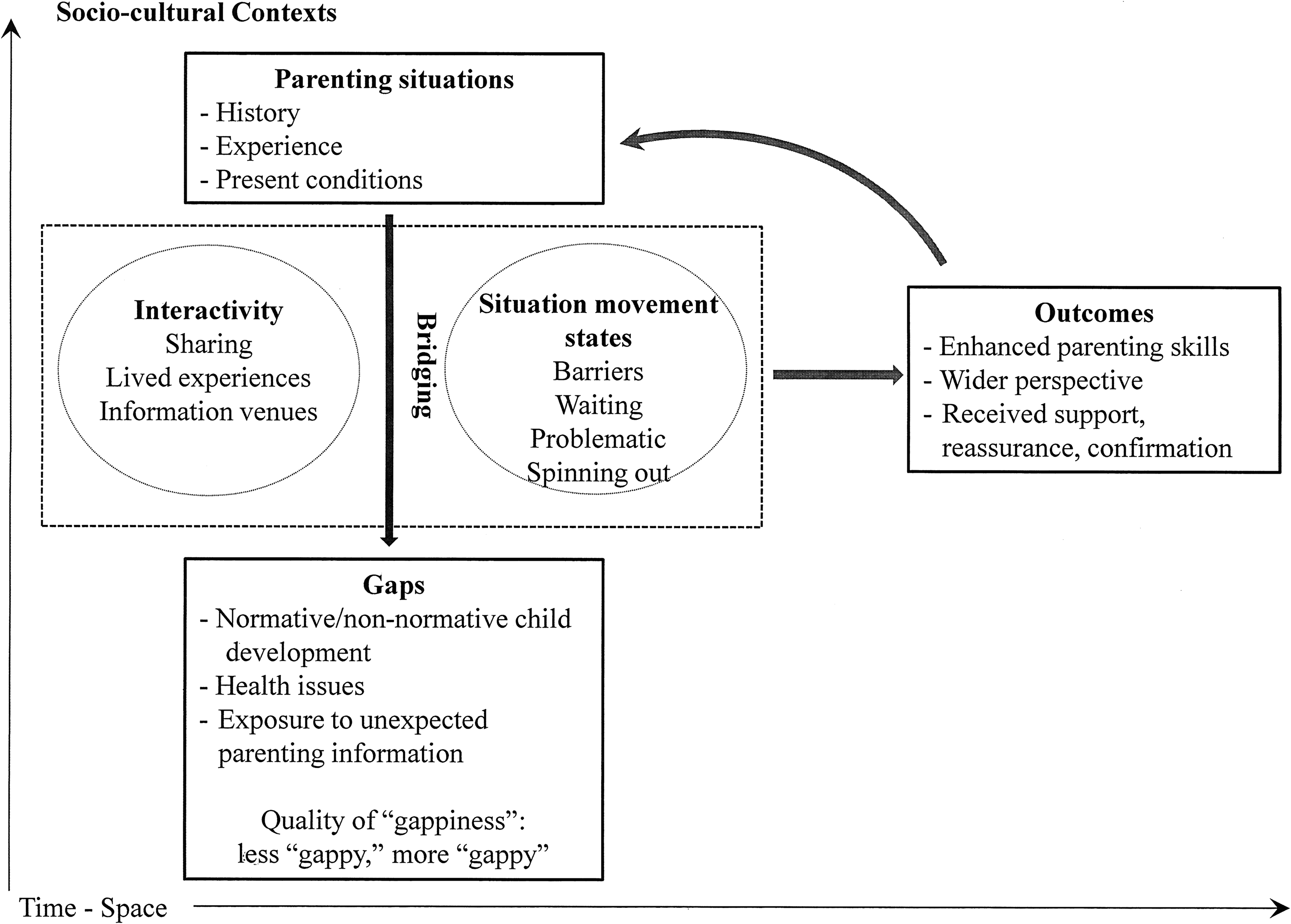
Process of sense-making about parenting. Note. Adopted from “From the dialogic to the contemplative: a conceptual and empirical rethinking of online communication outcomes as verbing micro-practices,” by DJ Schafer, B Dervin, Ethics and Information Technology 2009; 11, p. 268.
Parents' use of ICTs
Research has shown that parents are using online resources for both information seeking and social support. 6 These online resources may include social media, general Internet searches, discussion boards, e-mail, or online classes. Social support plays an important role in parental information-seeking behaviors, and as a result, the nature and level of online interactivity between parents are critical for determining parental gap-bridging online activities. 8
Parents go online to understand normative behavior, which has been demonstrated to be an information need.12,13,17,22 Information provided by traditional sources tends to be explanatory or didactic descriptions of parenthood, which may satisfy general inquiries, but may not satisfy all the dynamic information needs related to the challenges of raising children. 23 These needs often occur around the transition to parenthood, for example dealing with morning sickness, breast-feeding, and taking care of sick children. 23 To address this information gap, more experience-based and interactive online information sources, such as discussion forums, can help parents learn through dialogue and the personal experience of others. Using these online parenting resources allows parents to share others' lived experiences, thereby helping parents normalize their situation and bridge their information gaps. 8
Gap bridging
The concept of collective sense-making highlights a unique feature of online gap-bridging activities. Dervin argued that individuals make sense out of complex, constantly changing situations collectively by sharing information and opinions. 24 Sense is often constructed by integrating material from a variety of different sources and by evaluating the degree of consistency found between multiple sources. 12 Mothers rely on other parents as sources of high quality information on parenting topics.8,22 Parents also consider the extent of agreement between sources, which includes both professional and non-professional information venues.9,12,25 Collective conversations between numerous individuals online may result in collective, comprehensive sense-making. 17 As a result, varying levels of interactivity among ICTs (e.g., receiving e-mailed newsletters vs. engaging with discussion board posts) may be associated with different gap-bridging activities for parents. For example, for bridging gaps in a vague and complex situation such as identifying developmental problems, more interactive online information venues might be preferred by parents over less interactive online information venues. 17
Current study
The current study aims to address the above aspects of parental information-seeking behaviors utilizing the sense-making approach. Considering different levels and patterns of online information seeking between mothers and fathers7,9 and unbalanced sample sizes in the data, the study investigates mothers' gap-bridging activities. Specifically, the focus of this study is twofold:
Method
Participants and procedure
This study utilized a subsample of parents from the larger Parenting 2.0 study (
Subsamples of parents were selected for analyses. First, fathers were excluded to prevent bias from unbalanced sample sizes between mothers and fathers. Second, mothers who reported using specific online information venues (i.e., using blogs, discussion boards/chatrooms, reading e-mailed newsletters, or taking online classes) were selected for different analytic models. Because the expected frequency of using each online information venue varies due to the nature of each venue, different selection criteria were applied to each model: (a) using blogs monthly or more (n=662), (b) using discussion boards or chatrooms weekly or more (n=463), (c) reading e-mailed newsletters monthly or more (n=1,502), and (d) ever taking online classes (n=585). There were 194 mothers who used all four online information venues. Mothers regularly using blogs or discussion boards/chatrooms were similar in age (37.67 years and 37.80 years, respectively), and mothers regularly reading e-mailed newsletters or taking online classes were approximately 3–4 years older (42.06 years and 40.69 years, respectively). The mean age of the mothers' oldest child was approximately 9 years for the former group and 12 years for the latter. The majority of participants were white (>87% for each subsample) and had at least a college degree (>70% for each subsample). Mothers regularly taking online classes were more likely to live in rural areas (34.60%) compared to other mothers (range 23.30–28.39%).
Measures
To measure gap-bridging activities via online information venues, mothers who were users of blogs, discussion boards/chatrooms, e-mailed newsletters, or online classes were asked whether six gap-bridging activities helped them fulfill their role as a parent (yes/no): (a) seeking information, advice, or support about parenting and families (general information seeking hereafter); (b) identifying problems, warning signs, or diagnoses my child(ren) might have (identifying problems hereafter); (c) resolving conflicting parenting information or guidance (resolving conflicting information hereafter); (d) exploring different family or parenting perspectives (exploring perspectives hereafter); (e) confirming that what I'm already doing or what I believe as a parent is right (confirming parenting practices hereafter), and (f) checking to see if something my child is doing is normal (checking normal development hereafter). Mothers also provided extensive demographic information.
Statistical analysis
Latent class analysis (LCA) 26 was used to identify subgroups of mothers who were users of four online information venues based on their utilization of six gap-bridging activities. To determine the optimal model fit, G 2 , AIC, and BIC indices were compared among three- to six-latent class models. It was revealed that four-latent class models were optimal for the models of blogs and discussion boards/chatrooms, and five-latent class models were appropriate for the models of e-mailed newsletters and online classes.
Results
Descriptive information on gap-bridging activities for each online information venue is presented in Tables 1–4. Across information venues, general information seeking was the most popular gap-bridging activity, and resolving conflicting information was the least utilized.
Latent classes of gap-bridging via online information venues
Tables 1–4 present the item–response probabilities of gap-bridging activities for mothers in each of the four/five latent classes. These item–response probabilities express the profiles of gap-bridging activities via online information venues for mothers in each latent class.
Based on the profiles of gap-bridging activities identified in information venues, the following labels were assigned: the “limited gap bridging” class, the “active gap bridging” class, the “problem identifiers” class, the “perspective explorers” class, and the “reassurance seekers” class. Mothers in the “limited gap bridging class” were not likely to report any gap-bridging activities other than general information seeking; this is the most common latent class across all the information venues. Conversely, the “active gap bridging” class was comprised of mothers reporting all gap-bridging activities. The “problem identifiers” class was characterized by high probabilities of reporting general information seeking and identifying problems; in discussion boards/chatrooms, this class had a high probability of reporting checking normal development as well. The “perspective explorers” class was characterized by high probabilities of reporting general information seeking and exploring perspectives. In addition, the “perspective explorers” in discussion boards/chatrooms tended to report confirming parenting practices. Lastly, the “reassurance seekers” class was characterized by high probabilities of general information seeking and checking normal development. This latent class was found only in e-mailed newsletters and online classes. The “reassurance seekers” in online classes also had a high probability of reporting confirming parenting practices. The prevalence of the latent classes in each information venue is presented in Tables 1–4.
Situations predicting gap-bridging profiles
The following individual characteristics were added to the LCA models as independent predictors of gap-bridging profiles with regard to RQ2: mothers' age, education, and living in a rural area. The odds of belonging to the “limited gap bridging” latent class (reference class) over the remaining three/four latent classes were estimated, and the significant influences of the predictors varied. Older mothers were less likely to belong to any latent class other than “limited gap bridging” in the models of discussion boards/chatrooms, e-mailed newsletters, and online classes. In the blogs model, being older decreased the odds of mothers' membership in the “active gap bridging” latent class relative to the “limited gap bridging” class. More educated mothers were less likely to belong to the “problem identifiers” latent class relative to the “limited gap bridging” latent class in the discussion boards/chatrooms model and were less likely to belong to the “perspective explorers” latent class relative to the “limited gap bridging” latent class in the e-mailed newsletters model. Mothers living in rural areas were less likely to belong to the “perspective explorers” or “active gap bridging” latent classes relative to the “limited gap bridging” latent class in the discussion boards/chatrooms model.
Discussion
These data clearly reveal that there are different gap-bridging profiles of mothers. The most common class across online information venues was the “limited gap bridging” latent class (41–57% of mothers). Mothers in this class reported using only information seeking for gap bridging. In addition, mothers who were older, with more years of education, and living in rural areas were more likely to belong to this latent class than others. In contrast, mothers in the “active gap bridging” latent class (13–21%) reported participating in all gap-bridging activities. These two latent classes reveal that some mothers are quite active online and others are not. This is consistent with other studies that have found a few individuals account for the majority of activity on Web sites. 2
The remaining three latent classes, however, present a more complex picture of mothers' gap-bridging activities. These classes suggest that mothers actively utilize ICTs that they believe are appropriate to their needs, providing the support they need with normal child development issues, or more complex family health challenges.
The “problem identifiers” (10–25% of mothers) reported high information seeking and working to identify problems and warning signs, which could be best understood by collective sense-making. 17 The “problem identifiers” are most common in blogs and discussion boards, highly social and interactive online venues. These venues offer a variety of dynamic content that introduces mothers to new ideas. They can also help mothers identify warning signs they might not have otherwise known to look for, and provide an environment for back-and-forth discussion in which multiple people can participate in the sense-making process. This finding is consistent with previous research that has suggested that more interactive information venues might be preferred by parents when bridging gaps in vague and complex situations.17,27
The “perspective explorers” (12–18% of mothers) reported high information seeking and high exploration of different parenting perspectives. These mothers are active seekers of parenting information and resources, working to gather a variety of information, suggesting that they sense an information gap that needs to be bridged but may remain unidentified. These mothers may be dealing with a specific issue and are working to gather as much diverse information on the issue as possible. Because problems are often rare, or at least perceived that way, mothers need to actively seek out that information to find others like them. For instance, yours may be the only family in your community dealing with a particular health issue; going online gives you access to families across the country and across the world who may be small in number but are dealing with the same issue and can connect virtually in online spaces. Alternatively, mothers may simply desire diverse information to inform their parenting, without a specific concern. This group was consistently represented across information venues, suggesting a variety of online tools provide parents with the opportunity to explore different perspectives.
The “reassurance seekers” (7–16% of mothers) emerged only for e-mailed newsletters and online classes, the two least interactive online environments. These mothers are seeking reassurance in the form of confirmation of parenting practices and checking normative development. Perhaps mothers are less inclined to do those activities in more public virtual spaces. Consistency of information has been found to be a key factor in making sense of a situation, 12 whereas inconsistencies generate more information gaps. 27 It is possible that mothers want to confirm their parenting practices and check normative development using the most authoritative sources available—for example, newsletters from organizations they trust, online classes taught by professionals—rather than risk getting inconsistent or even inaccurate feedback from other parents online. These mothers might also be low need, doing well overall, and seeking minimal support from others. Therefore, reassurance from experts and professionals that there is nothing particularly alarming or of concern with their children's development would be enough to bridge their information gap.
While elucidating the complexities of mothers online information seeking, there are limitations to this study. First, most of the mothers in the current study were white, married, and had high socioeconomic status, which provides only a partial portrait of maternal ICT uses. Future research should utilize a more representative sample of mothers. Second, these mothers were regular users of online information venues. Investigation of mothers who are not frequent Internet users is essential to reveal potential barriers preventing them from ICT use for parenting. Further, the current study did not investigate the outcomes of gap-bridging activities (see Fig. 1). Future research is needed to examine the association between patterns of gap-bridging activities and parenting outcomes.
Conclusion
Utilizing Dervin's sense-making approach to understand mothers' online information seeking better represents a critical contribution to the literature (see Fig. 1). As the use and accessibility of ICTs continue to grow, it is essential to understand how ICTs are being used and for what purposes. The current study takes an important step in that direction by identifying the ways mothers use specific online tools to meet their information-seeking and gap-bridging needs.
Footnotes
Author Disclosure Statement
No competing financial interests exist.