




Abstract
Abstract
Nowadays, millions of people around the world use social networking sites to express everyday thoughts and feelings. Many researchers have tried to make use of social media to study users' online behaviors and psychological states. However, previous studies show mixed results about whether self-generated contents on Facebook reflect users' subjective well-being (SWB). This study analyzed Facebook status updates to determine the extent to which users' emotional expression predicted their SWB—specifically their self-reported satisfaction with life. It was found that positive emotional expressions on Facebook did not correlate with life satisfaction, whereas negative emotional expressions within the past 9–10 months (but not beyond) were significantly related to life satisfaction. These findings suggest that both the type of emotional expressions and the time frame of status updates determine whether emotional expressions in Facebook status updates can effectively reflect users' SWB. The findings shed light on the characteristics of online social media and improve the understanding of how user-generated contents reflect users' psychological states.
Introduction
F
Past research studying the relationship between Facebook status updates and SWB has found mixed results. Kramer 9 proposed an index of Gross National Happiness (GNH) by calculating the difference between the percentage of positive and negative emotion words in millions of status updates posted by users in a given country. GNH peaked on national and cultural holidays such as Christmas and Thanksgiving, and dipped on days of national tragedies such as the death of Michael Jackson. It also followed a weekly cycle with peaks on Friday and dips on Monday. This provided evidence of face validity and suggested that the positive and negative emotion word use in status updates was associated with SWB. However, Wang et al. 10 challenged the validity of Facebook GNH by comparing it with self-reported SWB judgment of Facebook users. They showed that GNH did not correlate with SWB scores aggregated by day and week, and had a negative correlation with SWB scores aggregated by month. Wang et al.'s study 10 suggested that Facebook GNH does not accurately reflect SWB. However, their sample size of 34 users on average every day is too small for a reliable comparison.
Therefore, the present study aimed to examine the relationship between emotional expressions in Facebook status updates and SWB further. Past research has shown that SWB fluctuates with everyday positive and negative experiences.11,12 High levels of SWB are characterized by high satisfaction with life, frequent experience of positive emotions, and infrequent experience of negative emotions. 13 In addition, Rutledge et al. 14 showed that emotional reactivity to recent events predicted SWB based on evidence from a computational model and functional fMRI. Suh et al. 15 asked participants to report positive and negative events they experienced over the past 4 years, and found that life satisfaction only correlated with events in the past 3 months. The above findings suggest that only recent events are related to SWB. Therefore, it was hypothesized that only recent emotional expressions in Facebook status updates would be associated with SWB.
Meanwhile, past research has shown that users often engaged in impression management when they use Facebook.16,17 Due to self-representational concerns, they selectively disclose more positive than negative emotions to present a positive self-image.16,18 This desire to make a positive impression on others may reduce individual differences in the expression of positive emotion on Facebook, weakening the association between the latter and self-reported SWB. In contrast, because there is relatively less social pressure to express negative emotion (vs. positive emotion), such expressions are more likely to reflect how a person actually feels. Therefore, it was predicted that the amount of negative (but not positive) emotional expressions in Facebook status updates would be related to self-reported SWB.
Many studies have used the Linguistic Inquiry and Word Count (LIWC) text analysis software 19 to examine emotional expressions in social media. LIWC counts words in predefined categories that have been developed based on psychological measurement scales and validated by independent judges. 20 It has been widely used and proven reliable to measure psychological attributes from writing samples, including emotion, personality, thinking styles, and social relationships.21–23 A recent study shows that LIWC coding of emotion in diary entries consistently correlated with self-reported emotional experiences. 24 Chee et al. 25 used LIWC to examine postings from illness groups in Yahoo! Groups and revealed changes in sentiment after FDA approval of certain drugs. Yu et al. 26 assessed overall sentiment in congressional speeches to classify political party affiliation. Golder and Macy 27 identified diurnal and seasonal mood patterns in cultures across the globe from millions of tweets. Qiu et al. 28 showed that extraverts expressed more positive emotions in tweets than introverts. These studies suggest that LIWC is a reliable tool for measuring emotional expressions, and therefore it was used in the present study to analyze Facebook status updates.
Method
Data were obtained from the myPersonality Facebook application, which has been used by more than six million users to voluntarily take a variety of psychological tests and receive feedback. 29 All users provided consent to the anonymous use of their Facebook data and test results for research purposes upon installation of the myPersonality application. They had the option to choose which Facebook data to disclose. Their data are only accessible to registered researchers of the myPersonality project. This research protocol has received IRB approval. 30
A total of 99,408 participants took the Satisfaction With Life Scale (SWLS). 31 The scale has five items, including “I am satisfied with my life” and “If I could live my life over, I would change almost nothing” with a 7-point Likert response scale (1=“strongly disagree” to 7=“strongly agree”). It is a well-established and widely used measure of an individual's own evaluation of life satisfaction and cognitive judgment of SWB.32,33 In the current study, SWLS scores were highly reliable (Cronbach's α=0.82; M=4.38, SD=1.37), consistent with past studies. 34
Among all the participants, only 3,324 provided access to their Facebook status updates. Their status updates posted in the year before they completed the SWLS were downloaded. Status updates were grouped into four 3 month periods. Period 1 consisted of the most recent updates (i.e., those posted within the 3 months prior to completing the SWLS). Period 4 consisted of the oldest updates (i.e., those posted in the 10–12 months prior to completing the SWLS). To keep the sample size consistent across the four periods, only 1,124 participants were included who had at least one status update in each of the four periods in the final analysis. In this sample, the SWLS exhibited high reliability (Cronbach's α=0.83) and had an average score of 4.32 (SD=1.40), comparable to that of the full sample. A total of 134,087 status updates were collected. The average number of words per status update was 13.8 (SD=6.1). Among the 195 users who reported their sex, 132 female were female. Among the 193 users who reported their age, the mean age was 26.2 years (interquartile range=6.5).
Results
First, the status updates of the sample (1,124 participants) were analyzed using LIWC. The mean frequency of positive and negative emotion words was 4.7% (SD=1.7%) and 2.5% (SD=1.2%), respectively. To examine the representativeness of the sample, the frequency of emotional expressions of a larger sample was analyzed: 150,383 myPersonality users who provided their status updates but did not provide their SWLS ratings. The mean frequency of positive and negative emotional words was 3.9% (SD=2.0%) and 1.8% (SD=1.1%), respectively. In both samples, positive emotional words were used about twice as often as negative emotional words.
Table 1 shows the descriptive characteristics and correlations among the variables in this study. Results showed no significant correlation between life satisfaction and positive emotional expression at any of the four periods (p>0.10). In contrast, life satisfaction correlated negatively with negative emotional expression in the three most recent periods (p<0.001), demonstrating that negative emotional experiences within the past 9 months were related to SWB.
p < 0.01; ***p < 0.001.
LS, life satisfaction; PE1, positive emotion in period 1 (the 1st to 3rd last months); PE2, positive emotion in period 2 (the 4th to 6th last months); PE3, positive emotion in period 3 (the 7th to 9th last months); PE4, positive emotion in period 4 (the 10th to 12th last months); NE1 to NE4, negative emotion in periods 1–4.
It is possible that the prediction of life satisfaction improves monotonically as status updates are aggregated over longer periods of time. For example, impression management notwithstanding, people who are truly happy may express positive emotion in their status updates more consistently across time. Therefore, status updates were combined into increasing periods of 1 month. Thus, the first period consisted of only the most recent month of updates, whereas the 12th period consisted of a full year of updates. LIWC emotion codings were obtained for each cumulative period. If aggregation improves the prediction of SWB, the correlation between life satisfaction and emotional expression should increase as updates are cumulated across more months. However, the results did not completely support this prediction (see Fig. 1). The correlation between positive emotion and life satisfaction did not improve as status updates were cumulated across time. Even when updates were cumulated across the full year, the correlation was not statistically significant (p>0.05). Thus, merely increasing the amount of status updates did not improve the prediction of life satisfaction from positive emotional expression. The correlation between negative emotion and life satisfaction increased gradually, but leveled out after aggregating 10 months of updates. This is consistent with the correlational analysis in Table 1 where the negative emotional experiences from the 10th to 12th last month (i.e., NE4) did not correlate with life satisfaction. Overall, the above results confirmed the hypotheses that only negative emotional expressions in status updates are associated with SWB, and only expressions within the most recent months (i.e., 9–10 months prior) are related to SWB.
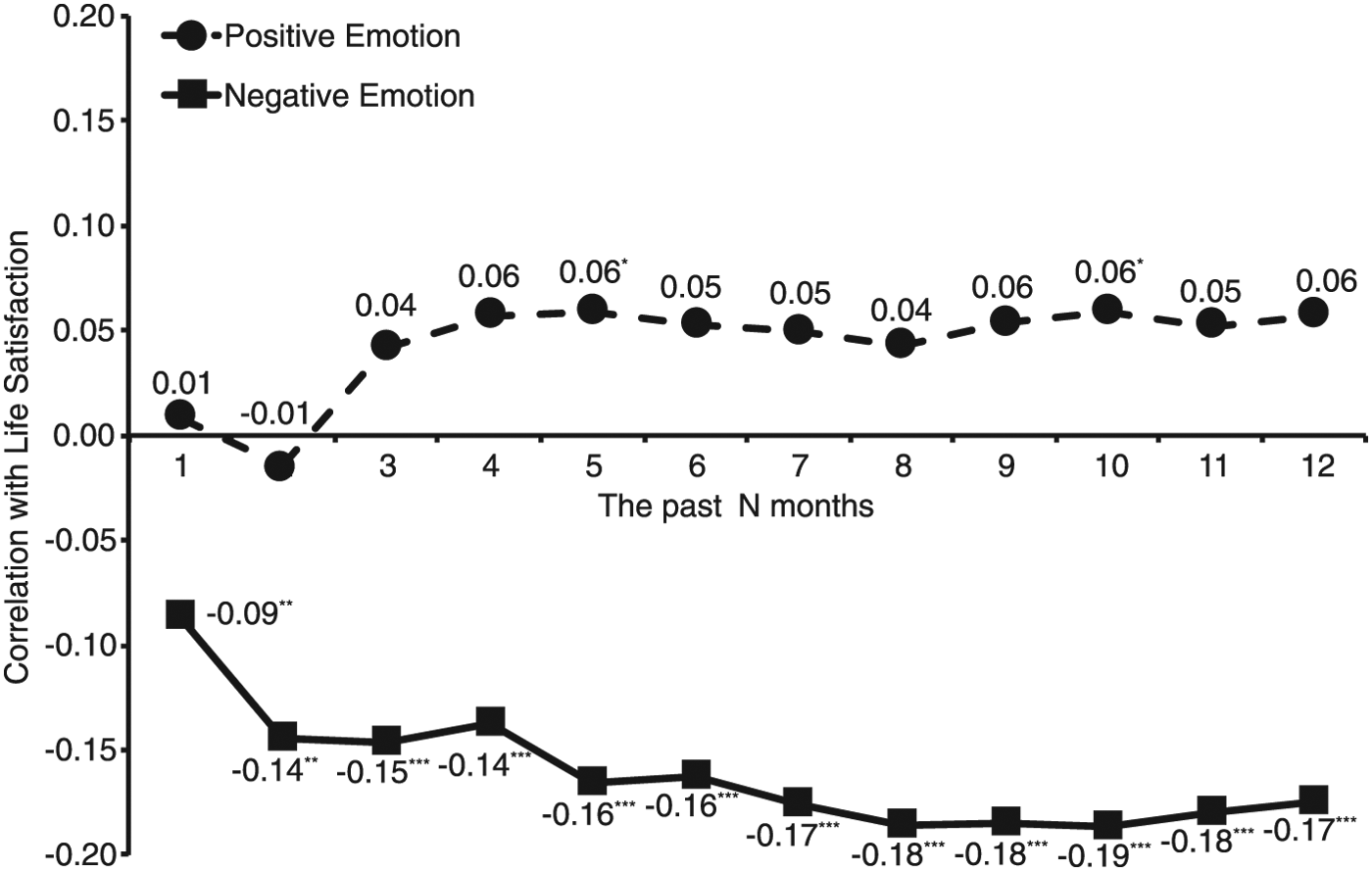
Correlation between life satisfaction and emotional expression in status updates cumulatively combined across 12 months. Numbers represent the magnitude of correlation between positive/negative emotion and life satisfaction; *p<0.05; **p<0.01; ***p<0.001.
To evaluate the relationship between emotional expressions and SWB further, a multiple mediation model was tested to examine both the direct effects and indirect effects of negative emotional expression at periods 1–4 on life satisfaction. A direct effect refers to whether expression at any given time period predicts life satisfaction, controlling for expression at other periods. However, it is also possible for expression at one period to have indirect effects on life satisfaction through subsequent time periods. For example, a car accident in period 4 might have trickle down effects on subsequent periods (e.g., increased financial burden due to repair costs and hospital fees), which ultimately affects life satisfaction. SPSS was used with the PROCESS macro, which employs a bias corrected bootstrapping method to provide confidence intervals (CI) around the indirect effects. 35 To evaluate the direct and indirect effects of each period, 5,000 bootstrap samples were specified and 95% CI were constructed. A 95% CI that does not include 0 indicates a significant (nonzero) indirect mediation effect.36,37
A path diagram of the multiple mediation model is shown in Figure 2. Note that these path estimates control for all possible indirect effects among the different periods (e.g., the path from period 4 to period 2 to life satisfaction). However, to simplify the presentation and discussion, the focus is only on the direct effect of each period, as well as the indirect effects through adjacent periods. The direct effect of each period is indicated by the arrows running directly from each period to life satisfaction. Significant direct effects were observed for periods 1–3, suggesting that negative emotional expressions at each period improves the prediction of life satisfaction above and beyond each other. There were also a number of indirect effects. For example, negative emotional expressions in period 2 predicted expressions in period 1, which in turn predicted lower life satisfaction. As shown in Table 2, each period prior to period 1 exerted significant indirect effects on life satisfaction. Although negative expressions in period 4 did not directly predict life satisfaction, they indirectly predicted lower life satisfaction through their effects on periods 3 through 1. This suggests that distant negative experiences may be related to life satisfaction through more recent negative experiences.
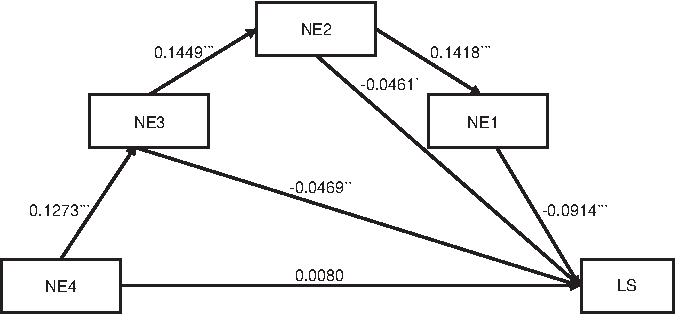
Path analysis for direct and indirect prediction of life satisfaction (LS) by negative emotion in each period. NE1 to NE4=negative emotion in periods 1–4. Numbers beside each arrow represent the path coefficients. *p<0.05; **p<0.01; ***p<0.001.
p<0.05; **p<0.01; ***p<0.001.
NE1, negative emotion in period 1 (the 1st to 3rd last months); NE2, negative emotion in period 2 (the 4th to 6th last months); NE3, negative emotion in period 3 (the 7th to 9th last months); NE4, negative emotion in period 4 (the 10th to 12th last months). Numbers above brackets represent the path coefficients. Numbers in brackets represent the 95% confidence intervals.
Discussion
Nowadays, millions of people use online media to express thoughts and feelings. Understanding how user-generated contents are related to psychological variables can improve the understanding of online behavior and allow better use to be made of online data. This study examined how emotional expressions in Facebook status updates are related to SWB—specifically, self-reported life satisfaction. The results show that positive emotional experiences reported on Facebook were not associated with life satisfaction. However, negative emotional experiences in the last 9–10 months were negatively related to life satisfaction. These findings have important theoretical and practical implications.
First, this study shows that Facebook status updates reveal users' SWB. This is consistent with past findings where users' behaviors on Facebook reflect a wide range of traits and attributes, including personality, ethnicity, gender, age, and sexual orientation.29,38–40 It suggests that Facebook data can be a valid source to explore psychological processes and phenomena. However, it is important to note that some previously established relationships may not hold in social media. For example, past research has shown that positive emotion is related to SWB. 6 However, in the present study, positive emotional expressions in Facebook status updates were not associated with life satisfaction. This is probably due to the use of impression management strategies to present a positive social image in social media. Users have been found to disclose more positive than negative emotions on Facebook selectively.16–18 In the present study, positive emotional words were used about twice as often as negative emotional words. This may reduce the predictive power of positive emotions on SWB. The findings suggest that the relationship between emotion and SWB can be context dependent, and past observations made in offline settings may not hold in online environments. This highlights the importance of considering social contexts in research on well-being. In addition, the results provide new longitudinal evidence to support the past finding that recent emotional experiences influence SWB. 15 Although negative experiences that occurred more than 9 months ago did not directly relate to life satisfaction, they contributed indirectly by predicting subsequent negative experiences. Thus, it suggests that distant events matter as well—even if only in an indirect sense.
Second, SWB is an important measure of life quality and has been found to affect health, income, and social relationships. 6 Understanding how contents in users' Facebook status updates reflect SWB provides researchers new opportunities for measuring SWB without self-report surveys. Past research has attempted to measure SWB based on social media but showed mixed results.9,10 The present study provides empirical evidence supporting that Facebook status updates can predict SWB, and found a similar effect size as Kramer's study 9 —although negative emotional expression appears to be more diagnostic than positive emotional expression. It also suggests that it is the time frame, not merely the amount of status updates, that determines the accuracy of the prediction. Only recent status updates matter in predicting current SWB. Including more distant status updates may not improve the accuracy of prediction—particularly in the case of positive emotional expression.
These findings provide important insights for optimizing tools to predict well-being accurately from social media. They open up the opportunity for health professionals to monitor users' psychological states naturally and provide appropriate interventions if needed. Tools can be developed to identify factors and events that influence SWB on a large scale, and provide policy makers with concrete evidence so that they can effectively formulate policies and create activities to improve the well-being of citizens. This study also illustrates an example of utilizing Big Data for psychological research. Future research can incorporate more factors in social media such as geographical information and network structure to understand better the interaction between psychological and environmental factors. It will also be important to determine if there are ways to disambiguate positive emotional expressions on status updates (e.g., by incorporating emoticons) to improve their correspondence with self-reported well-being. The effects of positive emotion are distinct from negative emotion. Positive emotions predict longevity and have important implications for social relationships. 8 Thus, there is value in improving the ability to detect positive emotional experiences accurately.
This study has several limitations. First, the results are based on active Facebook users who posted at least one status update in 3 months. Findings might be different for other users who do not frequently post on Facebook. It is possible that their status updates may not provide enough information to reflect SWB. It is also possible that infrequent users engage in less impression management, and therefore make both of their positive and negative emotional expressions predictive of their SWB. Future studies need to examine further the patterns of different users groups and identify possible variations.
Second, the study did not have detailed information about the characteristics of the participants, including sex and personality. Previous studies have shown sex differences in emotional expression, with women being more emotionally expressive than men. 41 In this study, only 195 participants reported their sex (132 female). No significant sex difference was found in positive or negative emotional expression, either for the total 12 months or any of the four 3 month periods (p>0.05). Past research has also shown close association between emotional experiences and personality traits, especially extraversion and neuroticism.42–44 Although these are important lines of research, the main objective of the present paper was to evaluate prediction and not establish causality. It could very well be that both the expression of negative emotions and low life satisfaction are reflections of a common personality trait such as neuroticism. Irrespective of whether this is the case, efforts to evaluate the quality of life via social media 9 are predicated on the assumption that emotional expressions on these platforms actually reflect how users feel. The observed correlation between negative emotional expression and self-reported life satisfaction is critically important from this standpoint. Moreover, the analyses suggest a critical window of 9–10 months, within which negative expressions correspond with users' well-being. Finally, research has shown that different online SNS have different user characteristics and usage patterns.45,46 Therefore, it is important to examine if the findings can generalize to other types of SNS and user groups.
Conclusion
The present study reveals the temporal relationship between emotional expressions in Facebook status updates and SWB. It showed that users' negative (but not positive) emotional expressions in Facebook status updates from the past 9–10 months were negatively related to their life satisfaction. These results suggest that both the valence and the time frame of emotional expressions determine whether Facebook status updates can accurately reflect users' subjective well-being. The findings shed light on the characteristics of online social media and improve the understanding of how user-generated contents reflect users' psychological states.
Footnotes
Acknowledgment
This research was supported by Singapore Ministry of Education Academic Research Fund Tier 1 Grant RGT37/13.
Author Disclosure Statement
No competing financial interests exist.