




Abstract
Abstract
This study investigated the roles of self- and social motivation in interacting with a brand on Facebook. An online survey was conducted using 11 familiar global brands randomly selected from Interbrand's 100 Best Global Brands. The result demonstrated that congruence between actual/ideal self and personality of a brand (i.e., self-motivation) positively influenced users' interaction with a brand on Facebook. In this relationship, self-expressive motivation and brand engagement emerged as moderators. Additionally, social identity as a social motivation positively affected users' interaction with a brand. Although not all components of social motivation influenced users' interaction with a brand, this study showed that two exclusive motivations, self and social, positively influenced users' interaction with a brand on Facebook. Managerial and practical implications were also proposed for marketing a brand on Facebook.
Introduction
O
Literature Review
This study follows a conceptual framework that is shown in Figure 1. Two dimensions of motivation are proposed: self- and social motivation. “Self-motivation” was defined as a user's personal, individual, and inner motivation to interact with brands on Facebook and is composed of self-congruence, self-expression, and brand engagement. On the other hand, “social motivation” referred to an external motivation affected by other Facebook users' opinions and values (i.e., social identity) and network externality that can facilitate and increase Facebook use. The following sections discuss components of self-motivation and social motivation, and their effects on interaction with a brand on Facebook.
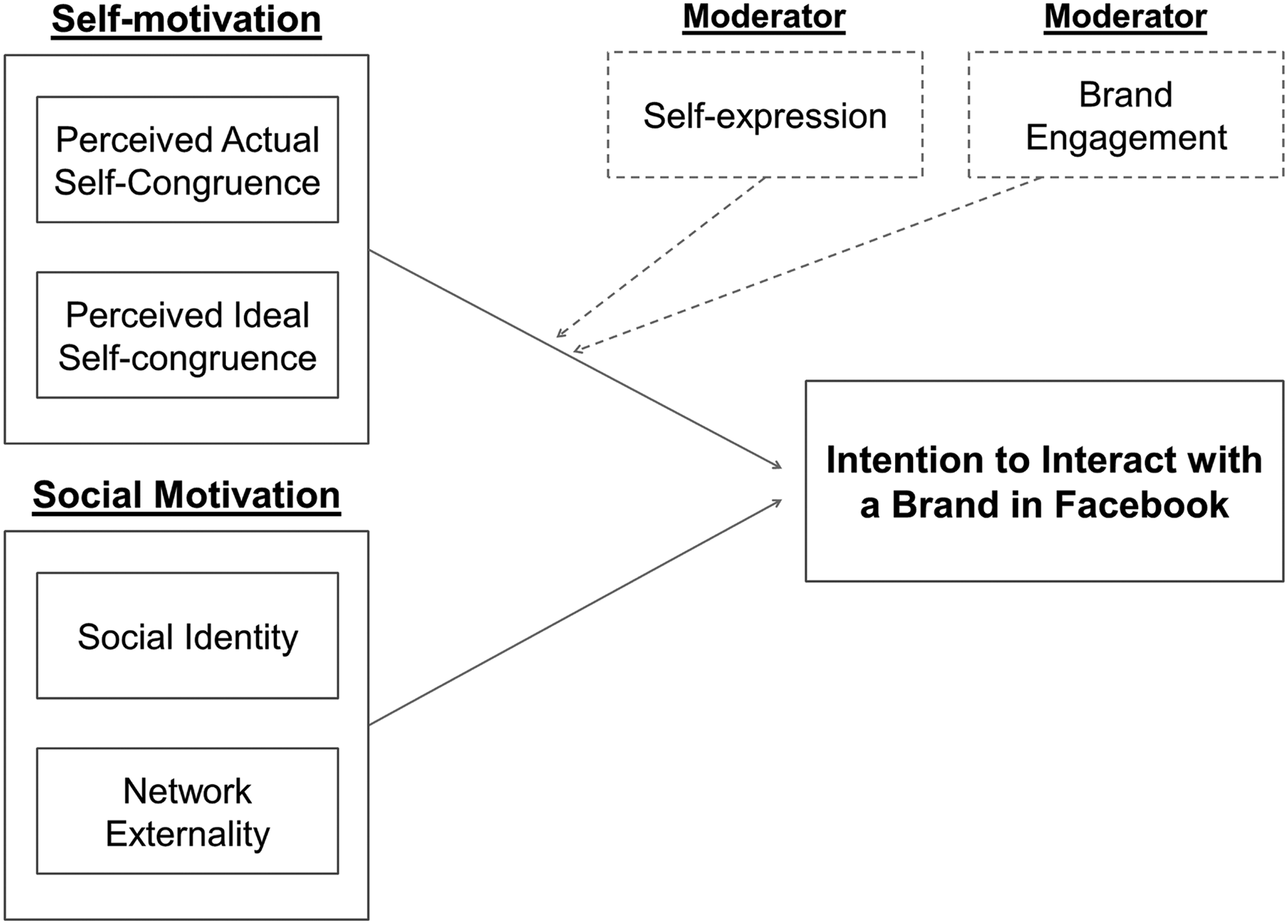
Conceptual framework.
Self-motivation to interact with a brand on Facebook
Self-congruence: expressing self-concept through a brand
“Self-congruence” is defined as the level of congruity between a person's self-concept and a brand's personality. 7 Self-concept is defined as the perception of “who” and “what I am” 8 or one's perceived personality and characteristics. Two dimensions exist within self-concept: actual and ideal self. The actual self focuses on associations and one's perceived characteristics at the present time, whereas the ideal self refers to the imaginary self that one aspires to be. Additionally, brand personality is defined as human-like characteristics that a brand has. 9 Aaker 8 suggested that consumers tend to own a brand whose personality is congruent with their self-concept. Kressmann et al. 10 also suggested that purchasing of and loyalty to a brand are substantially determined by self-congruence
Disclosing a brand that is liked on Facebook
Purchasing a brand is one way to express self-concept, 11 because it means owning and showing the brand to others, which signals the user's identity 12 ; Facebook users behave in a similar way. Facebook users have a personal profile that displays their personal information, such as educational background, residence, and tastes (e.g., movies or brands they like), that their friends (or other users, depending on privacy settings) can see. Information about brands that a user likes is gathered when they interact with a brand on Facebook (i.e., clicking “Like” or “Follow” buttons on brand accounts).
Self-expression through a brand
Swann et al. 13 explained self-congruence by employing self-expressive motivation (hereafter, self-expression) as positive emotional responses. They suggested that the personality or values people want to express through a brand are generally positive and favorable, such as pride and pleasure. Additionally, they can maintain their self-esteem by showing their positive characteristics through a brand. 14 Thus, self-expression positively influences the purchase of a brand that a user likes. Greenwald and Breckler 15 also supported this notion by suggesting that consumers want to purchase a brand, because it satisfies their self-expression.
Likewise, if a Facebook user does not want to disclose a brand that he or she likes due to low self-expression, they will not interact with the brand's Facebook page because it would result in disclosure and, therefore, expression of one's self-concept to others. Disclosure of a brand that a user likes on Facebook is equivalent to disclosure of personal values. Thus, those who have low self-expression would be less likely to interact with a brand on Facebook to prevent disclosing their personal values. Chu and Kim 16 supported this prediction, suggesting that self-expression is positively related to the motivation to share contents with friends on the Internet. Since content sharing provides others with information about a user's image and values, self-expression affects the intention to share content. Thus, self-expression accelerates interaction with a brand.
Brand engagement motivation
Brand engagement is defined as individual difference in engagement with brands, specifically “consumers' tendencies to include important brands as part of their self-concept.” 17 In other words, brand engagement is a general measure of the level of engagement and involvement with a brand that consumers consider important. Consumers with a higher brand engagement level are more likely to pay attention to brands that are exposed. 17 This means that they may be more likely to pay attention to brands exposed to their Facebook newsfeed compared with those with a lower brand engagement level. Thus, brand engagement may positively influence consumers' interaction with a brand on Facebook.
Social motivation to interact with a brand on Facebook
Brand as a reference for social identity
Social identity refers to a self-image developed based on social group membership, such as a family or a country. 18 Tajfel and Turner 19 suggested that social identity is in-group identity obtained by sharing similar attitudes and value systems. By identifying the norms of the group, they develop self-image and self-esteem. Berger and Heath 12 applied social identity to the consumption behavior of a brand and suggested that a brand can signal a certain social group.
For example, BMW, the German luxury car brand, is a symbol of a social group that is composed of rich urban people. Escalas and Bettman 20 suggested that if a person consumes the same brand that we own, we would consider that person as having our same values. A group of people owning the same brand is tied together by a social group, and owning a brand is one way of expressing and sharing their social identity.11,12
Thus, interaction with a brand on Facebook can be a way of expressing one's social identity. Facebook users get together under certain groups (e.g., Sony USA, a group of people who like Sony) and are tied together by common values and cultures through a brand. 21 In sum, users interact with a brand on Facebook to maintain their social identity.
Network externality on Facebook
Katz and Shapiro 22 defined network externality as the effects that create more benefits in a product or service as the number of users is becoming increasing. Network externality is composed of two dimensions: (1) perceived network size and (2) perceived complementarity. 23 Perceived network size refers to the direct effect of network externality, and it strengthens members' perception of connectedness and responsiveness. For example, the more users use Facebook as a way of communication with others, 24 the more benefit the users obtain from the Facebook service. The increased size of the network, that is, increased users of Facebook in this study, can facilitate other users' uses of Facebook and they can obtain more benefits, such as easiness to communicate with their friends. Perceived complementarity is another effect of network externality referring to how readily complementary products or services are achievable. For example, if a new application has many functions that enable users to achieve a particular goal, it can increase the number of users who use the application. Applied to Facebook, the degree to which complementary functions of Facebook are available will influence users' perceived control, playfulness, and connectedness to others, 25 which will increase benefit of the service and the number of users as a result. Thus, network externality will positively influence network members' perception of social interactions, as well as their behavior regarding use of network services. 26 In relation to Facebook, network externality will accelerate people's interaction with a brand, because they expect to connect more with other users and receive more social support and responses when network externality is high. 27
Methods
Data collection, sample, and procedure
A total of 223 undergraduate students who enrolled in mass communication courses at a Midwestern University in Minnesota in the United States participated in this study in exchange for extra credit using Qualtrics, an Internet survey service. Respondents were asked to answer the first set of questions regarding Facebook usage, self-expression, brand engagement, social identity, and perceived network externality. Then, respondents were asked to answer the second set of questions, which were composed of two parts: brand selection and a main question. In the brand selection portion, three brands were randomly assigned to participants from a pool of 11 famous global brands that were randomly selected from the top 100 “Best Global Brands 2013” in five product categories published by Interbrand (2014). At this stage, participants were asked to answer how familiar they were with the three selected brands, because a low level of familiarity with a brand meant respondents had little information regarding the brand's personality and, thus, self-congruence cannot be validated based on the definition of self-congruence. As long as participants reported a brand familiarity scale 28 score above the midpoint for each brand, they were allowed to proceed to the main question portion. If a brand familiarity score was below the midpoint, another brand from the pool was shown to respondents, and they were asked again about brand familiarity. In the main question portion, participants answered questions about self-congruence and intention to interact with a brand for the three selected brands.
Measures
To measure self-expression (M = 3.52, SD = 0.68), 18 items on the seven-point Likert scale were employed (e.g., “When I express my personal feelings on Facebook, I am always aware of what I am doing and saying”). 15 To measure brand engagement (M = 3.23, SD = 1.06), nine items from the seven-point Likert scale were used (e.g., “My favorite brands are an important indication of who I am”). 17 To measure social identity (M = 4.14, SD = 0.93), nine items adopted from Dholakia et al. 29 were used and measured with the seven-point Likert scale, which ranged from “very unlikely” to “very likely” (e.g., “I feel a strong feeling of belonging to the community”). Items about network externality (M = 5.71, SD = 0.92) were also adopted from Dholakia et al. 29 and adjusted; six items were employed to measure perceived network size (e.g., “I think most of my friends are using Facebook”), and four were used to measure perceived complementarity by using the seven-point Likert scale, which ranged from “strongly disagree” to “strongly agree.” To measure brand familiarity, three items were used. 30 To measure self-congruence, respondents were first asked to think about human personality associated with a brand. Then, they were asked to think about themselves (actual and ideal self-congruence). Finally, they marked their global perception of how well the two personalities corresponded to each other. Three items were used to measure actual (M = 2.83, SD = 0.83) and ideal self-congruence (M = 2.97, SD = 0.92) by using the seven-point Likert scale, which ranged from “strongly disagree” to “strongly agree” (e.g., “The personality of Brand X is consistent with how I see myself [how I would like to be.])” 9
Dependent measure
The dependent variable in this study was interaction with a brand (a brand page) (M = 2.73, SD = 1.09), which was measured by using intention to interact with a brand on Facebook. Three items were employed by using a seven-point Likert scale, which ranged from “strongly disagree” to “strongly agree,” including “I want to push the ‘Like’ button for the posts/messages from Brand X on Facebook,” “I want to share the posts/messages with my friends from Brand X on Facebook,” and “I want to comment on the posts/messages from Brand X on Facebook.”
Results
The current study used inter-construct correlation analysis to investigate the relationship among variables of interest. No correlations exceeded 0.7, except for that between perceived actual and perceived ideal self-congruence.
Measurement modeling
For the measurement model, confirmatory factor analyses (CFA) revealed a 27-item reduced model for self- and social motivation on interaction with a brand on Facebook along with seven factors: actual self-congruence (3 items, α = 0.86), ideal self-congruence (3 items, α = 0.93), self-expression (5 items, α = 0.85), brand engagement (5 items, α = 0.92), social identity (4 items, α = 0.89), network externality (4 items, α = 0.88), and intention to interact with a brand (3 items, α = 0.82). A Goodness-of-Fit Index (GFI) statistic >0.90 indicated a moderated fit (GFI = 0.928), the root mean square error of approximation (RMSEA) was 0.051, and the model had a satisfactory Comparative Fit Index (CFI = 0.976).
CFA testing reliability showed that all composite reliability values were >0.7. Internal consistency was strong for all factors. Convergent validity testing of CFAs showed that the variables did not correlate well with each other within their latent factor, indicating that the latent factor was well explained by its observed variables (average variance extracted, >0.5). Lastly, discriminant validity testing showed that the variables correlated more with those inside their latent factor than with those outside it, indicating that latent factors were better explained by their own observed variables than by others; the average variance extracted was greater than the maximum shared variance for all factors.
Causal model analysis
Self-motivation
Individual path coefficients were examined based on the causal relationships in this model (Fig. 2). To evaluate the estimated causal relationships, the actual size of each parameter was assessed using standardized beta coefficients. Two out of the four motivations (actual and ideal self-congruence) showed significant direct effects on intention to follow brand sites. Network externality showed a meaningful relationship with this intention, which was marginally significant (p < 0.1). The only exception was social identity. The results suggest that the intention to follow brand sites was mainly affected by self-motivation to be congruent with their favorite brands. On the other hand, the model revealed that social motivation had nonsignificant, direct effects on intention. The first set of hypotheses (H1-1 and −2) stated that the two self-motivations (actual and ideal self-congruence) would have direct, positive effects on intention. Actual self-congruence motivation had a positive effect on intention (β = 0.329, p = 0.001), which suggests that those who are highly motivated to be congruent with their actual self tend to follow their favorite brand sites; therefore, H1-1 was supported. Furthermore, ideal self-congruence motivation also had a positive effect on intention (β = 0.26, p = 0.011), supporting H1-2.
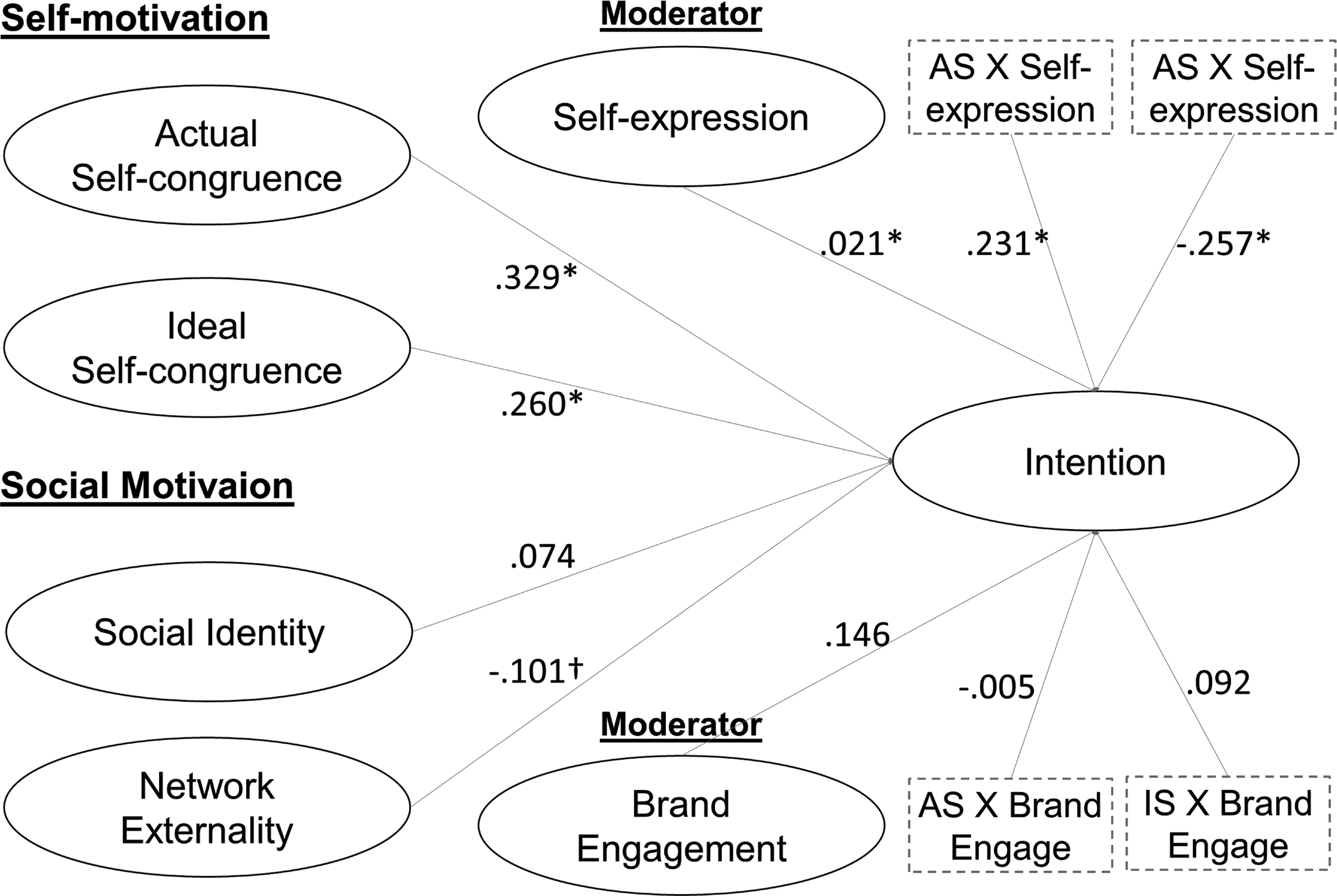
Causal model.
Moderating effects
The second set of hypotheses (H2-1 and −2) stated that self-expression and self-expressive motivation would moderate actual and ideal self-congruence on interaction with a brand on Facebook. The third set of hypotheses (H3-1 and −2) stated that brand engagement will moderate the interaction effects of actual and ideal self-congruence on interaction with a brand on Facebook. To test moderating effects, structural equation modeling with an interaction term was performed. The independent and moderator variables were entered into the structural equation model; then, the interaction terms were added. Regarding H3-1 and H3-2, there was no direct effect of self-expression on intention to follow brand sites. However, the interaction between actual and ideal self-congruence and self-expression produced a meaningful effect on intention to interact with a brand (for actual self-congruence: β = 0.231, p = 0.016; ideal self-congruence: β = −0.257, p = 0.008), as shown in Figures 3 and 4. Thus, H2-1 and H2-2 were accepted.

Interaction (actual self-congruence and self-expression).

Interaction (ideal self-congruence and self-expression).
Self-expression strengthens the positive relationship between actual self-congruence and interaction with a brand. The higher the actual self-congruence, the stronger the effect of self-expression on interaction with a brand. On the contrary, self-expression dampens the positive relationship between ideal self-congruence and interaction with a brand, meaning higher levels of self-expression equate to a smaller effect of ideal self-congruence on interaction with a brand on Facebook. Regarding H3-1 and H3-2, our model showed the direct effect of brand engagement on intention to follow brand sites. There was no interaction effect between brand engagement and actual and ideal self-congruence on interaction with a brand; thus, H3-1 and H3-2 were not accepted.
To examine moderator effects, this study created a new variable that was the cross-product between the predictor and the moderator and then included this interaction term directly into the path model. We compared a baseline model, including five variables (actual congruence, ideal congruence, social identity, network externality, and intention), with moderated models, adding two moderators (self-expression and brand engagement) in terms of model fit. The moderated model showed better fits compared with the baseline model; GFI was increased from 0.64 to 0.93, and the RMSEA decreased from 0.41 to 0.05.
Social motivations
The final set of hypotheses stated that two components of social motivation, social identity (H4) and network externality (H5), would positively affect interaction with a brand. It is interesting to note that network externality as a social motivation had a negative effect on intention to follow (β = −0.101, p = 0.08). Thus, H4 was marginally supported, whereas H5 was rejected.
Discussion
The purpose of the current study was to investigate the effects of self- and social motivation on users' interaction with a brand on Facebook. For self-motivation, the present study demonstrated that actual and ideal self-congruence with a brand was positively related to users' interaction with a brand. More importantly, self-expression emerged as a moderator of that relationship. Regarding social motivation, the present study showed that social identity, but not network externality, was positively related to users' intention to interact with a brand, which is consistent with results of prior research on the effects of self-congruence on purchasing behavior in the marketplace. Prior research suggests that a brand is purchased, because self-concept is congruent with the personality of a brand.10,31 Thus, present findings indicate that results of previous studies can be extended to social media. In other words, as with owning a brand, 32 consumers represent their personality by interacting with a brand on Facebook.
This study also demonstrated the moderating role of self-expressive motivation on interaction with a brand on Facebook. This finding is consistent with results of prior research on self-congruence and self-expression. As Sirgy et al. 7 suggested, the effects of self-congruence on consumers' purchasing behavior tend to be activated by consumers' self-expressive motivation. Furthermore, this finding can be explained by Malär et al., 30 who examined the effects of self-concept and self-congruence on consumers' emotional bond to a brand (i.e., brand attachment). They suggested that greater actual and ideal self-congruence with the personality of a brand increases consumers' emotional attachment to a brand. Likewise, on Facebook, a profile page where users' favorite brands are shown is where they express their personality and how emotionally they are attached to a brand.
Additionally, previous studies have suggested that self-expression is one of the most important motivations to use social media.33,34 The significance of this study is that the moderating role of self-expression is demonstrated by interaction with a brand on Facebook. These findings suggest that self-brand congruence is an important factor that positively affects users' interaction with a brand on Facebook. Thus, this study contributes to research on self-brand congruence in consumer behavior and extends it to the social media research domain. Lastly, our most interesting finding was the moderating role of brand engagement. This study suggests that brand engagement is a critical factor connecting self-congruence to interaction with a brand. Given that prior research has focused on consumer's engagement with individual brands as an outcome variable, this study contributes to the small body of research that shows the role of general brand engagement as an individual difference. 17 In other worlds, this study extends the literature on brand engagement to a social media context, and it emphasizes the importance of a brand in the consumer's interaction with a brand in social media.
The findings in this study have several practical implications. This study suggests that marketing communications on Facebook should focus on brand image and personality to enhance the consumer's interaction with brands, because those communications increase the possibility that consumers recognize congruence between their self-image and brand personality. Moreover, recent research suggests that consumers who interact with a brand on Facebook are more likely to make for higher-paying consumers. 35 Thus, marketing mangers could focus on self-congruence in their marketing communications (e.g., “This brand is for you”) to make more sales and profits.
The findings of this study could also apply to marketing communications in social media for symbolic brands such as luxury brands. Consumers tend to purchase symbolic brands (symbol-intensive brands) based on personality of the brands, and they often show those brands on Facebook as a way of expressing their self-image. Thus, social media campaigns focusing on brand personality could be more effective for those brands rather than focusing on product quality or superior attributes of the brand.
Limitations and future study
Some product categories, such as luxury, are more likely to lead to congruence between self-concept and a brand compared with other generic categories. Consumers are more likely to value expressive attitude toward luxury products (symbolic brands), but have a functional attitude toward ordinary products, where value for money is more important than other symbolic values. 36 Future studies should control these effects by differentiating luxury brands from others.
Footnotes
Author Disclosure Statement
No competing financial interests exist.