




Abstract
Abstract
Social networking sites offer individuals an opportunity to document and share information about themselves, as well as engaging in social browsing to learn about others. As a micro-blogging site within which users often share information publicly, Twitter may be a particularly suitable venue that can help satisfy both of these motivations. This study investigates how viewers react to disclosure of intimate information on Twitter. Specifically, the impact of disclosure intimacy is studied on attention that viewers pay to a Twitter page, reduction in their uncertainty about the attributes of the page owner, and their interpersonal attraction to the owner of the page. A total of 618 adult online panel members viewed one of six Twitter pages that contained either low-intimacy or high-intimacy tweets. Analyses indicated that viewers exposed to the Twitter pages containing high-intimate information paid more attention to the pages, were more confident about the attributions they could make about the page owner, yet were less willing to pursue further socialization with the page owner. Furthermore, attributional confidence mediated and perceived similarity moderated the relationship between disclosure intimacy and interpersonal attraction. This interaction between disclosure intimacy and perceived similarity was such that viewers who considered the page owner to be similar (dissimilar) to themselves were more (less) socially attracted to page owners who disclosed intimate information. These findings suggest that while intimate information shared on a Twitter page draws attention, this does not necessarily result in further socialization with the page owner—an effect we named as the “rubbernecking effect” of intimate information.
Introduction
S
Self-disclosure and SNSs
Self-disclosure is defined as the act of sharing personal information about oneself with others. 10 The degree of self-disclosure is typically measured by breadth (quantity) and depth (level of intimacy ranging from peripheral to core) of information. 6 Perspectives on dyadic relationships offer different mechanisms regarding the role that self-disclosure may play in relationship development and maintenance. On the one hand, perspectives like Uncertainty Reduction Theory predict that dyads will be motivated to engage in a symmetrical disclosure to each other to reduce uncertainty11,12; and, in turn, reduced uncertainty will lead to favorable judgments about each other. 13
On the other hand, research also suggests that self-disclosure may be counterproductive to the development of positive judgments about the discloser; such as when the recipient deems disclosure to be inappropriate due to its timing/context (e.g., public vs. private domain). 6 Furthermore, studies propose that some level of uncertainty may indeed add excitement to a relationship. 14 Relatedly, information-processing models of attraction suggest that disclosure leads to favorable relational outcomes only when the shared information is evaluated by the receiver to be indicative of similarity. 11 Otherwise, once the receiver encounters evidence of dissimilarity, it is likely that subsequent information will be interpreted accordingly, reducing the chances that the relationship will progress. 15
The extent to which the aforementioned assumptions can be applied to SNSs has recently been questioned by studies that underline key differences between SNSs and face-to-face dyadic interactions. Social penetration theory, for example, suggests that disclosure in face-to-face interactions is supposed to grow gradually. 16 While information with low-intimacy (e.g., demographics) is shared during the initial stages of an interaction, as the relationship progresses, an increase in disclosure of intimate information should be expected. 11 Yet, within the context of SNSs, development of relationships may follow a different trajectory. Though users customarily use SNSs to maintain offline relationships, research indicates that learning about others and becoming acquainted with strangers is also an important motive underlying SNS use.3,8 Consequently, contrary to face-to-face relationships, on SNSs, there may often be situations when intimate details a user shares will be among the first information a stranger comes across.
Possibility of self-disclosure on SNS platforms naturally brings a discussion of privacy management strategies. SNSs vary greatly in terms of the extent to which users are allowed to and typically engage in privacy management strategies. 17 For example, Facebook allows users to determine the groups with which disclosure will be shared (e.g., with a subset or all members of one's network or publicly). On the other hand, despite the availability of protected accounts as an option, Twitter users typically keep their tweets public.
Such differences in the availability and use of privacy management options in SNSs may also have important implications for recipients' evaluations about appropriateness of disclosure of intimate information. Indeed, Bazarova has recently shown that college students considered intimate disclosures that are done publicly on Facebook (i.e., as a wall post) to be less appropriate than intimate disclosures made privately. 1 Likewise, Utz observed that on Facebook, the impact of disclosure intimacy on feelings of connectedness was strongest for messages that were shared privately. 8
Conversely, Twitter's built-in retweet function and use of hashtags to disseminate tweets make it much more likely for tweets to be publicly available. 5 A recent report shows that while 60% of teens in the United States use a private Facebook account, only 24% report that their Tweets are private. 18 Other research has shown that on Twitter, level of intimacy of self-disclosure did not differ between public and private accounts. 5 Hence, it might be plausible to expect that viewers will be less concerned about the appropriateness of intimate disclosure on a micro-blogging platform such as Twitter.
Research on “mediated voyeurism” has underlined that users may be oriented toward opportunistically enjoying glimpses of private lives revealed through media, including, but not limited to, SNSs.19,20 Earlier work on reality television, for example, indicates that for a considerable proportion of audiences, the appeal of this genre stems from the ability to peek safely into the private lives of others.19,21 Likewise, the nondirected nature (i.e., addressing a general audience rather than a specific person) of online forms of communications (e.g., anonymous chats, blogs, discussion forums, webcams, and diaries) help bring together users who engage in public intimacies with users who enjoy social gazing.20,22,23 In a similar vein, SNS platforms such as Twitter may provide opportunities for “exhibitionists” and “voyeurs” to satisfy their respective needs mutually. According to a recent study, for example, “learning about others” and “sharing about themselves” are two equally common motivations of Twitter use among college students. 24
The structure of Twitter allows various levels of engagement between users. On the one hand, a public Twitter account may act as a window through which users can initiate longer-term relationships (e.g., following each others' account). Conversely, it is also possible for users just to browse public Twitter accounts and satisfy their social curiosity without having to engage in further interactions with the account owner(s). This behavior is akin to what has been named as “rubbernecking” in popular culture. While predominantly used to refer to car drivers slowing down to view the aftermath of an accident, the term “rubbernecking” was originally coined in the late 1890s to describe tourists in urban settings, who, lacking the time (and often money) to experience the city deeply, would use “rubbernecker wagons” for getting an authentic feel of a city, including its famous sites—mansions. 25 Later references to the concept in studies of popular culture have characterized rubbernecking as a human trait associated with morbid curiosity, particularly getting satisfaction from accessing what individuals would not typically witness in their lives. 26
These two possibilities underline three potential effects of disclosure of intimate information on Twitter. First, intimate information on a profile can attract more attention for viewers who utilize Twitter for social gazing. Second, intimate information can help reduce uncertainty about the profile owner. Third, depending on the viewers' evaluation/judgment, intimate information can be either conducive or detrimental to further interactions. Hence, the following research question is proposed:
Additionally, the following hypotheses are derived from discussions hereinabove:
Materials and Methods
Participants
The sample comprised 618 adult online panel members (provided by Qualtrics Panel from ClearVoice Research) out of 1,052 who received the invitation for the survey. ClearVoice Research has close to one million panelists from 120 countries. 27 Participation is voluntary, in exchange for cash or gift cards. Panel members are recruited and regularly verified via SMS or phone. The sample for the current study was drawn from panel members residing in the United States. The mean age of the respondents was 48.5 years (SD = 16.02 years), half were male (50.1%), and the majority had at least some college education (72.8%). Only 85 (13%) mentioned they have never used any form of social media (e.g., Facebook, Twitter, etc.).
Procedure
Six Twitter pages were created (three low intimacy and three high intimacy) to be used as the manipulation stimuli in this study. To create these pages, first a list of 1,098 tweets was compiled from 112 Twitter pages (all in English). Then, two coders independently rated the tweets in terms of their intimacy (i.e., depth; 1 = “peripheral”; 2 = “intermediate”; 3 = “core”). The coders agreed on the intimacy level of 587 Tweets. The remaining Tweets were removed from the library. Twitter pages in the low-intimacy condition were created by randomly selecting 10 tweets that were rated as peripheral by the coders. Twitter pages in the high-intimacy condition were created by randomly selecting 10 tweets that were rated as intermediate or core by the coders. In creating the pages, it was ensured that the lengths of the tweets were comparable across conditions. Each Twitter page was given a gender-neutral user name (s_n_o_w) and avatar (see Fig. 1A and B). Page owners were evenly judged to be male (50.2%) and female (49.8%) by the participants, confirming the gender neutrality of the profiles.

(

Each respondent was randomly assigned to review only one of the six pages (each page was shown to approximately 100 respondents). In the first screen, participants received an instruction indicating that they would review a typical Twitter page. Next, the Twitter page was shown in full scale as an image (no hyperlinks were provided for further interaction). Once they reviewed the page, respondents then moved on to the next screen, which contained the study questionnaire.
Measures
Attention
Time spent viewing the Twitter page was measured as an indicator of attention paid to the profile. The Qualtrics survey system coded how much time a viewer spent on the page in seconds (M = 53.76 seconds, SD = 41.5 seconds). Thirteen outliers (who spent between 300 and 11,324 seconds) were removed from the analysis.
Attributional confidence
A 5-item scale adapted from the (Proactive) Attributional Confidence Scale (CL7) 28 was used to assess reduction in participants' uncertainty about the attributes of the page owner (e.g., “I can predict well what kind of a personality this person has”; response categories ranged from 1 = “completely disagree” to 5 = “completely agree”). The items formed a one-dimensional scale (explained variance 80%), with a Cronbach's alpha of 0.93 (M = 3.09, SD = 0.98)
Interpersonal attraction
A 6-item scale adapted from the Interpersonal Attraction Questionnaire 29 was used to assess participants' level of social attraction to the target page owner (e.g., “I would like to meet this person” and “I would probably like talking to this person at a party”; response categories ranged from 1 = “completely disagree” to 5 = “completely agree”). The items formed a one-dimensional scale (explained variance 86%), with a Cronbach's alpha of 0.96 (M = 2.46, SD = 1.01).
Perceived similarity
To measure similarity, three items from the Perceived Homophily Measure 30 were used: “this person thinks like me”, “this person behaves like me”, and “this person is similar to me” (response categories ranged from 1 = “completely disagree” to 5 = “completely agree”). The items formed a one-dimensional scale (explained variance 95%), with a Cronbach's alpha of 0.97 (M = 2.04, SD = .09).
The correlations between the dependent variables were as follows: attributional confidence moderately correlated with interpersonal attraction (r = 0.29, p < 0.000) and perceived similarity (r = 0.28, p < 0.000). Interpersonal attraction and similarity were correlated strongly (r = 0.84, p < 0.000).
Results
Versions and manipulation check
As a manipulation check, participants were asked to indicate the percentage of tweets they deemed contained highly “intimate information” on the Twitter page they viewed. Analyses of variance (ANOVAs) suggested a significant difference, F(5, 610) = 21.972; p < 0.001, η2 = 0.15, with post hoc analysis confirming that the three high-intimacy pages (mean percentage of intimate information = 58.83%, SD = 24.06) were rated as containing more intimate items than the three low-intimacy pages (mean percentage of intimate information = 37.18%, SD = 27.65). Since there were no within-group differences among three versions of each experimental group, the versions were combined for subsequent analyses (resulting in 306 participants viewing low-intimacy pages and 312 participants viewing high-intimacy pages).
Since the Twitter pages were designed to be gender neutral, and initial analyses indicated that neither perceived gender of the page owner nor the viewer gender had an impact on page evaluations, the remainder of the results section does not report gender effects.
Table 1 summarizes ANOVAs comparing the effect of low versus high intimacy of information on the dependent variables. Participants who viewed the pages containing high-intimacy information spent more time on the pages (H1) and were more confident about the attributions they could make about the page owner (H2a). However, they were less socially attracted to them (RQ1).
Note. As mentioned in the methods section, the mean age of the participants was 48.5 years, higher than the mean age (37 years) of Twitter users. 31 To test whether the age of the participants played a role in the results, the participants were divided into two groups: (1) ≤ 50 years old (M = 34 years, SD = 7.34 years), and (2) ≥ 51 years (M = 62 years, SD = 9.14 years). The results were very similar across the two age groups, and were comparable to the results reported above. Additionally, interactions between intimacy of information and age did not have a significant effect on the dependent variables, implying that age was not a determining factor driving the findings.
Second, using the PROCESS macro in SPSS (Model 5, with a bootstrap approach of 5,000 drawings), 32 the overall model was tested whereby attributional confidence mediates (H2a and H2b) and perceived similarity moderates (H3) the relationship between intimacy of information displayed on a Twitter page and interpersonal attraction (Fig. 2). The model explains 85% of the variance in interpersonal attraction.
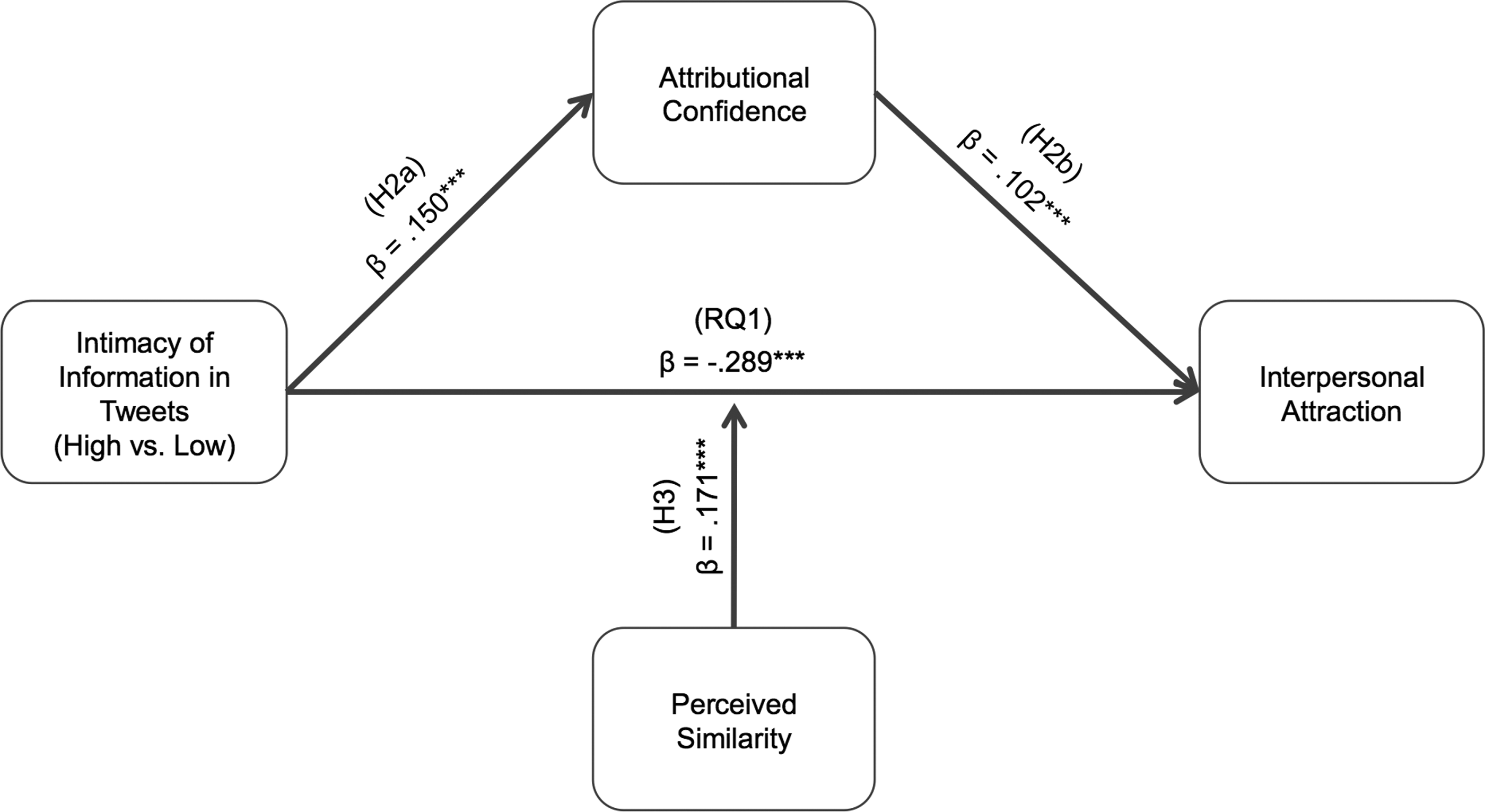
Observed model explaining the relationship between intimacy of information on Twitter page, attributional confidence, perceived similarity, and interpersonal attraction. Note. This figure uses standardized path coefficients. Additionally, the path model was tested as a structural model with EQS 6.2. The model had a very good fit (RMSEA = 0.06; CFI = 0.98; χ2 =225.276, ***p < 0.001, df = 52).
Attributional confidence mediated the link between intimacy of information and interpersonal attraction (β = 0.150, p < 0.001 [95% CI 0.14–0.44] for the path from intimacy of the profile to attributional confidence; and β = 0.102, p < 0.000 [95% CI 0.06–0.17] for the path from attributional confidence to interpersonal attraction). Furthermore, manipulation had a negative direct effect on interpersonal attraction (RQ1), such that high intimacy yielded lower social attraction to the page owner. Yet, this effect was moderated by participants' perceived similarity to the profile owner (β = 0.171, p < 0.000 [95% CI 0.08–0.25]). As seen in Figure 3, whereas intimacy of information displayed on a Twitter page had a negative effect on interpersonal attraction among participants who perceived the page owner to be dissimilar to them, it had a positive effect on interpersonal attraction among participants who perceived the page owner to be similar to them.
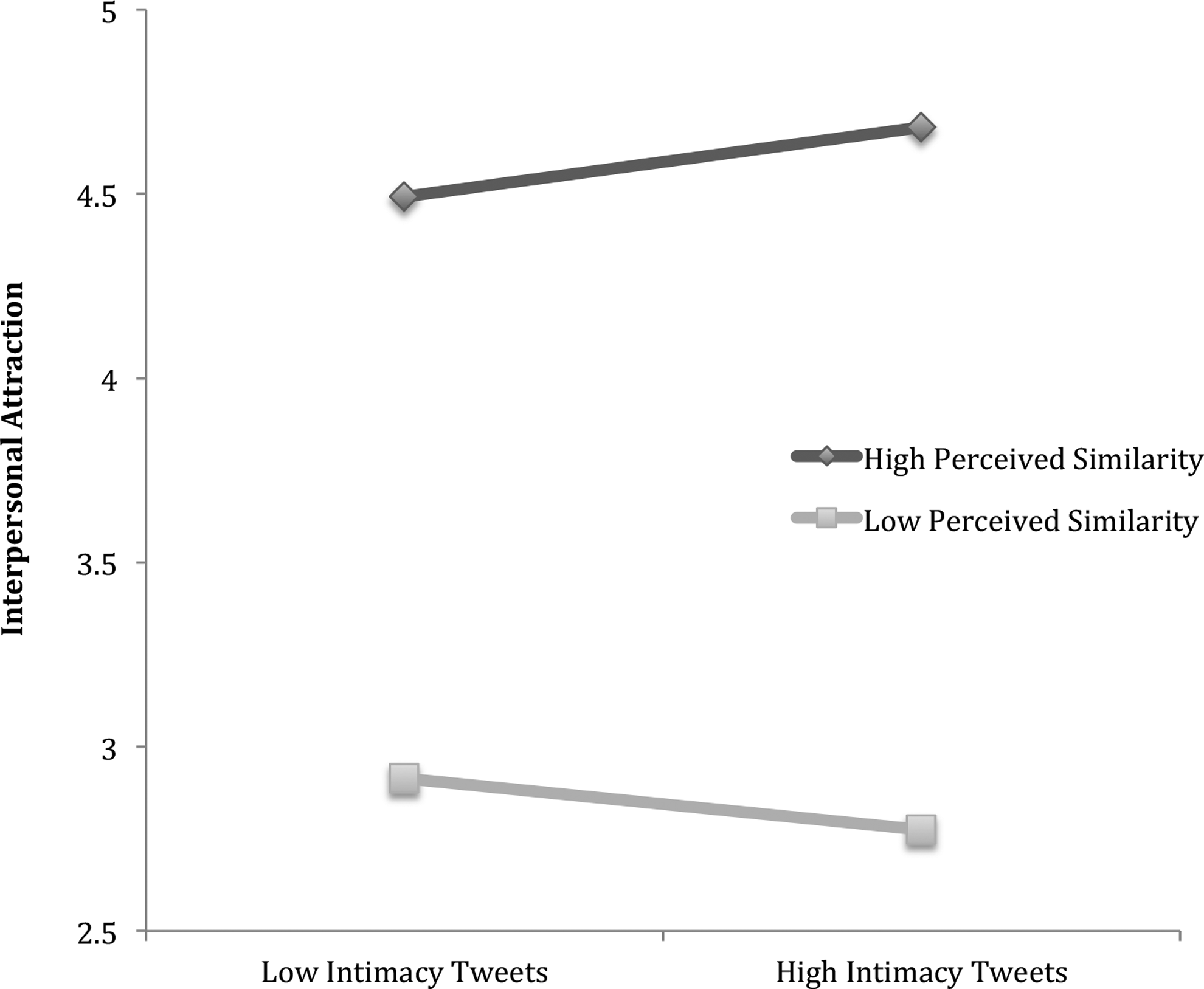
Interaction between intimacy of information and perceived similarity.
Discussion
Not long before the rise of SNSs, Patrick McCormick, an ethics scholar, lamented that the society was transforming into a “society of ‘watchers,’” with the Web and mass media acting as “our ‘wandering eye,’ letting us peek into the private lives not just of celebrities but of small fractured folks.”33(p46) With the increasing popularity of SNSs, a growing number of studies underline how various components of SNS profiles, such as photos and size of friends list, are likewise used to satisfy social curiosity.12,34–37 However, until recently, little attention has been paid to how self-disclosure on SNSs may influence judgments made about the profile owner and development of relationships.1,8,9,38
While evidence suggests that SNS users typically engage in intimate disclosures in directed communications, 39 the open structure of SNSs may also mean that users, willingly or accidently, share intimate information publicly. 1 This may particularly be the case on micro-blogging sites such as Twitter where users predominantly utilize unprotected pages. In this light, the aim of this study was to investigate how viewers reacted to disclosure of intimate information on Twitter.
The findings indicate that Twitter users who share more intimate information receive more attention from viewers. Also, with respect to the relationship between disclosure intimacy and interpersonal attraction (i.e., intentions to pursue further socialization opportunities with the page owner), the findings underline the existence of two distinct routes. First, in line with Axiom 7 of Uncertainty Reduction Theory, more intimate information in tweets increases viewers' attributional confidence, which in turn increases interpersonal attraction. In other words, by decreasing uncertainty, intimate disclosure via tweets may contribute to the likelihood that new users will follow a Twitter user. Second, in predicting interpersonal attraction, intimacy of tweets interacts with perceived similarity with the profile owner. Specifically, among viewers who perceive themselves to be similar to the profile owner, tweet intimacy is conducive to seeking further interactions with the profile owner. However, for viewers who do not consider themselves to be similar to the profile owner, tweet intimacy has a negative effect on interpersonal attraction.
These findings are in line with previous research on the effects of intimate disclosure on social attraction in SNS settings. For example, Bazarova and Choi observed that disclosure directed to a specific audience elicits a more positive response than disclosure made in a non-directed manner. 40 Likewise, Utz has recently reported that disclosure in private (and directed) conversations had a stronger impact on connectedness than nondirected status updates. 8
Extant research suggests that SNS users often do not adhere to the expected norm that disclosure of intimate information should gradually increase (as in offline dyadic relationships). 35 Yet, the present findings suggest that in the context of Twitter, particularly when the information presented is seen as an evidence of dissimilar personalities, being exposed to too much intimate information may turn off profile viewers. This implies that concerns about appropriateness of disclosure may indeed influence how a discloser is judged by profile viewers.
However, another potential explanation of the present findings pertains to the affordances created by different SNSs for satisfaction of mediated voyeurism. As discussed in the introduction, SNSs can accommodate different forms of information sharing, ranging from directed disclosure to undirected/public broadcasting of personal information. 5 Relatedly, voyeuristic uses of SNSs can also vary in terms of the level of engagement between the viewer and the profile owner who discloses. For example, on Facebook, within which users typically make their profiles accessible only to people on their friends' list, mediated voyeurism is motivated by keeping track of others for social comparison purposes. 41 Such behavior would potentially entail a more prolonged interaction between parties who can access each other's account. Conversely, due to its relatively more open structure, 5 Twitter may accommodate a more fleeting form of mediated voyeurism.
Indeed, the present results indicate that while intimate information attracts more attention from viewers, it does not necessarily lead to an intention to interact further with the profile owner—an effect named the “rubbernecking effect.” In other words, intimate information grabs attention and creates the opportunity for profile viewers to gaze at private experiences of others. And just like for the tourists on a rubbernecker wagon 25 in an urban setting, or a driver passing by a car accident, the satisfaction of voyeuristic curiosity through profile browsing on Twitter is temporarily enjoyed at the moment when the opportunity is available and, hence, does not call for further involvement.
In this respect, the present findings about the rubbernecking effect of intimate information shared on Twitter makes two important contributions to the existing literature. First, these findings suggest that in addition to social norms about the appropriateness of disclosure, expectations from a specific SNS platform may be an important factor that may determine whether disclosure of intimate information will contribute to formation of relationships. Second, and relatedly, while mediated voyeurism has long been associated with online communications (including blogs, video diaries and SNSs),20–24 the concept of rubbernecking effect helps qualify how affordances created by various online platforms may invite different forms of voyeuristic consumption that vary in terms of level of engagement between the viewer and the profile owner.
Footnotes
Author Disclosure Statement
No competing financial interests exist.