




Abstract
Abstract
The interruption of learning processes by breaks filled with diverse activities is common in everyday life. This study investigated the effects of active computer gaming and passive relaxation (rest and music) breaks on auditory versus visual memory performance. Young adults were exposed to breaks involving (a) open eyes resting, (b) listening to music, and (c) playing a video game, immediately after memorizing auditory versus visual stimuli. To assess learning performance, words were recalled directly after the break (an 8:30 minute delay) and were recalled and recognized again after 7 days. Based on linear mixed-effects modeling, it was found that playing the Angry Birds video game during a short learning break impaired long-term retrieval in auditory learning but enhanced long-term retrieval in visual learning compared with the music and rest conditions. These differential effects of video games on visual versus auditory learning suggest specific interference of common break activities on learning.
Introduction
W
Restful breaks have been found to be one of the most effective interventions connected to improving memory performance.9,10 Resource theory implies that the ability of an intervention to afford performance recovery is higher if there is little overlap between the intervention and the specific processing resources of the primary task. 10 A passive wakeful rest can help consolidate memories and prepare for upcoming tasks2–4 by minimizing interference. 11 Recent work indicates that a brief rest immediately after learning leads to better retention, 1 recall, 2 and recognition.4,12 The present study explored the effect of three common break activities on learning: having a wakeful rest was compared to listening to music and playing a video game. These three break activities were chosen specifically because they are often used in empirical studies and they are popular and widespread in everyday life.2,13,14
Music can enhance cognitive abilities, 13 and music education can promote memory function.15,16 Roden et al. 17 observed that music enhanced working memory specifically in the auditory domain but not in the visual domain, suggesting a specific effect of music on the phonological loop but not on the visuospatial sketchpad within working memory. 18
Video games are popular with people of all ages, 19 and the question of whether adolescents should play video games in between learning has sparked considerable debate. 14 In 2014, the JIM Study reported that 69% of adolescents aged 12–19 years old in Germany regularly play video games, with an average playing time of 77 minutes on weekdays. 20 Video game playing has been found to promote general learning across visual tasks.21–23 At the same time, video games can disturb performance and concentration14,24 and induce stress while gaming. 25 While some research proposes that video game playing facilitates learning in general, 19 other studies suggest that resting is better than gaming for recall 2 and recognition. 4
When memory performance is assessed, recognition can be distinguished from recall. While recognition requires only a simple familiarity process to identify an item that was previously encountered, 26 recall requires active retrieval of correct information. 26 Research has found that both recall and recognition can be negatively affected by concurrent media use, 27 and at higher difficulty levels, recall has been found to be more impaired than recognition is, which is consistent with research suggesting that recognition is easier than recall. 28
Memory performance has been found to differ as a function of stimulus modality. For instance, in visual recognition tasks, memory performance was superior to auditory recognition tasks. 29 Episodic buffer has been suggested to link phonological and visuospatial information to long-term memory. 30 Evidence shows that phonological and visuospatial short-term memory are interrelated to adolescents' long-term learning. 31 Previously, Dewar et al. 2 found that 10 minutes of wakeful resting after learning enhanced both short- and long-term memory after 7 days. The present study aimed to investigate how different break activities may affect auditory and visual learning, which may help adolescents and young adults improve their long-term academic performance. In this study, the terms “auditory” and “visual” learning refer to the encoding conditions of the information; this does not exclude that visual learning also utilizes the phonological loop to maintain the information in phonological form too.
It was hypothesized that different break activities would significantly affect learning. Specifically, the study explored whether active involvement in a popular video game affects visual and auditory learning differentially compared to passive open eyes resting and listening to music.
Methods
Participants
Forty-six right-handed healthy native German participants were recruited (24 female; Mage = 24.59 years, SD = 3.54 years, range 18–31 years). Of these, 19 (9 female; Mage =23.74 years, SD = 3.74 years, range 18–31 years) were exposed to both auditory and visual learning break activities. In order to increase variance and account for effects of stimulus modality, another 11 participants were recruited (6 female; Mage = 24.82 years, SD = 4.07 years, range 19–30 years) for auditory learning only, and another 16 participants (9 female; Mage = 24.31 years, SD = 3.18 years, range 19–29 years) for visual learning only. Participants were given detailed information and provided fully informed written consent. The study was approved by the Ethics Committee of the Charité—Universitätsmedizin Berlin and was performed in accordance with the ethical standards laid down in the 1964 Declaration of Helsinki.
Measures
Participants were screened for psychiatric disorders (SCID-I screening questionnaire) and underwent neuropsychological testing, including verbal knowledge, 32 fluid intelligence, 33 memory, and executive functioning (Table 1).33–36 Social and demographical data, video gaming experience (time per week, types of games), and music listening habits (time per week, types of music) were gathered and are presented in Table 1. On average, participants spent 7.6 hours per week more on listening to music than on gaming, t(44) = −5.96, p < 0.001. There were four frequent gamers 37 who liked to play strategy video games frequently, and there were no musicians. Seventeen participants had listened to the Mozart's Sonata piece on average 2.8 times and for 43.5 minutes in total. Seven had played the Angry Birds game on average 30 times and for 479.4 minutes in total. These variables were measured and individual differences in factors (e.g., fluid and crystallized intelligence, working memory, and habits) that have previously been shown to influence memory performance were also assessed in order to control for potentially confounding variables (see exploratory data analysis in Results). 38
Cognitive Speed was assessed by the Digit Symbol Substitution Test (DSST) from the WAIS-R. 33 Verbal Knowledge was assessed by the German Vocabulary Test. 32 Verbal memory was assessed using word lists from the Consortium to Establish a Registry for Alzheimer's Disease. 34 Verbal Working Memory was assessed by the Digit Span (DS) Backwards Test; 33 One-minute semantic verbal fluency (SVF) tested for the “animals” category. 35 Executive functioning was assessed by the Trail Making Test. 36
Standard error of the mean (SEM).
Break activity scenarios
To evaluate the effects of different break activities on verbal learning, participants were instructed to engage in “open eyes resting” (rest quietly with their eyes open), “listening to music” (Mozart's “Sonata for Two Pianos in D Major, KV.448—Allegro con spirito” through headphones), or “playing a video game” (the Angry Birds video game [Rovio Entertainment 2013] on a laptop computer) during a 8:30 minute break following the encoding phase of a verbal learning task. Participants' performance was assessed immediately after the break and again after 7 days. In the literature, ranges from 5 to 20 minutes have been reported for break duration.2,39 The 8:30 minute break duration in the present study was based on the length of the music and was also within the range of the published studies.2,39 Mozart's Sonata KV.448 has been a major musical piece in previous investigations on the effects of music on cognitive function.40–42 Angry Birds is a popular casual game, which utilizes concepts of spatial representation, and has also been previously used in research.40,43 Both have been associated with spatial reasoning and memory performance.40–42
Procedure
The general procedure is depicted in Figure 1. Three different versions of a German language auditory verbal learning test (AVLT) were used (word lists A, C, and D). 44 The 15 nouns of each original AVLT list were expanded to 25 German nouns to increase task difficulty and reduce ceiling effects that were encountered in pilot studies. 45 For the auditory learning, a native German speaker created a digital recording of each list. For the visual learning, words were presented on a screen using Microsoft PowerPoint 2010.
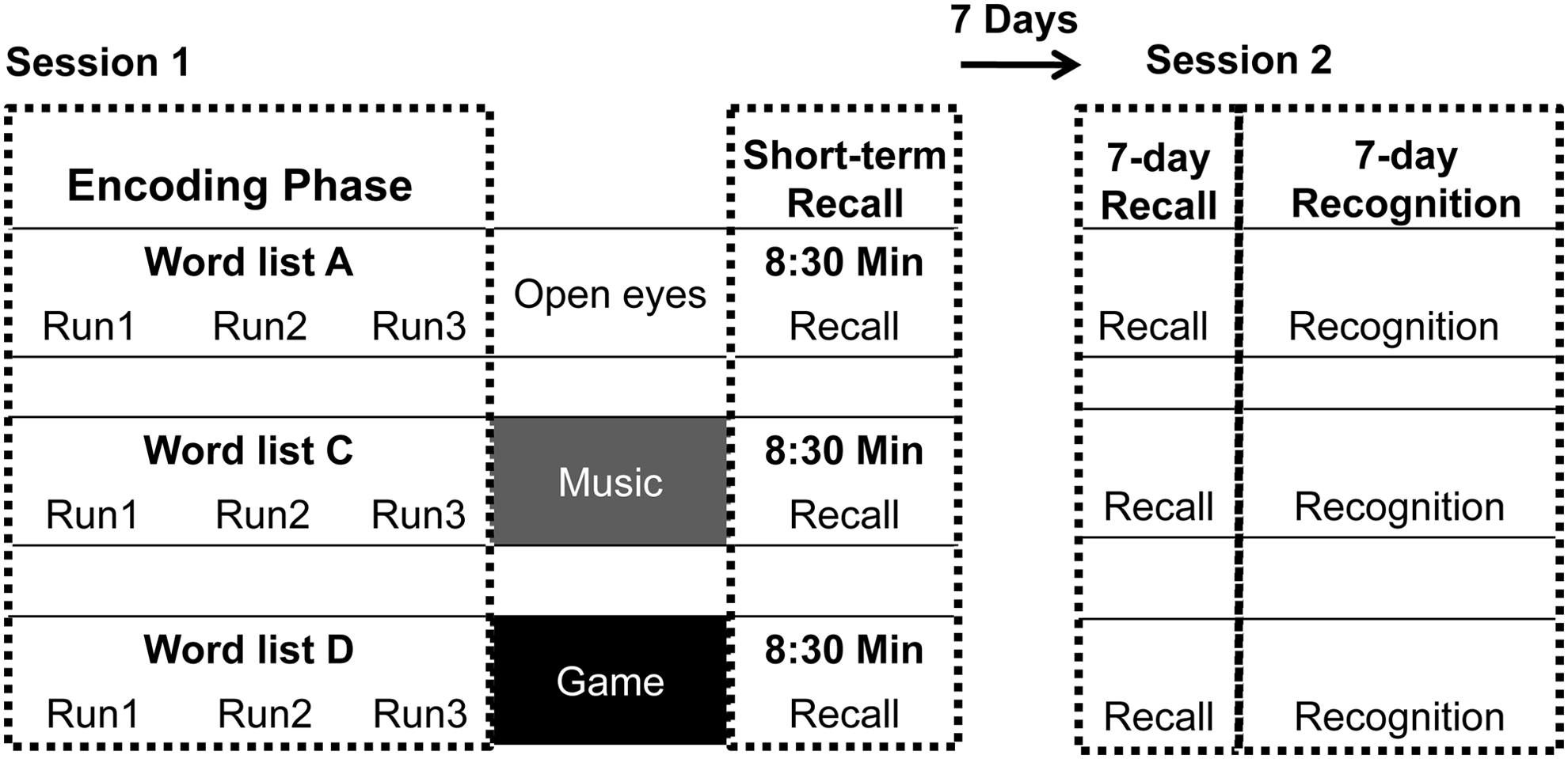
Testing procedure. The experiment consisted of two sessions separated by 7 days. Session 1 consisted of three word list learning phases (Run1, Run2, Run3) followed by a 8:30 minute break. During the break, participants engaged either in open eyes resting, listening to Mozart's Sonata, or playing the Angry Birds video game. Short-term recall took place after the 8:30 minute break. In session 2, 7 days later, both recall and recognition were tested.
The effect of three break activities (game vs. music vs. rest) was tested on recall time: immediately after learning and 7 days later. A within-subjects design was used. The presentation order of the three word lists and the order of the three break activities were counterbalanced across participants. Participants were randomly assigned to one of the presentation and break orders.
Session 1
In session 1, participants engaged in three rounds of word list learning with break activities. Every such round included: (a) an auditory presentation of the word list (25 nouns presented for 2 seconds each) with instructions to memorize as many of the words as possible for subsequent immediate recall; (b) 180 seconds of free recall of that word list (this encoding recall pattern was performed three times); (c) a subsequent break of 8:30 minutes, during which participants engaged in “open eyes resting,” “listening to music,” or “playing a video game”; and finally (d) 180 seconds of free recall of the previously memorized word list to test short-term recall.
Immediately after every task, participants were asked to rate the task difficulty, their ability to concentrate on the task, and their enjoyment of the break activity by using visual analog scales (VAS). 46
Short-term recall was calculated as the number of correctly recalled words after the 8:30 minute break divided by the overall list length (i.e., 25 words).
Session 2
Seven days after session 1, participants were asked to recall freely as many words as possible from the three memorized word lists within 9 minutes (7 day recall). Subsequently, participants were presented with a word list of 132 words with the original 3 × 25 words intermixed with semantically similar words from the recognition list of the German AVLT. 44 Words were presented every 4 seconds. Participants were asked to recognize the memorized words from session 1 and identify whether they belonged to the first, second, or third list that they memorized during session 1. Answers were recorded with a digital audio recorder. Seven day recognition scores were based on the number of correctly recognized and identified words from each word list calculated as a percentage of word list length (i.e., 25 words). Additionally, the percentage of recognized words was calculated regardless of context identification.
Results
The VAS questionnaires were analyzed in a repeated-measures analysis of variance with the within-subjects factors break activity (rest vs. music vs. game), separately for auditory and visual learning. When the assumption of sphericity was violated, degrees of freedom were corrected using Greenhouse–Geisser estimates. Post hoc tests were used for pairwise comparisons. Differences were considered significant at p < 0.05 (two sided).
There was no significant difference in the VAS ratings of the difficulty in auditory tasks, F(2, 58) = 1.13, p = 0.332, and visual tasks, F(2, 68) = 0.36, p = 0.701, and no difference in the ability to concentrate on the task between break activities (rest vs. music vs. game) for auditory tasks, F(2, 58) = 1.17, p = 0.319, and visual tasks, F(2, 68) = 1.93, p = 0.153. However, participants reported that on the average they enjoyed gaming 26% more than listening to music for auditory learning, t(29) = 4.67, p < 0.001, and 20% more for visual learning, t(34) = 4.36, p < 0.001.
Including all 46 participants for pooled analysis, a linear mixed-effects model was conducted in which the dependent variable was the percentage of correctly recalled as well as recognized words (i.e., recognized and correctly identified) after a 7 day delay. Multilevel regression models were estimated using the lme4 linear mixed effects package 47 and the stats package in R v3.1.0 statistical language. 48
For fixed effects, the study used—with effect coding—the predictors response type (recall vs. recognition; coding: +0.5 vs. −0.5), stimulus modality (visual vs. auditory; coding: +0.5 vs. −0.5), break activity (Helmert contrasts: music vs. rest, game vs. [music + rest], which contrast music with rest, and game with the average of music and rest), as well as all interactions between these factors. In addition, random participant intercepts and slopes for the three main effects were included. Lastly, the study tested whether additional random participant slopes for any of the interactions were justified and if there was any improvement in model fit (based on log-likelihood ratios, the Akaike information criterion [AIC], 49 or the Bayesian information criterion [BIC]). 50 The p value of the fitted model was calculated by extracting coefficients of the fitted model and using the z distribution to approximate the p value. 51 Regression coefficients (β) were reported to estimate the effect sizes of each independent variable in the fitted model.
For all 46 participants, data were best described by a model (see Table 2, “Model null”), where effects of response type (recall vs. recognition), stimulus modality (visual vs. auditory), and break activity (music vs. rest, game vs. [music + rest]) as well as all higher-level interactions were estimated as fixed effects, while random intercepts and random slopes for the three main effects were estimated as random effects varying across participants. In addition, the study tested whether additional random slopes for any higher-level interactions of main effects were supported by the data, but no reliable improvement in model fit was found (p > 0.465; see Table 2).
The best fitting model (
Model null: percentage correctijkm = β0 + β1(response typei) + β2(stimulus modalityj) + β3(break activityk) + β4 (response typei ×stimulus modalityj) + β5(stimulus modalityj × break activityk) + β6(response typei × break activityk) + β7 (response typei × stimulus modalityj × break activityk) + b0m + b1m (response typei) + b2m (stimulus modalityj) + b3m (break activityk) + ɛ ijkm.
β, fixed effects; b, random effects; models used for comparison: k, number of free estimated parameters; AIC, Akaike information criterion; BIC, Bayesian information criterion; deviance = −2LogLik, Pr (>Chisq) is based on comparing with Model null.
Based on the best fitting model (“Model null”), significant main effects were found of response type (β = 7.1, t = 3.36, p < 0.001), stimulus modality (β = 10.5, t = 4.01, p < 0.001), and a response type × stimulus modality interaction (β = 13.8, t = 4.72, p < 0.001), indicating that memory performance after 7 days was better in recall compared with recognition, and better in visual compared with auditory encoding learning (Table 3). Participants were better in visual compared with auditory learning in both recall and recognition. A significant interaction was found of stimulus modality × break activity when comparing gaming with the average of music and rest conditions (β = 3.5, t = 3.65, p < 0.001). As shown in Figure 2, after video gaming, visual memory performance was higher compared with the average of listening to music and rest, while auditory memory performance was lower.

Mean percentage of correctly memorized words in auditory and visual learning as a function of break activity (rest vs. music vs. game) and response type (recall vs. recognition) after 7 days. Error bars represent standard errors of the mean.
Number of observations: 390; groups: 46.
p Value of fitted model: used z distribution to approximate p value. 51
p < 0.05; **p < 0.01; ***p < 0.001 (two tailed).
Significant results are marked in bold.
The whole analysis was repeated with the percentage in 7 day recognition (i.e., recognized regardless of context identification) as the dependent variable. It was also found that gaming differed significantly from the average of music and rest as a function of stimulus modality (β = 2.2, t = 2.89, p = 0.004). Furthermore, it was found that recall performance after 7 days was worse than recognition regardless of context identification (β = −39.0, t = −20.9, p < 0.001).
Additionally, the study explored the potentially confounding effects of the individual neuropsychological test scores and habits (music/gaming) on individual estimates of the difference in the model between game and the average of music and rest conditions (i.e., β). The significance value was set at p < 0.006 after Bonferroni correction for multiple comparisons. No significant correlations were found (i.e., β, p > 0.254; correlation with Digit Symbol Substitution Test [DSST], p = 0.254).
Next, the whole analysis was repeated without the four frequent gamers. The results were consistent with the previous analysis. Performance with “gaming” as break activity differed significantly from the average of music and rest as a function of stimulus modality in both recalled versus recognized and correctly identified words (β = 3.4, t = 3.42, p < 0.001) and recalled versus recognized, regardless of context identification (β = 2.5, t = 3.15, p = 0.002).
To investigate break effects on short- and long-term recall, recall after 8:30 minutes and after a 7 day delay was analyzed with the same model structure and the percentage of correctly recalled words after short- and long term delay was used as the dependent variable and the predictor memory type (short term vs. long term; coding: +0.5 vs. −0.5). Significant main effects were found of memory type (β = 33.5, t = 21.99, p < 0.001), stimulus modality (β = 12.2, t = 5.65, p < 0.001), indicating that recall performance was better in short-term compared with long-term memory, and better in visual compared with auditory learning. Moreover, a significant interaction was also found of stimulus modality × break activity when comparing gaming with the average of music and rest conditions (β = 1.6, t = 2.07, p = 0.038), indicating that after video gaming, visual memory performance was higher compared with the average of listening to music and rest, while auditory memory performance was lower.
Finally, the study explored the effects of the potentially confounding individual neuropsychological test scores and habits (music/gaming) on individual estimates of the difference in the model between recall and recognition, short-, and long-term recall (i.e., β). The significance value was set at p < 0.006 after Bonferroni correction for multiple comparisons. No significant correlations were found of the individual neuropsychological test scores and habits (music/gaming), neither with the difference of individual estimates on recall and recognition (i.e., β, p > 0.051; correlation with DSST, p = 0.051) nor with short- and long-term recall (i.e., β, p > 0.095; correlation with DSST, p = 0.095).
Discussion
The influence of break activities—passively resting and listening to music and actively playing a video game—was explored on auditory versus visual learning performance. In the task, it was found that visual memory performance was superior to auditory memory. This is consistent with possible capacity differences between visual and auditory stimuli, with an advantage for visual processing. 29 Participants performed better in “recall” than in “recognition with correct identification,” but performed worse in “recall” than in “recognition regardless of correct context identification” after 7 days. This is consistent with the prior findings that recall is impaired compared with recognition at higher difficulty levels. 28
The main finding of this study is that stimulus modality interacted with break activity, affecting long-term recall and recognition memory performance. It was found that a short active gaming exposure after the encoding phase reduced long-term auditory memory performance but enhanced visual memory performance compared with the average of passively listening to music and open eyes resting. A significant interaction was also found of stimulus modality and break activity in short- versus long-term recall. Short-term recognition was not measured because the semantically similar words of the recognition list might have disturbed long-term memory performance.
A varied network stimulation might have resulted from the effect of sounds and visual elements in the game. In recall and recognition after 7 days, auditory learning performance was significantly worse than in visual learning. This might be because auditory memory operates via feature overwriting. 52 Emotionally salient gaming sounds as well as changes in timbre and pitch could have affected the phonological loop during the consolidation phase and thus retrieval performance of auditory words.42,43,53 Differing from music, gaming sounds are designed to engage the players' attention. During the Angry Birds game, subjects hear the “bang” and “laughing” sound every time they hit the target. 40 Such sounds may enable subjects to connect with the game. This interpretation is supported by the finding of more enjoyment in the gaming condition compared with music. At the same time, video gaming had a trend to promote visual learning. This is consistent with previous findings that the salient visual objects of video games may enhance visual tasks.21,22
The ambiguous effects of gaming on long-term memory performance might be attributed to its influence on participants' emotional states (i.e., arousal, mood, enjoyment). Emotional arousal interacts with consolidation of memory. 54 Choi et al. 55 found that working memory performance was lowest in a tense emotional state, followed by relaxed and then neutral emotional states. Therefore, it will be necessary to investigate the differential effects of gaming as a function of stimulus modality while considering emotional states. Participants in the present study reported greater enjoyment during gaming for both auditory and visual learning. Future studies including physiological response measurement (e.g., heart rate and skin conductance) during breaks could clarify the effect of arousal levels during breaks.
The observed results are so far restricted to young, well-educated participants and episodic memory performance. Other types of music or games (e.g., self-selected) 56 may result in different findings. Because the main interest was to compare the effects of ecologically salient break activities on verbal learning performance, the exact mechanisms by which gaming and music might exert their effects on learning were not manipulated.
Taking a short break from learning is known to have beneficial effects on memory performance. 1 The aim of the present study was to examine whether these effects differ with the type of break activities and how this affects long-term memory performance for auditory and visually presented words. The results support findings that different break activities after learning affect memory retention differently,1–3 and suggest that results may depend on the type of (verbal) learning as well as the type of break: playing the Angry Birds video game, compared with listening to Mozart's Sonata KV.448 and open eyes resting, enhanced visual verbal memory but decreased auditory verbal memory.
This research can help in the development of recommendations for young adults and potentially also for adolescents and their parents. Parents have to decide whether they should ban adolescents from playing video games in between learning or whether they can tolerate or even encourage them to play; young adults have to choose optimal break activities to enable them to perform continuously at high levels. Many studies have shown that concurrent media use and multitasking interfere with academic and cognitive task performance.28,57 The present study suggests that certain types of break activities might be detrimental to certain types of learning, while at the same time being beneficial to others. This may inspire future studies to investigate other common break activities, looking not only for the potentially negative effects of media use and multitasking habits in everyday life, but also with an eye toward enhanced learning and productivity.
Footnotes
Acknowledgments
This research was supported by the China Scholarship Council (CSC grant 201208080013 to SL) and the German Research Foundation (DFG grant FOR 1617). “Learning and habitization as predictors of the development and maintenance of alcoholism” to AH and Subproject 3, Model of learning, RA1047/2-2 to MAR) and the German Federal Ministry of Education and Research (BMBF grant 01EE1406A “Addiction: Early Recognition and Intervention Across the Lifespan (AERIAL)” to AH and grant 01EE1406I to MAR).
Author Disclosure Statement
No competing financial interests exist.