




Abstract
Abstract
Cybersex addiction (CA) has been mostly investigated in heterosexual males. Recent findings have demonstrated an association between CA severity and indicators of sexual excitability, and that coping by sexual behaviors mediated the relationship between sexual excitability and CA symptoms. The aim of this study was to test this mediation in a sample of homosexual males. Seventy-one homosexual males were surveyed online. Questionnaires assessed symptoms of CA, sensitivity to sexual excitation, pornography use motivation, problematic sexual behavior, psychological symptoms, and sexual behaviors in real life and online. Moreover, participants viewed pornographic videos and indicated their sexual arousal before and after the video presentation. Results showed strong correlations between CA symptoms and indicators of sexual arousal and sexual excitability, coping by sexual behaviors, and psychological symptoms. CA was not associated with offline sexual behaviors and weekly cybersex use time. Coping by sexual behaviors partially mediated the relationship between sexual excitability and CA. The results are comparable with those reported for heterosexual males and females in previous studies and are discussed against the background of theoretical assumptions of CA, which highlight the role of positive and negative reinforcement due to cybersex use.
Introduction
A
Cybersex refers to any sexually motivated behavior online. 5 Recently, studies on Internet use by homosexual and bisexual males were reviewed, and it was concluded that homo- and bisexual males also commonly use the Internet for cybersex, for example information searches, finding sexual contacts, or watching pornography. 6 Independently of gender or sexual orientation, cybersex users reported positive and negative consequences following their cybersex activities.7–10 Some homo- and bisexual participants reported a loss of control regarding their cybersex behavior. 11 Diverse studies suggest a relationship between pathological offline behaviors with heightened cybersex use.12,13 It was also found that time spent viewing erotica on the Internet predicts subjective complaints in everyday life. 14 Sexual behaviors on the Internet have been considered to result in CA in some hetero- and homosexuals. 15
A refined cognitive–behavioral framework of Internet addiction has been introduced.
16
Here, the role of predispositions, cognitions, and learning mechanisms were described for the development of Internet addiction. Parts of the model have been specified for CA.
4
Referring to earlier descriptions,
17
it was assumed that sexual gratification gained by cybersex plays a major role in CA. Accordingly, it was shown that arousal ratings of pornographic material predicted tendencies toward CA in heterosexual males and females.18,19 Moreover, it was reported that problematic cybersex users showed greater sexual arousal reactions to pornographic material than healthy cybersex users did, and that the frequency of and satisfaction with sexual real-life contacts were not associated to CA severity.
20
Lastly, it was shown that the relationship between sexual excitability and CA was mediated by coping by sexual behaviors.
4
The present study aims to investigate the relationship between sexual excitability, coping by sexual behaviors, and general psychological symptom severity in a sample of homosexual males. The following hypotheses were formulated:
Methods
Participants
Participants were recruited through advertisements at the University of Duisburg-Essen via e-mail lists and social networking sites, and among relatives and friends. The advertisements explicitly indicated that the study investigated sexual interests and cybersex use in homosexual males, and that pornographic videos were shown during participation. The online survey included questionnaires as well as a pornographic video evaluation and was implemented with the tool Limesurvey. Eighty-two males completed the survey. Eleven individuals were excluded because of technical problems during the video presentation (n = 10) or because of bisexual orientation (n = 1). The final sample comprised 71 homosexual individuals (Mage = 29.15 years, SD = 6.22 years, range 20–48 years). Forty-three individuals indicated that they were in a relationship. All participants had a mean coming-out age of 19.51 years (SD = 3.53 years) years. The mean age of first cybersex use was 17.68 years (SD = 4.08 years). Mean time in education was 12.90 years (SD = 0.45 years). All volunteers were invited to participate in a lottery to win one iPad mini (16GB) or one of five Amazon vouchers (each voucher €10). To ensure the validity of the data, participants were asked whether all of their indications during the survey were given honestly and whether their data could be used for scientific analyses. The participation in the lottery was independent from the responses to these questions. Moreover, data were checked for plausibility, and no noticeable problems were observed. The study was approved by the local ethics committee.
Pornographic video presentation
Participants viewed eight pornographic videos. Four videos depicted anal sex between two males, and four videos showed oral sex between two males. All clips were shown randomized and were between 30 and 40 seconds long. Participants rated each video on a scale from 1 = “not sexually arousing” to 5 = “very sexually arousing.” As in other studies,19,20 participants indicated their current sexual arousal on a scale from 0 = “not sexually aroused” to 100 = “very sexually aroused” before (t1) and after (t2) the stimuli presentation. A delta score (t2 – t1) was calculated to represent individual reactivity to pornographic material corrected for baseline (“sexual arousal reaction”).
Questionnaires
Symptoms of CA were assessed with the German short version of the Internet Addiction Test 21 modified for cybersex (s-IATsex). 20 Twelve items were answered on a scale from 1 = “never” to 5 = “very often.” An overall sum score and sum scores for the two subscales of the s-IATsex were calculated: “Loss of control/time management” (s-IATsex-1) and “Craving/social problems” (s-IATsex-2). To measure sensitivity to sexual excitation, a German short form of the Sexual Excitation Scale (SES) was used. 22 The response format was recoded compared to the original scale. 23 Six items were answered on a scale from 1 = “strongly disagree” to 4 = “strongly agree,” resulting in a mean value that represented high sensitivity to sexual excitation with high scores. As an indicator of a problematic sexual behavior, the Hypersexual Behavioral Inventory (HBI) was applied. 24 Nineteen items were answered on a scale ranging from 1 = “never” to 5 = “very often,” resulting in three mean scores for the three subscales of the HBI (“control,” “consequences,” “coping”). Motivation for pornography use was measured by the Pornography Consumption Inventory (PCI). 25 Fifteen items were answered on a scale ranging from 1 = “never like me” to 5 = “very often like me.” Mean scores were calculated for the four dimensions of the PCI (“emotional avoidance,” “sexual curiosity,” “excitement seeking,” and “sexual pleasure”). Subjective complaints in everyday life were assessed by the Brief Symptom Inventory (BSI). 26 The Global Severity Index (GSI) was computed.
PCI and SES were translated into German and retranslated by a native English speaker. Due to low internal consistencies, the PCI subscales “excitement seeking” and “sexual pleasure” were excluded from the analyses (Table 1).
Items were recoded. High scores of SES represent high sensitivity for sexual excitation.
s-IATsex, short version of the Internet Addiction Test 21 modified for cybersex; SES, Sexual Excitation Scale; HBI, Hypersexual Behavioral Inventory; PCI, Pornography Consumption Inventory; BSI GSI, Brief Symptom Inventory Global Severity Index.
Questions concerning sexual behaviors
Participants were asked to indicate the number of sexual contacts within the last 7 days and in the last 6 months, as well as their satisfaction with the frequency and quality of their sexual contacts from 0 = “not satisfied” to 3 = “very satisfied.” Moreover, participants answered whether and how often they had practiced 1 of 20 sexual practices. A sum score of sexual practices or lived out sexual preferences/fetishes in the last six months was computed, depending on the number of performed sexual practices (“variance real sex life”). In accordance with previous research, 19 participants were asked whether they generally use several cybersex applications. If so, they were asked the mean time (“minutes per week”) spent for a specific cybersex application by multiplying “mean frequency of a cybersex application use per week” with “mean time spent in minutes per use.”
Statistical analysis
Descriptive results, bivariate correlations, and t tests for dependent samples were calculated with SPSS v20.0 (IBM Corp., Armonk, NY). Structural equation modeling (SEM) was done with Mplus v6.0 (Muthén & Muthén, Los Angeles, CA). Two-tailed tests were performed for all analyses; p values of 0.05 were considered statistically significant.
Results
Descriptive results are demonstrated in Table 1. The sum score of the s-IATsex was 22.92 (SD = 8.22, range 13–47). The s-IATsex correlated significantly with the SES (r = 0.40, p < 0.001); with the HBI subscales “coping” (r = 0.46, p < 0.001), “consequences” (r = 0.63, p < 0.001), and “control” (r = 0.52, p < 0.001); with the PCI subscales “emotional avoidance” (r = 0.48, p < 0.001) and “sexual curiosity” (r = 0.24, p < 0.05); and with the GSI (r = 0.46, p < 0.001).
The pornographic video presentation led to an increase in sexual arousal (Mt1 = 15.89, SD = 20.30, Mt2 = 54.54, SD = 33.03, t = 11.65, p < 0.001, Cohen's d = 1.26). The s-IATsex correlated with the arousal rating of the anal videos (r = 0.30, p ≤ 0.01), with the current sexual arousal at t2 (r = 0.32, p < 0.01), and with the sexual arousal reaction (r = 0.28, p < 0.05). The s-IATsex score was not associated with the arousal rating of the oral videos (r = 0.03, p = 0.79) and the current sexual arousal at t1 (r = 0.13, p = 0.26).
Within SEM, the latent dimension “sexual excitability” was modulated by “SES” and “sexual arousal reaction.” The latent dimension “coping by sexual behaviors” was modulated by “HBI coping” and “PCI emotional avoidance.” The latent dimension “CA” was modulated by the two subscales of the s-IATsex. The correlations between the manifest variables included in the SEM are shown in Table 2.
Items were recoded. High scores of SES represent high sensitivity for sexual excitation.
p ≤ 0.05 (correlation is significantly different from zero with α = 5%, two tailed).
p ≤ 0.01 (correlation is significantly different from zero with α = 1%, two-tailed).
All data were entered into the mediation model. There were no missing data. A maximum likelihood parameter estimation was chosen. 27 Because three variables (“s-IATsex-2,” “HBI coping,” and “PCI emotional avoidance”) were not distributed normally in the sample as tested by the Kolmogorov–Smirnov test (p < 0.05), a natural logarithmic transformation was performed for these three variables to check if the distribution had any meaningful effects on the results. Using the transformed variables, the main effects remained stable. The latent dimensions were well represented by the manifest variables and the model fitted the data well.28–31 The results of the chi square test were χ2 = 3.27, df = 6, p = 0.77. The RMSEA was 0.00, the CFI was 1.00, and the SRMR was 0.02. The total effect was significant (β = 0.62, SE = 0.16, p < 0.001). The direct effect from “sexual excitability” to “CA” was significant (β = 0.45, SE = 0.20, p = 0.02). The direct effect from “sexual excitability” to “coping by sexual behaviors” was significant (β = 0.47, SE = 0.15, p < 0.01). The direct effect from “coping by sexual behaviors” to “CA” was significant (β = 0.36, SE = 0.16, p = 0.02). The indirect effect from “sexual excitability” to “CA” over “coping by sexual behaviors” was significant (β = 0.17, SE = 0.07, p = 0.02). The mediation analysis explained a large proportion of variance of “CA” (R2 = 0.49, p ≤ 0.001). No post hoc modifications were performed. Accordingly to the reported effects, a partial mediation was observed. Figure 1 illustrates the standardized regression coefficients in the mediation model.
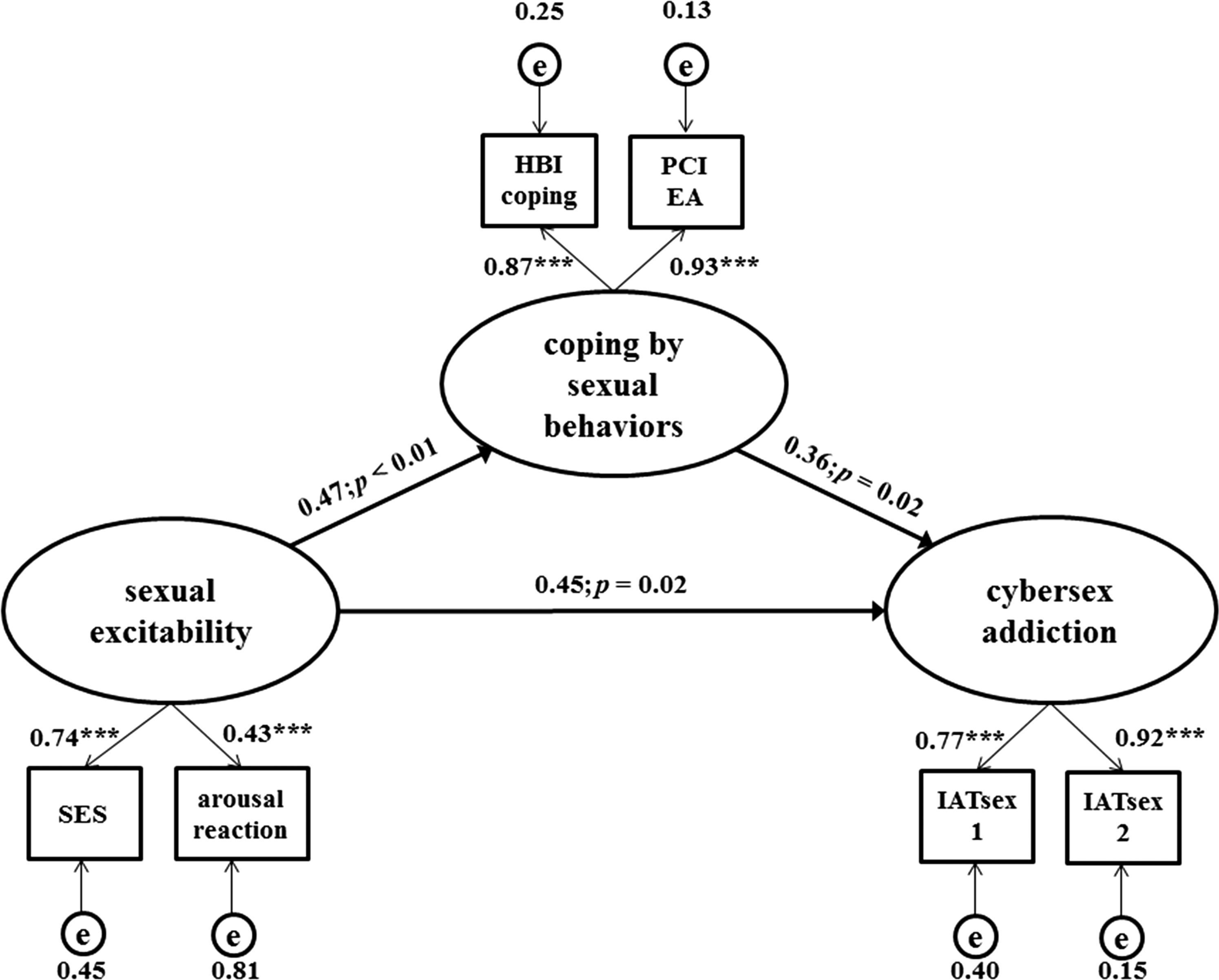
Results of the structural equation model including factor loadings of the latent dimensions, β weights, p values, and residuals. ***p < 0.001.
The sample's sexual behaviors in real life are described in Table 3. Forty-six individuals reported a frequency of 2.26 (SD = 1.62) real-life sexual contacts in the last 7 days. Sixty-seven individuals approximated having 30.19 (SD = 32.91) real-life sexual contacts in the last 6 months. The satisfaction with the frequency of sexual contacts was 1.93 (SD = 0.82); the satisfaction with the quality of sexual contacts was 2.13 (SD = 0.69). Participants engaged in 4.79 (SD = 2.90) sexual practices in the last 6 months. The s-IATsex was not correlated with the number of sexual contacts in the last 7 days (r = 0.14, p = 0.35) or in the last 6 months (r = –0.17, p = 0.17), the satisfaction with the frequency (r = –0.05, p = 0.67) or the quality (r = 0.11, p = 0.39) with real-life sexual contacts, and the variance real sex life (r = 0.19, p = 0.12).
Note. Mean scores and standard deviations of the number of performed sexual practices or lived out sexual preferences/fetishes in the last 7 days and the last 6 months are presented.
Weekly cybersex activities and the correlation of the s-IATsex with time spent weekly on cybersex applications are presented in Table 4 (all p's > 0.05). Several individuals indicated using online sex shops (n = 36), dating sites (n = 59), sexually arousing literature (n = 41), information searches (n = 63), or advisors (n = 50) irregularly.
Note. All mean scores and standard deviations only refer to individuals who used a specific cybersex application weekly.
Discussion
The main result of the study was that in homosexual males, CA was related to sexual excitability, coping by sexual behaviors, and psychological symptoms. The relationship between sexual excitability and CA was partially mediated by coping by sexual behaviors. CA was not associated with the number of real-life sexual contacts, the satisfaction with real-life sexual contacts, and time spent weekly on cybersex activities. The findings are comparable with results reported in heterosexual males and females.4,19,20
Cybersex use has been shown to be prevalent in the homosexual population, 6 and a higher use of Internet pornography by homosexual compared with heterosexual individuals was reported in one study. 32 Given the observed effects regarding sexual excitability, coping, and CA in this study are comparable with those observed in heterosexual males and females,4,18–20 the findings seem to be independent from gender and sexual orientation. Moreover, they are in line with the cognitive-behavioral model of CA, 4 which assumes that gratification due to cybersex use reinforces specific (e.g., sexual excitability) and nonspecific factors (e.g., psychopathology, personality) of vulnerability for CA as well as specific cognitions about cybersex use. Naturally, sexual arousal is highly reinforcing. 33 Some brain imaging studies compared neural activations of homo- and heterosexual men when presenting sexually relevant cues.34–37 The patterns of neural activation were related to emotion and reward (e.g., ventral striatum) and were comparable for hetero- and homosexual males when viewing material fitting to their sexual orientation. Therefore, brain imaging studies support the explanation of the equivalent role of sexual gratification in CA independently from sexual orientation.
Dysfunctional coping has been shown to be relevant across several psychopathologies, 38 as well as in Internet addiction.39,40 Moreover, it has been demonstrated that Internet-related cognitions (i.e., dysfunctional coping, Internet use expectancies) mediates the relationship of Internet addiction with predisposing personality characteristics. 41 In the present study, cybersex use expectancies or perceived stress were not investigated. Rather, an association of CA with psychological symptoms and with coping by sexual behaviors was presented in line with the observation that some individuals use cybersex to distract from aversive emotional states. 42 If individuals experience aversive emotional states and expect cybersex use to distract them from those, individuals will more likely engage in cybersex activities to escape from negative feelings in terms of negative reinforcement. Within the cognitive–behavioral model of CA, negative reinforcement received by coping by sexual behaviors is assumed to be another important process within the development of CA. 4
Real-life sexual behaviors, satisfaction with sexual contacts, and weekly cybersex use time were not associated with CA. These results are consistent with earlier findings in heterosexual males and females,19,20 and contradict the theoretical assumption that cybersex addicted individuals use cybersex excessively to compensate for missing or unsatisfying sexual real-life contacts. 3 One explanation could be that neither the number of sexual contacts, variance of sex life, nor time spent for cybersex activities might be sufficient indicators for problematic behaviors or markers for experienced subjective complaints in everyday life. For example, receiving negative consequences, conflicts, or discomfort resulting from cybersex use may rather be dependent on the individual's general living conditions, personal values, or social norms than on the actual frequency of cybersex behaviors. To understand subjective complaints and to treat CA, situational, emotional, and cognitive conditions of cybersex use need to be explored individually.4,17 Another explanation could be that the present findings support the hypothesis that gratification due to cybersex and not a compensation of little or unsatisfying real-life sexual contacts plays a major role only in the early stages of CA's development. 4 Although healthy and problematic heterosexual cybersex users did not differ regarding these variables in a previous study, 20 it might be that later in the addiction process 17 cybersex addicted individuals have fewer and fewer real-life sexual contacts, become lonely, and then cybersex may also be used to compensate missing real-life sexual contacts and loneliness. Thus, there might be a shift from gratification to compensation within the addiction process, but this cannot be seen in the current data given the cross-sectional design. Until now, strong support has been found for the gratification hypothesis, but longitudinal studies or studies with individuals who have long-lasting CA may address the potential shift from gratification to compensation.
Limitations and future studies
Although the empirical SEM model was derived from a theoretical framework and was shown to fit the data well, the sample size was relatively small for testing a mediation analysis in a SEM with latent factors represented by only two indicators. This might have biased the estimation of model parameters and should therefore be mentioned as limitation of the study. The cross-sectional design and reported direct and indirect effects in the mediation analysis do not allow conclusions to be drawn about causality. Questionnaires and the pornographic video paradigm were presented online. Although individuals were instructed to answer the survey alone at home, the response behavior might be confounded by unknown disturbing factors or biases. A selection bias resulting from the free recruitment and the information that the online study investigated sexual interests and cybersex use in homosexual males cannot be ruled out. Generalizations regarding sexual behaviors in real life and online cannot be reasoned by this study. Future studies should compare homosexual individuals with a low and high severity of CA to clarify the characteristics of homosexual males suffering from CA.
Footnotes
Author Disclosure Statement
No competing financial interests exist.