




Abstract
Abstract
Interactive digital games can promote self-efficacy by engaging players in enactive and observational learning. However, interactivity does not always lead to greater self-efficacy. Important constructs in social cognitive theory, such as performance outcome and perceived similarity, are often not accounted for in studies that have tested the effect of digital game interactivity on self-efficacy. This study assessed the effects of interactive digital games compared with passive digital games based on video comparison, a common experimental design used to test the effect of digital game interactivity on self-efficacy. In addition, this study also evaluated player performance and measured perceived similarity to the observed player. Findings suggested that in general, digital game interactivity predicted higher self-efficacy compared with noninteractive passive games. However, in the noninteractive conditions, the effects of performance on self-efficacy were moderated by perceived similarity between the observer and the observed player. When the observed player was perceived to be similar to the observer, the effects of performance on self-efficacy were comparable to the interactive game, but when the observed player was perceived as dissimilar to the observer, observing the dissimilar player failed to increase observer self-efficacy. Implications for interactivity manipulations and game developers are discussed.
Introduction
I
Many studies have reported the effectiveness of digital games on promoting self-efficacy, the perceived confidence to achieve a desired outcome, which is a key psychological predictor of learning and behavioral change.1,8 These studies were conducted by comparing digital games to passive media, such as a video, a news article, or a prerecorded gameplay video.9,10 These studies have argued that interactive media is more effective in fostering self-efficacy, as it affords both enactive learning and observational learning. Surprisingly, very few studies have accounted for the players' performance under these different gaming conditions. According to social cognitive theory, an enactive learning experience does not always promote self-efficacy.11,12 If players fail repeatedly, they may perceive themselves as incompetent, which would instead promote lower self-efficacy. Similarly, observational learning does not always promote lower self-efficacy. Social comparison theory posits that individuals may increase self-esteem through observing others fail.
This study evaluated the effects of interactivity and player performance on self-efficacy. Here, the interactive versus passive digital game study design is employed, a common paradigm used to test the effect of digital game interactivity.9,13 In addition, this study also evaluated perceived similarity as a moderator to assess the interacting effects of interactivity and performance on self-efficacy. The findings suggest that digital game interactivity does predict higher self-efficacy compared with passive conditions. However, the effect of observed performance on self-efficacy was moderated by perceived similarity between the observer and the observed player. When the observed player was perceived to be dissimilar to the observer, observing the player fail actually increased the observer's self-efficacy.
Self-efficacy
Self-efficacy is a key factor in social cognitive theory for predicting action. 11 Self-efficacy refers to the “beliefs in one's capacity to organize and execute the courses of action required to produce given attainments.” 14 (P.3) Self-efficacy influences how individuals approach a task, how much effort they devote, and how they interpret failure. Compared with individuals with lower self-efficacy, those with higher self-efficacy are more likely to perform an action, devote more effort to the action, and rebound from failures.
According to social cognitive theory, self-efficacy can develop through enactive learning (mastery experience) and observational learning (vicarious experience). Enactive learning refers to learning from one's previous experience. If an individual perceives their previous experience to be a success, they will likely have greater self-efficacy toward similar future tasks. Observational learning refers to learning from observing the actions and outcomes of others. When individuals observe others whom they perceive to be similar to themselves while they achieve a desirable outcome after performing a task, they are more likely to have greater self-efficacy toward similar tasks. Digital games afford both enactive and observational learning. During gameplay, players actively make decisions, take action, and learn from their experiences, as well as observe their avatars and the actions and outcomes of other players. Bandura argued that enactive learning is stronger than observational learning in predicting self-efficacy, as personal experience is a stronger indicator of the ability to perform an action. 14
Digital games and self-efficacy
Previous studies have demonstrated that digital games are effective in promoting self-efficacy to perform the suggested behaviors. For example, Cole et al. designed a game to help young cancer patients adhere to their treatment. 15 In a randomized study that included more than 300 patients, self-efficacy from game playing was found to be the strongest mediator predicting increased treatment adherence. Lieberman also used a digital game to help children manage their asthma. 16 After instructing children to play the game for 40 minutes, they found significant improvements in self-efficacy for asthma self-management and for discussion about asthma; these effects persisted after a month. Peng found that playing a serious game about healthy eating also had long-term effects on self-efficacy and perceived benefits of eating a healthy diet. 17
The interactivity component of digital games has often been described as the key factor for its effectiveness in increasing self-efficacy. However, the term “interactivity” is often used liberally, as it may refer to player control, feedback, or affordance for role-taking.3,6,18,19 Digital game interactivity is often studied by comparing a digital game to a prerecorded video of gameplay,9,10 so that the content and messages are controlled for and any effects found can therefore be attributed to digital game interactivity. However, is watching a gameplay video really comparable to playing a digital game without interactivity? According to social cognitive theory, enactive learning is stronger in predicting self-efficacy because the expected outcomes are directly attributed to an individual's ability. 11 However, several moderators influence whether actors will expect similar outcomes when observing other players perform the tasks. Actors are more likely to expect similar outcomes when observing other people that are similar to themselves. 11 When a similar actor achieves a desirable outcome, the actor is more likely to have greater self-efficacy. If the observed actor is perceived by the observer to be dissimilar, observing others fail may sometimes increase one's self-efficacy. According to social comparison theory, 20 comparing oneself to others who are not as skilled and thus perceived to be dissimilar, which is also known as downward comparison, can actually improve self-esteem and efficacy.
This study examined how game interactivity can influence self-efficacy from a social cognitive theory perspective. Following the theoretical argument that enactive experience would predict self-efficacy over observational learning, it was hypothesized:
It was also proposed that the effect of enactive performance may differ from observed performance based on whether the observed player was perceived to be similar or dissimilar. It was hypothesized:
Further, it was hypothesized that there would be an interaction effect between perceived similarity and performance (success/failure) in the passive observation conditions. More specifically:
Methods
A 2 × 2 (interactive/passive × success/failure) between-subjects experiment was conducted to test the hypotheses. In total, 135 undergraduates from a large Midwestern university were recruited for this study, using extra credit as an incentive. The mean age of the participants was 20.67 years (SD = 2.55 years), and slightly more males (53.2%) than females participated.
Upon arrival at the computer lab, participants were randomly assigned to one of the three conditions: passive fail, passive success, or interactive game, which was later categorized to successes or failures based on the player's performance. Participants completed a pretest questionnaire measuring their self-efficacy and previous civic experience. After completing the pretest questionnaire, the participants either played (interactive) the game, or watched (passive) a prerecorded gameplay video of Gumbeat Gold. Gumbeat Gold is an action game produced by Singapore MIT GAMBIT game lab. The main goal of the game is to mobilize supporters against the government's anti–bubble gum law. In the game, participants play a young girl who must mobilize supporters to fight against government oppression of chewing bubble gums. Players must navigate the young girl around the game map looking for potential supporters while avoiding patrolling police.
Participants in the passive-success condition watched a gameplay video in which the player succeeded in reaching the goal. The participants in the passive-failure condition watched a gameplay video in which the player failed to reach the goal. The gameplay videos were prerecorded by the researcher and lasted 10 minutes based on pilot testing, which is comparable to time spent in the interactive game condition. The passive-success video showed the player completing the game with no setbacks. In comparison, the passive-failure condition showed the player failing repeatedly to recruit supporters without completing the game in the end. The participants in the interactive game condition were instructed to play the game until they complete the game or until 10 minutes had passed. If the participants completed the game, they were categorized as an interactive-success. If the participants could not complete the game within 10 minutes, they were categorized as an interactive-failure. The interactive group's success and failure rates were not manipulated but categorized based on the participants' performance. After the game or the video, the participants filled out a post-test questionnaire, including manipulation checks, their enjoyment level, perceived similarity to the player, self-efficacy, and demographics. The post-test questionnaire also included an open-ended question about what they liked most about the game.
Self-efficacy
Bandura recommended that self-efficacy be measured with scales tailored toward a specific goal. 21 Self-efficacy was measured using a 4-item 7-point Likert-type scale tailored to the goal of the game. The statements included “I have confidence in my ability to change government decisions” and “Acting alone, I am confident that I can affect government decisions,” where 1 = “strongly disagree” and 7 = “strongly agree.” The four items were reliable, with a Cronbach's alpha of 0.78.
Previous civic experience
Previous civic experience was measured as a control variable. Participants were asked whether they engaged in a list of eight civic behaviors over the past year. The numbers of civic activities were aggregated, and previous civic experience ranged from zero to eight. Overall, the participants in this study had engaged in an average of 3.03 (SD = 1.79) civic activities over the previous year.
Perceived similarity to the observed player
The participants in the two passive conditions were asked, “How much do you think the player playing the game is similar to you?” on a 6-point scale where 1 = “not at all like me” and 6 = “extremely like me.” The mean score was 3.92 (SD = 1.62). Participants who reported a perceived similarity score of < 3 were categorized as having low similarity. Participants who reported a score > 3 were categorized as having high similarity.
Past civic experience
Studies in political communication have found a strong correlation between past civic experience and one's self-efficacy toward civic actions. Therefore, past civic experience was measured as a control variable in this study. 22 Past civic experience was measured using eight items that asked participants if they have participated in eight different civic actions such as signing a petition, voting, or joining a protest. The items were then summed.
Results
Comparability between groups
Participants were randomly assigned to conditions to control for individual differences. In order to ensure that the groups were comparable, analyses of variance and chi-square tests were conducted to compare the age and sex between the groups. The results showed that there was no significant difference between the groups in terms of age, F(3, 107) = 1.79, p = 0.159, or sex, χ2 = 8.70, p = 0.051, suggesting that the groups were comparable.
Hypotheses testing
Hypothesis 1 proposed that there would be a main effect for interactivity (interactive/passive) based on self-efficacy. An analysis of covariance (ANCOVA) was conducted with dummy-coded interactivity (interactive vs. passive) as an independent variable and self-efficacy as a dependent variable. Past civic experience was controlled for as a covariate. Interactivity was a significant predictor of self-efficacy, F(1, 109) = 3.17, p = 0.039, η2p = 0.03. This result is consistent with hypothesis 1, such that participants who played the interactive game reported higher levels of self-efficacy than participants who passively watched the gameplay video did.
Hypothesis 2 proposed that, under interactive conditions, participants who experienced success would report higher levels of self-efficacy compared with participants who experienced failure. In order to test this hypothesis, an ANCOVA was conducted for the two interactive conditions. Performance (success vs. failure) was entered as the independent variable and self-efficacy as the dependent variable. Previous civic experience was controlled for as a covariate. The analysis revealed that performance did not predict self-efficacy in the interactive condition, F(1, 61) = 1.05, p = 0.154, which suggests that the participant's experience of a successful outcome or failure in the game did not influence their perceived self-efficacy.
Hypotheses 3a and 3b proposed that there would be an interaction effect between perceived similarity and performance (success vs. failure) under passive conditions in which the participants watched the video. A two-way ANCOVA was conducted to test this hypothesis with perceived similarity and performance as independent variables and self-efficacy as the dependent variable. Again, past civic experience was also controlled. The analyses showed that there was no main effect for either perceived similarity, F(1, 40) = 0.07, p = 0.393, or performance, F(1, 40) = 1.46, p = 0.117. However, partially consistent with the hypotheses, the interaction effect trended toward significance, F(1, 40) = 2.73, p = 0.050, η2p = 0.06. As predicted, participants who perceived the observed player to be dissimilar reported higher levels of self-efficacy when the player failed (M = 3.78, SD = 0.41), but the participants reported lower self-efficacy when they observed the perceived dissimilar player succeed (M = 2.82, SD = 0.35). When the participants perceived the observed player to be similar, there was no significant difference in reported self-efficacy in terms of observed performance (success: M = 3.46, SD = 0.31; failure: M = 3.32, SD = 0.27). These data were consistent with H3b but not H3a (see Fig. 1 for comparison).
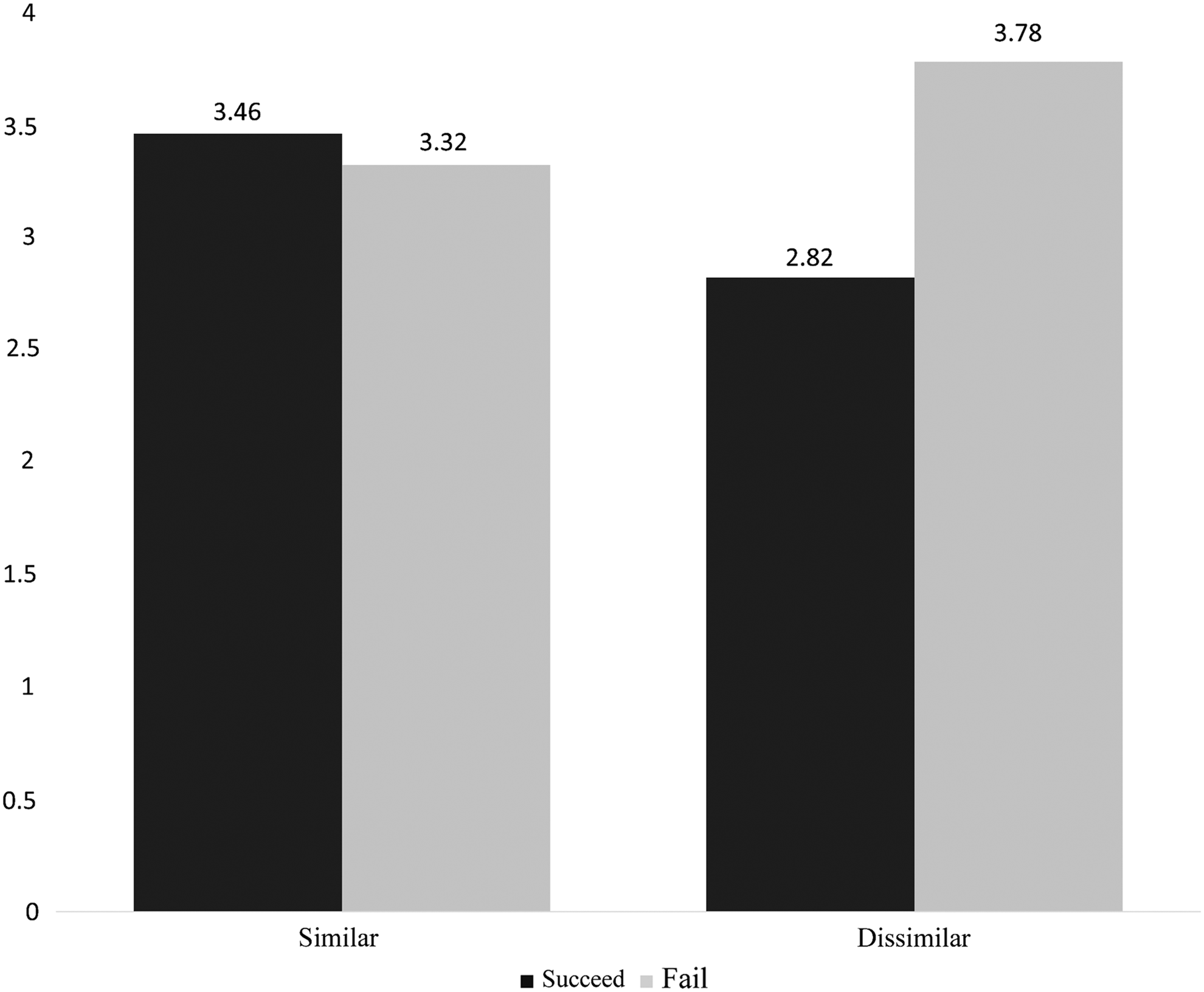
Mean comparison of self-efficacy between participants in the passive conditions.
Discussion
The aim of this study was to test the effect of digital game interactivity and performance on self-efficacy from a social cognitive theory perspective and to evaluate whether comparisons between interactive and passive gameplay are valid. It was proposed that perceived similarity to the observed player was an important moderator to the effect of performance on self-efficacy. It was found that participants who played the interactive game reported higher levels of self-efficacy compared with participants who passively watched a gameplay video. This finding is consistent with previous studies that found interactive digital games to be effective in increasing self-efficacy.1,8,15,16 However, success or failure did not affect self-efficacy in participants who played the interactive digital game. One possible explanation is that the participants did not perceive their experience of success or failure as such. Social cognitive theory argues that expected outcome is a perception that may or may not match the actual outcome. Another potential explanation is that playing the game was not challenging enough for the performance to affect self-efficacy. Several studies have argued that enactive learning is most effective when the player is sufficiently challenged. When the task is not challenging enough, or within one's capability, a success merely reinforces one's self-efficacy, while a failure can be countered by one's previous positive experiences.
An important contribution of this study was testing whether the common operationalization of digital game interactivity using interactive versus passive is a valid comparison. In line with social cognitive theory, the findings suggest that these were only comparable if the participants perceived the observed player to be similar to themselves. However, when the participants in the passive condition perceived the observed player to be dissimilar to themselves, participants actually reported higher levels of self-efficacy when they watched the observed player fail. A possible explanation is that the participants in the passive condition did not experience the task in the game. Therefore, they underestimated the difficulty of the task. However, they were forced to watch passively as the player failed repeatedly on a seemingly easy task. As a result, observing dissimilar players fail increases levels of self-efficacy. It is possible that the observers who watched dissimilar players fail were engaged in a downward social comparison.
This study has several limitations. First, only one game was tested. The results could have been influenced by many other variables associated with the game, such as pace, feedback design, and controls. This study should be replicated using other games so that the results can be more generalizable. Second, participants only played the game once for a short period. Perhaps with more practice, the participants who failed in their first game play would have greater levels of self-efficacy due to increased mastery. The findings are, however, still believed to be valid, since players who failed in the initial game play would be less likely to replay the game. It is important that the results are interpreted with these limitations in mind.
The findings reported here have important implications for future research on interactivity. When one is engaged in enactive learning, the outcome is easily attributed to one's ability. However, when one is engaged in observational learning, both performance and perceived similarity must be taken into consideration. Future research should try to prime perceived similarity before applying an interactivity manipulation in order to ensure that the results are comparable. As for practitioners seeking to apply interactive digital games for learning, it is important to ensure that the game is designed to challenge the target audiences' ability so that the game will promote self-efficacy, but not so challenging that the experience of multiple failures reduces self-efficacy.
Footnotes
Author Disclosure Statement
No competing financial interests exist.