




Abstract
Abstract
Body image disturbance (BID) is implicated in the etiology, maintenance, and relapse of the eating disorders, and remains challenging to treat. New paradigms such as virtual reality (VR) may offer an ecologically viable method to assess and treat BID. This pilot study aimed to determine if a VR environment could elicit increased BID in a nonclinical group of women who were dieting due to body image concerns or nonclinical women who were not dieting. Forty-one nonclinical females participated in the VR paradigm (a London Bus Journey), completing pre and post measures of body image satisfaction, and social evaluative concerns. Results did not support the hypothesis that the virtual London Bus would elicit increased BID. However, dieters reported significantly higher levels of social evaluative concerns and comparison to avatars during the virtual environment compared with nondieters. Participants reported acceptable levels of sense of presence and enjoyment of the VR environment. Possible explanations for the failure of the VR environment to trigger increased BID are discussed, including choice of environment and avatar fidelity. In conclusion, this pilot study suggests that VR might have potential in the treatment of disturbed body image, while highlighting the need for further research into the required levels of representational and behavioral fidelity of virtual environments and avatars.
Introduction
M
Previous studies theorized that not only does body dissatisfaction rely on one's own evaluation but also on the perceived evaluation or approval of others. In one such study, nonclinical women with high and low body concerns undertook a computerized evaluative conditioning task in which a picture of their body was always paired with a picture of a smiling face. In only those women with high levels of body concern, the pairing of their body with a positive stimulus led to increased global self-esteem and body satisfaction. 8 Similarly, Alleva et al. 9 found that “high BID” women saw others' bodies as thinner than their own. Women with “low BID” did not rate themselves differently on thinness, suggesting this dimension is less important for their self-evaluation. Individuals with eating disorders report fear of negative evaluation of appearance by others leading to psychosocial impairment, for example finding it difficult to go outside. 5 In a related field, Anson et al. 10 found individuals with body dysmorphic disorder had high levels of appearance concerns relating both to their own thoughts and to their perceptions of others' thoughts.
More investigation is required into how the perceived appraisal of others may influence BID of people with eating disorders. Further, there is limited exploration using “real-time” methodology to assess self-evaluation or perceived evaluation by others by people with eating disorders and how this may affect BID. Using methodology that is as “real life” as possible is key to ensuring that concurrent appraisals and beliefs are accessed, as methodology based on self-report may be biased. Virtual reality (VR) is more effective than traditional body image techniques. 11
Despite the crucial role of BID in eating disorders, it is often overlooked in treatment programs, possibly because it is a complex area resistant to intervention. 12 Potential challenges include limited research into the mechanisms of change in body image treatment, difficulties for individuals in expressing the construct of body image, and the possible limitation of utilizing treatments that are broadly “talking” and reasoning based in order to address a multidimensional concept.12,13 A recent review of BID treatments reported cognitive behavioral therapy as the most commonly used approach, but found room for improvement, 13 suggesting BID-focused interventions may enhance current evidence-based treatments. VR may enhance current treatments by addressing some of the above challenges, in particular by treating BID in a multidimensional and experiential manner, rather than predominantly cognitively and through high levels of acceptability and feasibility to patients.
It has been proposed that VR paradigms may be particularly effective for the assessment and treatment of BID. 12 VR is a proxy, ecologically valid method of assessing appraisals in real life, offering the unique advantage of the ability to “control” the environment and the avatars within it, thus providing a social setting that can replicated. It is therefore possible to observe how the individual interprets the avatar's behavior. An avatar that looks in the direction of the individual immersed in the virtual environment may be interpreted as a “curious glance” by an individual low in BID, while an individual high in BID may attribute thoughts such as “They think I'm fat.” VR exposure has potential for treatment. Unlike conventional exposure, the patient does not need to leave the therapy room, thus maintaining privacy, and it may also be more acceptable to patients who are highly anxious. Furthermore, it enables the clinician or researcher to be aware of exactly what is happening in real time, and may be beneficial to individuals with less imagination. For these advantages to be realized, it is imperative that the virtual environment elicits approximately similar degrees of anxiety as the real-life situation. 14
In relation to eating disorders, early studies demonstrate that VR produces similar levels of anxiety and body dissatisfaction as real life.15,16 Ferrer-Garcίa et al. 15 investigated the levels of anxiety of student controls and patients with eating disorders in five different environments, including a neutral room, kitchen, restaurant, and swimming pool. The control group demonstrated increased anxiety only in the swimming pool environment, whereas the clinical group showed significantly higher levels of anxiety in all environments compared with the neutral room. People with anorexia nervosa and bulimia nervosa had comparable emotional and physiological reactions when shown virtual food and real food but not when shown photographs of food. 16 In patients who binge eat, “eating” a forbidden food in the virtual kitchen led to characteristic reactions present in “live” binge-eating situations, including anxiety, guilt, and urge to overeat. 17 Interestingly, in contrast to their predictions, Gutiérrez-Maldonado et al. 18 found that the additional presence of avatars in the virtual environment did not have an impact on BID.
It remains unclear whether the presence of avatars in VR would trigger social evaluative concerns relating to BID. Fear of negative appearance evaluation predicts levels of body image, mood, and eating attitudes. 19 Additionally, the close relationship between social anxiety and eating disorders, 20 further supports the hypothesis that the presence of people may exert a significant impact on BID. There has been limited study of this in the VR BID field. However, one study found—in contrast to their prediction—that the presence of avatars in a restaurant VR did not have an effect. 18 They postulated that this was because participants were sitting down in the VR. Thus, a VR bus journey was selected as a familiar, everyday environment in which participants would be required to be standing and thus clearly visible to other passengers.
VR offers opportunities to investigate the social evaluative concerns of people with eating disorders. In order to determine proof of concept, a pilot study using nonclinical women with high and low levels of body concern was undertaken. The aim of this exploratory study was, first, to determine if a VR paradigm can elicit increased BID through the mechanism of self-evaluation and the perceived evaluation by others, and, second, to determine whether there was a difference between dieting and nondieting females.
Materials and Method
Participants
Twenty-one nonclinical women who were currently dieting and 20 nonclinical women who were not currently dieting participated in the study, recruited using King's College London research advertisement e-mail circular. Sample size was based on research that a total sample of between 24 and 50 is recommended for feasibility studies.21,22 Dieters and nondieters were recruited to access women with high and low levels of body concern. To ensure that groups were distinct and to assess levels of dietary restraint, all participants were screened using the Restraint Scale. 23 Participants with a score of ≥14 were classified as restrained eaters; those with a score <14 were classified as unrestrained eaters. 15 Participants who reported dieting but scored <14 were excluded from the group analysis (n = 3), and participants who did not report dieting and scored ≥14 or were excluded from the group analysis (n = 2). Thus, there were 18 participants in each group. The study was granted ethical approval by King's College London Research Ethics Committee.
VR environment
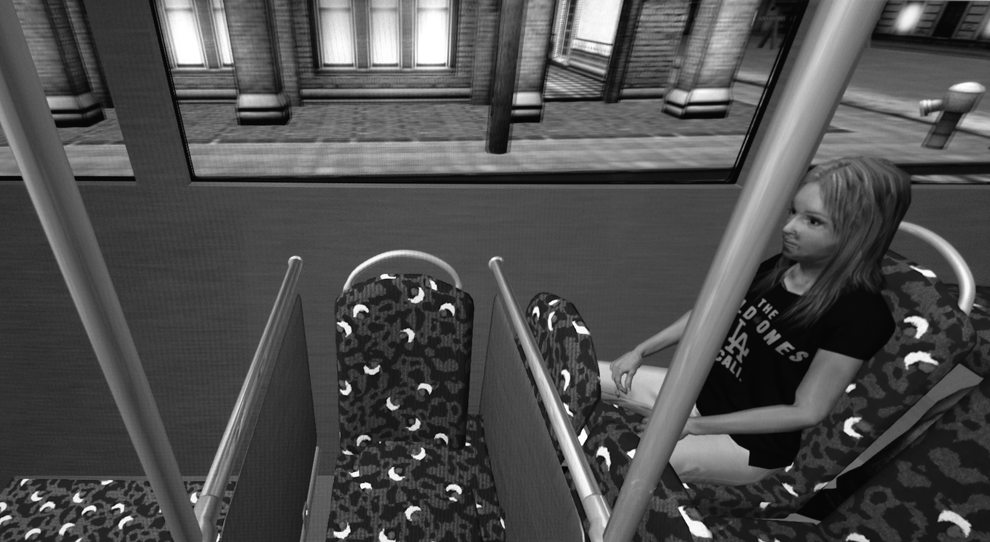
The virtual environment was a 4-minute journey on a London bus (see Fig. 1). The software was developed using the Unity software package by Ari Jacobs of “I'm VR” under commission of KCL London. “Middle VR for Unity” was used to make the software compatible with the VR hardware. The environment was displayed in color via a headset; the display used was an nVisor SX111 with headphones, with a resolution of 1,280 × 1,024 pixels, 280 × 1024 resolution, and 111° field of view with an Advanced Video Control Unit (NVIS, Reston, VA). Participants wore the headset and could move through the virtual environment on the bus by walking and whole body turning. Their head position and orientation were tracked with an inertial/ultrasonic system (IS900 VET tracking system; Intersense, Billerica, MA). A short film that demonstrates the equipment and an individual using the VR bus journey is available at
Virtual reality bus.
The VR bus journey was chosen as an appropriate scenario, as it is relatively neutral in relation to many aspects of eating disorders (e.g., in contrast to a café or clothes shop, which could trigger anxiety regarding eating or body image). The bus was populated by computer-generated characters, known as avatars, representing a mix of age, sex, and race/ethnicity. The avatars were all of normal body weight and appearance. Importantly, the avatars were programmed to display only neutral behavior, for example occasionally glancing around. Participants were not able to see their own body, nor were they represented as an avatar; they were fully immersed in the VR environment.
Procedure
All participants gave written informed consent. Participants were tested in a single session, lasting approximately 1 hour. First, participants completed demographic questions, and weight and height were recorded using calibrated scales and height measure. Participants completed the pre-VR measures. Three dieters and two nondieters were excluded at this point due to not meeting the criteria on the Restraint Scale. Participants entered the VR paradigm for a training session in order to ensure comfort and familiarity. Following this, participants entered the 4-minute VR bus journey, in which they were asked to “form some impression of what you think about the people on the bus and what they think about you.” Participants completed the post VR measures and undertook a brief semi-structured interview to elicit feedback about their experience. Participants were contacted 1 week later to determine if there were any side effects resulting from the VR.
Assessment instruments: pre-VR measures
Eating Disorders Examination Questionnaire
This 36-item 7-point self-report questionnaire assesses eating disorders pathology and is derived from the Eating Disorder Examination (EDE-Q) 24 . It consists of four subscales, measuring levels of restraint, shape concern, weight concern, and eating concern. It also assesses the level of eating disordered behaviors. The EDE-Q has good psychometric properties 25 and a clinical cutoff score of 2.3 in conjunction with objective binge episodes. 26 The Cronbach's alpha was 0.80 for restraint, 0.91 for shape concern, 0.83 for weight concern, and 0.81 for eating concern.
Restraint Scale 23
The 10-item 4-point Restraint Scale was used to assess levels of eating restraint in the dieters and nondieters in order to ensure that the groups were distinct. This method is established by Coehlo et al., 27 who identified 14 as the cutoff point to differentiate levels of restraint. The Cronbach's alpha was 0.86.
Fear of Negative Appearance Evaluation Scale
This six-item scale assesses concerns relating to negative evaluation of appearance by others. Each item is rated on a Likert scale ranging from 1 to 5, with higher scores indicating greater levels of fear of negative appearance evaluation. The Fear of Negative Appearance Evaluation Scale (FNAES) 19 has good internal consistency and is significantly correlated with other measures of BID. The Cronbach's alpha was 0.91.
Liebowitz Social Anxiety Scale
Individuals with comorbid social anxiety may present with higher levels of appearance-related concerns, particularly regarding the evaluation by others. The Liebowitz Social Anxiety Scale (LSAS) 28 was included so that levels of concern could be established in those with and without social anxiety. The LSAS is a 24-item 4-point self-report measure, which assesses levels of social anxiety. It has two subscales: fear and avoidance. Cronbach's alpha values were 0.86 and 0.77, respectively.
Assessment instruments: pre and post VR measures
Body Image States Scale
The Body Image States Scale (BISS) 29 is a six-item questionnaire that measures momentary evaluative and affective experiences of one's own physical appearance. Each item is rated on a 9-point scale. For example, participants are asked to rate “Right now, I feel … ” from “extremely dissatisfied with my appearance” to “extremely satisfied with my appearance.” The BISS was developed particularly for use in experimental manipulations, and therefore is highly acceptable to the current study. The BISS has acceptable reliability and validity. 21 The Cronbach's alpha was 0.87.
Visual analog scales
To assess how being in the social VR environment may have affected mood and BID, participants completed visual analog scales (VAS) before and after the VR experiment, rating affect (stressed/anxious/happy) and BID (attractive–unattractive/ugly–beautiful/fat–thin). Post VR only, four VAS were added: How much were you thinking about the way you look during the journey? How much were you thinking the other passengers were thinking about the way you look during the journey? How much were you comparing your appearance to the other passengers? How socially anxious do you feel with the other passengers? Two final VAS explored the experience of the VR journey, assessing level of presence or immersion and enjoyment.
Finally, because of the preliminary nature of the study, feedback was sought from participants regarding their experience of the VR environment and the avatars.
Statistical analysis
All analyses were conducted using SPSS Statistics for Windows v22 (IBM Corp., Armonk, NY). All significance tests were quoted as two-tailed probabilities. Paired sample t tests were conducted on the whole sample to determine if the VR scenario elicited an increase in BID. Independent t tests were carried out to determine that the two groups were distinct with regard to levels of restrained eating and body image concerns. A 2 × 2 (condition: nondieters vs. dieters × time: pre vs. post) design was used to analyze the data to determine if the VR scenario did induce the hypothesized increase in BID.
Results
The demographic and clinical characteristics are shown in Table 1. Most participants were women in full-time employment or study, and 75% of the sample reported themselves as white and 25% as Asian, black, or mixed background. There were no significant differences between the groups with regard to age, t(34) = −0.922, p = 0.363. The mean score for the EDEQ shape and weight concerns combined was 0.72 for nondieters and 2.67 for dieters. As expected, there were significant differences in body mass index (BMI), t(34) = −2.482, p = 0.018; restraint scale, t(34) = −10.26, p = 0.00; and all subscales of the EDEQ, thus indicating that the two groups were distinct and that the dieting group had significantly higher shape and weight concerns. The dieting group also had a significantly greater fear of negative appearance evaluation: FNAES, t(34) = −4.74, p = 0.00. There were no significant differences between the groups on social anxiety, suggesting that any findings would not relate to social anxiety.
p < 0.05; **p < 0.01.
Experience of the VR environment
Two VAS items asked about sense of presence and acceptability of the VR environment. There were no significant differences between groups. Therefore, results are presented for the complete sample. The mean score for sense of presence was 64% (range 5–100%), with 24/36 participants rating it >60%. The mean score for enjoyment of the VR environment was 60% (range 5–99%), with 22/36 participants rating >60%. At 1 week follow-up, one participant mentioned feelings of sickness for 3 hours post VR. No other participants noticed any side effects.
BID and the VR environment
Contrary to the first hypothesis, participants did not experience a change in BID after entering the VR environment. There was no significant difference on the VAS measuring body image–related items (attractive, beautiful, and fat) before and after. However, participants rated themselves as significantly less stressed after being in the VR environment, t(40) = 2.497, p = 0.017 (Table 2).
Please note the visual analog scale (VAS) descriptor is the item assigned to the 100% end of the scale.
p < 0.05; **p < 0.01.
VR, virtual reality; BID, body image disturbance.
The second hypothesis examined whether there were differences between dieters and nondieters. There was no significant time–group interaction for the BISS or the VAS that measured body image–related items (attractive, beautiful, and fat). There were no significant differences in emotional state (VAS; stressed, anxious, happy). Analysis of variance (ANOVA) results are presented in Table 3.
Please note the VAS descriptor is the item assigned to the 100% end of the scale.
p < 0.05; **p < 0.01.
ANOVA, analysis of variance.
Social evaluative concerns in the VR environment
Four post-VR VAS asked participants to what extent social evaluative concerns were present. These demonstrated that dieters reported themselves to be thinking significantly more about their appearance during the journey and to believe that others were thinking about their appearance. They also reported greater levels of comparison with other passengers and feeling more socially anxious, although all ratings were <50. Results are presented in Table 4.
p < 0.05; **p < 0.01.
Participant feedback on the VR environment
Due to the exploratory nature of the study, participants were also asked for their feedback on the VR environment. There was a high level of consensus, with participants stating they enjoyed the VR environment and found it interesting to take part. They reported a high sense of presence. Participants reported finding the bus and the buildings very realistic. Many commented on how it felt just like a normal urban bus, in that other passengers were not paying them any attention. Despite not asking directly about eye contact, two thirds of each group commented that they did not feel under scrutiny because the avatars did not make eye contact with them. Finally, some participants commented that they did not have much in common with the other passengers, and therefore this reduced anxiety regarding scrutiny. This feedback highlights significant potential limitations of the research, including lack of a sufficiently emotionally arousing VR environment and concerns regarding avatar fidelity.
Discussion
The current pilot study aimed to investigate the feasibility of using VR paradigms to assess social evaluative concerns relating to body image in women with high and low body concerns. The main hypothesis—that entering the VR scenario populated with avatars would lead to changes in state body image—was not supported, nor were there changes in analog measures of emotional state or appearance-related descriptors. Due to the main results being null, it is important to consider this research as an introductory investigation of VR environments in BID research. The groups differed significantly with their appraisals of social evaluative scrutiny while in the VR, with dieters rating themselves significantly more aware of such scrutiny.
These findings, in conjunction with participant feedback, indicate that VR may have a role in the study of body image and requires continued refinement to reach that potential. It is possible that had a group of women with eating disorders been included that greater differences may have emerged, particularly as other studies have found greater effects in individuals with eating disorders compared with noneating disorder controls. 15 A more plausible explanation, however, may relate to representational and behavioral fidelity of the avatars. In the post-VR interview, many participants commented on how “real” their sense of the bus and the town was. However, when asked about the avatars, participants commented that because the avatars did not make eye contact, they felt invisible.
Applying VR to social situations is complex, 14 and this may be exaggerated when body image is the focus. Further, the virtual environment was originally developed for a different, unrelated study. Of the seven avatars, only two were female, and only one of these was in her twenties (the average age of participants). Some participants stated that if there had been more avatars “like me,” they thought they would have been more concerned. Finally, many participants commented that the virtual bus was very real and that “everyone was ignoring everyone” as they do on a typical urban bus. Thus, it appears that being on a bus in “real life” was not associated with high levels of body scrutiny for participants. Although the virtual bus was chosen as a “neutral” scenario, it may be that a scenario that elicits greater social evaluative concerns in real life would be more effective. This supported by the finding in another study that only the swimming pool environment increased anxiety in student controls. 15
Future studies are recommended to use emotionally charged VR environments that emphasize body scrutiny (e.g., swimming pool, nightclub, highly attractive avatars). One option may be to develop avatars that can interact with the participants, for example by commenting on a physical attribute of the participant (“your hair looks nice”) or another avatar (“she looks so pretty”). Improving eye contact would add to the sense of interaction. Levels of BID may also be experimentally manipulated by asking participants to wear different clothing. An eye tracking component would also contribute to future research. Of course, as VR exposure is developed into treatment, more neutral environments are advised in order to develop a graded hierarchy for the patient.
The strengths of this pilot study include good sample size and experimental design. Due to the small-scale nature of the study, it was not possible to double blind the procedure. In order to reduce bias, the experimenter followed a script, and self-report quantitative measures were used. Another limitation is that the VR conditions were not compared to other variables (e.g., a nonimmersive movie, a blank period). Therefore, it cannot be ascertained what the use of VR added. A “nonsocial” control scenario would also enable investigation of differing levels of social evaluative concerns and the presence or absence of avatars. It is not possible from this pilot study to comment on treatment effects. A further limitation is the significant difference in BMI between the two groups. However, it is perhaps expected that those in the dieting group had a higher BMI. Although the main hypothesis was not supported, this introductory study allows further understanding of the complexities of VR and body image. As technology advances, so experimental paradigms can be enhanced.
Footnotes
Acknowledgments
This paper represents independent research part funded by the National Institute for Health Research (NIHR) Biomedical Research Centre (BRC) at South London and Maudsley NHS Foundation Trust and King's College London and NIHR/ Wellcome Trust King's Clinical Research Facility. The views expressed are those of the authors and not necessarily those of the NHS, NIHR or the Department of Health.
Author Disclosure Statement
No competing financial interests exist.