




Abstract
Abstract
Cognitive biases have previously been recognized as key mechanisms that contribute to the development, maintenance, and relapse of addictive behaviors. The same mechanisms have been recently found in problematic computer gaming. The present study aims to investigate whether excessive massively multiplayer online role-playing gamers (EG) demonstrate an approach bias toward game-related cues compared to neutral stimuli; to test whether these automatic action tendencies can be implicitly modified in a single session training; and to test whether this training affects game urges and game-seeking behavior. EG (n = 38) were randomly assigned to a condition in which they were implicitly trained to avoid or to approach gaming cues by pushing or pulling a joystick, using a computerized intervention (cognitive bias modification via the Approach Avoidance Task). EG demonstrated an approach bias for gaming cues compared with neutral, movie cues. Single session training significantly decreased automatic action tendencies to approach gaming cues. These effects occurred outside subjective awareness. Furthermore, approach bias retraining reduced subjective urges and intentions to play, as well as decreased game-seeking behavior. Retraining automatic processes may be beneficial in changing addictive impulses in EG. Yet, large-scale trials and long-term follow-up are warranted. The results extend the application of cognitive bias modification from substance use disorders to behavioral addictions, and specifically to Internet gaming disorder. Theoretical implications are discussed.
Introduction
M
Many studies indicated that neuro-bio-psychosocial signs of excessive Internet/online gaming parallel characteristics of substance and behavioral addictions, mainly pathological gambling.10–12 For example, brain structural and functional correlates of excessive gaming, such as changes in reward-learning circuitry and abnormalities in frontal brain regions that are believed to be responsible for cognitive control and control of inhibition resemble those found in problematic alcohol users.13–15 Symptoms include behavioral and cognitive salience, mood modification, tolerance, withdrawal, preoccupation, relapse, and craving.9,16,17 Excessive MMORPGers (EG) also express high novelty-seeking, risk-taking tendency and low self-esteem,18–20 and suffer significant psychological and health negative consequences.11,21 Therefore, the DSM-5 committee, considering substance use and addictive disorders, proposed diagnostic criteria of Internet gaming disorder (IGD), thus providing scientists and clinicians with a consistent classification for research that will enable IGD to be included in future versions of the DSM.22–24
Impulsivity, a central factor involved in the etiology of addictive behaviors, has been reported to be associated with and predict IGD.25–27 Several other aspects of compromised executive functions—for example impaired response inhibition, error processing, cognitive flexibility, decision making, and attentional bias for gaming-related stimuli—have been recently reported in EG.25,28–35
It is suggested that the dual process perspective of addiction14,36,37 may apply to IGD. Accordingly, impaired executive function and diminished cognitive control over reward-seeking motivational drives contribute to unconscious automatic processes that lead to persistent online gaming, despite reflective knowledge of the negative consequences.10,38 Cognitive biases (e.g., attentional and approach biases) are thought to be part of the cue-reactivity process, integral to the development and maintenance of addiction. When addicts are exposed to addiction-related cues, an automatic process occurs that manifests as physiological arousal, subjective craving, and cognitive biases.39–41 Indeed, IGD, much like substance use disorders, shows a cue-induced brain craving response11,42,43 and attentional bias toward addiction-related cues.25,33,35 However, to date, no research has investigated the process of approach bias, an automatically activated action tendency to approach addiction-related stimuli, 44 in IGD.
Cognitive bias modification (CBM) refers to procedures designed to change particular styles of cognitive processing that are thought to contribute to the development and maintenance of undesirable emotional reactions or disorders (e.g., anxiety), using systematic practice in an alternative processing style via computer-based tasks. 45 CBM experiments have demonstrated that biased cognitive processes of attention and interpretation can reliably be modified, although research on the effectiveness of attention CBM on decreasing emotional reactivity in clinical populations is limited and still in its early stage.46–48
CBM programs have been developed to target disorder-specific maladaptive cognitive processes in addiction, either through strengthening control processes 49 or through changing biases in attention and action tendencies. 36 In the alcohol Approach Avoidance Task (AAT), participants are instructed to pull or push a joystick in response to a stimulus feature (picture position) unrelated to the pictures' content. Using a retraining variety of this task, participants are trained to avoid alcohol indirectly by pushing alcohol pictures away while responding to picture position. It was demonstrated that alcohol approach bias could be modified using a single session retraining version of this task. 50 Moreover, in randomized controlled trials with alcohol-dependent patients,51,52 avoid trained patients not only reduced immediate approach bias but relapsed 10–13% less often than control patients in the following year.
The rationale of the present study was to apply the experimental logic of alcohol approach avoid retraining paradigm50,52 to retrain automatic action tendencies for gaming cues. Thus, the aims of the present study were to demonstrate an approach bias toward game-related cues in EG; to test whether approach bias to gaming cues can be implicitly modified in a single session training; and to examine whether this affects game urges and game-seeking behavior of EG.
Methods
Sample
Participants (N = 38) were recruited through online gaming groups and forums, and were eligible to enroll if they were 18–30-year-old single males, who regularly engage in MMORPGs for >10 hours a week for at least 1 year, 25 were free from significant medical or neurological conditions, and did not meet criteria for any DSM-5 Axis I disorder. Participants were Caucasian, reported an average of 16.1 weekly gaming hours, and had a high problematic gaming level (M = 2.5 on the Game Addiction Scale [GAS]).25,33 There were no significant baseline differences by experimental condition (p > 0.05). See Table 1 for demographics and gaming variables.
Note. Values shown are M (SD). Comparisons between the groups were made with a two-tailed Student's t test or chi square tests with Yates' continuity correction, as appropriate. Gambling, smoking, alcohol drinking, and psychoactive drug use were rated on one-item scales (1 = “never” to 5 = “daily”). General health was rated on a one-item scale (1 = “very bad” to 5 = “very good”). Emotional distress was measured by the General Health Questionnaire, 77 with high scores indicating higher emotional distress. Gaming addiction was measured using the Game Addiction Scale.
The study was approved by the Institutional Review Board for Ethical Research of University of Haifa. Written informed consent was obtained from all participants after a complete description of the study.
Materials and measures
Weekly hours of gaming
Weekly hours of gaming were calculated by multiplying results from two questions 53 : (a) days per week of gaming, rated on a 5-point Likert scale (1 = “never” to 5 = “almost daily”), and (b) average hours of use on a gaming day, rated on a 7-point Likert scale (1 = “don't use” to 7 = “8 hours or more”).
GAS
The GAS 54 assesses problematic gaming using 21 questions covering aspects of salience, tolerance, mood modification, relapse, withdrawal, conflict, and problems. Each statement is scored on a 5-point Likert scale (1 = “never” to 5 = “very often”), with higher average scores indicating higher likelihood of gaming addiction.
AAT
The AAT50,55 consisted of four consecutive phases that changed without participants' awareness:
(a) Practice phase (20 trials): participants learned to push or pull a joystick in response to image orientation (tilt 5° to left or right). The modified gaming version of the AAT employed a reversed movements' paradigm, since MMORPGers are used to pushing the joystick to zoom in, approaching objects within the game virtual world, and extending their virtual hand to grasp an object in the game. Therefore, pushing the joystick resulted in zooming in and increased picture size and sense of approaching, whereas pulling decreased the picture size and indicated avoidance. (b) Pretest assessment (80 test trials): participants were asked to respond to image orientation by pushing/pulling a joystick. Pictures of MMORPGs and animated movies came equally often in the push/pull format. The format was counterbalanced, with half of the participants pulling pictures tilted to the left and half pulling pictures tilted to the right. Experimental gaming pictures were in-game screenshots from six computer games that were selected according to: (a) most played popular MMORPGs in 2014,
56
and (b) most played computer games reported by participants prior to participation. Control pictures consisted of animated cartoons from popular films, similar in shade, number of characters, and overall composition, and were not present in any computer or video game.
33
(c) Approach/avoid training (440 trials with a 1 minute break every 60 trials): Breaks were inserted to decrease fatigue and enhance motivation, were the same for both conditions, and included encouraging feedback on participants' progress and number of trials left for task completion. In the avoid gaming condition, 90% of the game pictures appeared in the pull format and 10% in the push format, with reversed contingencies for movie pictures. In the approach gaming condition, all contingencies were reversed. (d) Posttest assessment (80 trials): identical to the pretest.
Behavioral measure of urge to play
Participants were presented with a blue background screen presenting dummy icons of 12 popular games, half of which appeared in the AAT (i.e., Diablo III) and half did not (i.e., Starcraft II), among other general program icons (i.e., my computer, Internet Explorer, etc.). The icons did not start the actual game, but rather recorded the number of times participants pressed each icon, thus providing a measure for game-seeking behavior.
Subjective current gaming urge
The subjective current gaming urge was assessed using a 10-point visual analogue scale (0 = “not at all” to 10 = “very much”). 42 This measure is widely used to assess craving for psychoactive substances.57,58
Game playing intentions
Game playing intentions were measured by a time allocation task. Participants were presented with names and icons of 12 popular MMORPGs, six of which appeared in the AAT. Participants were instructed to allocate 1,000 minutes of gaming time between these games according to their will to play. The index is the total time allocated to games presented in the AAT.
Procedure
The study design was a single session, randomized controlled pilot trial. A week prior to participation, participants filled in an online screening questionnaire asking about gaming habits and the GAS. Participants were randomized 1:1 into two groups: avoid training (index group; n = 19), or approach training (control group; n = 19).
Upon arrival, participants indicated their craving to play computer games. The AAT was then performed. Immediately afterwards, participants indicated their craving for gaming again and were given a short demographic questionnaire. In order to measure game-seeking behavior, the experimenter told the participant he was going to change money in order to pay them later, and instructed them to fill in the given questionnaire. In case they finished before he returned, they could use the laboratory computer at their convenience. The experimenter left the computer screen presenting the desktop with popular game dummy icons, and left the room. The experimenter returned after eight minutes. Participants completed the time allocation task, and were debriefed, thanked, and paid €15 for participation.
Statistical approach
The strength of motivational biases (i.e., to approach or avoid) toward the two image categories (gaming/movies) was calculated by subtracting the median50,59,60 “pull = avoid” reaction time from the median “push = approach” reaction time (RTpull − RTpush) for each image category, with positive difference scores indicating an approach bias (i.e., faster to pull than to push). These delta scores were then standardized for further analyses. Mixed analyses of variance (ANOVA) were computed to test for differences pre- and post-CBM. A priori power analysis using Gpower 61 indicated that a sample size of 32 would be sufficient to detect a significant medium-large effect (f = 0.30) with alpha level of 0.05.
Results
Automatic action tendencies to gaming among problematic gamers
Pretest delta AAT scores for each picture category (gaming, movies) were analyzed using a paired samples t test, in order to examine baseline approach tendencies to gaming among EG. Analysis revealed higher approach tendencies to gaming pictures (M = 50.1, SE = 11.1) than for movie pictures (M = 25.1, SE = 9.6), t(37) = 2.08, p < 0.05, d = 0.34, thus indicating that EG show approach bias to gaming pictures.
CBM effects on gaming approach tendencies
A significant interaction between time, picture type, and experimental condition was found using 2 × 2 × 2 mixed ANOVA, with picture type (gaming, movies) and time (pretest, posttest) as within-subjects factors, and experimental condition (approach or avoid retraining) as the between-subjects factor F(1, 36) = 7.86, p < 0.01, η2p = 0.18. Follow up analyses using paired samples t tests indicated that approach bias for gaming pictures decreased, t(17) = 2.24, p < 0.05, d = 0.53, following avoid gaming training (pretest: M = 0.03, SE = 0.12; posttest: M = –0.31, SE = 0.15), whereas approach bias to gaming pictures increased, t(19) = –2.10, p < 0.05, d = 0.47 following approach training (pretest: M = –0.14, SE = 0.13; posttest: M = 0.32, SE = 0.24; see Fig. 1). The change in AAT scores was not significant for movie pictures (p > 0.3). Participants reported no awareness of the change in contingencies from pre- to posttest AAT.
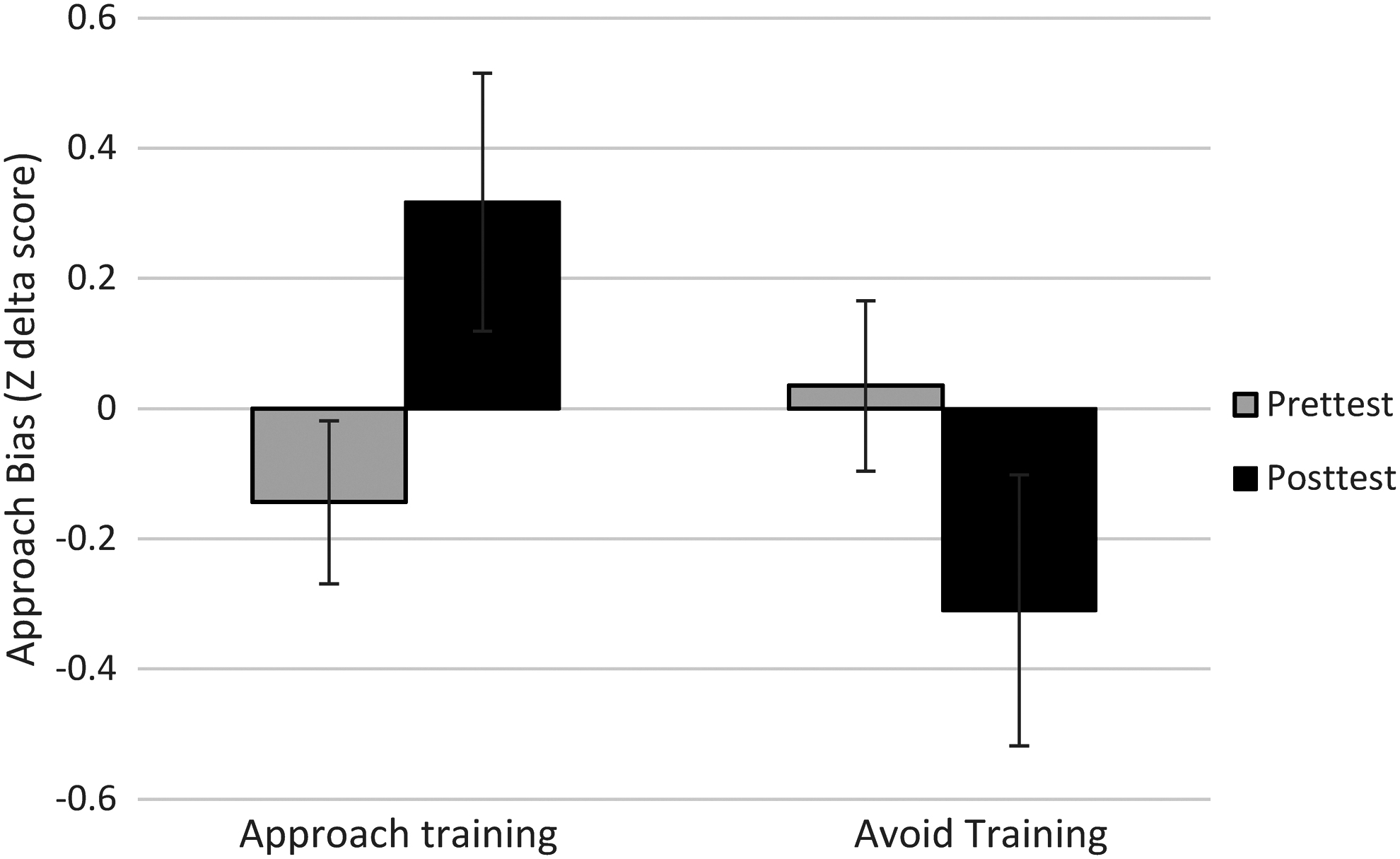
D scores on the games approach/avoidance task for participants in the two groups (approach and avoid). D scores were standardized difference scores, derived at pretest and posttest from the difference between mean response latencies for avoidance movements to pictures (pulling a joystick) and approach movements to pictures (pushing a joystick); a positive value indicates an approach bias, and a negative value indicates an avoidance bias. Error bars indicate ± 1 standard error of the mean.
CBM effects on game playing intentions
Following a significant correlation between intentions to play and gaming addiction, r(38) = 0.33, p < 0.05, a one-way analysis of covariance with GAS as a covariate was used to analyze the effect of CBM on intentions to play MMORPGs. Following CBM, participants in the avoid gaming condition allocated less time to games that appeared in the AAT (M = 352.2, SE = 70.1) compared with time allocated to these games by participants in the approach condition (M = 534.4, SE = 71.6), F(1, 37) = 4.32, p < 0.05, η2p = 0.11.
CBM effects on self-report and behavioral measures of urges to play
Using a 2 × 2 mixed ANOVA, with time (pre- and post-CBM) as the within-subjects factor, and experimental condition (approach or avoid retraining) as the between-subjects factor, a significant interaction between time and experimental condition was found, F(1, 33) = 11.41, p = 0.002, η2p = 0.26. Follow-up analyses using paired samples t tests indicated that craving for computer gaming decreased, t(15) = 7.57, p < 0.001, d = 1.89, following avoid gaming training (pretest: M = 8.6, SE = 0.29; posttest: M = 5.2, SE = 0.43), whereas approach training did not affect craving, t(18) = 0.88, p = n.s., d = 0.20 (pretest: M = 8.2, SE = 0.47; posttest: M = 7.6, SE = 0.55). Analysis also revealed a significant main effect of time, F(1, 33) = 22.81, p < 0.001, η2p = 0.41: craving for computer-gaming was higher pretraining (M = 8.4, SE = 0.29) compared with post-training (M = 6.4, SE = 0.36). Also, a main effect of condition, F(1, 33) = 4.30, p < 0.05, η2p = 0.12, revealed that the approach group reported higher subjective craving (M = 7.9, SE = 0.34) than the avoid group (M = 6.9, SE = 0.37).
Using an independent samples t test, it was found that participants who were trained to avoid gaming pressed less frequently on game icons (M = 2.7, SE = 0.3) compared with participants who were trained to approach gaming (M = 5.5, SE = 1.4), thus showing lower game-seeking behavior, t(13) = 2.43, p = 0.03; d = 1.30.
Discussion
This study demonstrated an approach bias toward game-related cues in excessive MMORPGers. In a randomized, controlled pilot trial using a modified gaming version of the well-validated AAT, it was shown that a single session CBM resulted in a significant decrease in automatic action tendencies to approach gaming cues. Furthermore, approach bias retraining reduced subjective urges and intentions to play MMORPGs, as well as decreased game-seeking behavior.
The finding that EG were faster to approach than to avoid gaming cues indicates an approach bias in EG specific for gaming-related images, but not for neutral movie cues. Previous research using the AAT has found similar bias for cigarettes,62,63 cannabis, 64 and alcohol, 60 suggesting that EG have yet another behavioral feature comparable to established addictions. By demonstrating approach bias in a behavioral addiction for the first time, results lend further support to the current conceptualization of addictive behaviors mirroring the clinical phenotypes seen in substance use disorders.17,65
Whereas evidence for attention bias, impaired response inhibition, and cognitive flexibility were previously reported in IGD,28–34 the current research demonstrates yet another cognitive bias thought to be part of the dual processes integral to the development and maintenance of addiction. These perspectives suggest that persistent engagement in addictive behavior is the result of an imbalance between an impulsive system that promotes automatic, habitual, and salient behaviors, and impaired reflective system for decision making. Future work should explore whether the cognitive deficit identified is evident before addiction, thus signaling risk, or is a consequence of repetitive engagement in habitual behavior. 65 Findings could imply that because of their automatic action tendencies toward game-related cues, high-level problematic gamers might have more difficulty restraining from starting a game or disengaging from a gaming session once started.
Studies of other appetitive targets have demonstrated a link between approach bias and consumption. For example, approach bias for alcohol has been associated with greater weekly alcohol consumption 66 and higher frequency of binge drinking 44 in heavy drinkers. Similarly, approach bias for cannabis has been shown to predict increased cannabis use in heavy cannabis users. 64 Future research will need to determine whether a similar link exists between approach bias for gaming cues, gaming behavior, and gaming addiction severity.
Based on the proposed neurocognitive perspective for IGD,10,11 a modified gaming version of the AAT was used in a randomized, controlled pilot trial. Results indicate that a single session CBM in EG reduced automatic action tendencies to approach gaming cues. These results are in line with previous studies that successfully retrained approach bias in cigarette smokers, 67 heavy alcohol drinkers, and alcohol-dependent patients,51,52,68,69 providing further evidence for a generalized effect of the AAT training. CBM increased control over gaming cue reactivity, suggesting that dual process perspectives of addiction14,36,37,70 may be useful in understanding IGD.10,11 Furthermore, this minimal intervention reduced subjective urges and intentions to play, as well as decreased game-seeking behavior. Thus, training not only improved performance on the cognitive bias test, but the benefits of training were also seen to transfer to other untrained emotions, cognitions, and behaviors (for a related discussion, see Owen et al. 71 ) that are associated with addiction severity and relapse.41,72
Prior studies that failed to show short-term effects of CBM on craving proved clinically beneficial in reducing subsequent consumption and relapse rates when coinciding with other treatment for addictive disorders.50,51,68 It is yet to be determined whether these short-term behavioral and subjective effects of CBM on EG will generalize outside the lab setting and for how long. In addition, the optimal number of training sessions for EG is a question that still needs to be addressed, as former studies with long-lasting clinical results have used multiple sessions.50–52,68,69 Nonetheless, the promising immediate decrease in craving and game-seeking behavior suggest a causal influence of CBM, 48 and therefore provides further support for theoretical models that posit a causal influence of cognitive bias on addictive behaviors,40,73 including IGD. As prior CBM administered in participants' home environments promote reductions in bias, craving, and substance use,67,74,75 future automated web-based and mobile CBM might be even more beneficial for gamers than the classic lab version of the AAT.
Limitations
Several limitations of this study are noted. First, only men were analyzed, with the majority of MMORPGers characteristically being men. 76 Men are more likely to play games excessively and are more prone to experience negative consequences due to their gaming behavior.33,38 Thus, these results may generalize to most gamers. However, further research may provide valuable insights into the differences between male and female gamers. Second, this study excluded participants with multiple addictions and those with psychiatric disorders. Thus, the results should be generalized cautiously to these groups. Third, this study lacks a control group of nonexcessive MMORPGers, following former CBM studies that include only hazardous/dependent drug users. Including participants who engage in other forms of video gaming might reveal the processes in which cognitive biases relate to IGD development. Fourth, participants reported an average of only 16 weekly gaming hours. However, they were all working adults with a high problematic gaming level. Future studies should try to replicate the present findings in a sample with higher daily gaming hours.
Conclusion
This study provides the first evidence for the existence of approach bias to gaming cues in EG, thus lending further support for the similarities between substance and behavioral addictions. Furthermore, by showing that CBM affects approach bias, craving, and game-seeking behavior, this study lays the groundwork for understanding the development of IGD through mechanisms of the dual process model. Future studies should explore the mechanisms behind IGD and the long-term effects of CBM.
Footnotes
Acknowledgments
An earlier version of this work has been presented at the 2015 International Conference on Behavioral Addictions (ICBA), Budapest, Hungary.
Author Disclosure Statement
No competing financial interests exist.