




Abstract
Abstract
Individuals who play Internet games excessively show elevated brain reactivity to game-related cues. This study attempted to test whether this elevated cue reactivity observed in game players is a result of repeated exposure to Internet games. Healthy young adults without a history of excessively playing Internet games were recruited, and they were instructed to play an online Internet game for 2 hours/day for five consecutive weekdays. Two control groups were used: the drama group, which viewed a fantasy TV drama, and the no-exposure group, which received no systematic exposure. All participants performed a cue reactivity task with game, drama, and neutral cues in the brain scanner, both before and after the exposure sessions. The game group showed an increased reactivity to game cues in the right ventrolateral prefrontal cortex (VLPFC). The degree of VLPFC activation increase was positively correlated with the self-reported increase in desire for the game. The drama group showed an increased cue reactivity in response to the presentation of drama cues in the caudate, posterior cingulate, and precuneus. The results indicate that exposure to either Internet games or TV dramas elevates the reactivity to visual cues associated with the particular exposure. The exact elevation patterns, however, appear to differ depending on the type of media experienced. How changes in each of the regions contribute to the progression to pathological craving warrants a future longitudinal study.
Introduction
I
Previous neuroimaging studies of cue reactivity in excessive Internet game users help us to understand the atypical motivational processes associated with Internet game addiction. However, a less frequently addressed but equally important question is whether the elevated cue reactivity and the associated pattern of neural activity are the consequence of repetitive exposure to Internet games. Furthermore, it would be worth investigating whether the observed post-exposure changes to brain cue reactivity are specific to Internet games or whether they are generalizable to exposure to other media such as TV dramas. As compared with viewing TV dramas or movies, playing Internet games have a greater impact on the player due to characteristics unique to playing games. Specifically, playing games entails interactive participation from the player, identification with the characters in the game, and explicit rewards and punishments, making gaming distinct from TV dramas, which entail a passive role of viewing. 10 These characteristics may increase the motivational and emotional value of the game cues and result in a greater brain reactivity to these cues in experienced game players. Therefore, the inclusion of a participant group who were repeatedly exposed to an Internet game and a separate group exposed to TV dramas would help identify changes in cue reactivity pertaining specifically to playing Internet games.
This fMRI study attempted to elucidate post-exposure changes that occur in brain reactivity to cues associated with an Internet game. It also tested if similar cue reactivity changes can be found after exposure to a TV drama. Healthy men and women without a history of excessive Internet game play were recruited, and each was assigned to one of three exposure groups: Internet game, TV drama, or a no-exposure control. The Internet game group played an online Internet game for 2 hours/day for five successive weekday sessions. The drama group viewed episodes of a fantasy TV drama for the same amount of time and on the same schedule as the Internet game group. Participants in the no-exposure group did not receive any laboratory exposure to the Internet game or the drama treatment. All participants performed a cue reactivity task with game, drama, and neutral visual cues in the brain scanner two times, before and after the exposure sessions. It was predicted that the post-exposure changes in brain reactivity in response to game-related cues would be observed in the game group but not in the other groups. Specifically, greater increases in brain cue reactivity were expected in the lateral prefrontal regions implicated in self-control. 11
Methods
Participants
Thirty healthy right-handed college students (11 women, 23.73±2.28 years; 19 men, 24.47±2.61 years) were recruited using advertisements. Participants were excluded if they (a) had a current or past diagnosis of any psychiatric illness or neurological disorder, (b) had a history of substance abuse or dependence, (c) used Internet games for more than 90 minutes/week, or (d) watched TV dramas for more than 60 minutes/day. Participants gave written informed consent prior to participation after the procedures were fully explained. This study was performed in accordance with the Declaration of Helsinki and the procedures were approved by the local Institutional Review Board. Participants were randomly assigned to one of the groups and monetarily compensated for their time. All participants completed Young's Internet Addiction Test (YIAT) 12 and the Barratt Impulsiveness Scale (BIS). 13 YIAT scores between the two groups were comparable (game: M=36.10, SD=6.70; drama: M=33.90, SD=7.58; control: M=39.50, SD=7.50), F=1.47, n.s. Similarly, BIS scores did not show any differences between the groups (game: M=50.30, SD=10.74; drama: M=45.70, SD=6.82; control: M=46.50, SD=7.75), F=0.82, n.s.
Procedures
Participants in the game and drama groups visited the lab a total of seven times on different days. During their first visit to the lab, all participants performed a cue-induced reactivity task inside the brain scanner. Participants returned within a week to begin five successive weekday sessions of game or drama exposure. Specifically, the game group played the online Internet game Diablo III (DB III; Blizzard Entertainment, Inc.), which is an action role-playing video game. This game features a fantasy virtual world with unrealistic characters such as a wizards, barbarians, and demon hunters. The drama group watched a TV drama series, Legend of the Seeker—Season 1 (LOTS), which also featured an unrealistic fantasy world with wizards and warriors. Both groups had 2 hours of exposure to their respective media in each daily session. Both the game and drama were viewed on a computer with a 17 inch monitor.
Within 24 hours of completion of the last daily session with the game or drama, participants again visited the brain imaging center to perform the cue reactivity task. The pre- and post-exposure cue reactivity tasks were identical, except for the order of image presentation. Participants in the control group were also scanned twice with the same time interval as the exposure groups. During the 5 day experimental period, the control group continued with their everyday lives without experimental constraints.
Materials and task
A total of 329 available images from DB III and LOTS were collected from the Web. A separate group of 10 volunteers rated the collected images for emotional valence (1=“unpleasant,” 7=“pleasant”) and arousal (1=“not arousing,” 7=“highly arousing”), together with neutral pictures selected from an in-house picture database. Forty standardized visual images were selected from each of the DB III (valence: M=4.26, SD=0.47; arousal: M=3.07, SD=0.46), LOTS drama (valence: M=4.27, SD=0.49; arousal: M=3.05, SD=0.45), and neutral (valence: M=3.88, SD=0.53; arousal: M=3.81, SD=0.94) picture categories. Selected images from the game and drama scenes were closely matched for emotional valence and arousal. Considerable effort was made to match the semantic content and visual complexities of the images across the three picture categories. That is, equal numbers of game and drama images were selected from eight different semantic classes (e.g., background scenes, using magic, magic items, battle, a character, several characters, a monster, several monsters). Similarly, neutral pictures were also selected to be similar but categorized into more realistic semantic classes (e.g., background scenes, manipulating objects, realistic objects, group interaction, a character, several characters, an animal or plant, several animals or plants).
Inside the scanner, participants viewed a total of 120 images during the cue reactivity task. Each trial began with a fixation cross that appeared on the screen for 3 seconds, followed by an image for 4 seconds. A cross hair fixation point was then presented for 2 seconds (Fig. 1). Following this, a picture from the Self-Assessment Manikin (SAM) with a 4-point Likert scale (1=“no or little,” 2=“somewhat,” 3=“moderate,” 4=“a lot”) appeared for 3 seconds, during which participants rated with a button press the level of craving for the DB III game. The order of image presentation was pseudo-randomly organized so that no more than two images from the same category were presented consecutively.
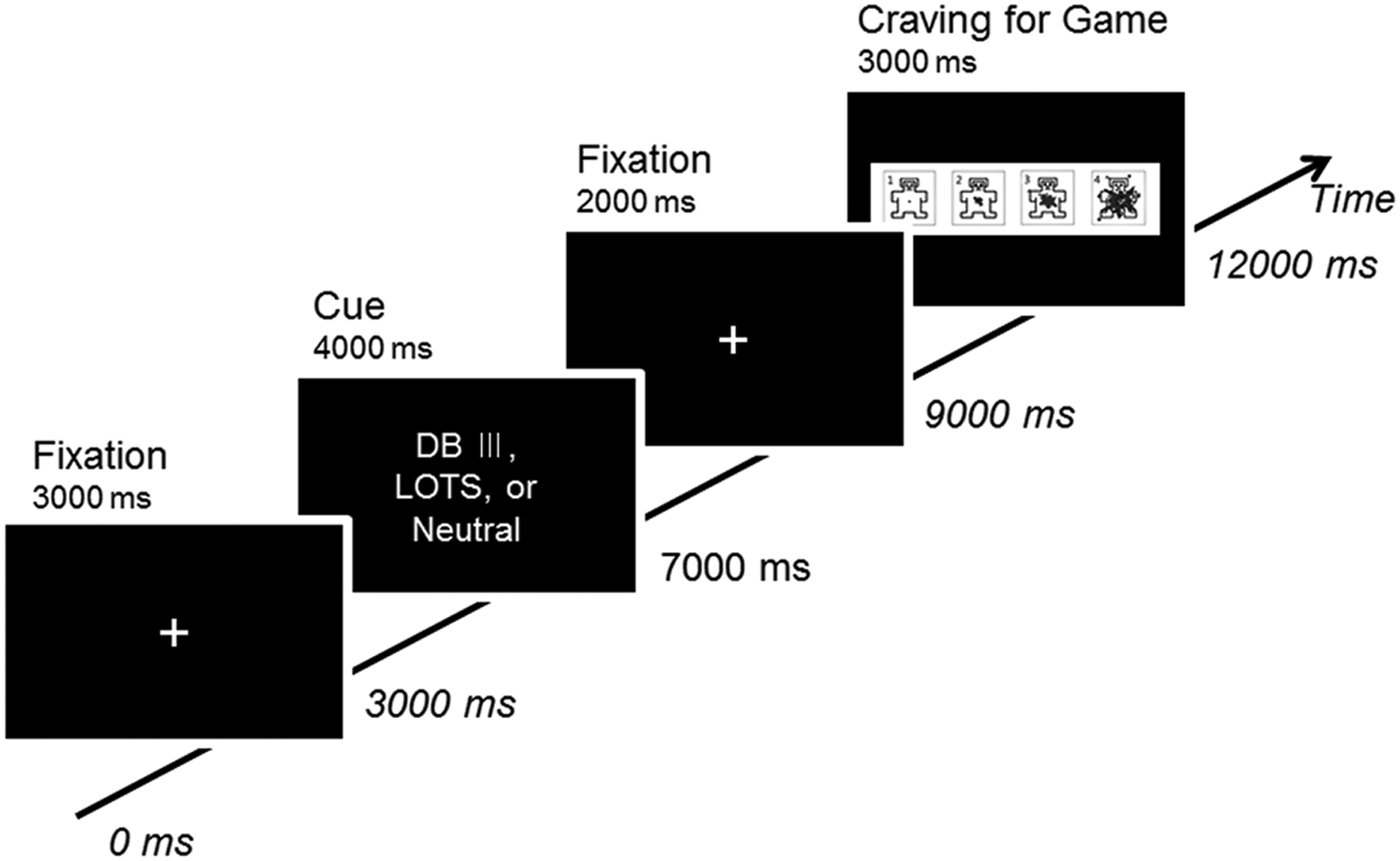
Illustration of the in-scanner cue reactivity task trial. Diablo III (DB III); Legend of the Seeker (LOTS).
Imaging data acquisition
Images were acquired using a 3T Siemens Trio scanner (Siemens Medical Solutions, Erlangen, Germany). A high-resolution T1-weighed whole-brain anatomical scan (1 mm3 voxel resolution, magnetization prepared rapid acquisition) with a gradient echo scan was also acquired. Functional brain images during the task were acquired in 36 axial slices using an echo planar imaging (EPI) pulse sequence, with a repetition time (TR) of 2,000 ms, a echo time (TE) of 30 ms, a flip angle of 90°, 240×240 mm2 field of view, a matrix size of 64×64, and a slice thickness of 4 mm with no gaps. The stimuli were presented on a computer screen using fMRI-compatible video goggles (Nordic Neurolab, Bergen, Norway). Responses were made via a fiber optic button box (Current Designs, Philadelphia, PA).
Imaging data analysis
Brain image preprocessing and statistical analyses were performed using SPM8 (
Defining regions of interest
Brain regions reactive to game cues were first identified from images obtained prior to the daily exposure sessions, and served as regions of interest (ROIs) for further analysis. A linear contrast of (DB III cues – neutral cues) was computed at the individual level and then taken to a second-level group analysis. A one-way analysis of variance (ANOVA) with the factor Group (game, drama, and control) revealed no differences in activation between groups. All group data were then combined and a one-sample t test was performed on the (DB III – neutral) contrast to search for ROIs reactive to game cues relative to neutral cues. The search for ROIs was limited to brain areas that had been shown to be consistently activated in previous brain cue reactivity studies of Internet game addiction4,6,7,9: the lateral prefrontal cortex (VLPFC and DLPFC), anterior cingulate, posterior cingulate, caudate, insula, and precuneus. ROI masks were created bilaterally using the Wake Forest University (WFU) Pickatlas toolbox (
Exposure-dependent changes in ROI reactivity
Brain images obtained after daily exposure sessions were also modeled for each image category. Percent signal changes from each of the ROIs were extracted as described above. For statistical analysis, exposure-dependent changes in PSC for each ROI were calculated by subtracting pre-exposure values from the post-exposure values (post-exposure PSCROI – pre-exposure PSCROI, separately for each cue type). Changes in PSC scores were then submitted to 3×3 (Group: game, drama, and control×Cue: DB III, LOTS, and neutral) repeated ANOVAs in PASW Statistics for Windows v18 (SPSS, Inc., Chicago, IL) to determine whether the exposure-dependent changes varied as a function of either the exposure group or the cue type.
Results
Behavioral results
A 3×3 (Group: game, drama, and control×Cue: DB III, LOTS, and neutral) mixed ANOVA on exposure-dependent craving changes (post-exposure – pre-exposure) revealed a Cue×Group interaction effect, F(4, 54)=5.26, p<0.001. Follow-up t tests indicated that the game group showed an increased exposure-dependent craving for the game cues compared with the drama cues, t=2.49, p<0.05, and neutral cues, t=2.38, p<0.05 (Fig. 2). The drama and control groups showed no differences in exposure-dependent craving changes across the different cues, t<2. No main effects of Cue or Group were found, F<1.

Changes in subjective craving for the game as a function of cue type and group. *p<0.05.
Neuroimaging results
A 3×3 (Group×Cue) ANOVA on exposure dependent PSC changes revealed an interaction effect of Cue×Group in several ROIs, including the right VLPFC, left caudate, posterior cingulate, and bilateral precuneus. To reveal the nature of these interactions, follow-up tests were conducted on each ROI. It was found that the game group showed greater exposure-dependent increases in VLPFC activity for game cues relative to drama or neutral cues (Fig. 3). On the other hand, the drama group showed greater exposure-dependent activity increases in response to drama cues in the left caudate, posterior cingulate, and bilateral precuneus, relative to game and neutral cues (p<0.05; Fig. 3). The game group showed no statistically significant exposure-dependent activity increases to drama cues relative to game cues, and the drama group showed no statistically significant exposure-dependent activity increases to game cues relative to drama cues, in any of the ROIs (p>2).
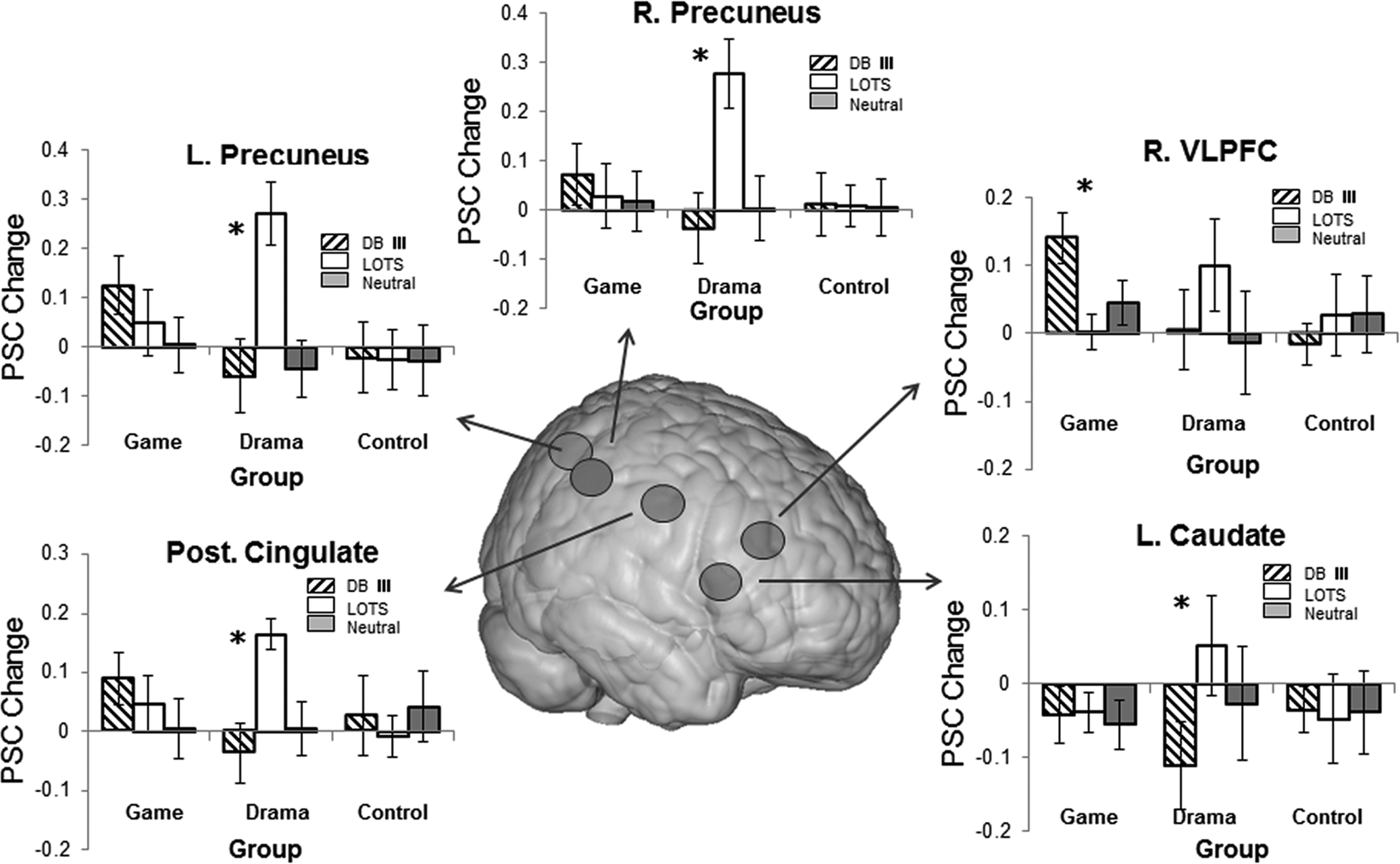
Exposure-dependent cue reactivity changes for different cues in the right ventrolateral prefrontal cortex (VLPFC), left caudate, posterior cingulate, and bilateral precuneus. Bar graphs illustrate (post–pre) difference scores of percent signal change (PSC) in each ROI as functions of cue type and group. The asterisks indicate significant differences (*p<0.05).
Correlation analysis
Whether changes in self-reported online craving for the game correlated with the changes in PSC of ROI activity was tested by conducting a Pearson correlation coefficient analyses. A positive correlation was found between changes in game craving and changes in VLPFC activity, r=0.46, p<0.01 (Fig. 4). That is, individuals with greater increases in VLPFC activity in response to game cues showed greater increases in reported craving for the game. Statistical significance also remained when results were considered for the game group only (n=10), r=0.67, p<0.05.

Illustrations of positive correlations between changes in VLPFC activity and subjective craving.
Discussion
The current study investigated brain regions showing elevated activity in response to the presentation of game cues after 10 hours of playing DB III. As predicted, the game group showed increases in subjectively reported craving for the game in response to game cues relative to other cues after the exposure sessions. The game group also showed greater increases in experience-dependent brain reactivity to game cues relative to other cues in the right VLPFC. The right VLPFC region has been implicated in inhibitory self-control. 11 In particular, when self-control occurs incidentally without conscious intention or awareness of regulatory processes, the right VLPFC often shows activation.16,17 Therefore, the increased right VLPFC activity in response to game cues might be associated with an increased need for self-control as participants' craving for the game increased. The observation that participants experiencing greater increases in motivational craving for the game also showed greater increases in the VLPFC activity supports this view. As participants felt a greater level of craving for the game, they might have needed to exercise a greater level of self-control, regardless of their conscious awareness, in order to remain focused and complete the required task. This view is in line with previous reports describing that the majority of game users had experienced automatic activations of mental processes and motor impulses associated with the game even after the end of the game playing, which has been referred to as game transfer phenomena (GTP).18,19 Typically reported GTP have included urges to use game elements in real-life settings, involuntary motor execution, and sensory hallucinations. These automatically elicited GTPs would be the subjects of self-control to perform an everyday life task normally. It has been suggested that game users with low self-control report more problems with GTP. 17
Unlike the present findings, a previous study found experience-dependent changes in reactivity to gaming cues in the ventral anterior cingulate and superior frontal gyrus. 20 This inconsistency could be due to multiple factors, such as the game genre (a fighting action game vs. an action role-playing game), the comparison condition (neutral vs. drama), and hours of experience (60 hours vs. 10 hours). In particular, the hours of gaming experience might be critical. Since in the previous study participants played the game for a longer period, they might have experienced a greater level of craving, which may have required a greater level of self-control. Previous fMRI studies have suggested that an easier version of an inhibitory self-control task activates the right VLPFC, whereas a difficult version of the task activates the anterior cingulate and medial prefrontal regions.21,22 Therefore, the differences in regional activations between the previous and current studies could be due to the differences in duration of exposure to the game. Longitudinal studies with multiple neuroimaging scans would be useful to clarify this issue.
Interestingly, the current study found that 10 hours of exposure to a fantasy TV drama induced greater reactivity to drama cues in the left dorsal caudate, posterior cingulate, and bilateral precuneus. The caudate has been implicated in the coding of reward magnitude and the elicitation of approach motivation. 23 The dorsal caudate was found to be more involved in the consumption of a reward, in contrast to the ventral caudate that is involved more in the expectation of a reward. 24 The increased activation of the dorsal caudate in the drama group during presentation of the drama cues appears to be associated with the rewarding experiences that drama watching may provide to the viewers. Viewers of TV dramas and movies reported to experience rewarding feelings while viewing TV dramas. 25 That is, watching dramas generated emotions such as fun and excitement; in addition, it was found to satisfy psychosocial needs such as social connectedness. 25 Because the drama cues were screen shots from the drama, viewing the drama cues was somewhat similar to watching the drama. The increased activation in the posterior cingulate and precuneus in response to drama cues supports this interpretation. These two posterior brain regions are reciprocally connected, 26 and they are often activated during episodic memory retrieval of familiar stimuli 27 and visual imagery during conscious memory recollection. 28 Therefore, in the drama group, the drama cues appear to stimulate visual imagery and conscious recollection of contextually related scenes and elements from the drama, which could generate rewarding feelings and result in increased dorsal caudate activation. From this perspective, the absence of increases in caudate activation in the game group could be explained by the different nature of game cues as opposed to drama cues. Presentation of the game scenes as game cues would be very different from the actual experience of playing the game. The actual availability of the game would have been a critical factor to determine activity in the dorsal caudate in the game group. 29
Despite the novel observations of this study, it admittedly has some limitations. Though considerable effort was put into matching the visual and semantic properties of game and TV drama cues so that they were as similar as possible, it is possible that the observed effects were not due to differences between the type of media but to differences in inherent to the media (e.g., storyline and fictional world). This ambiguity could be further resolved in future studies by using video games and TV drama series that are based on the same original work (e.g., Game of Thrones), which would allow much more closely matched cues to be used from the same storyline and background context. This would help to identify and differentiate cue reactivity specifically associated with the type of media. Another limitation of the study is the use of different inclusion cutoff times for game playing (<90 minutes/week) and TV drama watching (<60 minutes/day). The aim was to recruit individuals who were relatively naive, without excessive prior exposure to Internet games and TV dramas. The cutoffs chosen were based on empirical data from the authors' previous problematic Internet use study and other survey studies. In the previous study, young adults without problematic Internet use reported to engage in Internet games for an average of 98.63 minutes/week. Therefore, 90 minutes/week was set as the cutoff for the current study. Similarly, as young adults were found typically to watch a single, 1 hour long TV drama each day, thus 60 minutes was used as the cutoff for drama watching. However, it is unclear whether these seemingly different cutoffs for game and drama use before participation might have contributed to the differences observed in exposure-dependent cue reactivity.
The current study investigated exposure-dependent changes in brain reactivity to game cues as well as drama cues. Increased reactivity was found to game cues in the VLPFC, a brain region known to be involved in self-control, after 10 hours of playing an Internet game. Furthermore, individuals in the game group who showed greater VLPFC changes after the daily sessions also showed greater increases in subjective craving for the game. The interactive nature of Internet games may have elicited a greater need for self-control. 19 Interestingly, changes in brain cue reactivity were also found in individuals exposed to a fantasy drama. These participants showed exposure-dependent increases in drama cue reactivity in the caudate, posterior cingulate, and precuneus. Activity increases in these regions appeared to be related to conscious recollection and related visual imagery of particular scenes from the drama upon viewing the drama cues.
To conclude, gaming experience was found to alter brain responses to game-related stimuli. Experience-dependent changes were also found when viewing a TV drama, although the exact brain areas of the changes differed depending on the type of exposure. Follow-up studies are warranted to determine further psychological and neurophysiological correlates associated specifically with different forms of entertainment media.
Footnotes
Acknowledgments
This work was supported by the National Research Foundation of Korea (NRF) grants funded by the Ministry of Education, Science and Technology, the Republic of Korea (No. 2012R1A2A2A01012159 and 2014R1A1A2059849).
Author Disclosure Statement
No competing financial interests exist.