




Abstract
Abstract
The goal of this study was to investigate whether exposure to sexual reality television content and Internet pornography (IP) is related to sexual self-presentation on social media. Based on a two-wave panel survey among 1,765 adolescents aged 13–17 years, we found that watching sexual reality television content stimulated adolescents to produce and distribute sexual images of themselves on social media. In turn, sexual self-presentation on social media led adolescents to watch sexual reality television content more frequently. These relationships were similar among boys and girls. No reciprocal relationship between exposure to IP and boys' and girls' sexual self-presentation on social media was found. The results suggest that sexual content in mainstream mass media may predict adolescents' sexually oriented behavior on social media and vice versa. Moreover, adolescents seem to differentiate between types of sexual content (i.e., mainstream versus more explicit sexual content) when incorporating sexual media content in their sexual behavior online.
Introduction
S
Against this background, scholars have observed that the prevalence of sexual self-presentations on social media seems to reflect the prevalence of sexual messages in mass media content popular with adolescents.7–9 Consequently, scholars studying mass 10 as well as social 8 media have called for research, studying relationships between exposure to sexual content in mass media and the use of social media to distribute user-generated sexual content. To address this lacuna, the current study aims to investigate associations between exposure to sexual content in mass media and boys' and girls' sexual self-presentations on social media.
Regarding mass media, the study will focus on sexually oriented reality television content and Internet pornography (IP) because of their popularity among adolescents and their high degree of sexual content. Reality television attracts large numbers of adolescent audiences11,12 and is characterized by its focus on sex.11,13–16 In terms of IP, most individuals are likely to encounter pornography in adolescence17,18 with approximately 10 percent identifying themselves as frequent users. 19 IP can be described as “professionally produced or user-generated pictures or videos (clips) on or from the Internet that are intended to arouse the viewer. These videos and pictures depict sexual activities, such as masturbation as well as oral, anal, and vaginal penetration, in an unconcealed way, often with a close-up on genitals.” 19 (pp1015–1016) Content analyses have shown that both reality television and IP regularly portray ideal bodies and emphasize the sexual appeal of the characters.20–24
Due to the importance of sexual attractiveness in mass media, frequent consumers of these media may be more inclined to present themselves also in a sexual way. Social cognitive theory 25 posits that exposure to environmental incentives (e.g., observing the sexual behavior of attractive models in media content) may stimulate individuals to behave accordingly (e.g., engage in sexual behavior that is similar to the behavior of the observed models). Accordingly, research has shown that sexual television viewing relates to a younger age of dating initiation 26 and a greater number of dating partners. 26 Studies have also found that using IP is positively associated with more sexual partners27–29 and a greater variety of sexual activities. 30 However, we still lack knowledge on the relationship between exposure to sexual messages in mass media and the extent to which users present themselves in a sexual way on social media. As prior research suggests that young users' behavior is related to the sexual behavior of models in mass media, we hypothesize that exposure to sexual reality television content (H1) and IP (H2) will positively predict a sexual self-presentation on social media.
Next to the relationship between mass media exposure and user-generated content on social media, an inverse process also seems conceivable. Cognitive dissonance theory, for instance, posits that individuals are motivated to search for information that is cognitively consonant with their own cognitions and behaviors. 31 Individuals may thus avoid the unease that emerges when encountering cognitively dissonant information. 31 In line with this, longitudinal research has shown that being sexually active stimulated the selection of sexual content in television, music, magazines, and video games over time. 32 Accordingly, if adolescents present themselves in a sexual way on social media, they may prefer consuming mass media content, in which the characters also present themselves as sexy. Therefore, we hypothesize that a sexual self-presentation on social media will increase exposure to sexual reality television content (H3) and IP (H4). Hypotheses 1–4 are summarized in Figure 1.
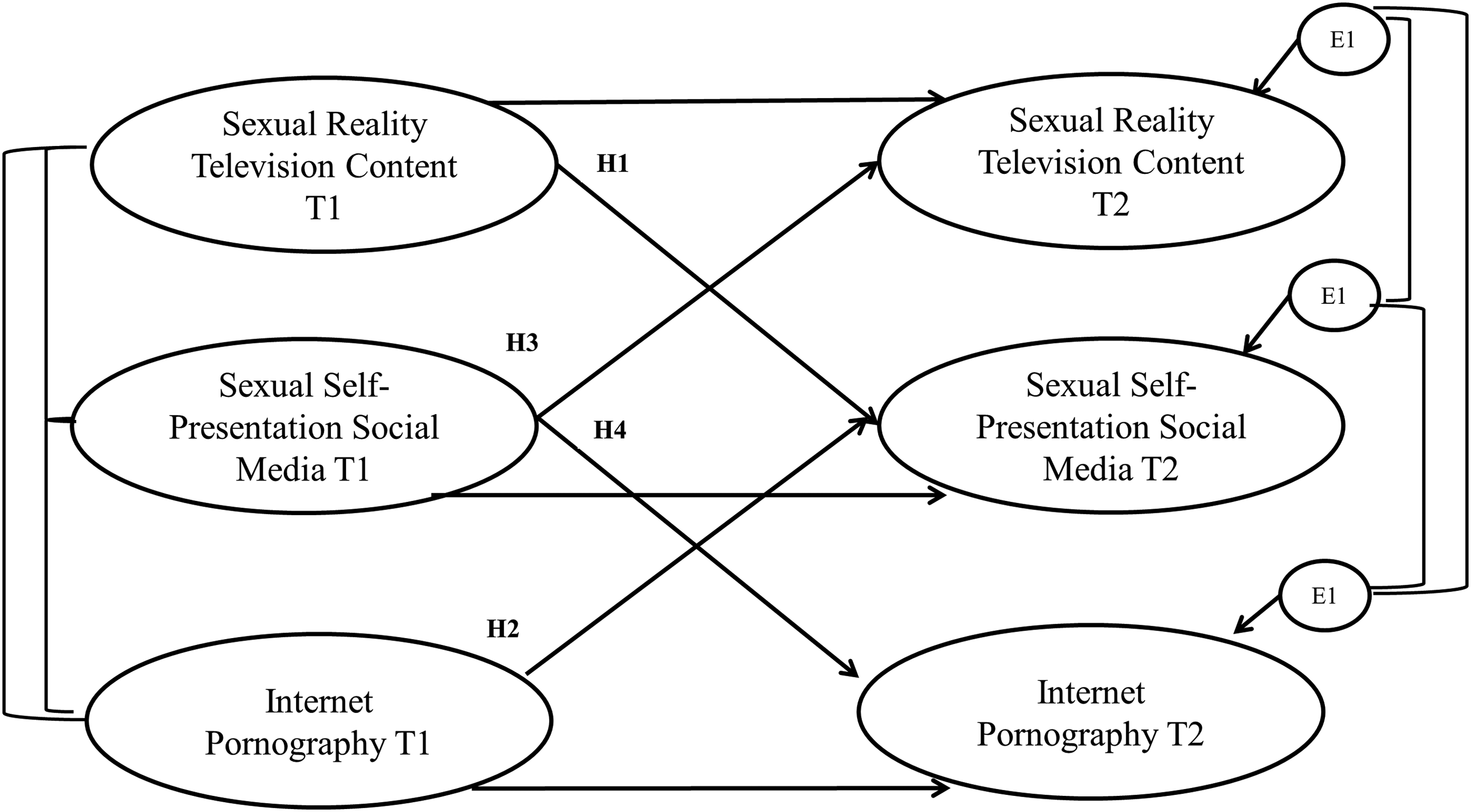
The hypothesized model for the relationships between exposure to sexual content in mass media (i.e., sexual reality television content and Internet pornography) and a sexual self-presentation on social media.
When studying the reciprocal relationship between exposure to sexual content in mass media and a sexual online self-presentation, it is important to consider potential gender differences. Gender socialization theory highlights that girls and boys are socialized toward different but complementary sexual attitudes and behaviors. 33 While boys are expected to play an active role in sexual relationships, girls are encouraged to adopt a rather passive role. 33 In this context, sexual attractiveness is more strongly valued for girls than for boys, 33 which in turn may be related to girls presenting themselves more frequently in a sexual way on social media.5,34–36
Differences between boys and girls have also been found in how media exposure relates to adolescents' sexual behavior. In line with the active role of boys, a recent longitudinal study 37 found that sexual media exposure stimulated sexual behavior only among boys. Conversely, sexual behavior triggered sexual media exposure only among girls. The study thus suggested that a media effect occurred among boys, while a selection effect occurred among girls. Possibly, sexual media exposure encourages boys to search actively for a sexual relationship, while girls seek validation of their sexual behavior in their media use (as it is less consistent with their passive sexual role). 37 However, other studies38–40 that examined relationships between exposure to mass sexual media and sexual outcomes have not found gender differences. Against this background, we ask whether gender moderates the reciprocal relationships between exposure to sexual reality television content/IP and a sexual self-presentation on social media (RQ1).
Methods
Procedure
The current study draws on the first two waves of a three-wave panel study with an interval of 6 months. The first two waves were conducted in May and October 2013. We selected the first two waves because two popular reality shows were broadcast during that time (see descriptions of exposure to sexual reality television content) in Netherlands. The study was carried out among 13- to 17-year-old adolescents. Sampling and fieldwork were done and organized by Veldkamp, a Dutch survey institute. The sample was randomly sampled from an existing nationally representative online access panel of adolescents, administered by Veldkamp. Participants filled in an online questionnaire at home, which took about 20 minutes to complete. For each completed questionnaire, participants received a compensation of 5 Euros.
Sample
At baseline, 2,137 adolescents participated. Six months later, 1,765 adolescents participated again (attrition rate = 17.4 percent). Using Pillai's Trace, a MANOVA showed that there were no significant differences between respondents participating only in Wave 1 and respondents participating in both waves regarding age, sexual orientation, gender, exposure to sexual reality television content, exposure to IP, and a sexual online self-presentation, V = 0.005, F(6, 2130) = 1.73, p = 0.11, ηp 2 = 0.005. It is thus unlikely that attrition caused a systematic bias in the data.
Measures
Descriptive statistics and psychometric properties for all relevant variables and scales are shown in Table 1.
Note: A correlation coefficient, r, between items was calculated for scales containing only two items.
SD, standard deviation.
p < 0.05, **p < 0.01.
Demographical information
Respondents indicated their age and gender (0 = boy; 1 = girl). Sexual orientation was measured by the H-scale 41 and recoded according to the procedure applied by Peter and Valkenburg 19 (0 = exclusively heterosexual; 1 = not exclusively heterosexual).
Exposure to sexual reality television content
With a seven-point Likert scale (1 = never to 7 = every episode), we measured how often respondents watched two reality shows (a) MTV's “Jersey Shore” and (b) MTV's “Geordie Shore” during the 6 months before the survey. These sexually oriented reality shows were broadcast before and during data collection.
Exposure to IP
Respondents indicated the extent to which they had intentionally watched, on the Internet, (a) pictures with clearly exposed genitals, (b) videos with clearly exposed genitals, (c) pictures in which people are having sex, (d) or videos in which people are having sex, on a seven-point scale (never = 1 through several times a day = 7). 42 Principal component analysis suggested that all items loaded on one factor (Time 1 eigenvalue = 3.56; explained variance = 88.96 percent).
Sexual online self-presentation
If respondents used social media, they were asked to indicate, for the past 6 months and on a seven-point Likert scale (1 = never to 7 = always), how often they had uploaded pictures portraying themselves (a) with a sexy gaze, (b) with a sexy appearance, (c) scantily dressed (e.g., bathing suit or underwear), and (d) in a sexy posture. Adolescents who had never used social media at Waves 1 and/or 2 (n = 179)a were given the code 1 (“never”), as they never have had the possibility to present themselves in a sexual way. Principal component analysis suggested all items loaded on one factor (Time 1 eigenvalue = 2.81; explained variance = 70.13 percent).
Analytical strategy
Structural equation modeling (software AMOS 7), maximum likelihood estimation method, was used to test the hypotheses and the model in Figure 1. Each latent variable was predicted by the manifest items used to measure that construct: exposure to sexual reality television content was predicted by two manifest items; exposure to IP and sexual online self-presentation were each predicted by four manifest items (see Measures section). Consistent with prior sexual media research, 42 baseline values of age and sexual orientation were entered as control variables and were expected to predict endogenous variables. Moreover, the control variables and the independent variables at baseline were allowed to covary with each other. Similarly, the disturbance terms of the media variables at Time 2 and the error terms of the identical items were modeled to covary between Time 1 and Time 2.
As the normality assumption is often violated in sexuality research, 19 bootstrapping (95 percent bias-corrected bootstrapped confidence intervals; 1,000 samples) was used to validate the significance tests based on normal test theory. Finally, to examine gender differences, the fit indices of an unconstrained model were compared with the fit indices of a constrained model (in which either the reciprocal relationship between a sexual self-presentation on social media and exposure to (1) sexual reality television content or (2) IP was constrained to be equal among boys and girls). The χ2-model comparison test value and ΔCFI were used to test for gender differences.43,44
Results
The model had an acceptable fit of the data (for zero-order correlations, see Table 1; for goodness-of-fit statistics, see Table 2). Watching sexual reality television at Time 1 positively predicted a sexual self-presentation on social media at Time 2 (for effect parameters, see Table 2). Moreover, a sexual online self-presentation at Time 1 was positively associated with watching sexual reality television at Time 2, thus supporting H1 and H3. Watching IP at Time 1 did not predict a sexual self-presentation on social media at Time 2. In addition, a sexual self-presentation on social media at Time 1 was unrelated to watching IP at Time 2. H2 and H4 were not supported.
Note: All standardized item loadings in the reported models varied between 0.48 and 0.98.
CFI, comparative fit index; CI, confidence interval; IP, Internet pornography; RMSEA, root mean square error of approximation; SE, standard error; SRTV, sexual reality television content; SSPSM, sexual self-presentation on social media.
The model comparison tests for sexual reality television content and IP (Table 2; RQ1) indicated that the χ2-difference test was not significant and that the differences between the CFI values (ΔCFI) of both the unconstrained and the constrained models did not exceed 0.01. The model fit of the unconstrained model was thus neither superior to the model constraining the reciprocal relationship between sexual reality television content and a sexual self-presentation on social media nor to the model constraining the reciprocal relationship between IP and a sexual self-presentation on social media to be equal across gender. As no gender differences emerged, the path results of the unconstrained model are not presented in Table 2.
Discussion
This study is one of the first to study the relationship between exposure to sexual messages in mass media and adolescents' tendency to present themselves in a sexual way on social media. The study points to the importance of sexual messages in mainstream mass media content in motivating adolescents' sexual self-presentation online. While exposure to sexual messages in sexual reality television content was reciprocally related to a sexual self-presentation on social media, no reciprocal relationship was found when studying exposure to IP. The study has several important implications for future research.
First, the reciprocal relationship between exposure to sexual reality television content and a sexual self-presentation on social media among boys and girls highlights the potential of mainstream entertainment on television to affect how adolescents behave in their online environment. The finding also suggests that adolescents who adopt a sexual self-presentation on social media may seek out, in particular, mainstream sexual media content on television. More generally, the reciprocal pattern between sexual reality television content and a sexual self-presentation on social media points to cyclical processes, as specified in theories, such as the Media Practice Model 45 and the reinforcing spirals model. 46 In such cyclical processes, adolescents' sexual self-presentation online and their exposure to sexual content in mainstream media influence and strengthen each other. Reality TV may be particularly relevant in this respect given that adolescents often look for people or situations in the media that are “credible” and “like them.”45,47 However, the literature has also indicated that adolescents identify with characters from other popular television genres. 48 As popular genres, such as music videos and soap operas, also frequently portray sexual characters,24,49 future research may explore whether similar cyclical processes between watching these genres and a sexual online self-presentation can be found.
Second, media theories, such as the Differential Susceptibility to Media Effects Model, have highlighted that (most) media effects may not hold equally for the whole (adolescent) population. 50 Particular dispositional susceptibility factors (described as person dimensions that affect a user's interaction with media content) may strengthen or weaken media effects among the general population of media users. 50 The current findings suggest that gender is not an important dispositional susceptibility variable for the reciprocal relationships between a sexual self-presentation on social media and exposure to sexual reality television content or IP. However, other dispositional susceptibility variables may still affect these relationships. Although IP exposure and a sexual self-presentation on social media were unrelated in the current study, this relationship may thus still occur among groups of users who are more susceptible to the effects of IP or more likely to select IP. In this view, the pertinent literature points to high sensation seekers, 51 hypergendered adolescents, 52 and adolescents in an early pubertal status 40 as important groups to examine.
That said, it is possible that exposure to IP and a sexual self-presentation on social media are unrelated because they differ in their sexual explicitness. A sexual self-presentation on social media5,7 is typically only sexually suggestive, while IP is sexually explicit. Adolescents may perceive the actors and actresses in IP as inappropriate exemplars. In line with this reasoning, qualitative research has shown that girls make sure that their online self-presentations are not considered “slutty.” 53 Similarly, a sexual self-presentation on social media may not be considered as similar to the sexually explicit content in IP. Adolescents who present themselves in a sexual way on social media may thus not be motivated to consume IP.
Our study had at least two limitations: first, our study applied self-report measures of adolescents' sexual self-presentations. This measure only taps whether adolescents present themselves in sexual ways on social media, but provides limited information on how adolescents present themselves. To understand how adolescents incorporate sexual messages from mainstream media in their online self-presentations, we need more detailed measures of sexual self-presentation, including both visual and verbal posts.
Second, the effect sizes of the reciprocal relationship between exposure to sexual reality television and a sexual self-presentation on social media were small, although in line with prior media research 54 and literature on longitudinal research controlling for stability effects. 55 Moreover, these relatively small effect sizes may be explained by the rather low occurrence of a sexy self-presentation among the adolescents included in our sample. Despite this low frequency score, a relationship between exposure to sexual reality television and an online sexual self-presentation still emerged, which highlights the importance of future research on this subject. In addition, the literature 56 suggests that even small effects of media can still be of relevance as the sexual messages promoted in the studied media content (i.e., reality television and social media) are similar to the socialization received from other sources (e.g., other mainstream sexual media content and peers2,53). Together, these socialization influences may cumulate over time in a stronger effect. 56
Conclusion
Overall, the current study shows that mainstream mass media content has the potential to stimulate adolescents to produce and distribute their own sexual self-portrayals. In turn, the sexual content in mainstream mass media appears to be particularly appealing to social media users who present themselves in a sexual way. Future research among adolescents is therefore warranted to deepen our knowledge about the interplay between mainstream sexual content in mass media and sexually oriented behaviors on social media.
Note
a. All the structural equation models reported in the results section were also conducted with a sample that excluded the participants who never used social networking site (SNS) at Time 1 and/or Time 2 (N = 1,586). The structural equation modeling results were similar to the results reported in the article for the sample that included participants who never used SNS at Time 1 and/or Time 2 (N = 1,765). These additional results can be obtained by sending an e-mail to the corresponding author.
Footnotes
Acknowledgment
This research was funded by a grant from the Netherlands Organization for Scientific Research (NWO) to the third author.
Author Disclosure Statement
No competing financial interests exist.