




Abstract
Abstract
Popular video games often provide people with the option to play characters that are good or evil in nature, and yet, little is known about how individual differences in personality relate to the moral and ethical alignments people chose in their digital representations. We examined whether participants' pre-existing levels of moral disengagement and Big 5 scores predicted the alignments they selected for their avatar in video game play. Results revealed that men, relative to women, were more likely to play “bad guys” and that moral disengagement predicted this finding. Agreeableness and conscientiousness mediated the relationship between moral disengagement and alignment such that those higher in these two traits were more likely to play good characters.
Introduction
S
Normative guidelines for avatar creation are often lacking or unclear. 8 On one hand, researchers have found that people generally intend for their self-representations to be similar to themselves2,9,10 and follow offline prescriptions for behavior. 4 On the other hand, there is some evidence that individuals construct new personas altogether. 7 It is possible that context accounts for these conflicting findings, as some research has shown that the context for which an avatar is created (e.g., video games, online dating, blogging) influences the characteristics of one's self-representation. 11 Alternatively, it may be personality characteristics that influence avatar selection. 2 The equivocal nature of these findings illuminates the need for more research on the avatar creation process.
Owing to the purposeful nature of the avatar creation process, research has focused on understanding why people vary in their self-representations. This broad area of research has examined this question across a variety of different types of communication technology ranging from personality as reflected in e-mail addresses 12 to the relationship between personality and avatar creation. 2 Dunn and Guadagno asked college students to construct an avatar under the guise of evaluating game play in a role playing game (RPG). They found that Big 5 (BFF) traits of agreeableness, 13 and extraversion influenced the physical attributes participants chose for their avatars. It is important to note that in Dunn and Guadagno's experimental paradigm, participants were asked to evaluate a video game, thereby focusing them on a task unrelated to avatar creation. The researchers structured the study this way to assess behavior sans social desirability pressure so that individual differences, rather than any situational pressure, affected their choices. This study established that individual differences play a key role in avatar creation and also laid the methodological groundwork for the current research.
Although personality traits can influence surface features of avatars, deeper associations such as the relationship between an individual's moral values and that of his or her avatar have not been widely investigated. Much of the existing work in this area focuses on social norm violation in virtual spaces (i.e., Second Life, or other Immersive virtual environments) and suggests that, when given the choice, people will imbue their avatars with a moral compass similar to their offline selves. For instance, Gabriels et al. 14 examined Second Life users' perceptions of morality and deviant behavior. Regardless of their reasons for using Second Life, all participants expected others to engage in moral behavior, and participants' moral beliefs in general were strongly related to their offline beliefs. In addition, MMORPG (Massively Multiplayer Online Role Playing Games) players who identify strongly with, and emotionally invest in, their avatars are likely to conduct themselves virtually in a manner akin to their offline self. 15 These studies suggest that most users channel their morality into their avatar and would expect others to do likewise.
In the context of the offline world, people's moral beliefs and ethical codes can be a measurement challenge. Moral behavior and beliefs have numerous antecedents, including moral standards, self-sanctions, ability to self-regulate, and the social context. 16 Bandura et al.'s 17 moral disengagement is one such factor that is defined as forgiving or justifying inhumane behavior in certain situations. Over time, the distinction between those who morally disengage often and those who do not emerged, emphasizing its importance as a contributor to morality. 18 The Moral Disengagement Scale (MDS) assesses this propensity to overlook or ignore one's moral rules for conduct in some situations and empirical evidence has validated and established that it predicts the penchant to engage in unethical or deviant behavior.17,19,20
Based on this previous research,17,19,20,21 we suggest that MDS as an individual difference measure can be useful in assessing people's internal moral standards. We are not the first scholars to consider MDS this way. Schlenker et al. 22 used moral disengagement to measure individuals' overall ability to forgive moral transgressions. Similarly, Hymel et al. 23 found that children high in MDS were more likely to bully others at school. Thus, the existing evidence supports our contention that MDS is a predictor of moral behavior. Gender differences have also been found in research with the MDS but only among adults, indicating that men are more likely to morally disengage than women. 21
Present study
To operationalize moral and ethical alignment in an experimental setting, we turned to Neverwinter Nights 2 (NWN2), 24 a fantasy multiplayer online role-playing video game that sold more than 2 million copies. This game was chosen as it was one of the only user-friendly games (someone who had never played any games can easily interact with) that allow players to choose complex moral and ethical dimensions to their character. Moral and ethical alignments in the game are based on the rules of Dungeons & Dragons (D&D) version 3.5. 25 D&D is popular tabletop game that has inspired numerous different tabletop iterations and video games. In the D&D universe, moral and ethical alignments are a driving factor of character creation and game play and serve as a useful paradigm for players to imbue morality and ethics in their avatar.
The present investigation explored the relationship between individuals' morality as assed by the MDS and the moral and ethical alignment of their avatars. Based on previous literature,2,17 we selected the MDS 17 and the BFF 13 as predictors of avatar moral and ethical alignment. To our knowledge, no research has directly investigated these relationships in an experimental setting.
Predictions
Based on work examining morality in other virtual environments,14,15 we make the following predictions:
Although no specific relationship is hypothesized between the MDS and the BFF, previous research has demonstrated that personality factors contribute to the creation of the avatar.2,26 RQ1 will explore the relationship between these variables and alignment to understand what personality aspects influence avatar alignment.
Methods
Participants and design
Participants were 174 (112 men, 62 women) undergraduates at a large public university in the southeastern United States who received partial course credit. Participants identified their race as follows: Caucasian (79 percent), African American (15 percent), Asian/Pacific Islander/Native American (1 percent), and multiracial (4 percent); 9 percent of the sample indicated that their ethnicity was Hispanic/Latino. Of those who played video games (n = 134), participants reported an average of 3.9 (SD = 3.80) video game hours per week, although 23 percent reported that they did not play video games at all. Due to experimenter error, age was not collected; however, the population was gathered from, and likely reflects, a college-aged sample.
The independent variables were participant gender, MDS, 17 and the BFF. 13 The MDS provided insight on the morality of participants, while the BFF examined other aspects of personality that affected alignment choice. The primary dependent variable was the alignment participants selected for participants' avatars.
Procedure
The procedure was similar to that used previously by Dunn and Guadagno. 2 On arrival in the laboratory, participants filled out the MDS 9-point Likert-type scale using a response scale from 1 (Completely Agree) to 9 (Completely Disagree) 17 and the BFF 13 9-point Likert-type scale using a response scale from 1 (Not at all like me) to 9 (Very much like me). They were then told that the purpose of the study was to evaluate the game play of NWN2 and that they needed to create an avatar before playing. The researcher instructed participants to the avatar selection and customization process using the game's character selection menus. The researcher showed the participant each menu and the various options available to them. This was an open-ended task and participants were told they could change the character's attributes any way they wanted (i.e., they could change their avatar's gender, appearance, profession, and alignment). Participants were allowed as much time as needed to create their avatar.
Moral and ethical alignment choices were presented to the participant as nine options, comprising three moral alignments (good, neutral, and evil) and three ethical alignments (lawful, neutral, and chaotic). Each option presented a specific description. These descriptions were introduced to the participant during avatar creation, but participants were not provided instructions on what to choose. Participants were told: “This section determines what kind of person (good, evil, etc.) your avatar is,” and was accompanied by detailed descriptions of each alignment, including how an avatar with the alignment may generally act. Participants were also encouraged to ask any questions about avatar creation if they did not understand the procedure. It is important to note that certain avatar classes (or jobs) prevented participants from choosing some alignments. For example, if the participant chose to play a monk, chaotic evil was not allowed by the game. These restrictions were congruent with the nature of the desired character. Thus, we inferred that if a participant wanted to play a monk, he or she would likely want that avatar to be relatively good and lawful. In addition, participants were warned before alignment selection that that their previous class choice might restrict their alignment choices. After avatar creation, participants played the game in single-player offline mode for 20 minutes and then filled out demographic information. The experimenter took a screen shot of each participant's avatar and then debriefed and dismissed him or her.
Results
Both the MDS and the BFF scores were reliable: MDS, α = 0.91; Extraversion, α = 0.88; Openness, α = 0.76; Conscientiousness, α = 0.81; Agreeableness, α = 0.81; Neuroticism α = 0.80. Nearly all (99 percent) of participants selected avatars that were the same gender that they themselves reported. Avatar alignment was based on one of nine possible attribute combinations (moral: good, neutral, or evil X ethical: lawful, neutral, or chaotic). However, we independently coded the two main dependent variables (moral and ethical alignment). Each dependent variable was assigned a value from 1 to 3, with higher scores indicating less moral or ethical alignments. There are numerous ways to interpret alignment selection with no clear direction provided in previous literature. We chose to separate the 1–9 choice into two variables and treat them as continuous variables for several reasons. First, coding alignments on a 1–9 scale would have resulted in a difficult to interpret continuous measure, ranging from chaotic good to lawful evil. In addition, because ethics and morality do not represent the same concept, we thought it was problematic to use the combination of the two dimensions. Finally, the original concept of alignment used in D&D similarly describes as two distinct axes 24 (Tables 1 and 2). Thus, two separate continuous variables were consistent with the original concept of alignment. Given that one could argue that these variables should be treated categorically, we conducted, a series of log linear analyses, the results of which did not significantly differ from the saturated model, indicating that similar results would come from treating the variables categorically. As expected, ethical and moral alignments were positively correlated, r(172) = 0.192, p = 0.011, however, the magnitude of the correlation coefficient was not strong enough to suggest that the different alignments assessed the same underlying construct.
To examine H1, a series of hierarchical linear regressions examined whether gender and moral disengagement together predicted alignment. Continuous predictors were centered in accordance with Aiken and West. 27 In step 1, gender predicted moral alignment, β = 0.17, t(172) = 2.32, p = 0.02. After MDS scores were entered into the model during step 2, gender was no longer significant (p = 0.303), and MDS was the only significant predictor of moral alignment, β = 0.26, t(171) = 3.25, p = 0.001. The interaction between gender and MDS was not significant (p = 0.563).
Similar results were revealed for ethical alignment with gender marginally predicting ethical alignment, β = 0.14, t(172) = 1.79, p = 0.075. During step 2, gender became nonsignificant and MDS once again became the only (marginally) significant predictor [β = 0.14, t(171) = 1.72, p = 0.086]. The interaction between gender and MDS was nonsignificant (p = 0.112). These results provide evidence in support of H1.
H2 was tested using a series of independent samples t tests. Consistent with prior research, 21 men scored significantly higher on MDS than did women [t(172) = −5.13, p < 0.001]. Similarly, men selected less moral alignments than did women, t(172) = −2.32, p = 0.022 (Table 3). There was no significant gender difference in ethical alignment, although the means trended in the same direction as with moral alignment choice, t(172) = −1.79, p = 0.022, p = 0.075. Thus, H2 was supported.
MDS, Moral Disengagement Scale.
To explore RQ1, we regressed each subscale of the BFF on moral and ethical alignment selections using the same model as the previous regressions. Our analyses revealed that agreeableness and conscientiousness were significant predictors of moral alignment; therefore, only these two BFFs were examined in detail. Agreeableness emerged as a significant predictor for both scores on the MDS and moral alignment. However, when agreeableness and MDS were both entered as predictors, agreeableness became nonsignificant (p = 0.296) and MDS remained the only significant predictor. The interaction between agreeableness and MDS was not significant (p = 0.841). A similar pattern emerged for conscientiousness as it significantly predicted both scores on the MDS and moral alignment. When conscientiousness and MDS were both entered as predictors, conscientiousness became nonsignificant (p = 0.199), and MDS remained as the only significant predictor of moral alignment. The interaction between conscientiousness and MDS was not significant (p = 0.421). For all regression coefficients, see Table 4. Ethical alignment yielded no significant results in the regression model, see Table 5.
*p < 0.05.
**p < 0.01.
***p < 0.001.
*p < 0.05.
**p < 0.01.
***p < 0.001.
Because the above regressions suggest evidence of mediation, we conducted a meditational analysis using the PROCESS method created by Hayes 28 for agreeableness and then for conscientiousness. Agreeableness was entered into the model as the independent variable with MDS as the mediator. Moral alignment choice served as the dependent variable. PROCESS created a 95 percent confidence interval (95% CI) for agreeableness via MDS on alignment choice in 5,000 bootstrapped samples. The 95% CI was from −0.11 to −0.02; since zero falls outside of this interval, this indicated that moral disengagement mediated the relationship between agreeableness and alignment choice (Fig. 1).
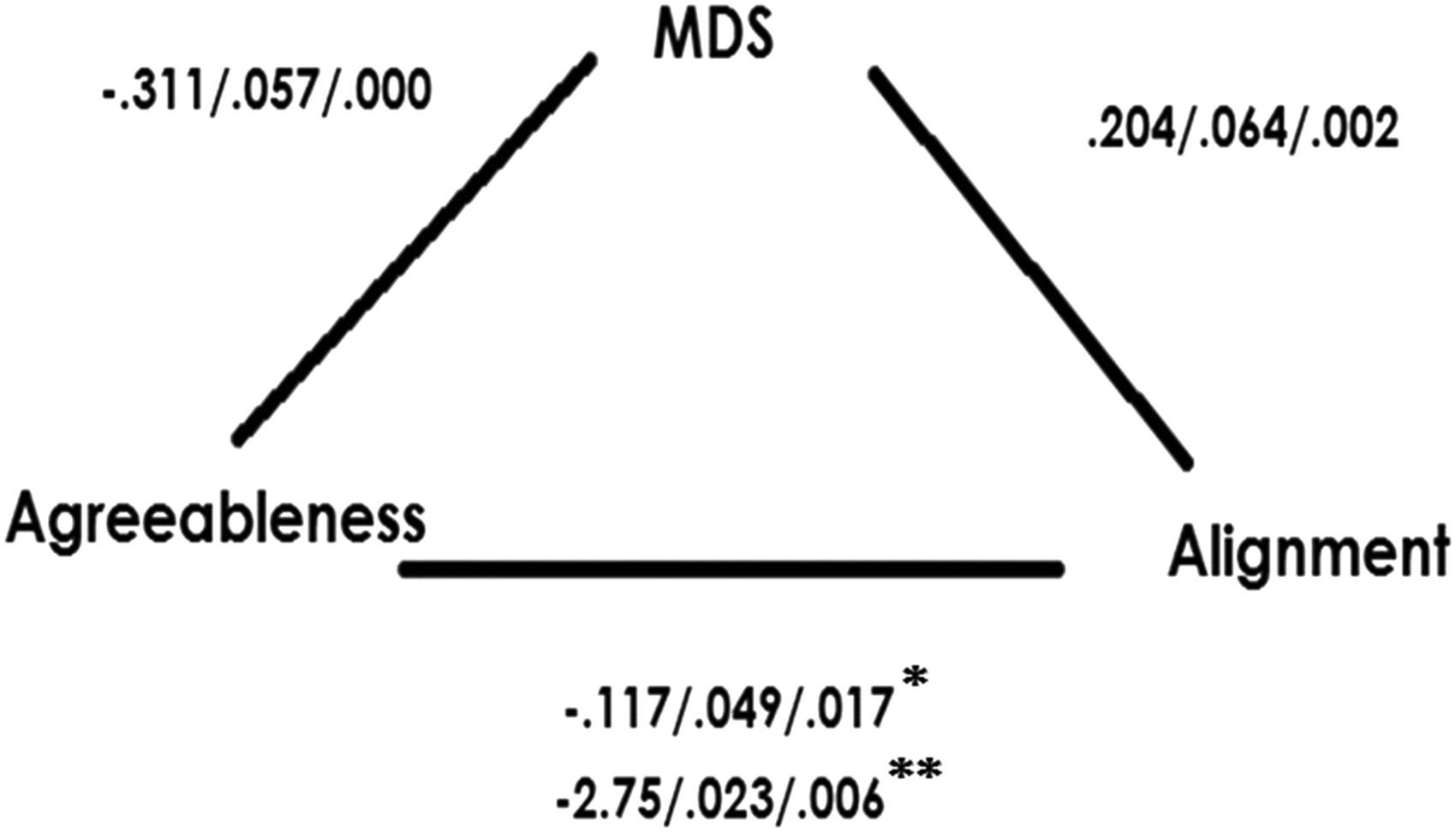
Mediation model for MDS and Agreeableness on Moral Alignment. Statistics represented as regression coefficient/standard error/probability. * is the relationship between agreeableness and alignment when MDS is not in the model. ** is the overall Sobel test results. MDS, Moral Disengagement Scale.
We ran the same meditational analysis for conscientiousness and found similar results. PROCESS estimated the confidence interval from −0.10 to −0.02. Once again, these results suggest that the higher the conscientiousness, the lower participants scored on the MDS, and the more likely they were to select a “good” character. These results were replicated by a Sobel test of mediation for each BFF scale (Agreeableness z = 2.64, p = 0.006; Conscientiousness z = 2.67, p = 0.009) (Fig. 2).
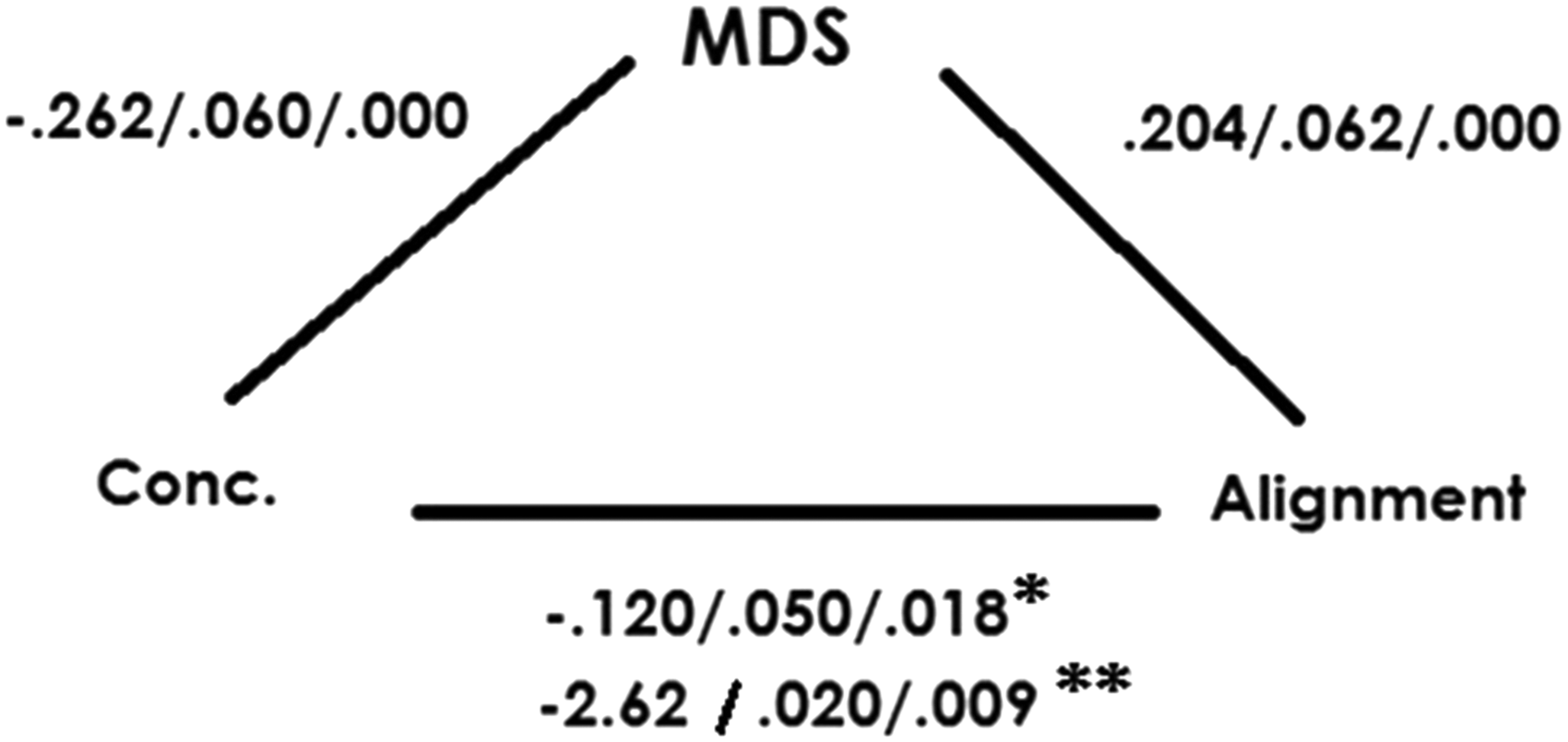
Mediation model for MDS and Conscientiousness on Moral Alignment Statistics represented as regression coefficient/standard error/probability. * is the relationship between conscientiousness and alignment when MDS is not in the model. ** is the overall Sobel test results.
Discussion
Our results supported our predictions that in an RPG context such as NWN2, people not only select avatars similar to themselves, 2 their avatars are also similar to their own moral values. Personality as assessed by the BFF also played a significant role in predicting avatar alignment. While considerable research has examined how individuals represent themselves in virtual environments,2,4,11 these results are the first (to our knowledge) to support the notion that people instill their ideas of right and wrong within their virtual self-representations. Generally, men created less moral and less ethical avatars than did women. Previous findings on moral disengagement 23 along with studies on role-playing in virtual environments are consistent with these findings. It is also possible that our results are due to men, more than women, perceiving that they have more agency to play a variety of different types of character alignments. Social role theory 29 posits that women feel social pressure to be “good girls”—likeable, helpful, cooperative. If we apply this to virtual environments as previous research 4 has, it may explain why women selected “good” avatars during their avatar customization.
The finding that MDS scores and alignment choices were negatively related to agreeableness and conscientiousness (i.e., the more morally disengaged, the lower the agreeableness and conscientiousness) has implications for scholarship beyond virtual environments and is the first study (to our knowledge) that links morality to personality factors such as the BFF. Our findings in this context suggest that people with higher levels of agreeableness and conscientiousness create avatars as a potential means to appear helpful and good to others.
Limitations and future directions
In this study, our stimulus video game was a popular RPG, and therefore, we did not have the ability to customize certain aspects of the players' experience. Specifically, the game was designed to only allow participants to choose moral and ethical alignment in a manner where nine different combinations—constructed from three levels of morality and three levels of ethics—were presented. Although we have explained our statistical and theoretical reasons for treating moral and ethical alignment as separate but related measures, there are arguments to be made for alternative ways to consider the variables and/or different ways to present them to the participant. In addition, if a participant had previous experience with NWN2 or the D&D alignment system, this knowledge may have changed how he or she created the avatar. In the future, we would like to develop or obtain a game that allows participants to choose how moral or ethical they are based on a larger, continuous scale separating the two axes. Finally, even though participants engaged in game play, we did not monitor or code their activities while they played the game. While this decision was intended to misdirect participants from the true nature of our study, it also means that the selection of their avatar's moral alignment for their avatar is essentially a measure of behavioral intention and remains to be seen if alignment choices reflect on actual behavior within the game.
In conclusion, the results of the present study suggest numerous meaningful aspects of avatar creation. It has long been questioned if people are willing to turn off their internal moral compass and indulge a desire to play the “bad guy.” The present study contributes to a growing body of research that shows people's actions and virtual representations in cyberspace say much about their personality and identity, and it is unlikely for an individual to deviate too far from their offline characteristics.
Footnotes
Author Disclosure Statement
No competing financial interests exist.