




Abstract
Abstract
A variety of instruments have been developed to assess different dimensions of playing video games and its effects on cognitions, affect, and behaviors. The present study examined the psychometric properties of the Game Transfer Phenomena Scale (GTPS) that assesses nonvolitional phenomena experienced after playing video games (i.e., altered perceptions, automatic mental processes, and involuntary behaviors). A total of 1,736 gamers participated in an online survey used as the basis for the analysis. Confirmatory factor analysis (CFA) was performed to confirm the factorial structure of the GTPS. The five-factor structure using the 20 indicators based on the analysis of gamers' self-reports fitted the data well. Population cross-validity was also achieved, and the positive associations between the session length and overall scores indicate the GTPS warranted criterion-related validity. Although the understanding of Game Transfer Phenomena is still in its infancy, the GTPS appears to be a valid and reliable instrument for assessing nonvolitional gaming-related phenomena. The GTPS can be used for understanding the phenomenology of post-effects of playing video games.
Introduction
T
Some of the better known are the homonymous decision task that assesses risk-related cognitions by completing a list of words, 18 and the Taylor Competitive Reaction Time task that assesses the level of hostility based on the intensity of the punishment provided to an opponent (e.g., aversive noise blasts, making them eat spicy sauce).19,20 Measures and behavioral tests of aggression have been criticized for the way the results have been interpreted and their lack of external validity,21–23 although some evidence supports the generalization of the results to real-world aggression. 24 Furthermore, the influence of unrealistic depictions of the real world in media on the perception of the real world have been assessed. 25 Cultivation effects (i.e., generalized influence on estimates of the probability of events, and judgments that reflect beliefs) have only been found in direct relation to video game content. In light of the debate about video game playing and its potential effects on gamers, it is important to develop new psychometrically sound assessment tools for examining the direct outcomes of playing video games, thus facilitating future examination of causal effects.
Research into Game Transfer Phenomena (GTP)—a multimodal research approach for investigating the transfer of video game experiences into the real world by examining altered perceptions, spontaneous mental processes, and behaviors and actions experienced mostly after stopping playing 26 —suggests that the effects of video games tend to be directly related to the content and experiences in the video game.27–31 The GTP research approach has explored the relationship between video game structural characteristics (e.g., visual or aural features) and in-game activities directly related to gamers' transfer of experiences. The GTP framework makes distinction between the inner and outer manifestation of phenomena, and whether they are interpreted as self-generated (e.g., inner-speech, auditory hallucinations) and if they occurred voluntarily or involuntarily (e.g., deliberate use of video game slang for amusement, involuntary verbal outbursts). GTP are divided in three main modalities: altered perceptions, automatic mental processes, and behaviors and actions.26–29
Altered perceptions are understood as perceptions and/or sensations related to the video game when not playing, and can take place in all the sensory modalities, across modalities, or be multisensory. Altered perceptions related to playing video games have been identified in the following dimensions27–32
:
• Altered visual perceptions include mind visualizations, pseudo-hallucinatory experiences (e.g., seeing game icons above people's heads), visual adaptations (e.g., perceiving objects or environments distorted), and visual misperceptions (e.g., confusing physical objects with those in the game).28,31,32. • Body and other altered perceptions experiences include proprioception (e.g., sensations of body or limb movement), tactile perception (e.g., pushing buttons of gamepad), and cronoceptive perception (e.g., feeling time slow down).28,31,32 • Altered auditory perceptions include auditory involuntary imagery (e.g., hearing auditory cues in the head), auditory hallucinations (e.g., hearing sounds coming from objects), inner speech (e.g., hearing one's own thoughts preserving features from video game character's voices), and auditory misperceptions (e.g., confusing physical sounds with those from the game).29,31,32
Automatic mental processes manifest as thoughts, urges, and automatic mental actions. These range from thoughts about the game (e.g., thinking continuously about the game) to cognitive biases (e.g., experiencing attention bias toward game-related cues, jumping to conclusions bias), and source monitoring errors (e.g., confusing what an in-game character said with what a person said).27,31,32
Behaviors and actions can range from experiencing involuntary motor activations (e.g., involuntary movements of limbs) to performing actions inspired by the video game or changes in behavior influenced by the video game (e.g., avoiding specific places, mimicking video game characters, having verbal outbursts).27,31,32
Given the aforementioned theoretical underpinnings of GTP, the aim of the present study was to examine the psychometric properties of the Game Transfer Phenomena Scale (GTPS), the first-ever theory-driven scale developed for measuring nonvolitional phenomena such as altered perceptions (i.e., visual, bodily, and auditory), automatic mental processes, and behaviors and actions experienced after playing video games, and understanding the underlying mechanisms of video game effects.
Method
Participants and procedure
A total of 1,736 gamers were recruited online, and split into two groups for the purposes of factor analysis (i.e., Sample 1 [S1], n = 1,078; Sample 2 [S2], n = 658) using opportunity sampling and an online survey methodology. Participants were recruited via online gaming forums, Facebook, and
Measures
Socio-demographics: The survey included questions regarding participants' sex, age, and occupation.
Gaming profile: Questions were included about typical video game session length and frequency of video game playing, as well as gamer type (i.e., newbie, causal, hard-core, or professional).
GTPS: The GTPS included 20 items comprising five different dimensions: altered visual perceptions, altered body perceptions, altered auditory perceptions, automatic mental processes, and behaviors and actions. Exemplars of GTP experiences were also provided to participating gamers. The items in the scale were originally developed for investigating the initial prevalence of GTP and their associated factors.26,33,42 These were derived based on a theoretical framework concerning GTP developed from previous analyses of more than 1,600 gamers' self-reports.26–31 The participants' responses are rated on a 5-point Likert scale where 1 = “never,” 2 = “once,” 3 = “sometimes,” 4 = “many times,” and 5 = “all the time.” Examples of items included: “seen video game images with eyes open when not playing,” “experienced bodily sensations of movement as in a video game,” “heard game music when not playing,” “wanted or felt the urge to do something in real life after seeing something that reminded of the video game,” “acted differently in real life situation because an experience in a video game.” (The final version of the GTPS can be obtained by contacting the first author.)
The following modalities were assessed in the GTPS via five first-order latent variables. The altered perceptions modality assesses (a) visual experiences (visualizing or seeing images, visual pseudo-hallucinations, distorted perceptions and misperceptions of physical objects and environments); (b) auditory experiences (auditory involuntary imagery, auditory/verbal hallucinations or inner speech and auditory misperceptions; and (c) body-related experiences (motion sickness, tactile hallucinations, other body-related altered perceptions/sensations, and altered perception of time). The mental processes modality assesses automatic mental processes such as (a) perseverative mental actions after playing; (b) thoughts and urges about either wanting to use video game elements in a real-life context or performing something from the game in physical contexts; and (c) source monitoring errors between video game and real-life events. The behaviors and actions modality assesses (a) involuntary movements of limbs elicited by automatic associations, (b) verbal outbursts, (c) performing behaviors influenced by a video game, and (d) change of behavior due to previous video game experiences.
Statistical analysis and analytical strategy
Statistical analysis comprised (a) descriptive statistics of the main sample's characteristics and (b) a psychometric examination of the GTPS. In order to assess the scale's psychometric properties, validity (i.e., construct, criterion-related, and population cross-validity) and reliability (i.e., internal consistency and factor determinacy) were scrutinized. Moreover, construct validity was investigated by performing a confirmatory factor analysis (CFA) on the GTPS in S1; criterion-related validity was assessed by examining the bootstrapped correlation coefficients with bias-corrected accelerated 95% confidence intervals (i.e., Pearson product–moment correlation coefficients) between the GTPS overall scores and participants' self-reported video game session length across both samples. Population cross-validity was further investigated by performing an additional CFA for replication purposes on S2. Finally, reliability analysis comprised an in-depth examination of the Cronbach's alpha of the GTPS instrument as a whole and also across the five subscales in both samples, while factor score determinacies for each latent variable were also computed. All the aforementioned analyses were performed on both MPLUS v7.2 (Muthén & Muthén, Los Angeles, CA) and IBM SPSS Statistics for Windows v20 (IBM Corp., Armonk, NY).
Results
Descriptive statistics
Table 1 summarizes the samples' main socio-demographic characteristics. Most participants were male (S1 92.7%; S2 80.9%) and were aged between 18 and 22 years (S1 52.9%; S2 42.1%). Additionally, most participants reported being a student (S1 54.8%; S2 38.8%). With regard to participants' gaming-related habits and behaviors, the majority were hardcore players (S1 65%; S2 55.8%), played video games mostly between 3 and 6 hours (S1 41.2%; S2 43.2%), and reported a weekly gaming frequency of 2–4 days a week (S1 42.6%; S2 28.3%). However, in S2, 40.3% (n = 265) reported playing video games every day (see Table 1).
Construct validity
In order to address the construct validity of the GTPS and also further verify the suitability of the five theoretical factors proposed, a CFA with maximum likelihood with robust standard errors estimation method (MLR) was performed on S1 (n = 1,078) on the 20 GTPS indicators. Because there is no consensus on the fit indexes for evaluating structural equation models,34–36 the goodness of fit was based on several fit indexes using the following thresholds: χ2/df (1; 4), root mean square error of approximation (RMSEA) (0.05; 0.08), RMSEA 90% confidence interval with its lower limit close to 0 and the upper limit <0.08, p-close > 0.05, standardized root mean square residual (SRMR) (0.05; 0.08), comparative fit index (CFI), and Tucker–Lewis fit index (TLI) (0.90; 0.95). In light of the aforementioned assumptions, all 20 indicators were entered into a five first-order factorial solution (see Fig. 1). As a result, the analysis of the first-order five factors model provided an acceptable model fit for the GTPS with acceptable item loadings (i.e., ≥0.50). More specifically, χ2(160) = 628.4, χ2/df = 3.9; RMSEA = 0.052 [90% CI 0.048–0.056], p-close = 0.203; SRMR = 0.040, CFI = 0.94; TLI = 0.93 (see Table 2 and Fig. 1).
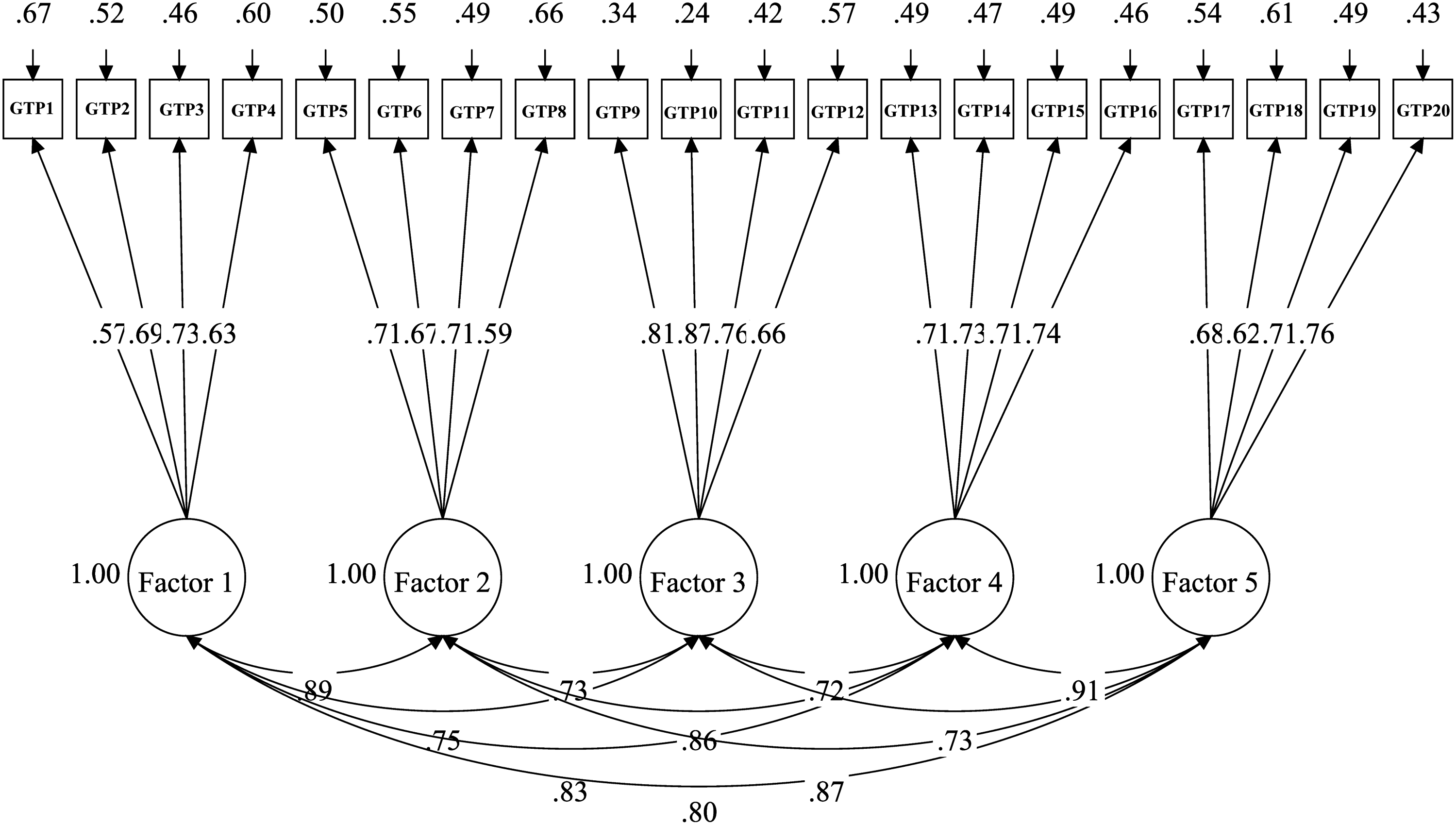
Graphical representation of the theoretical and empirical model of the Game Transfer Phenomena (GTP) construct.
Note. All factor loadings are significant at least at p < 0.0001.
Instructions: Have you ever experienced any of the following: visual Game Transfer Phenomena (GTP), body sensation GTP, auditory GTP, automatic GTP, behavior GTP?
Item wording was omitted for the sake of clarity. The final version of the GTPS is available upon request.
Factor 1, altered visual perceptions; Factor 2, altered body perceptions; Factor 3, altered auditory perceptions; Factor 4, automatic mental processes; Factor 5, actions and behaviors.
Criterion-related validity
Recent empirical findings suggested that GTP experiences are heightened by greater video game session length. 33 Therefore, an observed positive association between participants' session length and the overall score obtained in the GTPS would be indicative of the scale's criterion-related validity, since these variables are expected to co-vary at both the theoretical and empirical level. As shown in Table 3, positive statistically significant associations between video game session length and the overall GTP scores were found in both S1 and S2 (see Table 3).
Bootstrap results are based on 10,000 bootstrap samples.
p < 0.01.
BCa, bias-corrected accelerated; VSL, video game session length.
Population cross-validity
Population cross-validity was assessed by examining if the results obtained in one sample (i.e., S1) of a population could also be replicated in another sample (i.e., S2) drawn from the same population, for example Raju et al. 37 and Raju et al. 38 Therefore, in order to obtain evidence for population cross-validity, a second CFA was performed on another sample recruited from the same population (i.e., S2, n = 658) to test the initially underlying conceptual assumptions (i.e., first-order model with five latent variables) verified in the first CFA. Moreover, the results obtained in S2 (χ2[160] = 492.7, χ2/df = 3.1; RMSEA = .056 [90% CI 0.051–0.062]; p-close = 0.140; SRMR = 0.047; CFI = 0.93; TLI = 0.92) were highly consistent and comparable with the results previously found in S1, providing further empirical evidence that the five-factor model fits the data well, thus warranting population cross-validity.
Reliability
As shown in Table 4, the GTPS internal consistency as measured by the Cronbach's alpha was satisfactory (i.e., ≥0.60) at several levels. On most occasions, internal consistency could not be improved by excluding any items, and inter-item correlations were relatively high (i.e., ≥0.30) in general. With regard to the GTPS factor determinacy, this coefficient reflects the degree of the correlation among the indicators and their respective factors, with values of ≥0.80 being indicative of a strong correlation.39,40 Accordingly, factor determinacies in the present study ranged from 0.93 (i.e., Factor 1) to 0.95 (i.e., Factor 3; see Table 2), further supporting the GTPS reliability (see Table 4).
Cronbach's alpha could not be improved upon exclusion of any item on most occasions.
The Cronbach's alpha provided relates to all 20 GTPS items (i.e., whole scale).
Discussion
The purpose of the present study was to examine the psychometric properties of the first-ever instrument developed for measuring nonvolitional phenomena (i.e., altered visual perceptions, body and other altered perceptions, altered auditory perceptions, automatic mental processes, and behaviors and actions) related to video game playing. Accordingly, the first-order model including the five dimensions proposed for the GTPS was confirmed given the results obtained from the CFA in both samples yielded acceptable fit indices and factor loadings. Additionally, the validity of the GTPS at the construct, criterion-related, and population cross-validity level was warranted, and its internal consistency was adequate.
As suggested by previous research, 41 game-biased perceptions and associations with video game content comprise physical objects (i.e., gaming memories triggered by objects or people), sounds and music (i.e., gaming memories triggered by auditory cues or cravings for playing), vocabulary and expressions (i.e., use of slang, abbreviations and expressions from a game), daydreams (i.e., fantasies and thoughts with game contents that pop up), and night dreams (i.e., dreams about the game or insertion of video game elements into dreams). In the present study, the five dimensions of the GTPS were found to be comparable to a certain degree to those related to the concept of game-biased perceptions. Studies examining GTP have demonstrated that game-related cues do not simply elicit memories of the game, but they also trigger, for example, altered perceptions (e.g., seeing menus while in a conversation because gamers expect to see them as in the game).26,28
The present findings relating to the GTPS are still preliminary in nature, and therefore additional rigorous psychometric testing of the GTPS is paramount. A first descriptive analysis using the GTPS showed a very high prevalence of GTP (97%) when using the criteria to endorse at least 1 of the 20 GTPS items, and most participants endorsed 6–10 different types of GTP (95%) (Ortiz de Gortari AB, Griffiths MD. Prevalence and characteristics of Game Transfer Phenomena: a descriptive survey study. Int J Hum-Comput Int. In review.). When interpreting the GTPS scores, it is recommended that researchers take into consideration the frequency (i.e., number of occurences) of GTP experiences for assessing the level of GTP strength, as well as correlating with variables that assess distress or impairment in areas of functioning for understanding the effects of video games. In addition, the prevalence of GTP should be investigated using more representative samples of gamers.
GTP appear to be atemporal and are relatively common phenomena among gamers. Analysis of gamers' self-reports has shown that gamers can perceive GTP as something both positive and/or negative.26–29 In a survey of more than 2,300 gamers, GTP were perceived as more pleasant than unpleasant, and some gamers even wanted the experiences to reoccur. However, one in five (20%) reported that they had experienced distress and/or impairment in important areas of functioning at some point because of GTP. It has been suggested that the content of the game, the frequency of GTP, and the circumstances where GTP were experienced play a role in the consequences of GTP. 26 ,42 Further research should be undertaken to understand better why some gamers experience distress due to GTP experiences while others do not. Moreover, the majority of the gamers surveyed who reported having experienced GTP were from a nonclinical population and had never used psychoactive substances 33 (or were under the influence of them) when GTP occurred (Ortiz de Gortari and Griffiths. In review.). However, GTP have been significantly associated with medical conditions, and a small number of those who have experienced GTP (3.5%) consider they are problem gamers or suffer from gaming addiction. 33 Gamers who have experienced GTP reported playing excessively, but playing excessively is not a requisite for experiencing GTP. Future studies should assess the associations between GTP as measured by the GTPS and other measurable gaming-related phenomena (e.g., immersion, game engagement, gaming addiction, etc.).
Limitations
The present study has a number of limitations. Currently, there are no similar measures to further assess the validity of the GTPS (e.g., concurrent validity). Additionally, it is necessary to ascertain the invariance of GTPS to determine if its psychometric properties hold across both sexes and different cultural contexts. Only one indicator was used to assess criterion validity (i.e., length of gaming session). However, this is the only factor that has been consistently found to be associated with GTP in previously published empirical studies. Further criterion testing could be done once other associated factors found in future empirical GTP studies have been carried out. The present study was based on retrospective self-report data, and is therefore prone to well-known biases (e.g., recall bias, social desirability bias). Future studies could perhaps assess to what extent GTP experiences may be related to normal or abnormal functioning and gaming-related behaviors. The development of the GTPS provides a psychometric framework for further exploratory and empirical research into GTP and associated behaviors.
Conclusion
The findings of the present study demonstrate that GTP as measured by the GTPS represents a validly and reliably approach at several levels. The GTPS is the first instrument developed that assesses a broad variety of post-play gaming-related sensorial perceptions, cognitions, and behaviors. The GTPS may be an additional useful instrument to employ in studies examining video game engagement and/or the underlying mechanism of problematic gaming or gaming addiction, and may help to differentiate between nonvolitional phenomena induced by gaming and symptoms of psychopathology.
Footnotes
Acknowledgments
The authors are thankful to the gamers who participated in the survey.
Author Disclosure Statement
No competing financial interests exist.