




Abstract
Abstract
An increasing amount of evidence has shown that embodiment of a virtual body via visuo-tactile stimulation can lead to an altered perception of body and object size. The current study aimed to investigate whether virtual reality (VR) body swapping can be an effective tool for modifying the enduring memory of the body. The experimental sample included 21 female participants who were asked to estimate the width and circumference of different body parts before any kind of stimulation and after two types of body swapping illusions (“synchronous visuo-tactile stimulation” and “asynchronous visuo-tactile stimulation”). Findings revealed that after participants embodied a virtual body with a skinny belly (independently of the type of visuo-tactile stimulation), there was an update of the stored representation of the body: participants reported a decrease in the ratio between estimated and actual body measures for most of the body parts considered. Based on the Allocentric Lock Theory, these findings provide first evidence that VR body swapping is able to induce a change in the memory of the body. This knowledge may be potentially useful for patients suffering from eating and weight disorders.
Introduction
R
Recently, many interesting studies have used different techniques to induce multisensory conflict to investigate these aspects of bodily self-consciousness.3–9 One of these techniques is the well-known body swapping illusion, which is a method to induce the illusory experience of owning a virtual body.8,10,11 This illusion can be evoked by observing, from a first-person perspective, a virtual body being stroked synchronously and/or asynchronously with the participants' real body. This procedure offers the chance experimentally to separate the self-location from the physical body, a condition that is observable only in abnormal circumstances (i.e., out-of-body experiences). Previous work has shown that embodiment of a virtual body via visuo-tactile stimulation can lead to altered perception of body and object size (see, e.g., Kilteni et al., 12 Normand et al., 13 van der Hoort et al., 14 Piryankova et al., 15 and Ehrsson et al. 16 ). Indeed, in order to locate oneself consciously outside one's physical body, it is necessary to achieve a translocation of the stored first-person perspective from our physical experienced body to another body, through an integration of multisensory signals. This might affect our stored body representation. An interesting example of this process was offered by Normand et al., 13 who specifically demonstrated the influence of body swapping illusion on body representation. In their study, male participants viewed from a first-person perspective a virtual body with an inflated belly substituted for their own: this experience, combined with synchronous visuo-tactile stimulation, produced changes in their body representation toward the larger belly size. Along the same lines, Preston et al. demonstrated that illusory ownership over a slimmer body promoted a significant decrease in participants' perceived body size and an increase in body satisfaction. 17 However, Piryankova et al. 15 did not find a specific effect of synchronous visuo-tactile stimulation on the “experienced body” (in their definition, “the body that the participant feels she has at that moment”) in terms of body size estimations. Specifically, their findings indicated that changes in body size experience occurred after visual experience with the body, before visuo-tactile stimulation was provided.
A recent neuroscientific framework—the Allocentric Lock Theory18–21 —has emphasized the role of spatial representations and their transformation in body representations, which may influence the way the body is “experienced” and “remembered.” According to the literature, it is possible to distinguish between two spatial representations that are continuously interacting with each other: the egocentric and allocentric representation. These were defined based on the reference point used to encode and store information from the surrounding world.22–25 Egocentric representations code and continuously update information in relation to the individual (i.e., body as the reference point for first-person perspective experience), while allocentric representations are responsible for the long-term storage of information independent of the individual (i.e., environmental features as reference points with the body as an object similar to the others objects in the world). In particular, following the Allocentric Lock Theory,18–21 the egocentric representations, which are driven by perceptual input, continuously update the contents of the allocentric representation of the body. A recent clinical trial involving obese women offered support for this theory, finding that when virtual reality (VR) was used as an instrument to induce change in negative bodily representations, the maintenance of treatment results was significantly better at 1 year follow-up compared with the usual treatment (i.e., cognitive–behavioral therapy). 26 Although not definitive, these results are promising and give rise to interesting research questions. For example, could VR body swapping be an effective tool for modifying the memory of the body?20,27
The current pilot study takes the first step in providing an answer to this question. Using a VR set-up, female participants viewed, from a first-person perspective, a virtual body with a skinny belly substituted for their own physical body (i.e., updated egocentric body) in two conditions (i.e., synchronous vs. asynchronous visuo-tactile stimulation). Specifically, it was hypothesized that illusory ownership of a virtual body resulted in changes in the remembered body representation, as measured by asking participants to estimate their body size.
Materials and Methods
Participants
Twenty-one female participants from the Catholic University of the Sacred Heart, Milan, Italy (Mage = 22.76 years, SD = 2.42 years; MBMI = 21.36, SD = 1.91) voluntarily took part in the study. They were recruited through announcements during lessons. See Supplementary Table S1 for more details about study criteria and the clinical assessment procedure.
Materials
The Virtual Belly Illusion
A virtual body was developed (standard for all participants). The body was shown with a skinny belly (avatar waist circumference: 73.94 cm; mean actual waist circumference in the sample: 85.70 cm, SD = 6.27 cm) and was standing upright in a stimulus-free room (The Belly Illusion VR Software; see Fig. 1). As detailed later in the procedure, all participants were asked to wear a head-mounted display (HMD; Oculus Rift DK2) to visualize the first-person perspective of the skinny belly of the virtual body (1080p resolution).
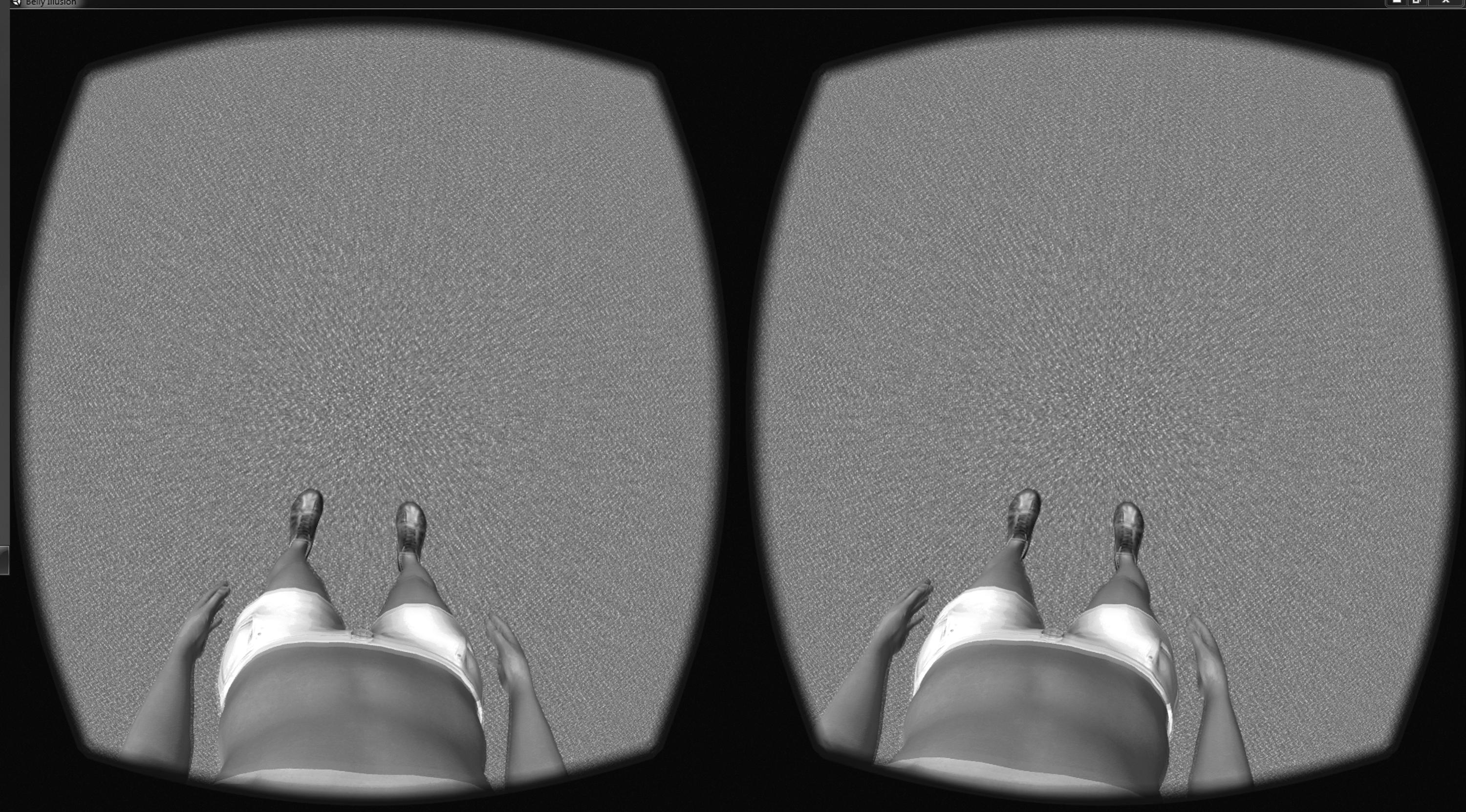
The Virtual Belly Illusion.
The HMD was connected to a portable computer (HP TRUE VISION with CPU Intel® Core™i7). An extra-infrared camera, positioned at the top of the portable computer, was used to reduce the latency of the visualization in the VR environment. During the illusion, participants were touched on their actual belly. This touching was visually mimicked on the belly of the virtual body using a motion tracking device (Razer Hydra Portal 2 Bundle) that was connected to the portable computer. Touching the actual belly of participants was mimicked in VR either synchronously or asynchronously, depending on the experimental condition.
To evaluate the efficacy of this procedure in inducing an illusory feeling of ownership of the virtual body, an adapted version of the embodiment questionnaire developed by Piryankova et al. 15 was administered at the end of the two virtual experiences (i.e., synchronous vs. asynchronous visuo-tactile stimulation). The embodiment questionnaire is a 15-item self-report questionnaire using a 7-point Likert response scale. It evaluates how participants experience the illusion at the level of ownership (i.e., “I felt as if the virtual body was my body”), self-location (i.e., “I felt as if I was inside the virtual body”), and agency (i.e., “I had the feeling that I had control over the virtual body”).
Body size estimation
Participants were asked to estimate the width and circumference of three different parts of their body: shoulders, abdomen, and hips. Moreover, they were also asked to estimate their height. Each body part was estimated separately and in counterbalanced order. Regarding width estimations, participants were asked to stand in front of a wooden blackboard and indicate the distance between the left and right side of a certain body part (e.g., the distance between the left and right hip) using adhesive rubbers. Regarding circumference estimations, participants were asked to estimate the circumference of the abovementioned three parts of their body by placing a piece of rope in a circle/oval on the floor. Specifically, in this procedure participants were required to retrieve a memory of their body representation and to reproduce it within a third-person perspective. Then, using the same procedure, participants were also asked to estimate the height, width, and circumference of the shoulders, abdomen, and hips of the virtual body they had seen during the illusion to investigate whether this procedure results in changes in transient egocentric representations related to the body avatar. The experimenter measured and wrote down all the body size estimations.
Actual body measures
The actual width and circumference of the relevant body parts of the participants were measured at the beginning of the experiment using the Size Stream 3D Body Scanner. The Size Stream 3D Body Scanner is a full-body, no-contact, 3D body measurement system using 14 infrared depth sensors positioned at six angles and seven different heights around the body to obtain full coverage in less than 6 seconds (scan volume of 2 meters, 2.15 meters in height by 0.95 meters in width by 0.8–1.2 meters in depth).
Procedure
Before starting the experimental procedure, each participant was provided with written information about the study and was asked to sign an informed consent form to participate in the study. Subsequently, clinical standard tools were administered to each participant (Mini International Neuropsychiatric Interview—MINI,28,29 and Eating Attitude Test—EAT-26 30 ) to exclude present and past psychiatric illness, specifically eating disorder symptoms. Next, all participants were asked to enter a private enclosure attached to the Size Stream 3D Body Scanner and take off their outer clothing in order to obtain the most accurate scan results. In the scan area, footprints on the floor indicated where the participants should stand, and there was a handle for them to hold. The scan session lasted less than 6 seconds. Moreover, all participants were weighed to ensure that they met the study criteria (see Supplementary Table S1). Then, all participants were asked to provide a first estimation of their body size as explained previously. At the start of the experimental session, participants were required to wear the HMD to complete the Virtual Belly Illusion. The experimenter provided tactile stimulation by stroking each participant's belly (with the wired handheld controllers of the Razer Hydra Portal 2 Bundle), and the participant saw the virtual hand making similar stroking movements on the virtual body either synchronously or asynchronously with actual tactile stimulation. During both the synchronous and asynchronous condition, participants were asked to look down in the direction of the belly of the virtual body that was being stimulated. Visuo-tactile stimulation was provided by making stroking movements on the abdomen for 90 seconds. The order of the conditions (i.e., synchronous vs. asynchronous visuo-tactile stimulation) was randomized. After each condition, participants were asked to provide body size estimations of their own and the virtual body using the procedure described above. Participants also completed the adapted version of the embodiment questionnaire after each condition.
Data analysis
First, to verify whether the illusory feeling of ownership of the virtual body was induced successfully, differences in the three subscales of the embodiment questionnaire (i.e., ownership, self-location, and agency) were analyzed using a repeated-measures analysis of variance, with condition (“synchronous visuo-tactile stimulation” vs. “asynchronous visuo-tactile stimulation”) and embodiment (“ownership” vs. “self-location” vs. “agency”) as within-subjects factors.
Then, to investigate the effect of embodying the virtual body (i.e., updated egocentric body) on the participants' remembered body and experienced body after the two experimental conditions, following the procedure of Piryankova et al., 15 the ratio between the body size estimations and the actual body size measure of the participants was calculated. Differences in body size estimation for each body part were calculated and subsequently compared using a separate repeated-measures analysis of variance, with type of stored body (“remembered body” vs. “remembered body after synchronous visuo-tactile stimulation” vs. “remembered body after asynchronous visuo-tactile stimulation”) as within-subjects factor. Finally, to investigate the differences in the perceived virtual body that participants had seen within the two experimental conditions, a separate repeated-measures analysis of variance for each virtual body part was carried out, with type of perceived virtual body (“perceived virtual body after synchronous visuo-tactile stimulation” vs. “perceived virtual body after asynchronous visuo-tactile stimulation”) as the within-subjects factor. For all of the analyses that were conducted, the Greenhouse–Geisser test statistic was used when the assumption of sphericity was violated. Pairwise comparisons (with Bonferroni's adjustment) were carried out to break down significant effects. The level of significance was set at α = 0.05 for all statistical analyses.
Results
Data were entered into Microsoft Excel and analyzed using SPSS Statistics for the Windows v18. Prior to this analysis, the Kolmogorov–Smirnov test was used to check the normality of data distribution.
First, a repeated-measures analysis of variance, with condition (“synchronous visuo-tactile stimulation” vs. “asynchronous visuo-tactile stimulation”) and embodiment (“ownership,” “self-location” vs. “agency”) as within-subjects factors, was carried out. No significant effect of condition or embodiment was found. Results indicated a significant effect in the interaction between condition and embodiment, F(1, 40) = 3.604, p < 0.05, η2 = 0.153.
Subsequently, a paired t test showed a significant difference for the scale self-location, t = −2.29(20), p < 0.05. Specifically, after synchronous visuo-tactile stimulation, participants had a stronger feeling of being located inside the virtual body (self-location after synchronous visuo-tactile stimulation: 4.29 [0.92] and self-location after asynchronous visuo-tactile stimulation: 3.68 [1.21]). Table 1 offers a comprehensive overview of results.
Next, separate repeated-measures analyses of variance were conducted to investigate the differences in the body size estimation for each body part, with type of remembered body (“remembered body” vs. “remembered body after synchronous visuo-tactile stimulation” vs. “remembered body after asynchronous visuo-tactile stimulation”) as within-subjects factor. Table 2 provides a comprehensive synthesis of the results.
Type of remembered body (“remembered body” vs. “remembered body after synchronous visuo-tactile stimulation” vs. “remembered body after asynchronous visuo-tactile stimulation”) is the within-subjects factor.
All values are reported as the ratio between the estimated body and the actual body size measure of the participants. The result of this ratio expresses the percentage of similarity with respect to physical body, so that values near to 1 represent a remembered/experienced body similar to the physical one. For example, a value to 0.85 of the participants' actual size would represent an underestimation of 15%. Values are shown as mean (SD).
Pairwise comparisons (with Bonferroni's adjustment) were carried out to break down significant effects.
p < 0.001; **p < 0.01; *p < 0.05.
N.S., not significant; ANOVA, analysis of variance.
As shown in Table 2, analyses yielded main effects for type of remembered body for most of the estimated body parts. It is interesting to note that findings revealed a difference between the “remembered body” and the “experienced body,” independent of the type of visuo-tactile stimulation. Pairwise comparisons (with Bonferroni's adjustments) indicated a significant difference within the “experienced Body after synchronous visuo-tactile stimulation,” as well as the “experienced Body after asynchronous visuo-tactile stimulation,” only for the ratio between estimated and actual height. Moreover, these data give support to the idea that embodying a virtual body with a skinny belly (independent of the type of visuo-tactile stimulation) had an effect on the “remembered body,” since there was a significant decrease in the ratio between estimated and actual body measures.
Finally, separate repeated-measures analyses of variance for each virtual body part were carried out, with type of perceived virtual body (“perceived virtual body after synchronous visuo-tactile stimulation” vs. “perceived virtual body after asynchronous visuo-tactile stimulation”) as within-subjects factor to investigate the differences in the perceived virtual body. Table 3 provides a complete overview of results. As shown in Table 3, findings revealed only one significant difference between the perceived shoulders of the virtual body.
Type of perceived virtual body (“perceived virtual body after synchronous visuo-tactile stimulation” vs. “perceived virtual body after asynchronous visuo-tactile stimulation”) as the within-subjects factor.
Values are shown as M (SD).
p < 0.001; **p < 0.01; *p < 0.05.
Conclusion
The current pilot study aimed to investigate whether VR body swapping might be an effective tool for modifying the memory of the body by embodying a first-person-perspective virtual body with a skinny belly substituted for one's own real body (i.e., updated egocentric body).
First of all, in line with previous studies, the findings confirmed that VR body swapping can be used to locate oneself outside one's physical body in a conscious way. More related to the hypothesis, the results revealed that after participants embodied a virtual body with a skinny belly (independent of the type of visuo-tactile stimulation), there was an update of their “remembered body.” Specifically, participants reported a decrease in the ratio between estimated and actual body measures for most of the body parts considered. Furthermore, no differences were found in transient egocentric representation related to the body avatar. Indeed, regarding body avatar perceived measures, the data showed only one significant difference in the perception of the shoulders at two different stimulations. This effect likely occurred because the virtual body's shoulders were the only virtual body parts that participants did not see during the virtual exposure. Thus, they had to rely only to their imagination to give an estimation. This evidence further supports the conclusion that the illusionary ownership of a virtual body resulted specifically in changes in the participants' own stored body representation, and not in the egocentric representations related to the body avatar.
Following the Allocentric Lock Theory,18–21 which emphasizes the role of spatial processing in body representations, it is possible to suppose that the long-term representations of the bodies had been updated by contrasting perceptual inputs driven by parietal egocentric representations coming from VR. It is interesting to note that there was no difference between the effects of the synchronous and asynchronous visuo-tactile stimulation on the experienced body. As underlined by Slater et al., 9 the visual first-person-perspective input was sufficient to induce an update in the memory of the body. Multisensory integration of visual and tactile information did not strengthen this effect, nor did asynchronous visuo-tactile stimulation decrease it. These results are in line with the findings of Piryankova et al., 15 who did not find a particular effect of synchronous visuo-tactile stimulation on the “experienced body.” Indeed, other researchers have demonstrated that when an highly realistic spatially coincident virtual body was used to induce the illusion, an asynchronous visuo-tactile stimulation was also consequently able to induce a feeling of ownership.31,32
These findings are also valuable for the understanding of body representation disturbances in eating and weight disorders. Recent studies using different methods have demonstrated an abnormal estimation of body size in eating and weight disorders and have conceptualized it as more than merely a perceptual deficit, concluding that the overestimation of one's own real body may be related to a distorted representation of one's own body.33–37 For example, Keizer et al. 34 found that disturbances in body image in anorexia nervosa (AN) were extremely profound, since they not only affect the visual mental representation of body size but also extend to disturbances in its somatosensory components. Indeed, they showed that AN patients were significantly less accurate when required to estimate the distances between tactile stimuli on both the arm and abdomen (i.e., tactile body image). According to the Allocentric Lock Theory,18–21 patients suffering from eating and weight disorders are not able to update the contents of the enduring representation of their body. Indeed, they are locked into it. As a future challenge, it would be helpful to investigate whether VR body swapping could be an effective tool to induce changes in the “locked” body representation of patients suffering from eating and weight disorders and to verify the difference in comparison with a control group.
Although the methodology used did not require specialized training for scoring, many techniques for body part size estimation have poor validity and reliability. 38 Dramatic advances in technology allow for more sophisticated and controlled methods of measuring body size estimation. To this end, in future studies, it would be interesting to adopt other methodologies to assess changes in body representation, such as the Body Image Virtual Scale 39 or the recently validated Body Image Assessment Software. 40
In conclusion, although preliminary, these findings provide first evidence that VR body swapping is able to induce a change in the memory of the body. Future studies may offer the possibility to understand the potential of this approach in a clinical population as well.20,27,41
Footnotes
Acknowledgment
We thank Ordina ICT B.V. for technical development of the VR Belly Illusion.
Author Disclosure Statement
No competing financial interests exist.
References
Supplementary Material
Please find the following supplemental material available below.
For Open Access articles published under a Creative Commons License, all supplemental material carries the same license as the article it is associated with.
For non-Open Access articles published, all supplemental material carries a non-exclusive license, and permission requests for re-use of supplemental material or any part of supplemental material shall be sent directly to the copyright owner as specified in the copyright notice associated with the article.
