




Abstract
Abstract
This study examined the role of Facebook friends lists in identifying potential sexual and committed relationship alternatives and the effects this had on relationship investment in a sample of 371 young adult undergraduates. A Facebook versus memory experimental protocol was developed to test whether Facebook friends lists act as primers for recognition of potential sexual and committed relationship partners and whether identifying these potential partners (either from Facebook or from memory) caused lower relationship investment. Facebook friends lists did act as memory primers for potential partners, but only for sexual partners, and the effect was stronger for men than it was for women. However, identifying potential partners through Facebook actually lowered a person's perceptions of the quality of their alternatives. In contrast, merely thinking about potential alternatives from one's social sphere lowered relationship satisfaction and commitment with one's current committed partner. The implications of these findings are discussed in relation to current work on the negative effects of Facebook use on relationship outcomes.
Introduction
C
Facebook's threat to current romantic relationships
Despite the diversification of social networking application usage over the past few years, Facebook still dominates the social networking market. 17 Almost three fourths (71%) of Americans use Facebook; 70% of these users access the site daily, and 45% access it multiple times a day. 17 Accordingly, most of the research on social networking and its effects on romantic relationships has involved Facebook,1,6,7,10–12,14,15 focusing on its potential negative effects on everything from relationship satisfaction 9 to empathic skills and overall life satisfaction. 18 Notably, recent studies in this area have started to focus on other popular social networking applications, such as Twitter 5 and Snapchat, 15 which indicates that Facebook is not unique in its potential to affect romantic relationships negatively.
In terms of romantic relationships, the research on Facebook and its effects has focused mainly on negative relationship outcomes, such as conflict, physical and emotional cheating, dissatisfaction, and lower commitment4,6,7 or jealousy and surveillance behaviors,9–15 with many inquiries examining multiple negative effects simultaneously. Overall, the research has been fairly consistent. Facebook usage, especially at high levels and when used to solicit new connections with romantic alternatives, is related to negative relationship outcomes such as lower commitment levels, relationship conflict, and infidelity.4,6 Moreover, Facebook can intrude on romantic relationships, 9 spurring both jealousy4,6,7,9,11–15 and relationship dissatisfaction. 9
In their 2014 study examining the relationship between social networking use, marital satisfaction, and divorce, Valenzuela et al. 8 suggested that there are at least two theoretical explanations for the relationship found between social network use and negative relationship outcomes. One possible route is that those who are already in troubled relationships are using Facebook more (i.e., the self-selection route). The other is that Facebook use actually causes lower relationship satisfaction, which they define as the negative effect hypothesis. 8 In line with the latter hypothesis, Valenzuela et al. 8 proposed three facets of social network usage that might be problematic to relationships: (a) compulsive use, (b) facilitation of potential relationship-threatening situations (e.g., reconnecting with past partners) that could induce romantic jealousy, and (c) easy access to potential partners.
It is this third route of the negative effect hypothesis—access to potential partners— that is the topic of the current study. In line with social exchange theories, such as interdependence theory 19 and the investment model, 20 relationships are established through the identification of potential partners, and this partner searching can take place even when individuals are already in committed relationships. 21 Two recent studies2,3 examined the ways in which young adults are using modern technologies such as Facebook to keep in touch with these potential romantic partners (i.e., back burners). Collectively, they found that: many young adults have social networking connections with individuals whom they would consider having future romantic connections (more for sex than for committed relationships); men have more of these potential partners than women do; and, most importantly, communicating with these potential partners via modern technologies is not related to lower levels of commitment with current partners.2,3 As research has shown that men have a greater number of desired sexual partners than women do, 22 it is unsurprising that men in these studies identified more potential partners. And although it is somewhat surprising that this communication with potential partners was not related to commitment levels, the authors proposed that modern technologies may be facilitating contact with potential mates, such that communicating with alternative partners might be normalized in today's society, common among those with all levels of commitment.
This follow-up experiment examined the potential partner hypothesis in more detail, focusing on the memory-priming effects of Facebook (vs. memory) for the recognition of potential partners, as well as the potential negative effects the recognition of these partners has on commitment in existing romantic relationships. Based on the two-stage model of memory that posits that recognition (i.e., matching information presented to that stored in one's memory) is easier than recall (i.e., generating information from memory),
23
as well as previous research on the topic of relationship alternatives on Facebook,2,3 it was expected that:
Method
Participants
Participants were 371 undergraduates (93 men) from a Midwestern U.S. university. Their average age was 21.67 years (SD = 7.08 years), and 87% were Caucasian, 4% were African American, 3% were Hispanic, and 6% were Asian, biracial, or Native American. All participants indicated that they were in committed relationships at the time of the study. Most were heterosexual (95% heterosexual, 2% homosexual, and 3% bisexual), and their average relationship duration was 32.34 months (SD = 40.56 months).
Procedure
Participants were recruited from an introductory psychology subject pool and completed the Institutional Review Board–approved online survey for course credit. Within the survey, participants were randomly assigned via the survey system to one of four conditions:
Facebook condition (FB → IMS)
Participants (n = 83) first identified potential sexual and committed relationship partners from their Facebook friends list and then completed the Investment Model Scale (IMS 16 ), as described below.
Memory condition (MEM → IMS)
Participants (n = 90) first identified potential sexual and committed relationship partners from their memory of everyone in their current social sphere and then completed the IMS. 16
Facebook control condition (IMS → FB)
Participants (n = 81) completed the IMS 16 first and then identified potential sexual and committed relationship alternatives from their Facebook friends list.
Memory control condition (IMS → MEM)
Participants (n = 99) completed the IMS 16 first and then identified potential sexual and committed relationship alternatives from their memory of everyone in their current social sphere.
Measures
The survey consisted of demographic questions and the following measures:
Sexual alternatives
In the Facebook conditions, participants were asked to “go to your Facebook ‘friends’ list and estimate as accurately as possible” the number of Facebook friends they would consider having a sexual relationship with if they were single. In the memory conditions, participants were asked to “use your memory to think about all of the people in your current social sphere (this includes all of the people with whom you have at least some contact), please estimate as accurately as possible” the number of people they would consider having a sexual relationship with if they were single.
Committed relationship alternatives
Using the same wording as above, participants were asked to estimate how many Facebook friends (Facebook conditions) or people in their current social sphere (Memory conditions) they would consider having a committed relationship with if they were single.
IMS. 16
Participants were asked to rate their current relationship using on a scale from 1 to 4, where 1 = “don't agree at all” and 4 = “agree completely” or a 0–8 agreement scale where 0 =“don't agree at all” to 8 = “agree completely” on the following dimensions: relationship satisfaction—10 items, α = 0.930 (e.g., “My relationship is close to ideal”); quality of relationship alternatives—10 items, α = 0.859 (e.g., “If I weren't dating my partner, I would do fine—I would find another appealing person to date”); investment size—10 items, α = 0.813 (e.g., “I have put a great deal into our relationship that I would lose if the relationship were to end”); and commitment level—7 items, α = 0.765 (e.g., “I am committed to maintaining my relationship with my partner”).
Results
The first part of the analyses examined whether Facebook friends lists served as memory primers for potential sexual or committed relationship partners and whether this differed by sex. A multivariate analysis of variance revealed a significant difference in the number of sexual alternatives identified based on condition, F(3, 345) = 11.17, p < 0.001, η2p = 0.088; sex, F (1, 345) = 24.76, p < 0.001, η2p = 0.067; and condition × sex, F(3, 345) = 3.58, p = 0.01, η2p = 0.030 (see Table 1 for descriptive statistics). Bonferroni post hoc comparisons showed that those in the Facebook conditions reported significantly more sexual relationship alternatives than those in the memory conditions did, men in all conditions reported more potential sexual partners than women did, and the memory priming effect of the Facebook condition was stronger for men than it was for women (p < 0.05). However, there were no significant differences in the number of committed relationship alternatives identified based on condition, F(3, 345) = 2.24, p = 0.08; sex, F(1, 345) = 2.84, p = 0.09; or condition × sex, F(3, 345) = 1.24, p = 0.30. Those who perused their Facebook friends list and those who thought of potential partners only from their memories reported equal numbers of persons with whom they could consider having a committed relationship with, if single, and although men identified more partners than women did, these numbers did not differ significantly.
Note. Values shown are M (SD). The four experimental conditions are described in the Methods.
FB, Facebook; IMS, Investment Model Scale; MEM, memory.
Next, the study examined whether the act of perusing a Facebook friends list would lead to a lower level of investment in one's current partner, as measured by the four dimensions of Rusbult et al.'s IMS. 16 Participants' reports of their quality of alternatives, satisfaction, investment, and commitment were examined using analyses of variance. For these analyses, the two conditions in which participants filled out the investment scale variables before perusing their Facebook friends list (IMS → Facebook) or thinking of potential partners from their social sphere (IMS → Memory) were combined into a single control condition, as these groups did not differ significantly on any outcome measure. Additionally, as preliminary analyses showed that there were no significant sex × condition interactions, men and women were combined for the following analyses.
Satisfaction
There was a significant effect of condition on participants' reports of their relationship satisfaction, F(2, 366) = 3.03, p = 0.050, η2p = 0.016. Bonferroni post hoc comparisons indicated that participants who were asked to recall relationship alternatives from memory reported lower satisfaction levels (M = 54.97, SD = 11.86) relative to participants in the control condition (M = 58.17, SD = 8.84), p = 0.015. There were no other significant differences across conditions.
Quality of alternatives
There was a significant effect of condition on participants' reports of the quality of relationship alternatives, F(2, 366) = 3.75, p = 0.024, η2p = 0.020. Bonferroni post hoc comparisons indicated that participants who perused their Facebook friends list before completing the scale reported lower-quality alternatives (M = 25.92, SD = 12.15) compared with participants who were asked to recall potential relationship alternatives from memory (M = 30.91, SD = 13.38), p = 0.008. Additionally, participants in the Facebook condition reported lower-quality alternatives relative to participants in the control condition (M = 29.27, SD = 12.22), p = 0.038. Ratings from the memory condition and the control condition did not differ significantly.
Investment
There were no significant differences across conditions for participants' reports of their relationship investment, F(2, 365) = 1.95, p = 0.14.
Commitment
There was a significant effect of condition on participants' reports of their relationship commitment, F(2, 366) = 4.21, p = 0.016, η2p = 0.022. Bonferroni post hoc comparisons indicated that participants who were asked to recall relationship alternatives from memory reported lower commitment levels to their current relationship (M = 24.71, SD = 4.71) compared with both participants in the Facebook condition (M = 25.94, SD = 3.23), p = 0.02, and participants in the control condition (M = 25.95, SD = 2.93), p = 0.006. There were no significant differences between the Facebook and control conditions.
Comparisons of these measures by condition are displayed graphically (using z scores) in Figure 1.
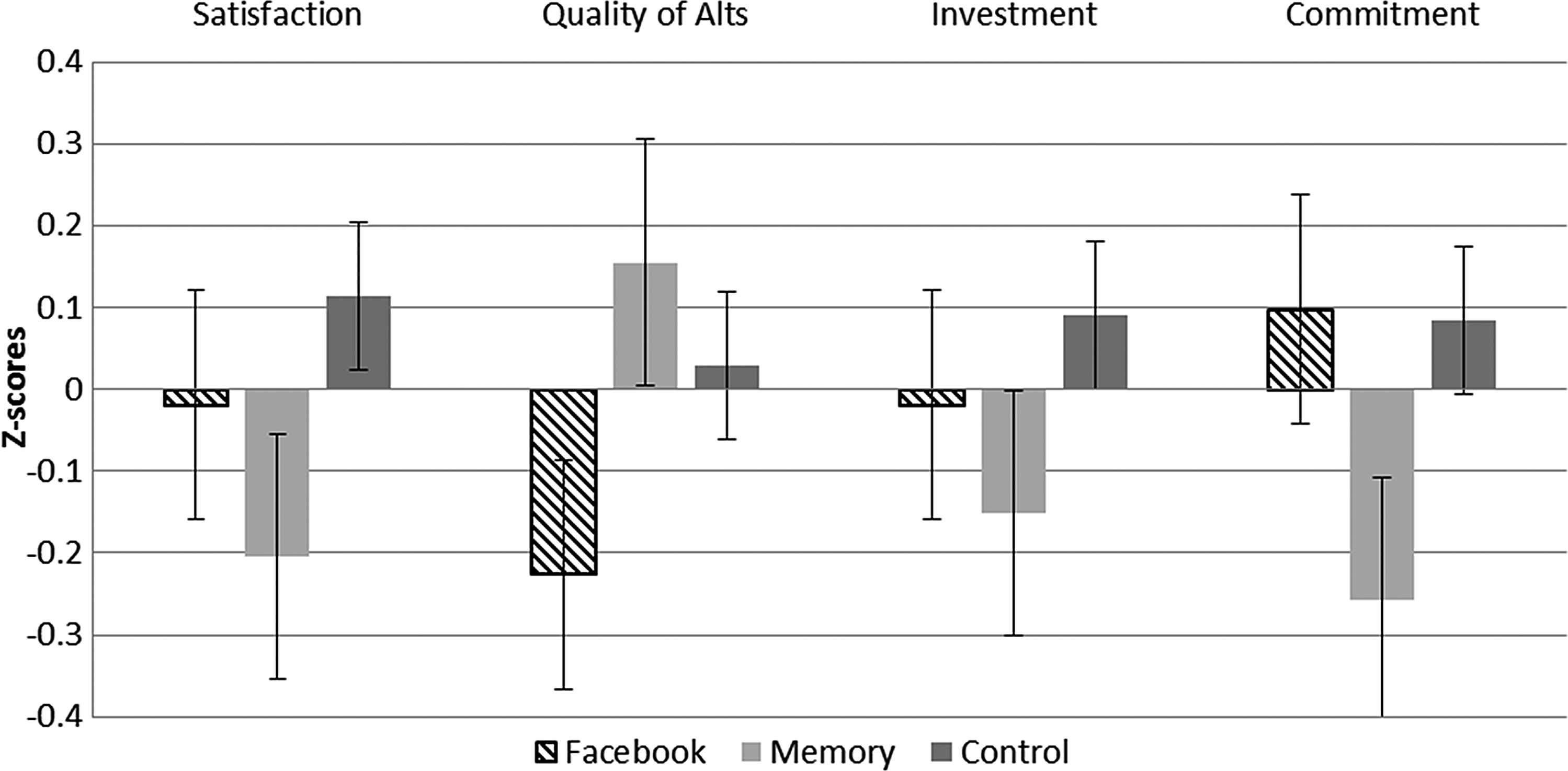
Comparison of z scores for four facets of the Investment Model Scale by condition.
Discussion
Research on the effects of Facebook (and social networking generally) on romantic relationships has found mainly negative effects between Facebook use and relationship outcomes. Facebook has been related to emotional and physical cheating, jealousy, breakups, and even divorce.6–8 Valenzuela et al. 8 suggested that access to potential partners via social networking may be one of the reasons behind these negative outcomes. However, two recent studies2,3 found that although a good number of romantic alternatives were identified through Facebook friends lists, the number of alternatives identified was not related to lower levels of commitment to current partners, even when the nature of the communication with those alternatives was sexual or romantic. This study expanded on this previous research with an experiment to examine whether perusing a Facebook friends list for potential sexual and committed relationship partners would increase the number of potential alternatives identified and/or have a negative effect on relational investment.
In line with the hypothesis, Facebook friends lists did act as memory primers for potential partners, but the significant effect held for sexual alternatives only (not committed relationship alternatives), and the priming effects were stronger for men. In other words, Facebook does seem to facilitate the recognition of potential sexual partners, especially for men. This reinforces the concept that access to potential partners may be one of the features of Facebook that is leading to negative relationship outcomes, in that without Facebook (or other types of social networking), fewer alternatives would be identified.
That said, the most notable finding of the study was that the recognition of these partners through Facebook lowered individuals' perceptions of the quality of their alternatives. Compared with those asked to recall their alternatives from memory and even a control group who listed their alternatives after completing the IMS, those who recalled more alternatives via Facebook rated their quality of alternatives as lower. Meanwhile, those who recalled potential alternatives from memory had lower relationship satisfaction and commitment than those in the control condition and lower commitment levels than those in the Facebook condition. There are a few possibilities for why these results emerged. First, it could be that more alternatives generated equates to a lower average desirability of those alternatives. Thus, those in the Facebook condition, who generated many alternative partners, especially sexual partners, likely averaged together the desirability of all of those potential partners (some very desirable, some not as desirable) when completing the IMS. In contrast, because it was a recall task, those in the memory condition probably recalled only the few salient alternatives in their social spheres, which, when averaged together, were more desirable than the larger lot of alternatives from Facebook. Another possibility is that the potential connections on Facebook may not be the most desirable alternatives in one's social circle. Thus, those in the Facebook condition rated their alternatives as lower in quality than those in the memory condition because the people the Facebook condition participants really wanted to have a sexual or committed relationship with were not contained in their Facebook friends list. In order to test this hypothesis further, participants in the memory condition were asked to indicate how many of those people they named as sexual or committed relationship alternatives were Facebook friends. Participants indicated that, on average, 75% of the sexual alternatives they thought of were Facebook friends, and 76% of the committed alternatives they thought of were Facebook friends. Thus, it is possible that the most appealing relationship alternatives (i.e., those that lowered relational investment) were not part of individuals' Facebook friends lists. This could be an intentional choice to maintain relationship harmony (e.g., avoiding actions that would make a partner jealous), to keep actual relationship alternatives hidden from one's romantic partner, or even to lessen one's own access to potential partners (i.e., consciously avoiding Facebook friendships with romantic desirables). Finally, it may be that the act of recalling romantic alternatives from memory lowers investment (lower commitment and satisfaction, higher quality of alternatives) for one's partner. Perhaps those in the memory condition, who were not given any memory primer, felt that because they generated a number of alternatives simply from their memory that their investment in their partners must be lower. This alternative aligns with Bem's self-perception theory, 24 which suggests that observations of our own behavior influence our attitudes. Each of these possibilities merits further investigation.
Limitations and conclusion
The current study was conducted with young adults, for whom, although they identified themselves as being in committed relationships, it is not known how committed their partnerships were, and who were not usually married. Thus, it is unknown how well these results will generalize to samples of older, married adults, whose commitment levels might be higher and whose Facebook friends list might contain fewer romantic alternatives. Additionally, questions were not asked about the nature of the relationship with the romantic alternatives identified. Thus, it is not known if these alternatives were simply platonic or whether any of these alternatives identified were already sexual or romantic liaisons, either online of offline. Future research should include more inquiry into the nature of the relationship with these alternatives.
Overall, the results support previous work in this area2,3 that suggests that romantically desirable contacts in one's Facebook friends list are not necessarily threats to current relationships. Although Facebook can act as a memory primer for sexual alternatives, the alternatives we keep in our memories are the ones that are most threatening to our existing committed relationships. Long before technology emerged, we were cheating, breaking up, and divorcing because we found alternative partners. With or without technology, we continue to do so, using our minds to store information about the potential partners who pose real threats to our romantic relationships.
Footnotes
Acknowledgment
A portion of this work was presented as a poster at the annual meeting of the Midwestern Psychological Association.
Author Disclosure Statement
No competing financial interests exist.