




Abstract
Abstract
This study analyzes the potential of virtual reality (VR) to enhance attentional distraction in overweight children as they experience bodily sensations during exercise. It has been suggested that one reason why obese children stop exercising is the perception of bodily sensations. In a counterbalanced design, a total of 109 children (33 overweight, 10–15 years old) were asked to walk twice for 6 minutes on a treadmill under one of two conditions: (a) traditional condition (TC)—focusing their attention on their physical feelings and sensations or (b) distraction condition (DC)—focusing their attention on a virtual environment. Attentional focus during exercise, bad–good feeling states (pre- and postexperimental), perceived exertion (3 minutes and post), heart rate, and enjoyment were assessed. Results indicated that overweight children focused on internal information under the TC, but they significantly shifted their attention to regard the external environment in the DC. This attentional distraction effect of VR was more intense in overweight than in normal-weight children. No differences between groups were found when examining changes in feeling states and perceived exertion. VR increased enjoyment during exercise, and children preferred exercise using virtual environments. VR is useful to promote distraction and may help overweight and obese children to enjoy exercise.
Introduction
O
Many interventions have been developed to promote physical activity. However, dropouts and noncompletion of the proposed programs are important problems affecting their efficacy and effectiveness, 3 and the lack of accomplishment is even higher for obese children. 4 Therefore, studying the variables related to the acquisition and the maintenance of physical activity levels has become a major challenge, especially in childhood and adolescence since, if the habit is established at this developmental stage, it tends to be maintained throughout adulthood. 1
It has been suggested that one reason why obese children stop exercising is because physical activity is aversive for them and because of the perception of uncomfortable body sensations. 5 Thus, enjoyment and attentional processes seem to be relevant factors in practicing exercise because both work together as a distraction process that could help disengage from sensations and feelings that could generate the lack of motivation to practice physical activity.
Attentional processes have been extensively investigated in adult athletes, and evidence has shown that they can enhance performance and influence psychological states during exercise and competition. Neumann and Piercy 6 found that when runners focused their attention on the distance run and on their running movements, rather than focusing on breathing or when given no explicit instructions to focus on anything, they consumed less oxygen. However, their role in promoting physical activity in children has been scarcely studied. Only two studies have investigated this issue in obese youngsters. In the first study, De Bourdeaudhuij et al. 7 examined the effects of attentional distraction (listening to a favorite piece of music) on running time using an incremental treadmill test in obese youngsters (9–17 years old) and found they ran significantly longer during distraction; this effect was observed even though participants indicated they did not strongly believe they could run longer while listening to music. The second study, published recently 8 (also making use of musical diversion), investigated the effect of attentional distraction on field running distance and activity intensity during an exercise session involving normal-weight and overweight youngsters (12–14 years old). Results showed attentional distraction had a positive effect on exercise intensity and feelings of annoyance. However, results did not show differences between normal-weight and overweight youngsters, and the effect of attentional distraction was similar in both groups.
Researchers have suggested that virtual reality (VR) is useful in promoting physical activity in sedentary and obese children, 9 especially for increasing motivation to exercise.10,11 In two previous studies, we compared the performance of obese and normal-weight children using a treadmill either with or without a VR platform. In the first study, 12 we investigated the effort (measuring ECG, heart rate, oxygen consumption, and perceived exertion), as the children walked on a treadmill while using a VR platform (Study 1), and then compared the two groups. No differences were found between conditions (with or without VR), but most participants liked the idea of combining physical activity with the VR platform. The second study 13 compared the effects of a commercial platform (Wii Fit, walking mode) on perceived exertion, self-efficacy, and satisfaction between clinically obese and normal-weight children. Results showed obese children scored significantly higher on satisfaction in the VR condition but not on self-efficacy and perceived exertion. Previous results showed obese children preferred to do exercise in VR environments, although there were no measureable differences in effort (objective or perceived) and self-efficacy.
So far, no study has explored the role of attentional strategies during exercise using VR. This technology could be useful as it provides a 3D environment, where distraction from physical sensations can be promoted.
The main purpose of the present study was to analyze the potential of VR to enhance the use of attentional distraction from body sensations during exercise, and we hypothesized this effect will be stronger in overweight compared to normal-weight children. Furthermore, we expect to find differences in affect, perceived exertion, and enjoyment between exercise sessions with VR (promoting attentional distraction) or without VR (promoting body-focused attention). We further hypothesized that these differences will be stronger in overweight compared to normal-weight children.
Materials and Methods
Design
Our study consisted of a between- and within-subjects counterbalanced design, where all participants were asked to walk fast on a treadmill under two conditions: (a) traditional condition (TC), focusing their attention on their physical feelings and sensations (no VR available), and (b) distraction condition (DC), focusing their attention on a virtual environment. The order of both conditions was counterbalanced; half of the participants performed first TC and then DC, and the other half performed first DC and then TC.
Participants
A total of 109 children (56.9% girls) with ages ranging from 10 to 15 years (X = 11.86, SD = 1.24) were recruited from summer schools for this study. Seventy-six children were normal weight (BMIz scores ranged from −2.5 to 1.08) and 33 children were overweight (BMIz scores ranged from 1.30 to 2.65).
Measurements
Anthropometric data
Participants' heights were measured to the nearest 0.5 cm using a fixed calibrated stadiometer (Scale-Tronix, Wheaton, IL). Body weight was recorded to the nearest 0.1 kg with the use of a standard beam balance scale, with participants wearing lightweight clothing and no shoes. Then, body mass index was adjusted to age (BMIz) and calculated.
Heart rate
We monitored HR by a wireless electronic shirt (NUUBO TIPS) that records continuous ECG and HR. 14 The mean HR for each participant in each period of the study was also calculated.
Attentional Strategies Assessment
We designed this measuring tool ad hoc for this study to evaluate the frequency of attentional focus during the exercise. The instrument is composed of six pictorial panels, each representing children walking on a treadmill with different attentional focuses. The six items are as follows: (1) bodily sensations (heart, breathing, pain, sweating, etc.); (2) thoughts about performance (e.g., “Am I doing well?,” “Will my outcome will be good?”); (3) thoughts of encouragement (e.g., “Go ahead!,” “Come on!”); (4) thoughts about the task (e.g., “How long until the end?,” “Would it be better for me to hold onto the treadmill?); (5) distraction by thoughts not related to the task (e.g., remembering past events, movies, or other thoughts); and (6) distraction by the environment (e.g., looking at aspects of the room). At the end of each exercise session, participants were asked to allocate 10 stickers to these 6 panels, representing the percentage of time they had focused their attention during the exercise on each item. They could put as many stickers (up to 10) as they wanted in each panel.
Feeling scale 15
This is an 11-point bipolar scale, ranging from −5 to +5, to gauge how bad or good the child feels while exercising, providing a measure of the affective dimension. The item, “How are you feeling right now?” was asked before and after exercise in both conditions.
The Eston–Parfitt scale 16
This scale is an adaptation of the Children's Effort Rating Table 17 to assess perceived exertion. It is a pictorial curvilinear scale that depicts a character at various stages of exertion on a concave slope with a progressively increasing gradient at the higher intensities. Answers range from 0 to 10. This scale was asked after 3 minutes of exercise and at the end of the session in both conditions.
Enjoyment and preference
This instrument was also designed ad hoc for this study. At the end of each condition, participants were asked how much they enjoyed the exercise session on a 1- to 7-point scale. At the end of the experiment, participants were asked to choose between both conditions if they had to repeat the exercise.
VR Exercise Platform
The VR platform was used in a previous study. 12 It is composed of a 3D graphical environment controlled by a computer and synchronized to a treadmill. The virtual environment consists of a virtual journey across a mountain and includes an avatar representing the participant in a third-person perspective. The virtual environment was projected onto a 150 × 150 cm screen.
Procedure
All participants were informed about the purpose of the study, and written informed consent was obtained from them and their parents before participating. After taking anthropometric measures, children were explained the procedures and how they would be scored on scales for assessing attentional strategies, feeling states, and perceived exertion. They were asked to walk twice for 6 minutes on a treadmill. For the first 3 minutes, the treadmill was set at a speed of 4.6 km/h, and for the last 3 minutes, it was set at 5.7 km/h. They repeated both conditions (TC and DC) in a counterbalanced design. There was a 5-minute break between the two conditions.
Results
The pre- and postexercise mean scores for rate of perceived exertion (RPE) were as follows: DC: overweight: pre = 2.3 (1.6), post = 4 (2.3); normal weight: pre = 1.9 (1.4), post = 3 (1.6), and TC: overweight: pre = 2.5 (1.4), post = 4.4 (1.7); normal weight: pre = 1.7 (1.2), post = 2.5 (1.4). The scores in affect were as follows: DC: overweight: pre = 2.8 (2), post = 2.1 (2.1); normal weight: pre = 3.5 (1.4), post = 3.1 (1.4), and TC: overweight: pre = 3.1 (1.5), post = 2.1 (2.1); normal weight: pre = 3.5 (1.2), post = 2.9 (1.5). The rest of the descriptive data are shown in Table 1. For analyzing differences between normal-weight and overweight children in both conditions, several mixed ANOVAs with 2 × 2 (groups × conditions) (groups: normal weight vs. overweight and conditions: TC vs. DC) were applied for the different measures.
DC, distraction condition; TC, traditional condition; RPE, rate of perceived exertion; ASA, attentional strategies assessment.
Regarding attentional strategies, to know whether there were differences between normal-weight and overweight children and between the conditions, we analyzed the attentional strategies assessment (ASA) scores on each item. Results showed significant differences on Item 1 (focus on bodily sensations) between conditions [F(1, 86) = 34.381, p < 0.001, η2 partial = 0.28] and groups [F(1, 86) = 11.142, p < 0.001, η2 partial = 0.11]; more importantly, the group × condition interaction was also significant [F(1, 86) = 20.15, p < 0.001, η2 partial = 0.10] (Fig. 1). Results showed overweight children focused their attention significantly longer than the normal-weight participants on bodily sensations in TC, but there were no differences in DC.
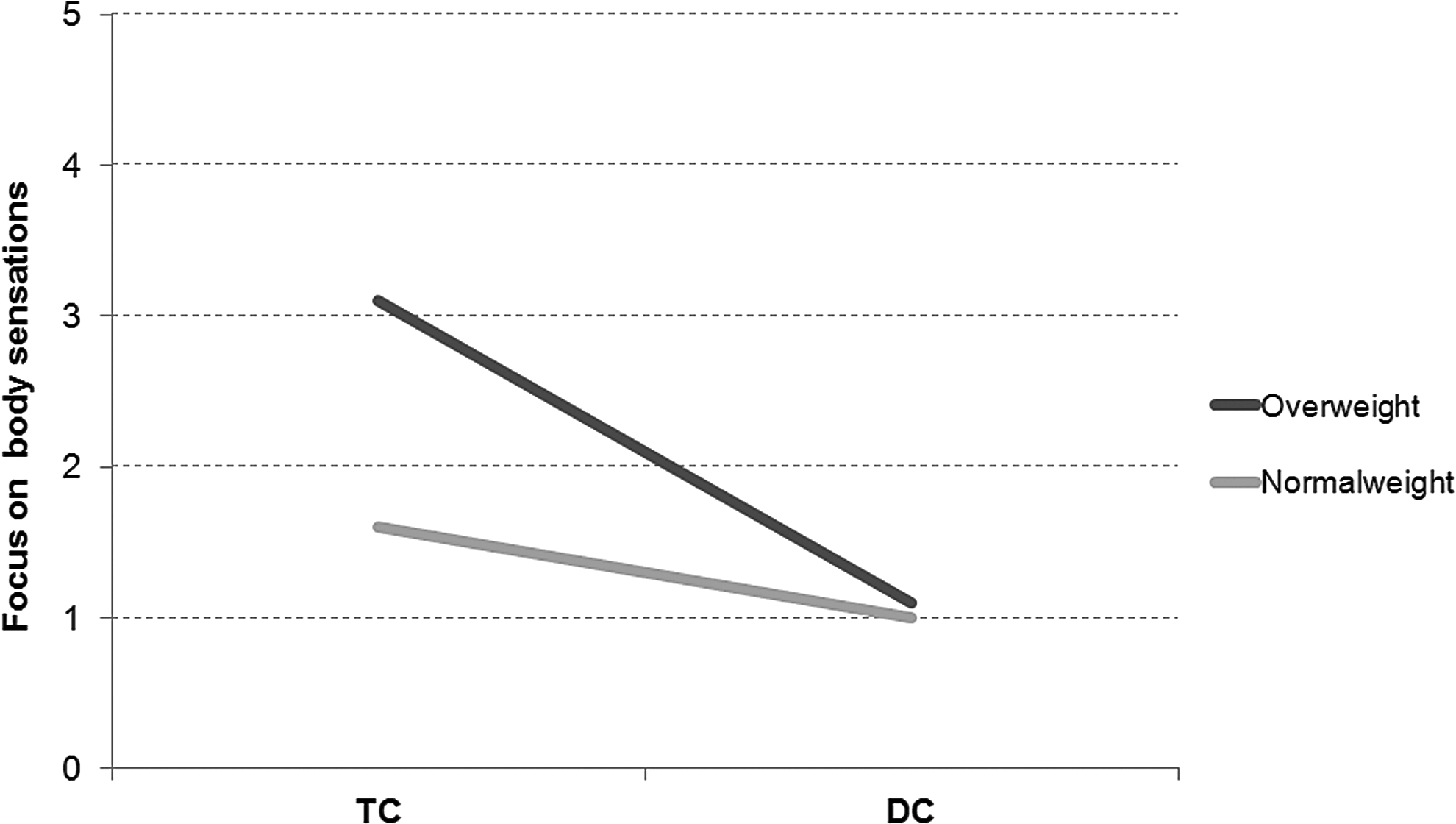
Attentional focus on bodily sensations in overweight and normal-weight children in both conditions.
Results also showed significant differences on Item 6 (external focus on the environment) between conditions [F(1, 86) = 15.95, p < 0.001, η2 partial = 0.15] but not between groups. Again, the group × condition interaction was significant [F(1, 86) = 8.409, p < 0.001, η2 partial = 0.08]. Post hoc tests showed that differences were for overweight children who were distracted longer during DC than in TC (Fig. 2). There were no statistically significant differences between conditions, groups, or interaction for any other attentional item.
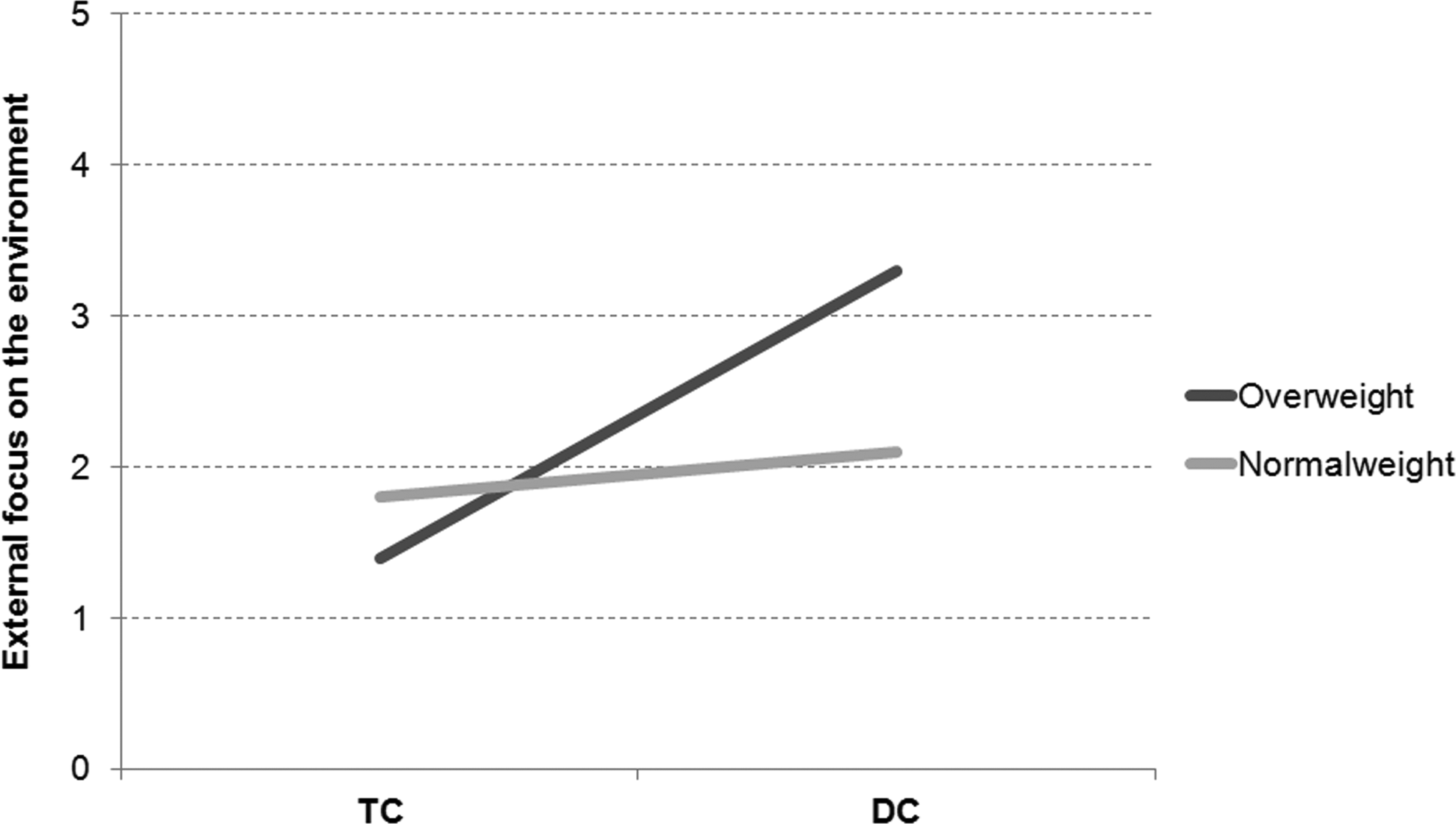
Attentional focus on the environment in overweight and normal-weight children in both conditions.
Regarding affect, a differential feeling scale (FS) score (postexercise–preexercise) was calculated, and a mixed ANOVA 2 × 2 was carried out. Results did not show differences between groups, conditions, or interaction. As for perceived exertion, a differential Eston–Parfitt scale (EP) score (postexercise at 3 minutes) was also calculated, and a mixed ANOVA 2 × 2 was carried out. Again, results did not show differences between groups, conditions, or interaction.
Heart rate responses were analyzed, and results showed differences between groups, with higher HRs recorded for the overweight children [F(1, 84) = 5.913, p < 0.05, η2 partial = 0.06]. There were no differences between conditions or interaction.
Regarding enjoyment and preference, mixed ANOVAs 2 × 2 (groups × conditions) showed that all participants enjoyed the DC more [F(1, 86) = 3.893, p > 0.05, η2 partial = 0.04), but there were no differences between groups, and the group × condition interaction was not significant. Finally, 70% of participants said they would like to repeat the DC exercise, but no differences were found (X2 = 0.50) regarding children's weight.
Correlations among the six ASA, FS, EP, and BMIz scores were calculated for TC and DC. Results showed significantly negative correlations between BMIz scores, with changes in feeling states in DC (−0.253, p < 0.01) and changes in perceived exertion in TC (−0.375, p < 0.000). In addition, changes in FS scores correlated in both conditions (0.387, p < 0.00).
Regarding ASA scores, only Item 1 (focus on bodily sensations) correlated with BMIz in TC (0.215, p < 0.05) and Item 6 (external focus on environment) with BMIz in DC (−0.226, p < 0.05).
Discussion
The present study investigated the use of VR to promote attentional distraction from bodily sensations during exercise in overweight children. We also wanted to investigate whether attentional strategies had an effect on affect and perceived exertion and if these effects were different in normal-weight and overweight children.
Regarding the first objective, VR proved to be efficacious to promote attentional distraction from bodily sensations in overweight children. Results indicated that overweight children focused longer on internal information under TC, but when VR was used, their focus significantly shifted to the external environment. This distraction effect was more intense in overweight than in normal-weight children. In addition, BMI correlated with internal focus only in TC and negatively with external focus on environment only in DC. This is an important finding as literature points out overweight children usually interpret bodily sensations during physical exercise as negative and aversive, and they report more physical complaints while exercising. 18 VR could therefore be a useful tool to change attentional focus for overweight youngsters.
However, the hypotheses about the effect of distraction on subjective variables, such as affect and perceived exertion, were not confirmed. Results showed affect decreased in both groups in both conditions, and perceived effort increased in both groups in both conditions after exercise. Limitations of this study that could have influenced the results were the exercise routine was performed at moderate intensity and intensity and time were standardized for both groups and for both conditions. Maybe differences could be found at higher intensity, but at low or moderate intensity, distraction has no effect on subjective variables. In fact, some studies have shown that the use of distraction is less efficient in reducing perceived effort and increasing the affective response at lower intensity activities. 19 In any case, overweight children reported lower rates of affect and higher rates of perceived exertion, and they enjoyed the exercise sessions less than normal-weight children. These data are in line with previous studies. 18
Finally, this study demonstrated that VR increases enjoyment during exercise and children prefer exercise using virtual environments. As enjoyment is the most important predictor of physical activity in children, 20 VR might be a useful strategy to increase exercise adherence in overweight children.
This study has some limitations. First, the ASA questionnaire was created ad hoc for this study. Stevinson and Biddle 21 argued for classification of attentional processes in terms of task relevance (task relevant vs. task irrelevant) and direction of attention (internal vs. external). These authors stated that dichotomous thinking about distraction is often too simplistic to account for the complex reality of cognition and attentional processes. This approach was followed in the construction of the ASA scale, but it is uncertain whether it adequately covered the most important attentional strategies during exercise and whether it is appropriate for children.
A second limitation is related to the instructions about attentional focus as they were different in both conditions. However, they were the same for both groups of children, so instructions could not be responsible for the differences between groups or the interaction of group × condition. As some previous data indicate overweight children often complain about physical sensations, we feared if they did not receive specific instruction, there probably would not be observable differences between the two conditions regarding normal-weight children; thus, we proposed to “force” participants to pay attention to internal sensations in the TC. However, data showed no differences in the attentional focus of normal-weight children; even when given explicit instructions to direct their attention to their body, they did not focus on it. It is necessary to replicate this study without giving explicit instructions, or by giving the same instructions in both conditions, to confirm these differences between children of different weights.
The third limitation is that the exercise sessions were standardized for time and intensity for both conditions, and, as mentioned, the absence of differences in reported affect and perceived exertion could be influenced by the moderate-intensity exercise. Other exercise paradigms varying duration and intensity and including a variety of activities are needed. Fourth, the virtual environment was not a game; thus, further research using VR to increase enjoyment and positive emotions is also needed. Finally, another limitation is that as the children exercised in a laboratory setting, researchers need to investigate whether VR is useful in overweight children in other contexts.
To our knowledge, this is the first study to investigate the effect of attentional distraction in overweight children using VR during exercise. Results showed this technology is useful to promote distraction and may help overweight and obese children enjoy exercise. Usually, overweight youngsters' motivation to exercise is extrinsic (e.g., to lose weight or look better 18 ) rather than intrinsic (e.g., for enjoyment). Since physical activity is a key factor in overweight prevention and treatment, strategies are needed to intrinsically motivate obese children to be physically active. VR could be a useful tool for this purpose.
Footnotes
Acknowledgment
This study was funded in part by ACTIOBE (MINECO, Spain, Plan Nacional I+D+I 2008–2011 PSI2011-25767), PROMOSAM (MINECO, Spain, PSI2014-56303-REDT), and CIBEROBN, an initiative of ISCIII (ISC III CB06 03/0052).
Author Disclosure Statement
No competing financial interests exist.