




Abstract
Abstract
Social networking sites, such as Facebook, offer adolescent users an ideal platform for negative comparison (i.e., experiencing negative feelings from social comparison). Although such negative comparison on Facebook has been associated with users' well-being, the reciprocal relations between the two remain unclear, particularly in an adolescent sample. To examine this reciprocal process, a two-wave study among a representative sample of Flemish adolescents was set up (NTime1 = 1,840). Data were analyzed using structural equation modeling. Cross-lagged analyses indicated that negative comparison on Facebook predicted decreases in life satisfaction over time. Conversely, lower scores on life satisfaction predicted increases in negative comparison on Facebook. The discussion focuses on the understanding of these findings, key limitations, directions for future research, and implications for prevention and intervention strategies.
Introduction
A
One factor that may partly explain decreasing life satisfaction is negative online comparison; studies found an association between negative online comparison and college students' well-being.7–9 At the same time, although, we may expect, based on cognitive dissonance theory 10 and selective exposure theory, 11 that life satisfaction also predicts adolescents' tendency for negative online comparison. However, no study thus far examined such reciprocal relations. Therefore, the present two-wave study aims to investigate the reciprocal relations between negative online comparison and adolescents' life satisfaction, hereby adding to prior studies that were mainly cross sectional 9 or focused on the unidirectional impact of online social comparison.7,8 We believe it is critical to determine whether negative online comparison and poor life satisfaction are reciprocally related and reinforce one another, given the detrimental outcomes of poor life satisfaction. This study focuses on adolescents as this age group may be particularly at risk for the impact of negative online comparison, given both their online presence 12 and the decrease of life satisfaction during this developmental period. 2
Facebook use and adolescents' well-being
Facebook is the most widely used social networking site (SNS) 12 ; young people spend ∼2 hours per day on Facebook, during which they frequently update their status, upload photos, and browse others' profiles.13–15 While some scholars argue that Facebook use is related to poor well-being, others suggest that Facebook use does not affect users' well-being.16–18 This controversy may be due to the lack of focus on indirect associations, specific user characteristics, and different usage patterns within initial studies. However, more recent studies addressed these critical gaps.19–23 For instance, Chen and Lee found that Facebook interaction was indirectly related to greater psychological distress through increased communication overload and reduced self-esteem. 19 In line with these studies, the present study focuses on a specific Facebook usage pattern, that is, negative comparison on Facebook, and its reciprocal relations with adolescents' life satisfaction.
We particularly focus on this specific Facebook usage pattern as many users may use Facebook for social comparison. This expectation is based on social comparison theory, which argues that individuals are driven by a desire to evaluate their opinions and abilities. 24 In the absence of an objective base for comparison, this self-evaluation motive is served through comparison with (similar) others. 24 Recent studies showed that Facebook users are frequently exposed to other users' feelings and experiences as young people mainly use Facebook to browse through others' profiles. 25 This exposure is more than relevant as Facebook hereby offers users an ideal setting where they can easily compare themselves with (similar) others.26–28 By exploring the reciprocal relations between this specific Facebook usage pattern and adolescents' life satisfaction, the present study aims to contribute to a more nuanced insight into the role of Facebook in adolescents' lives.
Social comparison processes can be either downward (i.e., comparison with those who we believe are worse off) or upward (i.e., comparison with those who we believe are better off).29,30 Festinger, however, proposed that individuals have “a unidirectional drive upward”; people generally prefer to compare themselves with others who are better off. 24 In line with this, we believe that SNSs, in particular, may offer adolescent users the perfect platform for engaging in such upward comparison. Studies already demonstrated that social media users tend to portray themselves as positively as possible online,27,28 applying various techniques to optimize their online self-presentation, including carefully selecting and retouching photos31,32 and disclosing mostly positive emotional experiences. 33 Due to this “ideal” online self-presentation, adolescent SNS users may develop the feeling that others are better off. Recent studies supported this claim, showing that the use of SNSs may stimulate young people's upward comparison processes 26 on a variety of dimensions, such as appearance7,34,35 and success in life.33,36
Negative comparison on Facebook predicts lower life satisfaction
Upward comparison provides a reference point against which one's own situation may be perceived as “inferior” 37 ; people are especially likely to compare themselves negatively when they engage in upward social comparison. 38 It is this negative comparison that may harm individuals' well-being. Scholars believe that individuals' tendency to engage in maladaptive emotion regulation strategies, such as rumination (i.e., the tendency to focus repetitively on negative stimuli), may explain this harmful impact of negative comparison as negative comparison has been found to stimulate rumination, and this rumination, in turn, further stimulated the development of depressive symptoms. 8 In line with these suggestions, research reported an association between negative online comparison and individuals' well-being.7–9 For instance, Feinstein et al. showed that negative comparison on Facebook predicted increases in depressive symptoms. 8 It was therefore hypothesized that:
Hypothesis 1: Negative comparison on Facebook (Time 1) will negatively predict adolescents' satisfaction with life (Time 2).
Lower life satisfaction predicts negative comparison on Facebook
Although the impact of online social comparison on well-being has often been reported, the possible reverse impact is still unclear. However, various scholars emphasize the need to examine individual antecedents of social comparison processes39,40 as the strength and frequency with which individuals apply social comparison processes may vary. According to Festinger, individuals who are uncertain about their opinions and abilities will be more likely to make social comparisons. 24 Especially people who are uncertain about various aspects of their lives may be more motivated to engage in social comparison as it offers them a way to gain information for a deeper understanding about themselves and their social worlds.41–43 In line with this suggestion, studies have shown that individuals who are depressed 44 or have low self-esteem42,43 are more likely to compare themselves with others.
However, based on cognitive dissonance theory 10 and selective exposure theory, 11 we believe that people with poor well-being may be particularly attracted to negative comparison on Facebook. While cognitive dissonance theory 10 argues that individuals actively avoid situations and information in which dissonance may occur, but prefer information that is consistent with their cognitions and behaviors, selective exposure theory 11 suggests that people may select specific media content that confirms and supports their own behavior. In line with these theories, we expect that adolescents who are dissatisfied with their life will compare themselves negatively on Facebook as this negative comparison confirms and supports their own negative cognitions about one's life.
In line with these suggestions, de Vries and Kuehne showed that Facebook use more strongly predicted negative social comparison among those who were dissatisfied with their lives. 45 In addition, Johnson and Knobloch-Westerwick found that SNS users with a negative mood select specific media content (i.e., downward online comparison) to enhance their negative mood. 46 Although this study provided support for cognitive dissonance theory and selective exposure theory with regard to online comparison behaviors, these findings somewhat differ from our expectations. However, this may be partly explained by differences between mood in that study and life satisfaction in the present study, whereas individuals' mood fluctuates strongly over time, 47 life satisfaction is more stable. 48 Individuals with a negative mood may therefore feel more capable to change their negative feelings compared to persons who are dissatisfied with their life. As a result, individuals with a negative mood may be particularly driven to downward comparison as this type of comparison can immediately improve their mood, whereas those who are dissatisfied with their life may be especially driven to negative comparison as this type of comparison can confirm their negative feelings. It was therefore hypothesized that:
Hypothesis 2: Satisfaction with life (Time 1) will negatively predict adolescents' negative comparison on Facebook (Time 2).
Materials and Methods
Sample and participant selection
After having obtained consent from participants' parents or legal guardian, 12- to 19-year-olds from 15 randomly selected Flemish high schools (i.e., the northern part of Belgium) were invited to fill out paper-and-pencil questionnaires in March (Time 1) and October 2014 (Time 2) (response rate = 97 percent). In line with previous longitudinal studies on adolescents' life satisfaction, we used a 6-month time lag.49,50 The schools were located in different provinces of Flanders and offered different types of schooling levels. To track participants over time, they filled out separate identification forms at Time 1 and Time 2. Approval for the study procedures was received from the institutional review board of the host university.
At baseline, 1,840 adolescents completed the questionnaire; 1,577 participated in the second wave and 1,235 completed the questionnaires at both time points (67 percent of the first wave). As this study examines relations between negative comparison on Facebook and adolescents' life satisfaction, we only included the respondents who had a Facebook account at Time 1 or Time 2 in our analyses (NTime1 = 1,621; 88 percent). At baseline, 52 percent of these participants were boys; the mean age was 14.76 years (SD = 1.41); 9 percent of these participants were in 7th grade, 19 percent in 8th grade, 27 percent in 9th grade, 29 percent in 10th grade, and 16 percent in 11th grade.
To examine whether attrition biased our final sample, we examined differences between those who participated in both waves and those who participated in one wave. A multivariate analysis of variance using Pillai's trace revealed significant differences, V = 0.02, F(5, 1470) = 6.25, p < 0.001, hp2 = 0.02. Followup univariate analyses showed that adolescents who participated in both waves scored higher on life satisfaction at Time 1 (M = 4.99; SD = 1.32 vs. M = 4.63; SD = 1.48), F(1, 1575) = 24.71, p < 0.001.
Measures
Control variables
Participants indicated their gender and age. To control for social media use, we assessed, first, respondents' overall SNS use, asking “How often do you visit social networking sites” [7-point Likert scale; never (1) to several times per day (7)]. Second, to assess average daily time spent on Facebook, we questioned how much time respondents spend, on average, on Facebook on a regular weekday, Wednesday, Friday, and weekend day. Items were rated on an 11-point Likert scale, ranging from 0 hours (0) to I am always logged in to Facebook (11). We distinguished Wednesdays from regular weekdays because participants then have a half day at school. A composite score was computed by calculating the average of the time spent on these days. Third, using a 7-point Likert scale, ranging from never (1) to several times per day (7), respondents rated five different types of passive Facebook activities (e.g., “How often do you visit a profile of a Facebook friend”). These items were averaged to create an estimate of adolescents' passive Facebook use (αTime1 = 0.85).
Negative comparison on Facebook
To assess the level of respondents' negative comparison while using Facebook, we used the “Frequency of Having a Negative Feeling from Comparison on Facebook Scale.” 9 Using a 5-point Likert scale [strongly disagree (1) to strongly agree (5)], respondents were asked three questions: “When I read my Facebook news feed or see others' Facebook photos …,” (a) “… I often think that others are having a better life than me,” (b) “… I often think that others are doing better than me,” and (c) “… I often think that I am isolated from others” (αTime1 = 0.89; αTime2 = 0.89). These items were averaged to create an estimate of adolescents' negative comparison on Facebook.
Life satisfaction
The 5-item Satisfaction with Life Scale taps into the global life satisfaction component of subjective well-being. 3 Using a 7-point Likert scale from strongly disagree (1) to strongly agree (7), respondents evaluated five items (e.g., “I am satisfied with my life”) (αTime1 = 0.90; αTime2 = 0.90). By averaging the item scores, an estimate of adolescents' life satisfaction was created.
Analysis
To test the reciprocal relations between negative comparison on Facebook and life satisfaction, we computed an autoregressive cross-lagged panel model with structural equation modeling (AMOS) using the maximum likelihood method. The fit of our model was evaluated with the chi-square-squared-to-degrees-of-freedom ratio (χ 2 /df), the root-mean-squared error of approximation (RMSEA), the comparative fit index (CFI), the adjusted goodness of fit index (AGFI), the goodness of fit index (GFI), and the normed fit index (NFI). 51
All variables at Time 2 were predicted by their preceding values at Time 1 and by the value of the respective independent variable at Time 1. We further allowed covariances between our control variables and the study variables at the same time point and estimated paths from these control variables at Time 1 to each of the study variables at Time 2. In addition, we estimated correlations between latent variables measured at Time 1 and allowed covariances between the measurement errors of the same indicators.52,53
Results
Descriptive statistics
Means, standard deviations, and range of all variables are presented in Table 1.
NTime1 = 1,621.
T1, Time 1; T2, Time 2.
Table 2 presents the zero-order intercorrelations for all relevant variables in the model. Negative comparison on Facebook and life satisfaction showed significant negative correlations over time.
NTime1 = 1,621.
p < 0.05; **p < 0.01.
T1, Time 1; T2, Time 2; ns, nonsignificant.
Cross-lagged model
The final autoregressive cross-lagged model, presented in Figure 1, indicated a good overall fit of the data and yielded a chi-square value of 754.49 with 150 degrees of freedom, p < 0.001, RMSEA = 0.05, CFI = 0.97, AGFI = 0.93, GFI = 0.96, NFI = 0.96, and χ 2 /df = 5.03. Confirming Hypothesis 1, negative comparison on Facebook at Time 1 decreased adolescents' life satisfaction at Time 2, β = −0.08, B = −0.12, SE = 0.04, and p < 0.01. Negative comparison on Facebook explained 44 percent of the variance in adolescents' life satisfaction. Confirming Hypothesis 2, life satisfaction at Time 1 decreased adolescents' negative comparison on Facebook at Time 2, β = −0.12, B = −0.08, SE = 0.02, and p < 0.001. Life satisfaction explained 34 percent of the variance in adolescents' negative comparison on Facebook.
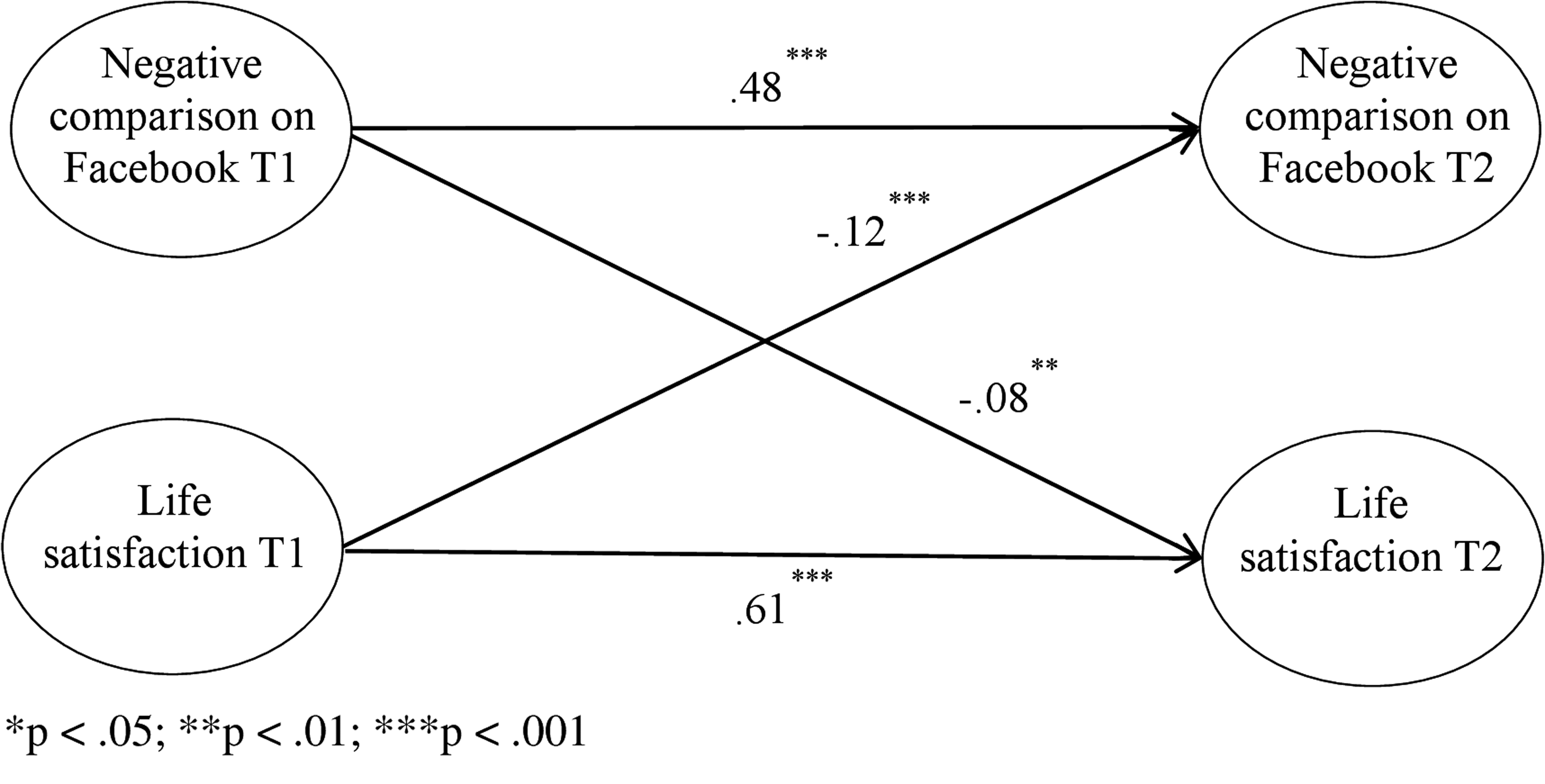
Final model examining the longitudinal and reciprocal relations between negative comparison on Facebook and adolescents' life satisfaction. Note: Values reflect standardized coefficients. All paths are significant at p < 0.05. For clarity, error terms, covariances, control variables, and measurements are not shown. *p < 0.05; **p < 0.01; ***p < 0.001.
Discussion
This study showed that negative comparison on Facebook and adolescents' life satisfaction are reciprocally related over time. Negative comparison on Facebook negatively predicted adolescents' life satisfaction and, at the same time, life satisfaction negatively predicted adolescents' negative comparison on Facebook.
The first finding is in line with previous cross-sectional8,46 and experimental28,34 findings, showing that negative online comparison decreased individuals' well-being. In his hyperpersonal model, Walther proposed that the reduced cues of computer-mediated communication allow users to present themselves in their best possible way. 54 With the rise of SNSs, adolescents are offered a new platform where they can easily present their best possible self. As a result of this upward comparison on SNSs, people may compare themselves more negatively with others, which in turn may negatively affect adolescent users' life satisfaction. This finding extends prior research as negative comparison on Facebook leads to similar negative outcomes for adolescents' subjective well-being as negative comparison in an offline context. 38 Future studies are, however, needed to identify those groups that are particularly vulnerable for the harmful effects of negative comparison on Facebook. Future research should examine whether this relation differs when the target is (dis)similar to the self as social comparison is more likely to occur when the target is similar.55,56 Future studies should also explore the type of Facebook user within this association as passive Facebook users (i.e., lurkers) may be especially attracted to comparison behaviors on Facebook. 57
The finding that life satisfaction, in turn, predicted adolescents' negative comparison on Facebook is in line with cognitive dissonance theory 10 and selective exposure theory. 11 Furthermore, this finding provides additional support for the claim that youth display cross-situational continuity in the online domain. 58 Mikami et al. showed that youths' behavioral adjustment at ages 13–14 years predicted similar qualities of problem behavior on their SNSs at ages 20–22 years. 58 Similarly, our findings showed that those who are already dissatisfied with their life (in an offline context) are more likely to use SNS in a similar way, that is, in a way in which they compare themselves with those who have a better life. Thus, the present study confirmed continuity in adolescents' social behaviors over time (i.e., 6-month interval) and across different contexts (i.e., offline–online context).
This study is, however, not without limitations. First, although its short-term longitudinal design may exceed conclusions based on correlational data, this design still limits the derivation of causal inferences. Experimental studies are needed to further unravel these reciprocal effects. Second, this study was limited by the relatively high attrition between Time 1 and Time 2. However, similar to attrition patterns noticed in previous studies,59,60 participants in both waves were more satisfied with their life compared to those who dropped out. As a result, the observed associations may have been even stronger, when attrition would be absent, as participants who dropped out were less satisfied with their life. Future studies should try to minimize attrition to provide a more correct understanding of the actual strength of these associations. Third, although we assume that negative comparison on Facebook may be interrelated with upward comparison behaviors on Facebook, as users often portray themselves in their best possible way on Facebook,27,28 this is only an assumption. The present study did not question adolescents' upward or downward comparison tendency on Facebook. Future studies are needed to further explore the relations between upward, downward, and negative Facebook comparison and adolescents' well-being.
We, however, believe that our findings extend prior research in at least two important ways. First, the present two-wave study is among the first to examine the reciprocal dynamic between negative comparison on Facebook and adolescents' well-being. It hereby adds to our knowledge on associations between negative online comparison and adolescents' well-being. Second, while previous studies mainly focused on college students,8,28,34 this study provides a deeper understanding of the predictors and outcomes of adolescents' life satisfaction.
The results suggest that effective prevention and intervention strategies should include considerations of how specific Facebook usage patterns (i.e., negative comparison on Facebook) are capable of amplifying existing negative feelings about one's life. We therefore recommend that parents and educators should warn vulnerable teens for the negative outcomes of negative comparison on Facebook as this specific type of online comparison may intensify their negative feelings. Given that poor life satisfaction has been related to various negative health outcomes, such prevention and intervention programs aimed at vulnerable teens are thus clearly needed.4–6
Footnotes
Acknowledgment
This research was funded by a grant from the Flemish Fund for Scientific Research (FWO).
Author Disclosure Statement
No competing financial interests exist.