




Abstract
Abstract
While technological advancement enhances the effectiveness and versatility of mediated environments, researchers have sought to better understand how endogenous characteristics of individuals relate to the ways in which mediated environments are experienced. Although the Big Five personality traits and absorption have shown marked relations with reports of immersion, further investigation of these traits is needed. In particular, there is need for a psychometrically sound model that integrates these concepts. The aim of this study was to build upon previous research looking at the Big Five personality traits, absorption, and immersion in a large sample of college-aged individuals. Results indicate that the Big Five traits of neuroticism, openness to experience, and extraversion are positively related to immersion and that openness to experience possesses the strongest relationship with immersive tendency overall. By integrating an established measure of absorption, a more psychometrically sound model was achieved.
Introduction
I
Seminal work by Witmer and Singer 1 aimed to emphasize an individual predisposition to feeling immersed in a virtual environment. In their estimation, sensory stimuli, environmental factors, and individual differences, interact to produce the overall experience of being “immersed” in mediated environments. Furthermore, characteristics of the individual and the environment (i.e., immersive factors) may facilitate (or hinder) the sensation of immersion; these factors alone are not sufficient in creating an immersive experience. 1
Although the role of personality traits in immersion has received much attention,2–4 empirical evidence as to which combination of scales best assess for immersion is still needed. One trait that has gained increasing interest for understanding experiences in mediated environments is absorption. By “absorption,” researchers mean the capacity for “getting lost” in media whether it involves watching a movie, reading a book, or experiencing a virtual environment. 2 A recent study 5 investigated a number of personality variables to isolate those most strongly associated with feelings of immersion in mediated environments. Results indicated that the personality factors that most closely reflected a sense of being present in a virtual context were immersive tendency, absorption, mental imagination, and perspective taking.
These findings build upon the work of Baños et al., 2 wherein the role of absorption was emphasized in relation to the experience of immersion in a virtual environment. Baños et al. found that higher scores in absorption were correlated with increased reality attributions and increased sense of presence. It is interesting to note that two established measures of absorption and immersive tendency, the Tellegen Absorption Scale (TAS) 6 and the Immersive Tendency Questionnaire (ITQ), 1 have been found to be highly correlated with one another in previous studies.5,7
This is not surprising given that a number of items on the ITQ are similar to those found on the TAS. For example, the TAS asks participants to rank their agreement with the following: “While watching a movie, a TV show, or a play, I may become so involved that I may forget about myself and my surroundings and experience the story as if it were real and as if I were taking part in it.” The overlap becomes apparent when one compares this to a similar question on the ITQ: “Do you ever become so involved in a movie that you are not aware of things happening around you?” (see Murray et al. 7 for more examples).
In an attempt to expand the present understanding of relations between personality factors and immersive experiences in virtual environments, Weibel et al. 8 used a German version 9 of the Neuroticism–Extraversion–Openness Personality Inventory (NEO-PI) 10 to examine the five-factor model of personality (extroversion, neuroticism, openness, conscientiousness, and agreeableness) and found that openness, neuroticism, and extroversion were positively related to immersive tendency, whereas conscientiousness and agreeableness showed no significant relation.
By factor analyzing the responses of 220 participants to the ITQ 1 they resolved that immersive tendency is comprised of two distinct subdomains called absorption and emotional involvement. Absorption has been previously defined as “openness to absorbing and self-altering experiences,” 6 whereas emotional involvement was defined by the authors as “strong emotional reactions toward media exposure.” 8 Using this model, they determined that extroversion, openness to experience, and most of all, neuroticism, were related to emotional involvement; however, absorption was only found to be influenced by openness to experience.
While there is an increasing interest in the importance of personality traits, absorption, and immersive tendency, there is need for a model that includes well-validated measures of each of these areas instead of extrapolations of potential constructs. The purposes of the present study include: (a) replicate the ITQ “absorption” factor findings of Weibel et al.8,9 in a much larger sample (to increase power and sample size) of college students by using structural equation modeling (SEM); (b) add the TAS to the model; and (c) examine the potential relationships among personality traits (NEO Five-Factor Inventory [NEO-FFI]), 10 immersive tendency (ITQ), 1 and absorption (TAS). Rather than measuring absorption by way of factor analyzing a measure of immersive tendency, an established measure of absorption (TAS) 6 was used.
Materials and Methods
Participants
A total of 2014 students were offered extra credit to participate in the study. Thousand six hundred seventy-one college-aged subjects participated in the study. Participants were 76.6 percent female and were between the ages of 18 and 22 (M = 19.9, SD = 2.1). Of these, 20.4 percent were enrolled as freshmen, 32.1 percent sophomores, 27.5 percent juniors, and 20 percent seniors. 4.4 percent of participants were identified as black/African American, 10.6 percent Hispanic, 31.5 percent Asian, 36.2 percent white/Caucasian, 0.3 percent Native American, and 17 percent other and/or mixed ethnicity.
No significant differences were found for age, sex, or education. Participants were also given a medical health history form to assess the presence of any mental or physical disorders that may have hindered their performance. All subjects were free of histories of neurologic disease or injury, psychiatric illness, including substance abuse or dependence, or self-reported specific developmental disorders. No participants were excluded for responses given on this form.
Procedures
This study was approved by the institutional review board of a university in the southwestern United States. Participants had 1 hour to complete the surveys in a computer laboratory and received extra credit for participating in the surveys.
Measures
Immersive Tendency Questionnaire
The ITQ 1 is an 18-item self-report questionnaire designed to measure individual differences in the tendency to become immersed in mediated environments. The ITQ is comprised of three subscales: focus, which measures the ability to maintain attention during a task; involvement, which measures the tendency to become involved in activities; and games, which measures the tendency to play games. Participants respond to items using a seven-point Likert scale with varying response anchors suited to each question. In this study, Cronbach's alpha for the ITQ subscales were: focus (α = 0.532), involvement (α = 0.751), and games (α = 0.693), whereas the ITQ as a whole featured adequate internal consistency reliability (α = 0.771). For the custom subscales put forth by Weibel et al., 8 emotional involvement was (α = 0.633) and absorption (α = 0.568).
Tellegen Absorption Scale
The TAS 6 is a 34-item self-report measure comprised of six subscales designed to assess individual susceptibility to hypnotization. A five-point Likert scale version of the TAS was used with values ranging from not at all to completely. In this study, internal consistency reliability for the TAS as a whole was high (α = 0.944).
NEO Five-Factor Inventory
The NEO-FFI 10 is a 60-item self-report measure designed to assess how individuals score on five broad domains of personality: extroversion, neuroticism, openness, conscientiousness, and agreeableness. The NEO-FFI is scored using a five-item Likert scale with responses ranging from strongly disagree to strongly agree. Cronbach's alpha for the five domains of the NEO-FFI in this study were as follows: extroversion (α = 0.819), neuroticism (α = 0.860), openness (α = 0.743), conscientiousness (α = 0.838), and agreeableness (α = 0.652).
Data analytic approach
SEM in Amos 18 (SPSS, Inc.) was used to test relationships among immersive tendency, absorption, and NEO personality subscales. Parameters estimation involved a maximum likelihood estimation approach to missing data, wherein data are assumed to be missing at random. 11 Given a desire to minimize Type I and II errors, the data analytic approach relied on multiple indices to evaluate the overall model fit: chi-square (χ2) statistic, comparative fit index (CFI), and root-mean-squared error of approximation (RMSEA). To justify interpretation of model parameters, good model fit was believed to best be found using χ2 p value >0.05, CFI >0.95, and RMSEA <0.06. 12
Results
Correlations among all variables of interest are displayed in Table 1. As described in the Data Analytics section, preliminary analyses were conducted to ensure that there were no violations of assumptions. Multivariate SEM was used to investigate the relationships among five personality traits, absorption, and immersive tendency.
significant at the .05 level.
significant at the .01 level.
significant at the .001 level.
ITQ, Immersive Tendency Questionnaire; TAS, Tellegen Absorption Scale.
Replication of Weibel's model
The first model specified used the English version 10 of the NEO-FFI to explore replication of Weibel et al.'s 8 structural equation model using a German version 9 of the NEO-PI. Weibel et al. found that openness to experience, neuroticism, and extroversion were positively related to immersive tendency. A covariance was drawn between neuroticism and extroversion.
The two scales that Weibel et al. 8 derived from factor analyzing the ITQ, emotional involvement, and absorption, were entered into the model. Regression lines were drawn from the immersive tendency latent variable to both of these variables. The model resulted in a Heywood case in that the emotional involvement showed negative error variance and the regression line from immersion to emotional involvement demonstrated a squared multiple correlation greater than 1. Bootstrapping (5,000 resampling procedures) was performed, and the 95% confidence interval of the negative error variance contained 0 (estimate −1.887, 95% CI [−1.887, 2.196], p = 0.377), indicating that random sampling error was responsible.13,14 The model was respecified, and the error variance of emotional involvement was set to 0.01. The model yielded acceptable fit across indices, χ2 (5, N = 1,673) = 52.377, CFI = 0.960, and RMSEA = 0.075, p < 0.001.
Results from all regressions revealed statistically significant outcomes: neuroticism to immersion (β = 0.366, p < 0.001), openness to experience to immersion (β = 0.182, p < 0.001), extroversion to immersion (β = 0.175, p < 0.001), immersion to emotional involvement (β = 1.00, p < 0.001), and immersion to absorption (β = 0.549, p < 0.001). The model was able to explain 14.8 percent of the variance in the endogenous variable immersive tendency. This model is shown in Figure 1.
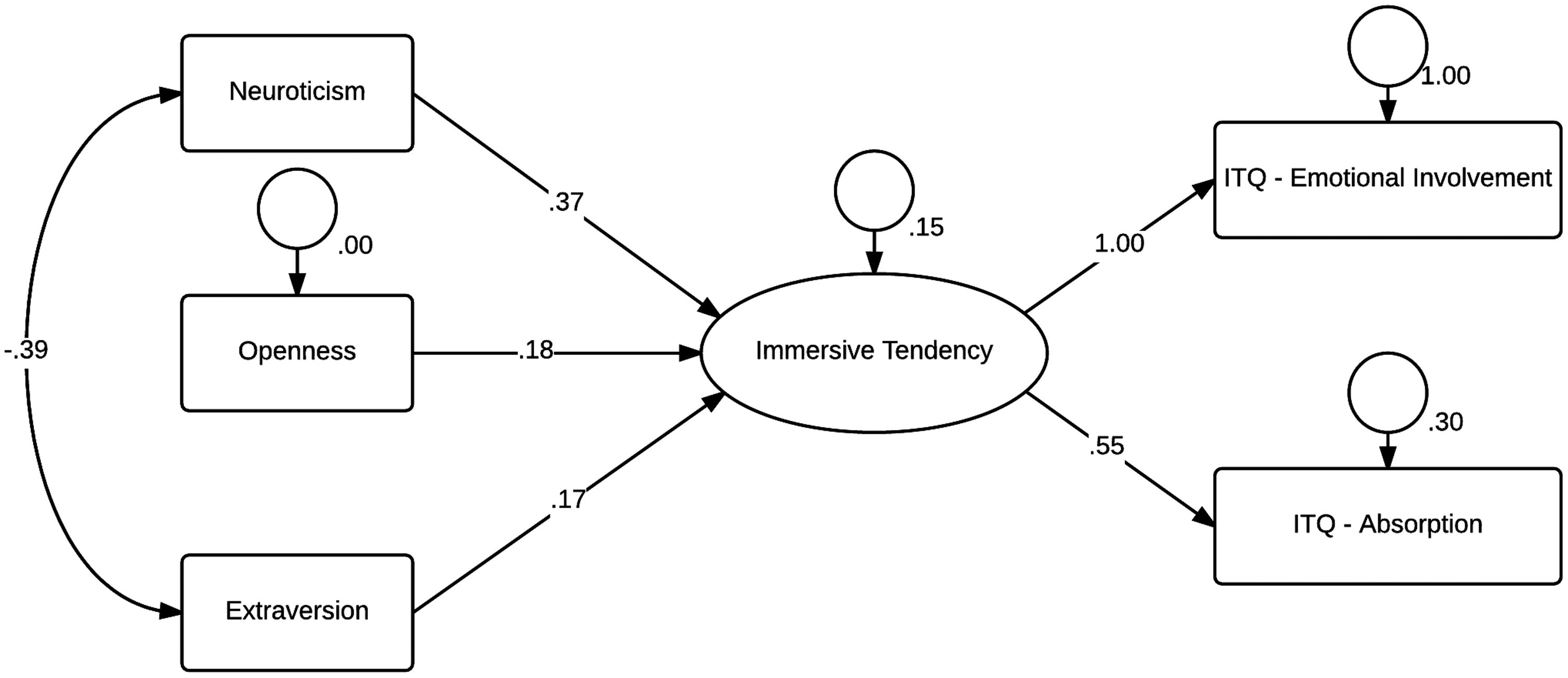
Replication of the Weibel et al.'s model.
Second model: addition of the TAS
The second model specified aimed to improve upon the model found by Weibel et al. 8 by using the total ITQ and absorption as measured by the TAS. This model was identical to the previous model except that emotional involvement and absorption variables were removed and replaced by the overall ITQ score and absorption as measured by the TAS. The model yielded acceptable fit across indices, χ2 (4, N = 1,673) = 85.541, CFI = 0.928, and RMSEA = 0.110, p < 0.001.
All regressions were statistically significant: neuroticism to immersion (β = 0.223, p < 0.001), openness to experience to immersion (β = 0.469, p < 0.001), extroversion to immersion (β = 0.161, p < 0.001), immersion to ITQ total (β = 0.466, p < 0.001), and immersion to absorption (β = 0.907, p < 0.001). The model was able to explain 26.8 percent of the variance in the endogenous variable immersive tendency. This model is shown in Figure 2.
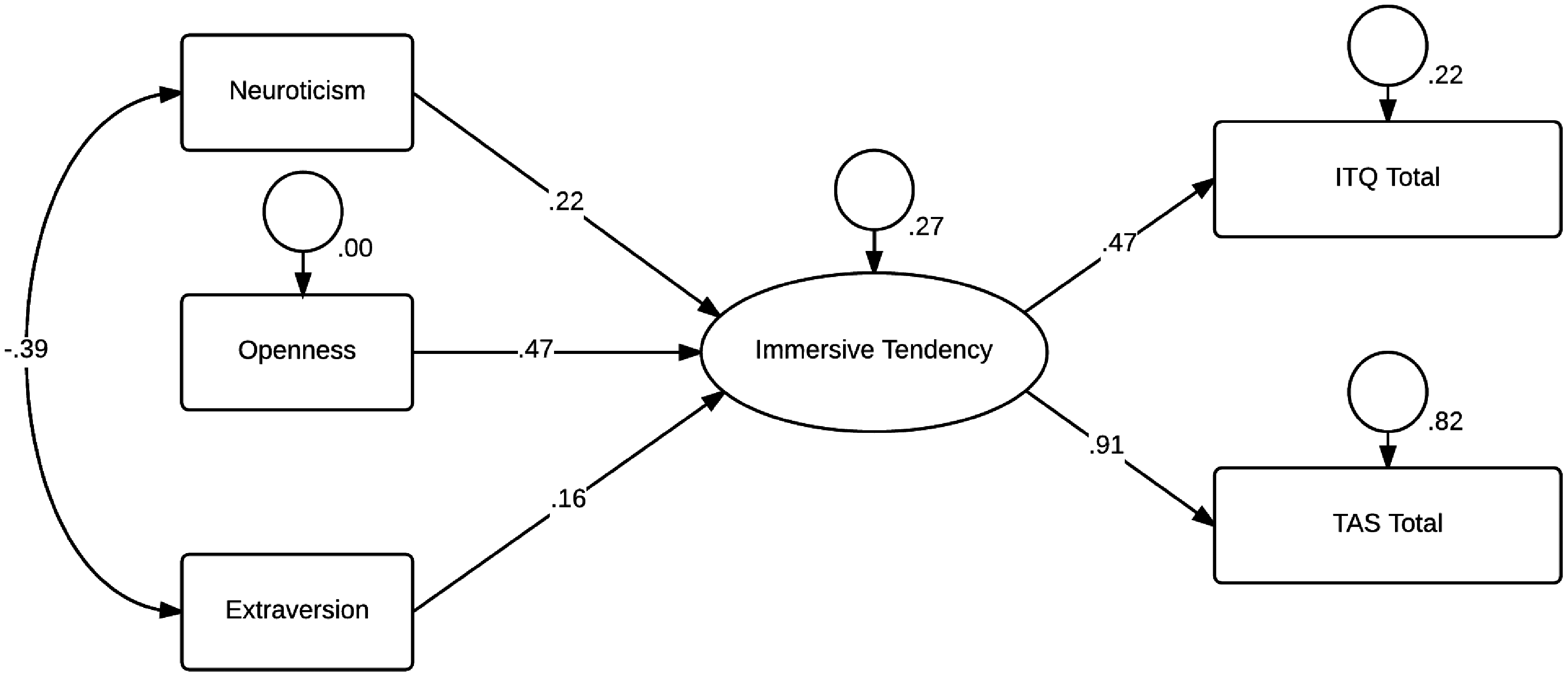
Updated model featuring Immersive Tendency Questionnaire and Tellegen Absorption Scale total scores.
Discussion
In this study, we replicated the work done by Weibel et al. 8 (German cohort; N = 220) in a much larger sample of English-speaking college students (N = 1,671). Our results found significant flaws in the model proposed by Weibel et al. 8 We also modified the model using an established measure of absorption (TAS) and found that this model did not show the same shortcomings. This second model (including the TAS) is considered to rest on a more solid psychometric foundation and, therefore, the results of this study lend support to the authenticity of this model.
Psychometric issues in the replication of Weibel's model
In this study, we replicated the work done by Weibel et al. 8 in a much larger sample of college students. In so doing, two primary issues were encountered: (a) psychometric issues were apparent when using the custom scales derived from the ITQ by Weibel et al. 8 ; and (b) problems with the model itself. Regarding the psychometric issues with the custom scales derived from the ITQ, both the emotional involvement and absorption scales demonstrated low internal consistency (Cronbach's α = 0.633 and 0.569, respectively).
Also, the scales showed little evidence of convergent validity in that the scale scores demonstrated only small correlations with the TAS (r = 0.406, p < 0.001 and r = 0.339, p < 0.001, respectively). This suggests that, at least in this larger English-speaking sample, these constructs demonstrated poor psychometric properties. Regarding problems with the model, it resulted in a Heywood case in that emotional involvement showed negative error variance and a squared multiple correlation greater than 1. Although these results could be the product of random sampling error, they suggest that the specified model may be an improper solution.
Enhanced second model: addition of the TAS
When the second model using an established measure of absorption was used, the aforementioned issues were avoided in that all measures demonstrated strong internal consistency and there were no issues with error variance. Although the second model demonstrated somewhat lower-than-ideal fit (i.e., CFI was <0.95 at 0.928) and lower fit than the first model, this model is considered to rest on a more solid psychometric foundation and, therefore, the results of this study lend support to the authenticity of this model.
Relations among personality trait, immersive tendency, and absorption
In keeping with Weibel et al., 8 the Big Five personality traits of neuroticism, openness to experience, and extraversion were positively associated with immersive tendency, despite a negative relationship evident between the traits of neuroticism and extraversion. Although both SEM models emphasized the role of these three personality traits in immersion, the relative contribution of these traits to the latent variable immersive tendency was notably different. In the model put forth by Weibel et al., neuroticism bore the strongest relationship with immersive tendency. A reproduction of this model featured in this study demonstrated similar relationships between the Big Five and immersive tendency.
The inclusion of an established measure of absorption resulted in a considerable shift in the relative contribution of these traits such that openness to experience exhibited the strongest relationship with immersive tendency overall. These findings coincide with those of previous studies in which openness to experience and absorption were found to be significantly related.2,5,7 These relations can likely be explained by the somewhat meager correlation between Weibel et al.'s subdimension of absorption and the TAS. Not only was this subdimension far less internally consistent than the TAS, but also its failure to correlate strongly with the TAS suggests potential issues with its validity.
Furthermore, our findings reflect studies that have found the TAS and ITQ to be highly correlated with one another.5,7 Due to the significant overlap of these variables, this study only tested a single inclusive model of personality, immersive tendency, and absorption rather than the additional testing of two distinct models as in the case of Weibel et al. 8
Limitations and future directions
Limitations of this study include the disproportionate female makeup that may potentially hamper the generalizability of these results to more heterogeneous populations. Likewise, the study sample was drawn from a college population. Future studies should seek to replicate the current findings with noncollege-aged samples. Moreover, this study utilized the 60-item NEO-FFI, a shortened version of the 240-item revised NEO-PI (NEO PI-R). Future studies investigating the association between personality traits and immersion might consider using the NEO PI-R as this measure typically features greater internal consistency and would allow researchers to explore associations with the more detailed facets of these personality dimensions.
As the applicability and versatility of immersive mediated environments continue to grow (e.g., in cybertherapy, education, and gaming), further research is needed to develop a more comprehensive understanding of how endogenous participant characteristics relate to immersion and the overall experience of presence in these environments. One direction that is of critical importance is to better understand how personality variables that relate to immersion relate to these same outcomes under different circumstances. In other words, although these personality characteristics may, in a broad sense, relate to these outcomes, the nature of the mediated environment participants encounter (e.g., relaxing, stressful, realistic) as well as the intended purpose of these environments may dictate which personality characteristics come into play.
In summary, our findings indicate that the addition of an established absorption measure enhanced the overall model. Given that immersion is one determinant for successful cybertherapy and e-learning, a practical implication of our findings is that adding the TAS may enhance our understanding of user experience. Like the model of Weibel et al., our findings are also relevant to media designers interested in facilitating immersion and enhancing sensations of presence.
The addition of an absorption measure may help the researcher to know how much of the variance in the results is due to the individual's personality traits. Likewise, game designers may have a better idea of when to increase the level of immersion and presence. 15 Hence, through judicious use of the NEO, ITQ, and TAS, researchers can consider personality trait factors as covariates when analyzing their results.
Footnotes
Author Disclosure Statement
No competing financial interests exist.