




Abstract
Abstract
The present study examined the role of positive outcome expectancy in the relationship between peer/parental influence and Internet gaming addiction (IGA) among adolescents in Taiwan. Two thousand, one hundred and four junior high students completed the Chen Internet Addiction Scale for IGA, Parental Influence for IGA, peer influence for IGA, and Positive Outcome Expectancy of Internet Gaming Questionnaire. Results showed that the three types of peer influences (positive attitudes toward Internet gaming, frequency of Internet game use, and invitation to play) and positive outcome expectancy were significantly and positively correlated with IGA. Moreover, peer influence was also positively correlated with positive outcome expectancy. On the other hand, positive outcome expectancy and parental influences had a low correlation. Structural equation modeling analysis revealed that positive outcome expectancy did not mediate the relationship between either type of parental influences and IGA, and only the parent's invitation to play Internet games directly predicted IGA severity. However, peers' positive attitude or the frequency of peers' Internet game use positively predicted IGA and was fully mediated through positive outcome expectancy of Internet gaming. In addition, the frequency of peers' invitation to play Internet games directly and indirectly predicted IGA severity through a partial mediation of positive outcome expectancy of Internet gaming. The overall fit of the model was adequate and was able to explain 25.0 percent of the variance. The findings provide evidence in illuminating the role of peer influences and positive outcome expectancy of Internet gaming in the process of why adolescents may develop IGA.
Introduction
I
Social influences and IGA
Different game genres may foster varying player experiences in which games that are played with other players (e.g., MMORPG and MOBA) are more about social connection with others, teamwork, and cooperation. 12 With the heightening risks associated with adolescents and Internet gaming, the role of social influence plays an important aspect in the development of IGA. Similar findings in substance use indicated that approval and encouragement by parents and peers were positively associated with adolescent substance use behavior. 13 At home, adolescents may be greatly influenced by parents through monitoring, supervising, or inviting their children to play on the Internet. At school, adolescents value the opportunities to socialize with their peers. A Malaysian study found that parents who restricted Internet use made adolescents more inclined to take risks on the Internet; while peer influences (close friends) may result in socially undesirable consequences. 14 Similarly, the impact of friends has been indicated to be an important factor for the initiation of playing computer games, 15 and adolescents who have more friends using the Internet were more likely to be connected online. 16 However, various types of influences have not been comprehensively examined in their role to IGA. A previous literature review indicated that different types of peer influences might have unique contributions to a college student drinking. 17 Other researchers distinguished between active (explicit drug offer) and passive (social modeling and overestimation of friends' use) influence on the social influence process in adolescent substance use. 18 Similarly, we proposed that active (frequency of social invitation to play an Internet game) and passive influence (frequency of other's Internet game use or other's positive attitude to Internet game use) would have differing effects on IGA. Active influence refers to the invitation of others and directly requires adolescents to provide an immediate response. Thus, active influence involves conformity pressure, emotional support, and the need for acceptance. When one is directly invited to play online games, it may be difficult for adolescents to refuse and instead, they choose to accept the offer. On the other hand, passive and social norm influences involve the observation of others' attitude and experience of Internet gaming. Adolescents can hold conversations with others regarding Internet gaming and observe their performance, which in turn may indirectly change their opinions about Internet gaming through changes to outcome expectancies. In other words, active influences (invitations to play) should influence behavior without necessarily influencing one's attitudes/perceptions, while passive influences may require a change in attitudes/perceptions to influence behavior. Thus, the process between active and passive social influence may differ due to one's cognitive processes and their positive outcome expectancies of Internet gaming.
Positive outcome expectancy and IGA
Previous studies have examined factors that contributed to IGA among adolescents, yet a social–cognitive process is lacking. Bandura's social learning theory has often been applied to explain addictive behaviors 19 ; in particular, positive outcome expectancies are commonly defined as beliefs perceived by an individual on the likelihood of a behavior leading to some desired outcome.20,21 Examining IA, Lin et al. 22 found the positive outcome expectancy to be positively correlated with IA among college students. Similarly, Brand et al. 23 sampled 1,019 nonclinical individuals from the community and found that Internet use expectancies served as a mediating role between dysfunctional coping and generalized overuse of the Internet. Subsequently, a large-scale national survey conducted by the Taiwan Ministry of Education found that Internet expectancy predicted IA and also attitudes toward online gaming and online social interaction among adolescents. 24 However, a limited research has examined the mediating role of positive outcome expectancy in the relationship between social influence and IGA. Adolescents may be greatly affected by their surrounding environment, especially parental influence at home and peer influence at school. Parental influence and peer influence may have different impacts in how adolescents view their Internet gaming use, and such a discrepancy may be caused by the mediating role of positive outcome expectancy of Internet gaming.
Hypotheses
Due to the need for peer socialization, adolescents are more likely to favor the membership of friends to provide and gain emotional or instrumental support, foster friendships, and facilitate social interaction. 25 Thus, compared to parental influence, peer influence can serve a greater role in the cognitive process of IGA among adolescents. The present study will probe at the active (frequency of others' invitation to play an Internet game) and passive influence (frequency of others' Internet game use or positive attitude to Internet game use). We hypothesized that both active and passive peer/parental influences would be associated with more positive outcome expectancies, and an increase in positive outcome expectancies would be associated with an increase in IGA behaviors. In addition, active peer/parental influence would have both a direct and indirect (through positive outcome expectancy) effect on IGA severity, while passive peer/parental influence would have only an indirect (through positive outcome expectancy) effect on IGA severity.
Methods
Procedures and participants
The present study was constructed using a cross-sectional design. Participants were recruited from four junior high schools by stratified and clustered sampling in Taiwan. In total, 2,406 seventh- and eighth-grade students were invited to participate in the study, of which 2,104 students completed all questionnaires (response rate 87.5 percent).
The study protocol was approved by the review board of the National Science Council. Surveys were distributed, completed, and returned during classes. Participants were fully informed of the purpose of the study and were invited to complete the questionnaire anonymously after informed consent was obtained.
Participants in the study consisted of 1,049 females (49.9 percent) and 1,055 males (50.1 percent); 988 seventh graders (47.0 percent) and 1,116 eighth graders (53.0 percent); with a mean of 1.69 (SD ±3.07) hours per day of Internet usage time on weekdays and a mean of 4.26 (SD ±4.43) hours per day of Internet usage time on weekends; and 1,515 (72.0 percent) had parents with a high school education or lower and 589 (28.0 percent) had parents with a college education or higher.
Instruments
Chen Internet Addiction Scale for IGA
The IGA scale was modified from the Chen Internet Addiction Scale (CIAS). 26 To assess one's tendency of IGA, each statement of the CIAS on Internet use was changed to pertain to Internet gaming use. The criterion-related validity between each subscale ranged from 0.70 to 0.81, and a positive correlation of 0.63 (p < 0.01) was found between the CIAS and CIAS-IGA. 27 The 26-item CIAS-IGA was measured on a Likert scale with responses for each subscale scored from rarely/never (1) to almost always (4). Total scores ranged from 26 to 104 with higher scores indicating a greater degree of IGA.
Parental influence for IGA
Three items were constructed to assess positive parental influences, including perceived parental positive attitudes toward Internet use, perceived parental Internet use frequencies, and the frequency of parental invitations to use Internet games. Higher scores in parental influences indicated a stronger approval of Internet use, perceived higher frequencies of parental Internet use, and higher frequencies of parental invitations to use the Internet to play games (Appendix Table A1).
Peer influence for IGA
Six items were composed to assess positive peer influences, including perceived peer/best-friend positive attitudes toward Internet use, perceived peer/best-friend Internet use frequencies, and the frequency of peer/best-friend invitations to use the Internet. Higher scores in peer/best-friend influences indicated stronger approving attitudes of Internet use, perceived higher frequencies of peer/best-friend Internet usage, and a higher frequency of peer/best-friend invitations to use the Internet. Respectively, the correlations were 0.77, 0.69, and 0.80 in the present study (Appendix Table A2).
Positive Outcome Expectancy of Internet Gaming Questionnaire
The Positive Outcome Expectancy of Internet Gaming Questionnaire (POEIGQ) was designed in reference to the POEIGQ-Revised. 22 First, the expectancies toward Internet gaming use were collected through interviews with Internet-addicted adolescents and sentence completion among 120 junior high students. Through qualitative analysis, 15 items were constructed and measured with a 6-point Likert scale. The total scores ranged from 15 to 90, with higher total scores representing a greater degree in positive outcome expectancy of Internet gaming use. The internal consistency coefficient was 0.93. The POEIGQ comprised of four factors, including satisfaction (to gain pleasure and fulfillment; Cronbach's α = 0.77), interpersonal (to make more friends and bolster friendships; Cronbach's α = 0.79), reaction training (to develop a faster and smarter reaction; Cronbach's α = 0.73), and tension reduction (for relaxation and to reduce stress; Cronbach's α = 0.79) subscales. A positive correlation of 0.38 (p < 0.01) was found between the CIAS and POEIGQ 27 (Appendix Table A3).
Statistical analyses
The SPSS for Windows version 20.0 and Amos 16 were used for data analyses. We used Pearson correlation coefficient to examine the association among parental/peer influences and POEIG and IGA severity. Furthermore, structure equation modeling (SEM) analysis was conducted to determine the mediating effect of POEIG. The three types of peer influences, positive outcome expectancy of Internet gaming, and IGA were included in the model as latent variables, predicted by their corresponding subscales.
Results
Pearson correlation among variables
Table 1 shows the Pearson correlations matrix among measures, and the means and standard deviations for all study variables.
p < 0.01.
The POEIG had a moderate and significantly positive correlation with IGA severity or each type of peer influence. However, the POEIG had a weak correlation with each type of parental influence.
The IGA severity was significantly and positively correlated with the frequency of parental Internet game use or the frequency of parental invitation to play Internet games, but not with the parental positive attitude to Internet game use. The IGA severity was significantly and positively associated with each type of peer influence.
Mediating role of positive outcome expectancy between peer/parental influence and IGA
The hypothesized model was examined using SEM (Fig. 1). For the parental influences, POEIG did not show a significant mediation between all types of parental influences and IGA. Only active parental influence (frequency of parental invitation to play Internet games) had a significant direct effect on IGA. The indirect effects of passive influences to POEIG were significant for peers only, thus, passive parental influence was removed from the model. The revised model is presented in Figure 2.

Hypothesized model. χ2: 1320.77*** (df: 114); NFI: 0.95; RFI: 0.93; IFI: 0.95; CFI: 0.95; RMSEA: 0.07. CFI, comparative fit index; IFI, incremental fit index; NFI, normed fit index; RFI, relative fit index; RMSEA, root mean squared error of approximation.
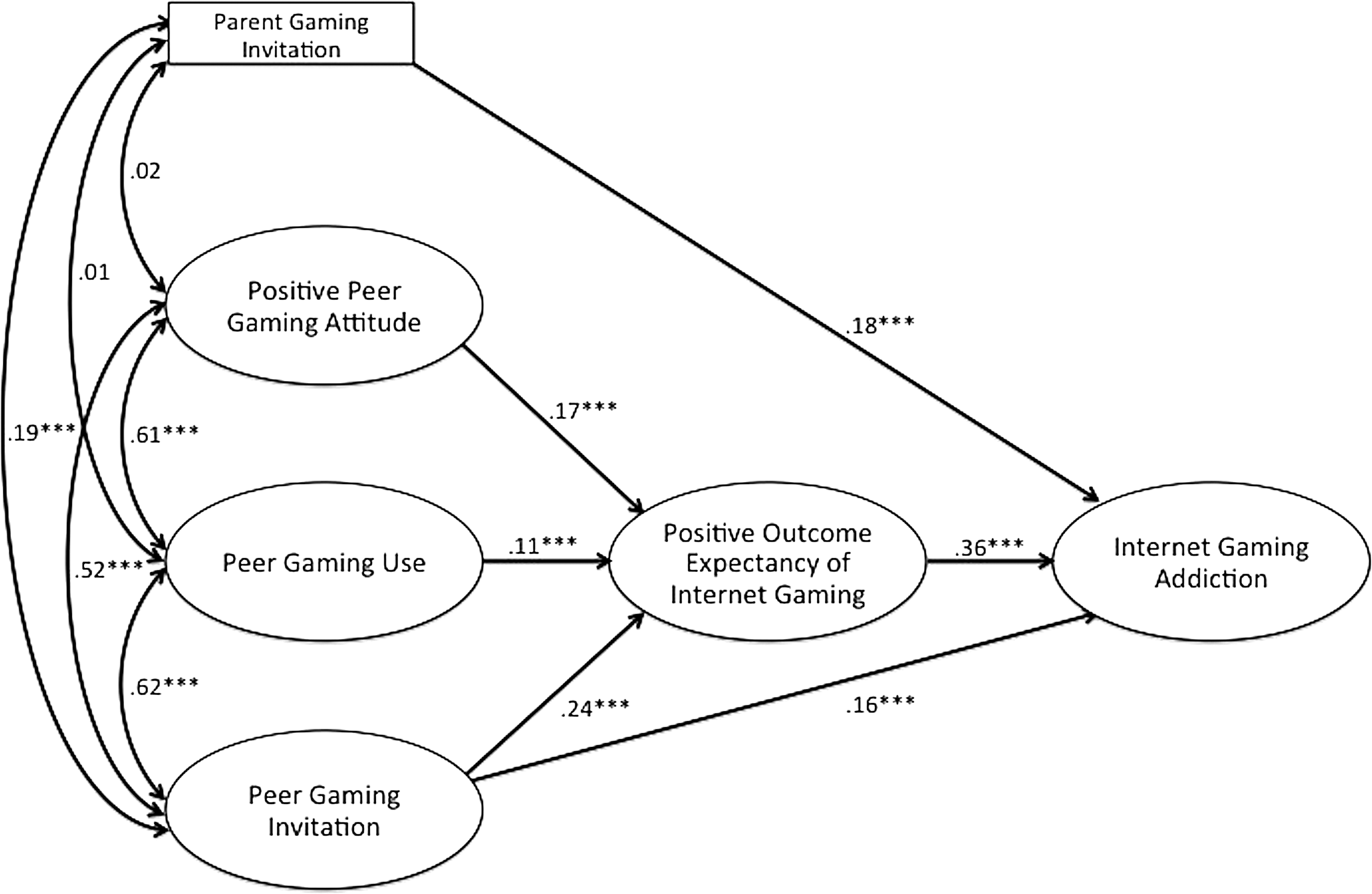
Mediational model. χ2: 1278.44*** (df: 93); NFI: 0.95; RFI: 0.93; IFI: 0.95; CFI: 0.95; RMSEA: 0.07.
For the peer influences, the mediating role of POEIG was significant in the relationship between all types of peer influences and IGA. In particular, the relationship between passive peer influence (either peer positive attitude to Internet game use or frequency of peer Internet game use) and IGA was fully mediated by POEIG. (a) Peer positive attitude to Internet game use had a significant effect on IGA severity (path standardized coefficient 0.09), but became nonsignificant when POEIG was added as the mediating factor. The Sobel test indicated that the mediated effect was significant (z = 6.31, p < 0.001), demonstrating a full mediation effect. (b) Frequency of peer Internet game use had a significant effect on IGA severity (path standardized coefficient 0.10), but became nonsignificant when POEIG was added as the mediating factor. The Sobel test indicated that the mediated effect was significant (z = 5.94, p < 0.001), showing a full mediation effect. In addition, the relationship between active peer influence (Frequency of peer invitation to play Internet games) and IGA was partially mediated by IGA. The frequency of peer invitations to play Internet games had a significant effect on IGA severity (path standardized coefficient 0.31) and decreased to 0.20 when POEIG was added as the mediating factor. The Sobel test indicated that the mediated effect was significant (z = 5.04, p < 0.001), demonstrating a partial mediation effect.
Model fit was interpreted on the basis of a range of fit indices, including 0.95 on the comparative fit index, 0.95 on the normed fit index (NFI), 0.95 on the incremental fit index, 0.93 on the relative fit index, and 0.07 on the root mean squared error of approximation. The measurement model demonstrated a good fit. Therefore, the overall fit of the revised model was adequate and explained 25.0 percent of the variance.
Discussion
Peers' positive attitude and frequency of peers' Internet game use positively predicted IGA and was fully mediated through POEIG. However, frequency of peers' invitation to play Internet games directly and indirectly predicted IGA severity through a partial mediation of POEIG. On the other hand, POEIG did not serve a strong correlation with parental influences, and only the frequency of parental invitations to play Internet game directly affected IGA severity, showing that adolescents may not be strongly affected by their positive outcome expectancy of their parents' Internet gaming behaviors.
Results showed that all three types of peer influences predicted IGA severity through the mediation of POEIG. Such findings may indicate that peer influence could change and promote one's POEIG to play online games, which was consistent with the study of Bahr et al. in showing that peer alcohol use/smoking was the strongest predictor of adolescent drinking/smoking. 28 In the past, social influences have been found to be one of the strongest correlates of adolescent substance use and misuse and have been incorporated to show its affect in the social learning theory models of alcohol use. 29 Junior high school students spend a large amount of their time in the company and support of peers and friends. It has been indicated that individuals with a higher tendency of being Internet addicted were normally shy, have less faith, have a firmer belief in the irresistible power of others, 30 and have the tendency to use the Internet as a way to escape their problems and to satisfy interpersonal needs. 10 In accordance, depressive symptoms were indicated to be highly associated with IA 31 and shown to mediate the relationship between actual/virtual social support and IA. 32 Thus, one's expectancy that they can alleviate negative moods and gain social support may all contribute to the increase of IGA. Future studies could assess the role of depressive symptoms to examine whether positive outcome expectancy may be affected by depression in the development of IGA. Similarly, a study of 1,410 eighth-grade students in the United States found that a greater exposure to peer alcohol use was related to alcohol outcome expectancies among both drinkers and nondrinkers and was associated with more alcohol positivity 1 year later. 33 Thus, our findings on social influence and positive outcome expectancies provide support for the need to take both social and cognitive factors into account. We suggest that educational agencies may profit from addressing the consequences of IGA to decrease POEIG.
In addition, active peer influence (frequency of peers' invitation to play Internet games) also indicated a direct influence on IGA. When invited by classmates, adolescents have difficulty in rejecting a peer's request due to peer pressure and a desire to fit in. A greater level of IA was found among adolescents with more peer pressure 34 ; the Internet may serve as an escape from being unable to cope with the problems in life, including the inability to resist the pressure from peers. Similar results have been found with alcohol, showing that students who do not drink at parties are often exposed to teasing and report a sense of inferiority, while on the other hand, those who are socially secure can resist explicit invitations of alcohol from peers. 17 Thus, effective refusal skills should be taught regarding the invitation of others under risky situations and students should learn alternative ways for tension reduction.
On the other hand, parental influence did not indicate a strong affect on POEIG, and the correlation between the three types of parental influences and IGA was also inconsistent. Similarly, a review of 87 studies on adolescent smoking also indicated a weak and inconsistent relationship between parent and adolescent smoking, while sibling and peer smoking showed a greater association with adolescent smoking, suggesting that parental influences may be comparatively modest. 35 Thus, it is possible that positive outcome expectancy has only a small influence on the parental influence of Internet gaming. Only the frequency of parental invitation to play Internet games directly affected IGA severity, indicating that a parent's direct offer can cause the adolescents to play Internet games. Thus, not only should prevention and interventions focus more on the effects of peer influences but also parents should be educated on the consequences of Internet game use.
A number of limitations should be noted. First, the present study was a cross-sectional design. Thus, it is difficult to assume the direction of the causal process in the cross-sectional mediation model. Longitudinal data from several time frames are necessary to determine the potential cause–effect. Second, the social influence measurements were composed by the authors, and information was obtained through survey questionnaires to assess behavior. Thus, we were limited in validating the response against actual behavior. Third, findings from the present study suggest that while POEIG was affected by social influences, it is not the only pathway through which social influences affect IGA. Future research should probe at the possible roles of social support and depressive symptoms in the relationship. Despite the limitations, the study delineated various forms of parental and peer influences and provided the process of social influences toward Internet game use.
To our knowledge, this was the first study to examine the expectancy process between the relationship of social influence and IGA severity among adolescents. Research suggested that adolescents hold different positive outcome expectancies of their parents' and peers' gaming behaviors. Both peer influence and positive outcome expectancy of Internet game use should be considered when designing prevention programs and strategies for IGA. In addition, future studies should examine the role of social influence among different game genres to see if adolescents may foster differing positive outcome expectancies pertaining to various types of Internet games.
Footnotes
Acknowledgments
This study was supported, in part, by the Grants to HCK from the National Science Council (NSC98-2511-S-006-002-MY3 & NSC101-2511S468-002-MY3) and the Medical Foundation of Behavioral and Women Medicine. We also thank the reviewers for providing their valuable suggestions.
Author Disclosure Statement
No competing financial interests exist.
| Playing Internet games… … | Totally disagree | Often disagree | Sometimes disagree | Sometimes agree | Often agree | Totally agree |
|---|---|---|---|---|---|---|
| 1. Makes one feel happy. | 1 | 2 | 3 | 4 | 5 | 6 |
| 2. Allows one to sell things and earn money. | 1 | 2 | 3 | 4 | 5 | 6 |
| 3. Allows one to express emotions. | 1 | 2 | 3 | 4 | 5 | 6 |
| 4. Allows one to pass away those boring hours. | 1 | 2 | 3 | 4 | 5 | 6 |
| 5. Allows one to have imagination. | 1 | 2 | 3 | 4 | 5 | 6 |
| 6. Allows one to have more topics to discuss with others. | 1 | 2 | 3 | 4 | 5 | 6 |
| 7. Makes one feel excited. | 1 | 2 | 3 | 4 | 5 | 6 |
| 8. Makes one's reactions quicker. | 1 | 2 | 3 | 4 | 5 | 6 |
| 9. Makes one caoasis:entryh up with the trend. | 1 | 2 | 3 | 4 | 5 | 6 |
| 10. Reduces stress. | 1 | 2 | 3 | 4 | 5 | 6 |
| 11. Allows everyone to play games together. | 1 | 2 | 3 | 4 | 5 | 6 |
| 12. Allows one to feel a sense of achievement. | 1 | 2 | 3 | 4 | 5 | 6 |
| 13. Allows one to make more friends. | 1 | 2 | 3 | 4 | 5 | 6 |
| 14. Allows one to become detached with reality. | 1 | 2 | 3 | 4 | 5 | 6 |
| 15. Can train the flexibility of the fingers. | 1 | 2 | 3 | 4 | 5 | 6 |