




Abstract
Abstract
Depression is a major public health concern in current society. In recent years many studies began to investigate the potential benefits of exergames on depression. The current study aimed to provide a systematic review to synthesize the existing studies and discover the overall effect size of exergames on treating depression. A comprehensive literature search was conducted among major bibliographic databases in computer technology, psychology, and medical science. Key study characteristics of participants, interventions, and experiment were extracted in the systematic review. Both studies using independent groups and matched groups were included in meta-analysis. Overall effect size of Hedges' g was calculated, followed by subgroup analyses. Nine studies included in the review, while eight studies applying exergames of Nintendo's Wii or Wii Fit. A random effects meta-analysis on eight studies resulted an overall significant effect size of g = 0.21. Demographic factors, depression severity, number of session, and game type were found to be significant moderators for the effectiveness. The study has not only supported the positive effect of exergames on alleviating depression, but also provided many theoretical and practical implications for health professionals and police makers. More rigorous experimental controlled studies are needed in this new research field.
Introduction
D
There are increasing systematic reviews and meta-analyses conducted to examine the effect of different digital interventions on depression, including computerized psychotherapies, 23 Internet-based cognitive behavior therapy, 24 and game-based interventions. 25 As a special type of digital intervention combing physical exercise, it is worthwhile and essential to identify its overall effectiveness on depression. Although more and more attempts were carried out to investigate the impact of exergames as a novel depression intervention, their findings were much different. While some exergame studies reported significant reduction in depression,26,27 some reported conflict results.20,22 In addition, they were conducted in different contexts, with different methodologies. An overview of exergame studies is highly needed in depression literature, to explore the true antidepressive effect of exergames and identify research trends. Further, some potential moderators were identified in previous review studies on digital interventions. In a recent systematic review by Li et al. 25 for example, older adults were reported to have a lower depression improvement than other aging groups. Richards and Richardson 28 have indicated that number of sessions moderated the antidepressive effect of digital interventions in their meta-analysis. These factors may also affect the effectiveness of exergames on depression.
To address the gap and contribute to the new domain of exergames for depression, this study aimed to provide a systematic review to synthesize the existing studies and identify research trends from an overall perspective. Further, a meta-analysis was also carried out to discover the overall effect size of exergames on treating depression, as well as explore possible moderators that may affect the effectiveness.
Method
Identification and selection of studies
The scope of the systematic review was limited to studies that investigate the effect of exergames for depression. Based on the definition from the American College of Sports Medicine, 29 the inclusive criteria for a qualifying “exergame” were as follows: (a) involving technology-driven game playing; and (b) requiring participants to be physically active to exercise (go beyond simple hand finger movements) or to play the game. In the study, we included exergames from both existing market products and researcher-designed interventions. In addition, eligible studies had to contain an evaluation of the treatment's effects on participants' depression symptoms by using a reliable and valid depression scale. There were no limitations on participants' depression severity in order to obtain a complete picture of exergames' effect on depression. Consequently, the inclusive studies can even include healthy participants or those with other chronic or mental illnesses.
A comprehensive literature search was conducted among major bibliographic databases in computer technology, psychology, and medical science, including ACM Digital Library, PsycINFO, PubMed, and Cochrane Central Register of Controlled Trials. Potential studies were identified by the combination of intervention terms (“exergame” or “exer-gaming” or “exercise game” or “digital exercise” or “active videogame” or “virtual reality game” or “Wii” or “Wii Fit” or “Kinect”) and disorder terms (“depression” or “depress” or “emotion” or “mood” or “mental”). Reference lists from included studies and relevant reviews were also inspected for additional studies. After identifying the final included studies, their study characteristics were extracted in the systematic review, including details of participants (total number; sex; ethnicity; physical mobility; included criteria; mean age), intervention (format; duration and number of sessions), and experiment (study design; depression measurement).
Meta-analysis procedure
Considering the small number of identified studies, the meta-analysis involved studies that used independent groups and also studies that used matched groups (or prepost designs). In the book Introduction to Meta-Analysis, Borenstein et al. 30 stated that there are no technical barriers to using studies with different designs in the same analysis. From a statistical perspective, the effect size has the same meaning regardless of the study design. 30 Therefore, we compute the effect size and variance from each study using the appropriate formula and then include all studies in the same meta-analysis. We used the Comprehensive Meta-Analysis software (version 3.0; Biostat, Inc., Englewood, NJ) for the data analysis. Given the small sample size in most of the involved studies, Hedges' g was used to estimate effective size because it can adjust for small sample bias. 31 In brief, the effect size (Hedges' g) for each study reflects the outcome difference between intervention and control treatments, or between pre- and post-test conditions. They were then pooled via a random effects model. 32
A series of subgroup analyses were tested in the mixed effects model (random effects model within subgroups but fixed effects model across subgroups), according to several potential moderators, such as age, sex, ethnicity, depression severity, athletic abilities, number of session, and game type. We used I2-statistic to assess the heterogeneity of the pooled effective sizes. The I2-value indicates the percentage of total variation across trials, which was caused by their heterogeneity rather than by chance. A value of 0 percent indicates no observed heterogeneity, with 25 percent as low, 50 percent as moderate, and 75 percent as high heterogeneity.
Results
The search yielded a total of 1,099 articles, with nine studies meeting the criteria for inclusion in the final systematic review. Among them, one study 33 was excluded from meta-analysis because of uninterpretable data. As a result, eight studies were included in the final meta-analysis process. Figure 1 shows a flowchart of the selection of studies into the systematic review and meta-analysis.
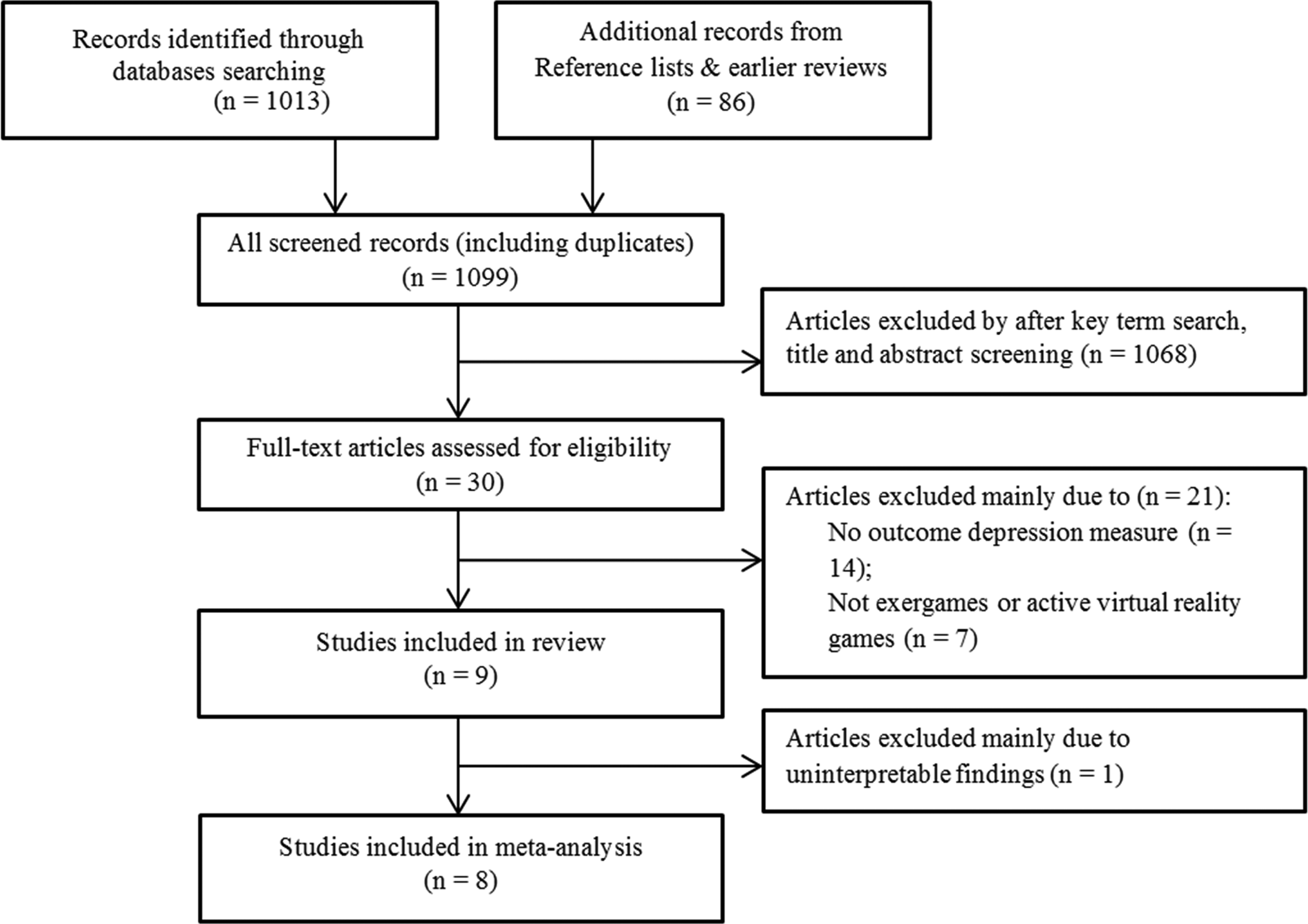
Flowchart for the included studies in systematic review and meta-analysis.
Results from systematic review
Table 1 outlines the selected characteristics of the nine studies included in the review. Two open trial studies examined the impact of exergames Nintendo's Wii Sports (or Wii Sports) on depression. The Wii Sports game package includes virtual sport games such as tennis, bowling, baseball, golf, or boxing. Participants were required to use their arm or body motions to simulate actions that they do in the actual sports. Findings from Herz et al. 34 demonstrated that Wii Sports serves as a useful therapy for reducing depression among patients with Parkinson's disease (PD) after 4 weeks period. Similarly, Rosenberg et al.'s study 26 have supported that there was a significant improvement in depressive symptoms among older adults with subsyndromal depression after 12-week Wii Sports playing.
F represents the percentage of female participants.
If any, data from the intervention and the control arms are presented respectively.
ADS-L, allgemeine depressionsskala; CG, control group; GDS, geriatric depression scale; HADS-D, hospital anxiety and depression scale - depression; HAM-D, hamilton depression scale; PAID, problem areas in diabetes; PD, Parkinson Disease; QIDS, quick inventory of depressive symptoms; RCT, randomized controlled trial; SD, standard deviation; TAU, treatment as usual; WHO-5, WHO well-being index.
Six studies were identified to investigate exergames from Nintendo's Wii Fit (or the new version Wii Fit Plus). Different from Wii Sports games, Wii Fit exergames focus less on entertainment but more on improvement of physical fitness. They consist of many physical activities using the Wii Balance Board peripheral, such yoga poses, strength training, aerobics, and balance games. While three studies have supported the significant effect of Wii Fit exergames on alleviating depression,21,33,35 the rest two did not show significant depression changes in their studies.20,22 In addition, instead of using the existing Wii Fit exergames, Chao et al. 27 examined the antidepressive effect of improved Wii Fit exergames that incorporated self-efficacy theory for assisted living older adults. Their findings had shown that the improved Wii Fit exergames brought significant relief from depression when compared to a health education program.
Only one study by Shin et al. 36 applied a non-Wii exergaming platform called RehabMaster™. It is a game-based virtual reality rehabilitation system that involves 10 minutes of “rehabilitation training” and 20 minutes of “rehabilitation games.” Results indicate that the intervention has specific effect on reducing depression among patients with chronic stroke.
It is worthwhile to highlight that all the identified studies were published in/after the year 2010. Only four studies employed Randomized Controlled Trials (RCTs) to compare the effect of exergames to a control condition such as treat-as-usual21,33 or occupational therapy. 36 Particularly, Meldrum et al. 22 compared Wii Fit exergames with exercise performed in traditional setting. The target population in four studies was identified to be older adults, while the rest were general generation. Four studies recruited Caucasian-dominant participants,22,27,33,34 while only one study was conducted among Asian population 36 and African population. 35 Further, some studies involved more percentage of female participants.26,27,35 In terms of the inclusive criteria for participants, only three studies focused on patients with depression or related mental disorder (Parkinson Disease). Except two studies,22,33 the other studies used small simple size that was less than 50 participants. The intervention duration among majority of the studies were around 30 minutes per session, although the total session number varied considerably (ranging from 8 to 40 sessions). More than half of them were conducted in the United States, and only one study was conducted in a non-Western country. 36 Lastly, the common depression assessments used in the studies were Geriatric Depression Scale (GDS), Hospital Anxiety and Depression Scale-Depression (HADS-D), and Hamilton Depression Scale (HAM-D).
Results from meta-analysis
A random effects meta-analysis on eight studies resulted in an overall effect size of g = 0.21, (95% CI [0.03, 0.39]). A Z-value of 2.26 (p < 0.05) further indicated the statistical significance of the antidepressive effect of exergames. Effect sizes and 95% CIs of each individual studies are plotted in Figure 2. No significant heterogeneity was detected among the studies, with I2 = 0 percent.

Effect sizes in meta-analysis. Note: Effect sizes were conducted in random effects model.
Subgroup analyses were performed based on several key characteristics of the studies, testing whether these factors influenced outcomes. Table 2 displays the results of these analyses.
Note: All subgroup analyses were conducted in mixed effects analyses. CI, confidence interval; M, mean of age; N, number of studies.
p < 0.05.
p < 0.01.
Demographic factors
Significant subgroup differences were reported across different groups of age, sex, ethnicity, and athletic abilities. The results have supported these demographic factors to be significant moderators on the antidepressive effect of exergames. There was a significant effect size observed on older adults (g = 0.56, z = 3.14, p < 0.01). It was much larger than the nonsignificant effect size found on general adults (g = 0.07). Moderate heterogeneity was found in general adults group, while no observed heterogeneity in older adults group. In terms of sex, studies with more female participants (more than 60 percent) tended to have a larger effect size (g = 0.31) than others. However, neither of the effect sizes reached a statistically significant level. The high heterogeneity among female-dominant studies should also be taken for consideration when interpreting this conclusion. Further, participants of the white race (Caucasian) were found to benefit less from exergames in depression treatment (g = 0.16), than other ethnic groups (g = 0.40). Moderate heterogeneity was found in studies with Caucasian participants, while less heterogeneity among those with other ethnic groups. Findings have also indicated that different athletic abilities led to different effect of exergames on depression. Participants with relatively good mobility had more overall depression reduction in exergames (g = 0.33) than those with athletic dysfunction (g = 0.05). Moderate heterogeneity was found within the two subgroups of athletic abilities.
Depression severity
Exergames were found to have larger effect size on participants with depression or related mental disorders (g = 0.29), than on participants without depression-related illness (g = 0.15). However, neither of the effect sizes reached a statistically significant level. Low to moderate heterogeneity was found within the other two subgroups. Significant subgroup differences were reported among participants with different depression severity.
Number of sessions
The effect size in small number of sessions (g = 0.36) was higher than that in large number of sessions (g = 0.13), and it was also supported to be statistically significant (z = 2.22, p < 0.05). Moderate heterogeneity was found in studies with large number of sessions, but not in those with small number of sessions. Significant subgroup differences were also reported across the two subgroups.
Game type
Considering the potential effect from the game types, a subgroup analysis was conducted between exergames with high playfulness and those with low playfulness. In this analysis, studies with Wii Sports games were categorized as high playfulness group, while those with Wii Fit and other rehabilitation games as low playfulness group. Wii Sports games are originally designed for game-playing and entertainment; thus, they are more likely to elicit high level of playful experience among participants. Conversely, Wii Fit exergames and others were designed for maintaining fitness or for rehabilitation, and they may therefore lead to a relatively low level of playful experience. Results showed that exergames in high playfulness have a significant larger effect size (g = 0.52, z = 2.72, p < 0.01) than those in low playfulness (g = 0.08, z = 0.60, p > 0.05). The difference was further confirmed by the significant heterogeneity across the two subgroups. Lastly, both of the two subgroups were reported to have small to moderate in-group heterogeneity.
Discussion
The aim of this study was to systematically review the existing literature on exergames used for depression, and examine their effect sizes via a meta-analysis. Overall, clear and consistent evidences have indicated an increasing research interest in the recent years on studying the potential impact of exergames on depression, with all the nine identified studies published in the past 5 years. Nevertheless, on the other hand, the limited number of studies identified in this exhaustive review also reflected that exergames are still a very new concept in depression research context. Findings from meta-analysis suggest a significant overall effect size (g = 0.21) with low heterogeneity among the included studies. Consequently, exergames are proven to have positive effect on alleviating depression. Compared to other recent meta-analyses, the effect size found in exergames was much larger than that found in aerobic exercise, 37 but generally smaller than those in other traditional forms of exercise.38,39 What's more, the effect size of exergames was similar to that in other psychosocial therapy such as psychotherapy. 40 However, only three out of the eight studies applied RCT study design, and the conclusion from this meta-analysis should be interpreted with caution. Since RCTs are considered to be the gold standard for evidence-based study, high-quality RCT studies are needed in future to discover the true power of exergames as depression interventions.
Findings from subgroup analysis help to provide a comprehensive picture of the various factors that moderate the effect of exergames on depression. It suggested that exergames have larger antidepressive effect on older adults rather than general adults. Despite that exergames are initially designed for young generations, increasing percentage of older adults are engaging in exergame playing. The health benefits of exergames for older adults have received attention from many researchers. Although some early attempts in exergame domain compared the age difference in physiological responses and enjoyment level,41,42 no research to date has reported the antidepressive effect comparison between young and old populations. This review supported that older adults may benefit more from exergames than general adults in terms of depression improvement. A possible explanation is the different depression causes across the age groups. While young and mid-age adults often feel depressed due to negative events in work, family, or sexual relationship, 43 older adults develop depression mainly because of physical illness or social isolation. 44 Since exergames can promote both physical well-being and social interaction, they therefore may have better antidepressive effect on older population.
Furthermore, being female and having better physical mobility led to better depression treatment from exergames. Some research studies has shown that gender is a stronger predictor of exergame motivation and performance.14,45,46 For instance, Sun 14 suggested that male perceived exergames to be more enjoyable than female, while Graves et al. 46 found that male are more physically active than female in exergaming play. Nevertheless, little was known on the gender difference in the psychosocial effect of exergames. A recent study from Donker et al. 47 reported that female gender predicted better depression outcome in digital psychotherapies. Additional research is needed to explore the possible explanations for the moderating effect of gender on the relationship between exergames and depression. Similar to gender, ethnicity was also a significant moderator in the review. Previous studies have often used socio-cultural variance to explain the difference in depression outcomes 48 and exergame performance, 49 more in-depth investigation need to be conducted to understand why Caucasian tends to have less depression improvement than other ethnic groups. As per expectation, exergames have better antidepressive effect on individuals with better physical mobility. It can be assumed that people who are already physically flexible can take advantage of exergames and receive psychosocial benefits compared to those with poor mobility.
Studies in exercise domain have investigated the different treatment effects between depressed and nondepressed samples.50–52 Earlier reviews have suggested that the depressed participants seem to gain more effects from exercise than the nondepressed ones.53,54 The results of the meta-analysis further extended the conclusion to the exergame domain, by indicating that exergames have a larger effect on depressed participants (including those with depression-related mental disorders) rather than nondepressed ones. Nevertheless, the variances in the disorder types diagnosed across studies (lupus, Parkinson Disease, unilateral peripheral vestibular loss) may limit the validity of the conclusion. In addition, exergames with a smaller number of sessions have a more promising outcome that those with a larger number. The finding appears to be a bit surprising, given the common assumption that longer intervention duration leads to more positive results. Some researchers have highlighted the potential use of shorter psychosocial interventions in depression treatment.55,56 However, the results are needed to be confirmed in future research since the meta-analysis involved studies with different study design and measure instruments.
Lastly, the meta-analysis compared the antidepressant effects in exergames with high and low playfulness. Playfulness is a multidimensional concept; it is the internal disposition or mental propensity to engage in playful behavior. 57 In HCI and game research, playfulness is often studied as a subjective experience of players that involves the attributes such as “fun” or “pleasure”. 58 Playfulness has been supported to be associated with motivation, and even emotional and cognitive functioning. 59 However, little was known on the relationship between playfulness and depression. This review has contributed to the literature by indicating that exergames with high playfulness have a significant superior effect on improving depression over those with low playfulness. The finding has emphasized the importance of enhancing playful user experience from a healthcare perspective, and inspired researchers and designers in the specific domain of “exergaming for health.”
Limitations of the review
There are some limitations to be noted in this systematic review and meta-analysis. First, the very limited number of identified studies and moderate heterogeneity among them might need cautious interpretation of conclusions. Second, a publication bias, particularly language bias, might have occurred since we restricted the search to English language publications. Last, because the use of terms varies greatly in the exergame and depression area, the key word search in the review might limit the complete inclusion of all existing studies. However, we tried to meet this limitation by screening the reference list of reviews and relevant articles.
Research trends and implications
The systematic review and meta-analysis have implied several important research trends for future studies. The findings shown in the systematic review have clearly indicated that exergames for depression is still a new but rapidly developing research area. Large-scale and well-designed RCT studies are needed to assess the effectiveness of exergames on depression across diverse populations with different conditions. Findings on moderators may provide unique new and valuable information to guide future design and implementation of exergames. It supported that exergame is a suitable and effective depression intervention for female, older participants with good physical mobility and depression symptoms. These implications inform health professionals and policy makers to restructure the clinical practice in terms of the selection of inclusion and exclusion criteria, and choice of stratification variables to maximize the antidepressive effect of exergames. Furthermore, exergames with high playfulness, such as Nintendo's Wii Sports games, are recommended to be implemented for healthcare purpose. At the same time, designers in health game context should think more on enhancing playful user experience to facilitate the antidepressive effect. However, given the limited number of studies and involvement of different study designs, the findings and conclusions from the systematic review and meta-analysis should be confirmed in future rigorous experimental controlled studies.
Footnotes
Acknowledgment
This research is supported by the National Research Foundation, Prime Minister's Office, Singapore under its International Research Centres in Singapore Funding Initiative and administered by the Interactive Digital Media Programme Office.
Author Disclosure Statement
No competing financial interests exist.