




Abstract
Abstract
We examined the effect of habitual regulation of massive multiplayer online role-playing game (MMORPG) playing on the problematic (addictive) usage and excessiveness of gaming (time that user spent playing weekly, per session, and in relation to his other leisure activities). We developed the approach to assess the strength of habitual regulation that was based on sensitivity to situational cues. We defined cues as real-life or in-game conditions (e.g., work to be done, activities with friends or family, need to relax, new game expansion) that usually promote gaming (proplay cues) or prevent it (contraplay cues). Using a sample of 377 MMORPG players, we analyzed relationships between variables through partial least squares path modeling. We found that proplay cues sensitivity significantly positively affected the excessiveness of gaming (playing time) as well as the occurrence of problematic usage symptoms. Conversely, contraplay cues sensitivity functioned as a protective factor from these conditions; significant negative effects were found for playing time and problematic usage. Playing time was confirmed to be a mediating variable, affected by cues sensitivity and at the same time affecting problematic usage symptoms. We obtained moderately strong coefficients of determination for both endogenous variables (R2 = 0.28 for playing time; R2 = 0.31 for problematic usage) suggesting that the proposed variables possess good explanatory power. Based on our results, we argue that the strength of habitual regulation within MMORPG usage has both positive and negative effects on excessive and problematic usage, which is a new and important finding within the area of Internet gaming addiction.
Introduction
P
On the other hand, many studies revealed negative correlates of gaming such as physical problems (i.e., fatigue, physical pain, reducing sleep time), personal life problems (i.e., conflicts with friends or family, decreased time management skills, sacrificing hobbies), professional/academic problems (i.e., missing work or school, deteriorated performance), lower psychosocial well-being, loneliness, and others. 6 These outcomes are usually related with playing too much—excessive gaming—or with gaming addiction. According to reviews on Internet gaming addiction,6,7 addicted online gamers likely represent a minority of the gaming community. Many players, however, perceive their playing as excessive and being out of control, although they do not meet the criteria for gaming addiction. 8 Many authors confirmed that among Internet users, MMORPG players are the most prone to develop addictive usage.6,7,9,10
It has been argued that unregulated media use, which is usually regarded through the paradigm of addiction, should be reinterpreted by the concept of self-regulation deficits. 11 This seems reasonable in regard to young people who appear to be less self-regulative and more susceptible to media influences 12 and MMORPG players where signs of deficient self-regulation are often observed. 13
Following the operant conditioning based theory of addiction,14,15 LaRose et al. 11 claimed that satisfactory media use leads naturally to repetitive habitual use that undermine self-monitoring, which is believed to play a crucial role in self-regulation.16,17 Consequently, it is less likely that the behavior will be consciously moderated. “Unregulated” habitual use, which is conditioned through unattended incentives (situational cues—see further), is opposed to “regulated” intentional use. Therefore, as habits strengthen, conscious control weakens. 11 To put it differently, when behavior is performed repeatedly and becomes habitual, it is guided by automated cognitive processes, rather than being preceded by elaborate decision processes. 18
The links between media use, the habit's strength and self-regulation, have been tested and proven. 11 The habit, therefore, is regarded as something that causes media overuse. Although we agree with the importance of habit in media overuse, we believe that its role is more complex. Previous studies11,13 measured only the strength of media use habits in relation to its conscious regulation, but (a) some habits can lead to overuse and some might prevent it (e.g., the habit to stop Internet browsing when a partner gets home) and these opposite influences should be clearly differentiated, while assessing the role of habit in media use, and (b) media use is not the only activity in which one usually engages (people work, date, have other hobbies); other activities, which are often also habitually regulated, may interfere with media use, providing “natural barriers.”
We therefore elaborated more thoroughly on the idea of habitual regulation of media use and applied it to MMORPG usage, which we presumed to be difficult to consciously regulate because of its immersive nature and the ability to blur the lines between virtual and real life. 19 Our approach toward habits is based on the role of situational cues as triggers that activate mental patterns connected with the habitual behavior and consequently, the habitual behavior itself. 18 Orbell and Verplanken 20 argued that cues are critically important in the function of habits. The most important characteristic of the habitual behavior is the delegation of action from conscious decision-making to contextual cues: “For example, a person's initial decision to eat a cookie when drinking a cup of tea might be guided by an active goal state (e.g., feeling hungry). However, over time the goal becomes less necessary as cookie eating is repeated and becomes integrated with the act of drinking tea so that it can be triggered by the cue alone. The behavior slowly acquires the qualities of cue contingent automaticity…” (p374)
In our article, we propose that the habitual regulation of MMORPG playing has a significant impact on the amount of time spent playing, as well as on problematic usage symptoms. For assessing the habitual regulation of MMORPG usage, we developed a simple inventory in which players indicate their promptness to start, prevent themselves from, stop, and continue playing under various conditions (cues). We understand this cues sensitivity (CS), as a learned behavioral pattern—habit, which is relatively stable and largely unconscious, but open to change, while made conscious and worked with.
We believe that this habitual regulation may lead to game overuse and problematic playing, as well as be a mean to prevent these conditions. Therefore, we differentiate the proplay habits (proplay cues sensitivity [PCS]) and contraplay habits (contraplay cues sensitivity [CCS]).
We approach two aspects of MMORPG usage—the amount of time that a person invests in MMORPG playing, excessive gaming, and the amount of problems that a person experiences due to gaming, problematic (addictive) gaming. These terms often overlap in MMORPG usage research. Most researchers agreed that gaming addiction should not be characterized by the amount of time spent playing, but rather by the extent to which excessive gaming impacts negatively on other areas of the gamers' lives.21,22 However, it has been repeatedly documented in Internet users that casual users are less likely to be addicted to the Internet than heavier users.12,23,24 Excessive gaming has a risk of evolving into problematic gaming. Within our study, we therefore hypothesized that the amount of time invested in gaming (playing time) is the predictor of the amount of problems that a gamer experiences due to gaming (problematic usage).
Hypotheses
We attempted to recognize the effect of MMORPG usage habits (CS) on the time investment into MMORPG playing (playing time) and the symptoms of problematic (addictive) playing (problematic usage).
In line with the previous research that suggested the positive relationship between excessive and addictive usage, we treated playing time as the mediating (both dependent and independent) variable that has its own impact on the presence of problematic usage symptoms and mediates the influence of CS, which is believed to be its predictor. Based on previous research on relationship between habitual and addictive media use, we presume a positive direct effect of PCS on problematic usage. In line with arguments presented in “Introduction”, we hypothesize the negative direct effect of CCS on problematic usage.
The main conceptual framework is shown in Figure 1. We presumed that we would reveal significant relationships (direct effects in paths) between variables in the proposed model (H1–H5, Fig. 1) and the model would manifest satisfactory explanatory strength, expressed by coefficients of determination for both endogenous variables—playing time (H6) and problematic usage (H7).
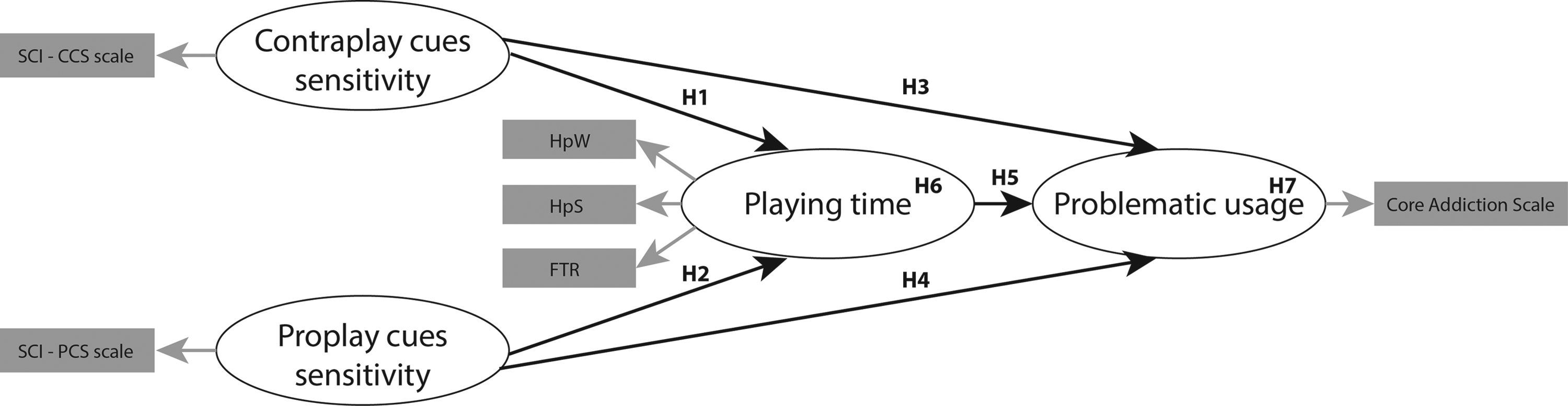
Conceptual framework with hypotheses. Black arrows represent the inner model-hypothesized paths between latent variables (in ovals). Grey arrows represent the outer model—how latent variables were measured by manifest variables (in rectangles).
Methods
Sample
The respondents were recruited online through an advertisement on a Czech gaming web site and the official SWTOR forum in September 2012. Four hundred sixteen respondents completed the survey. Twenty-four respondents were removed due to missing values. Fifteen respondents were removed due to positive markers of addictive playing (see further).
The final dataset therefore consisted of 377 respondents (340 males, 30 females, 7 respondents did not enter their gender), mostly Czech (277) and Slovak (39), but also people of other nationalities (17 Americans, 7 British, 4 Australians, 3 Germans, 2 Greeks, Dutch, Vietnamese, and Portuguese, 1 Austrian, Belgian, Canadian, Caucasian, Polish, Swede, and Swiss; 15 respondents did not state their nationality). The age within the sample ranged from 12 to 67 years (M = 24.14, SD = 6.84).
Measures
We had two dependent variables: playing time and problematic usage.
Playing time was measured by three items, all based on players' self-reports: First, we asked players to indicate the overall usage by giving the number of HpW they spent playing MMORPGs (item: How many hours per week do you spend playing MMORPGs?). Second, we established the hours per session (HpS) measure by asking players to indicate the length of their average session (item: How long do your sessions usually last?). Third, we asked players to estimate how much percent of their free time they spend playing on a 10-point scale from “0–10 percent” to “91–100 percent” (item: Please try to estimate in percent how much of your free time do you spend playing MMORPGs.) We represented each step of the ordinal scale with the middle value (e.g., 5 for 0–10 percent, 15 for 11–20 percent) and treated it as the ordinal variable.
Problematic usage was measured by Charlton's scale of core Internet gaming addiction. 25 It consists of seven statements, which a respondent considers on the 1–5 scale from very untrue (1) to very true (5). A player was categorized as addicted if he or she scored in at least one item from all four core criteria with at least a 4: withdrawal items (no. 7), relapse and reinstatement items (no. 5), at least one of the conflict items (nos. 2, 3, 4), and at least one of the behavioral salience items (nos. 1, 6). 26 Fifteen respondents in our dataset met the criteria for IGA. Because of the small number of addicted users in our sample, which did not allow for statistical measurement, we removed those users from the dataset and conducted analyses with players who did not score items in any of the four core criteria higher than 3—non-addicted, casual players (135), and the players that scored higher than 3 in some, but not all criteria—neither addicted nor casual (242). For the purpose of the path-modeling, we computed for each player a score of problematic usage as the average of their responses on all Charlton's core addiction items.
The explanatory variable—CS—was measured by a simple scale—the Cues Sensitivity Scale (CSS)—that consists of 23 items divided into two subscales: PCS and CCS. The items are in the form of statements, and subjects express their level of agreement on a five-point scale ranging from fully disagree to fully agree. Statements specify conditions that may occur in the game or in the real world and are likely to
(a) encourage a player to start or continue a gaming session (proplay cues), for example, I start playing if I need to relax, I start playing when I get home from school/work; Even if I should stop playing, I do not stop if I am close to my desired achievement in the game, Even if I should stop playing, I do not stop playing if I have fun.
(b) prevent players from starting or encourage him to end the gaming session (contraplay cues), for example, I stop playing if there is work to do., I stop playing if the action (e.g., guild raid) I participated in is finished., Even if I would like to play, I do not start playing if I need to be well-rested the next day., Even if I would like to play, I do not start playing if I am asked not to play by someone close (e.g., partner, friend, parents, brother or sister).
The full inventory (with its psychometric properties) follows in “Results”.
Process
Data were analyzed using the statistical software R. 27 The path modeling was conducted with the R-package pls-pm. 28 Partial least square path modeling enables the researcher to examine how much of the variance of dependent variable is explained by the hypothetical independent (explanatory) variables. This measure is called the coefficient of determination (R2), and it is the same as it in any other multiple regression analysis. The higher the R2, the more variance of the dependent variable is explained by the independent ones. The R2 can be classified in three categories: (a) Low: R2 < 0.30 (although some authors consider R2 < 0.20); (b) Moderate: 0.30 < R2 < 0.60 (alternatively 0.20 < R2 < 0.50); and (c) High: R2 > 0.60 (alternatively R2 > 0.50). 28
Results
The obtained values for all measured variables are shown in Table 1.
CS, cues sensitivity.
Playing time
We examined how three proposed Playing time measures related to each other. HpW and HpS correlated strongly (r = 0.69, p < 0.001), as well as HpW and FTR (ρ = 0.72, p < 0.001) and HpS and FTR (ρ = 0.65, p < 0.001).
Problematic usage
The internal consistency of the Charlton's core addiction inventory was rather low (Cronbach's α = 0.69), but still acceptable.
Cues sensitivity
We measured two CS factors, and both revealed good internal consistency: PCS (Cronbach's α = 0.78) and the CCS (Cronbach's α = 0.75).
PCS and CCS were significantly negatively correlated (r = −0.39, p < 0.001), however, the strength of correlation suggests they are independent variables.
Because CSS is a new measure, we present more detailed psychometrical properties in Table 2.
Item-whole correlation corrected for item overlap and scale reliability.
PCS, proplay cues sensitivity; CCS, contraplay cues sensitivity.
PCS and CCS as MMORPG usage predictors
All paths presumed in our hypothetical model were found to be significant (Fig. 2; Table 3). Therefore, we consider hypotheses 1–5 confirmed. PCS has a significant positive direct effect on the overall time spent playing MMORPGs as well as on the presence of problematic usage symptoms. This is in congruence with previous research on the role of habitual regulation in media usage. 11 On the other hand, we observed that CCS had significant negative effects on both playing time and problematic usage.

Path model with observed direct effects and coefficients of determination (R2) for dependent variables. ***p < 0.001.
Significant at p < 0.001.
Using the milder criteria, which is usual in areas concerning human behavior, the coefficient of determinations (R2) that we obtained by path modeling were moderate, which means that the hypothesized independent variables explained a moderate amount of variance in the dependent variables (playing time, problematic usage). Hypotheses 6 and 7 were thus also confirmed.
Discussion
Significant direct relationships were observed between habits related with starting and ending the MMORPG playing sessions (CS) and the excessive and problematic MMORPG usage. These effects were both positive (in case of PCS) and negative (in case of CCS). That brings the new light into the discussion on the effects of habitual regulation of media usage, suggesting that habits may both prompt and prevent the excessive and problematic usage. Moderate coefficients of determinations for both dependent variables (time spend playing and problematic usage) suggested that habits related with starting and ending of gaming sessions (CS) are highly relevant either for game overusage or for the presence of problematic gaming symptoms. CS is hence the important proximal factor of usage that can be easily and reliably measured (Cronbach's α for both scales were above 0.75 and the majority of items showed moderate or high correlation to its respective scale as shown in Table 2).
The way how the user will develop his habits probably depends on some personality and situational factors. The investigation of these distal factors of usage together with CS would be the natural step in online gaming research as well as in the research on similar consumption activities such as online shopping, chatting, and various kinds of media usage.
Moreover, we identified the mediating role of user's time investment into gaming—playing time, which is significantly predicted by CS and at the same time predicts the problematic usage symptoms presence. It means that the time spent playing and problematic usage are related, but not overlapping concepts, and each of them significantly depends on gaming habits. Therefore we believe that when investigating the relationship between habits and problematic MMORPG usage, the time spent playing should be incorporated into the analysis.
We believe that by focusing on situational cues, we advanced the conceptualization and measurement of habitual regulation that has been very general and one-way focused. The shift toward such proximal behavioral markers of habitual regulation such as the CS seems to be especially useful in MMORPGs and similar activities (e.g., online shopping, chatting) that rather lack the natural stop points (e.g., the end of movie in the case of TV watching or finishing the cigarette in case of smoking). The CS approach enables both researchers and users to better understand gaming in relation to other activities and commitments.
Limitations
We used a new instrument, CSS, for measuring the habitual regulation of MMORPG usage. However, the instrument demonstrated good internal consistency, and while its content is rather manifest than latent, focusing on the behavioral patterns of usage, we believe that it can be used with some caution. We provided detailed psychometrics and encourage researchers to use it in their own research.
It would be beneficial to measure cue sensitivity together with the conscious self-regulation and a metric measuring the strength of habitual regulation of behavior that had been used in previous studies.
We believe that our results are relevant for all MMORPGs because all possess very similar traits, however, our sample consisted mainly of World of Warcraft or Star Wars: The Old Republic players, and these players were recruited by the advertisement on one web site or one forum post on the official SWTOR forum. Therefore, future research that would cover more MMORPG titles and use more sophisticated recruitment strategy would be desirable (e.g., to recruit respondents directly in the game environment instead on forum and other game-related web sites).
Footnotes
Acknowledgment
The authors would like to acknowledge the support of the Grant Agency of the Charles University in Prague, the project no. 684112 and the support of RVO 68081740.
Author Disclosure Statement
No competing financial interests exist.