




Abstract
Abstract
This study examines the relationship between exposure to political personalized ads on Facebook and voters' responses toward those ads and studies the mediating role of the use of persuasion knowledge in this relationship. Results from an online experiment (N = 122) demonstrate that exposure to a personalized ad from a political party activates persuasion knowledge, which in turn leads to lower intentions to engage in electronic word of mouth, but only for those participants who recall seeing the Sponsored label. We found no effects on source trustworthiness. Adding a text explaining the practice of personalized advertising did not lead to higher levels of persuasion knowledge and did not change the responses toward the message.
S
To date, the consequences of political marketing are understudied, 10 especially with regard to online political marketing and microtargeting. 11 Microtargeting involves finding and combining information about individuals' political preferences and consumer habits. […] These individuals could then be targeted [online] with messages designed to appeal to them (p. 5). 12 Currently, a major gap in research on technology and election advertising exists in understanding the psychology of the voter in response to digital election ads (p. 5). 13 This lack of research is surprising, considering that many claim that microtargeting might harm political processes. 11 Many voters are unaware that they are being targeted, but if they knew, they might avoid campaign information. 12 This could have serious implications not only for campaigning effects but also for society at large. Surprisingly, previous research has not dealt with voters' responses to microtargeting. Where general tweets or Facebook posts can affect voters in a positive way,1,2 personalized political ads might generate totally different effects. The usage of personal information, such as previous online behavior or personal information, may be perceived as invasive14–16 and thus may evoke resistance.
To understand citizens' responses toward political messages on SNSs, this study examines the effects of exposure to different types of political Facebook posts (regular posts vs. personalized ads) on the intention to engage in electronic word of mouth (eWOM) and perceived trustworthiness of the post's source. To examine the underlying process, we examine the mediating role of the use of persuasion knowledge, defined as personal beliefs toward, and knowledge about, advertising. 17 Last, this study investigates whether informing voters about the practice of personalized advertising may change effects.
Voters' Responses Toward Personalized Online Advertising
Prior research found that personalized online advertising has a great variety of influences on people. Some studies note that people perceive personalized ads as useful because they reduce information overload, serve users' needs, and provide aids for decision-making.18,19 However, some people are concerned about their privacy and perceive personalized ads as creepy.14–16 In addition, when the content of advertising is political, the positive consequences seem to be largely absent. Personalized ads leads to lower support for politicians, lower engagement in political behavior, negative attitudes, lower source trustworthiness, and more ad skepticism.12,20 However, evidence remains anecdotal because a lack of research into the persuasiveness of personalized ads exists. This study addresses this gap in the literature.
Persuasion Knowledge and Personalized Online Advertising
Persuasion knowledge is important when examining the implication and consequences of personalized advertising. Persuasion knowledge can be defined as personal beliefs and knowledge about advertising motives and tactics. 17 Citizens can use this knowledge in response to a persuasive message to decide upon the perceived appropriateness and effectiveness of the tactics used in the message. 17 We expect that the activation and usage of persuasion knowledge play an important role in affecting citizens' responses to different types of political posts on Facebook. In other words, if citizens become aware of the sponsored content, they might respond negatively to political ads and resist the information.
Regular Facebook posts appear in people's timelines because their Facebook friends liked or shared them or commented on them. This means that a post sent by a political party can appear in a person's timeline, even if this person is not connected to this party. In this situation, the only information provided is, for instance, Friend A, Friend B, and 11 others like Party X. Because these types of posts are not advertising, chances are low that they will activate persuasion knowledge.
Personalized ads on Facebook appear in people's timelines because the sender paid for them. These posts look similar to regular posts, with the exception that they include a label saying Sponsored. Research has demonstrated that making the commercial purpose more salient, by disclosing it using a label, enhances the activation of persuasion knowledge.21,22 Therefore, we expect that compared with a regular post, a personalized Facebook ad may activate citizens' persuasion knowledge. However, research has also provided evidence for the fact that labels, such as Sponsored, are often unnoticed23,24 and misunderstood.24,25 This means that the label, Sponsored, may not be sufficient to activate citizen's persuasion knowledge. For that reason, we examine whether a short training that informs citizens about the practice of targeted advertising may help citizens to develop their persuasion knowledge and, consequently, use this knowledge in response to a personalized ad. Prior studies have shown that additional information accompanying a label or logo can increase its effects.24–26 Altogether, we expect that
Moreover, the realization that a message has a persuasive purpose has repeatedly been shown to alter the interaction with the sender and consequently people's attitudes toward the sender and the message.17,27 This effect of the activation of persuasion knowledge on the responses to the message may be explained by a difference in processing. The Elaboration Likelihood Model (ELM) suggests that people can process a message through the central route, which involves careful and thoughtful consideration of the information, or through the peripheral route, which focuses more on simple cues in the persuasion context. 28
According to the ELM, warnings of the persuasive intent of a message, such as the label, Sponsored, in the Facebook post that indicates it is a personalized ad, might induce resistance of the message by evoking more biased processing. 28 In the context of Facebook, this would mean that the Sponsored label motivates the Facebook user to carefully scrutinize the message and thus to use the central route of processing. In other words, when the personalized ad activates persuasion knowledge, this may motivate people to process the message, its content, and its sender more carefully and critically. 29 In the situation where a label is not provided, and people are not aware of the commercial nature of a Facebook post, they are probably more likely to use the peripheral route. The fact that their friends like the sender of a post or the post itself may then be a cue that influences their attitude and behavior.
We therefore expect that a regular Facebook post sent by a political party does not evoke biased processing and resistance, whereas a personalized ad on Facebook does. This may cause a difference in the perceived trustworthiness of the source of the post. Source trustworthiness is defined as the perceived credibility and honesty of the communicator. 30 When people understand the persuasiveness of the message, the trustworthiness of the sender decreases because the commercial aims of the advertiser become known. 27 Hence, we expect that exposure to personalized advertising triggers people's awareness of its persuasive nature, motivating them to process the post more critically, which ultimately reduces their trust in the political party.
We also expect that the different Facebook posts and a training may influence citizen's likelihood to engage in eWOM. In this study, eWOM is defined as any positive or negative statement made by potential, actual, or former voters about a political party or politician, which is made available to a multitude of people through the Internet (based on a previous definition 31 ). On Facebook, eWOM includes, for instance, liking the post, commenting on it, or sharing it with others. People are more likely to engage in eWOM when they see their friends' involvement in ads on Facebook.32,33 In a situation where persuasion knowledge is not activated, and people use the peripheral route, their friends' engagement may be a cue that encourages them to also engage in eWOM. However, when a Facebook post is a personalized ad, and people become aware of its persuasive nature, this may again enforce biased processing and resistance, making it less likely that they would engage in eWOM.12,19 Hence, based on the ELM and prior research, we propose a mediation hypothesis (Fig. 1):
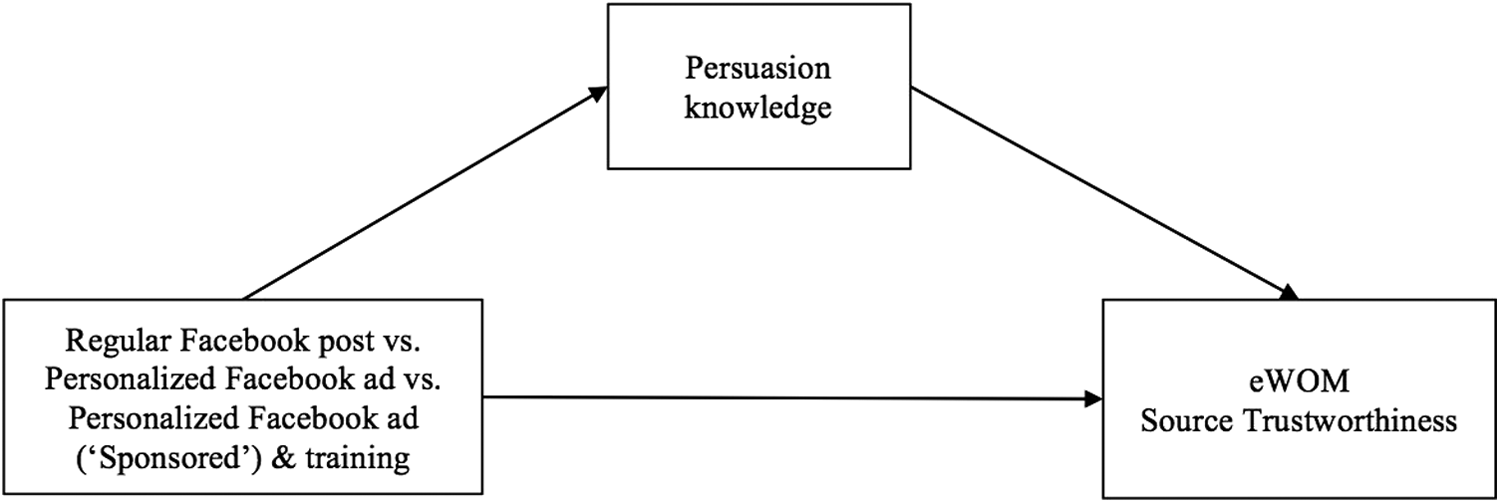
Proposed mediation model, in which the nature (regular post or personalized ad) and the information provided about its nature (training or not) of a Facebook post sent by a political party generate different levels of persuasion knowledge, which consequently affects responses to the post and source.
Methods
Participants and research design
To test our hypotheses, a factorial between-subjects design was employed in May and June of 2015. This experiment entailed three conditions: Participants were exposed to either a regular Facebook post, the same post, but labeled as a personalized ad (Sponsored), or to the personalized ad combined with a training explaining the practice of personalized advertising. Participants were recruited through the online message board from the University of Amsterdam (N = 122, 78.7 percent = female; Mage = 21.19, SDage = 2.27).
Procedure and stimulus material
After clicking on a URL that redirected respondents to the online experiment, participants were instructed that they were going to see a Facebook message. Participants were instructed that this message appeared between other posts on their own Facebook News Feed. After this short instruction page, they were randomly assigned to one of the three conditions. Participants were then exposed to the stimulus material and redirected to a questionnaire. Each participant viewed a screenshot of a fictitious Facebook post sent by a political actor (party leader) from the Dutch political party, D66. This post was based on an actual political ad that was posted on Facebook during the last political election in The Netherlands.a In all conditions, the post said “Do you want more jobs, lower costs, and better education too? Vote D66.” On top of the post, the text: “Sophie Watergang, Minem Sezgin, and 4 other friends like D66” was placed. In the regular Facebook post, this was the only additional information provided. In the personalized ad condition, the post was labeled as Sponsored. Finally, in the personalized ad plus training condition, a text was displayed before participants viewed the personalized ad. The text explained that Facebook targets users with personalized ads based on their demographic information and online behaviors (the stimulus material is available upon request from the authors).b At the end of the experiment, participants were debriefed and thanked. Participants received research credits for participation.
Variables
The likeliness to engage in
The
Several
Results
To test for differences in persuasion knowledge (H1), we used an ANCOVA analysis with the three conditions as the independent variable, persuasion knowledge as dependent variable, and likeliness to vote for D66 as control variable. Results indicated that no significant differences exist in the activation of persuasion knowledge between the three conditions, F(2, 118) = 0.67, p = 0.512.
In total, 68.0 percent of the participants correctly recalled the Sponsored label. As previous research repeatedly found that labels only affect people when they notice it, 23 we only included those people who correctly recalled the label, Sponsored (N = 83). We ran the same ANCOVA with this subsample, and the results showed a significant effect on persuasion knowledge. Participants in the personalized ad condition (M = 6.29, SD = 0.71) and the personalized ad with training condition (M = 6.36, SD = 0.64) had higher levels of persuasion knowledge than participants in the regular Facebook post condition (M = 5.88, SD = 0.94; respectively, p = 0.088 and p = 0.041), F(2, 79) = 3.87, p = 0.025, ηp2 = 0.089. In other words, participants were more likely to understand that the Facebook post was advertising when it included the Sponsored label compared with the regular Facebook post (Table 1). Unlike our expectation in H1, adding a text explaining the usage of personal data did not lead to higher levels of persuasion knowledge. H1 was thus partly supported.
Mean scores with standard deviations between parentheses. All scores based on seven-point scales, N = 83.
eWOM, electronic word of mouth.
To test H2, a mediation analysis was conducted with the SPSS macro PROCESS (Model 4) using 1,000 bootstrap samples to estimate the indirect effects. 36 The mediation analyses were run thrice with one dummy variable as the independent variable, the other one as covariate, and the last one as the reference category, and separately for each dependent variable (Table 2). With regard to source trustworthiness (H2a), we found no significant mediation (or indirect) effect. This means that H2a was not supported. Interestingly, results show that the personalized ad negatively affects eWOM through persuasion knowledge. When comparing the personalized ad condition with the regular Facebook post condition (with the personalized ad with training condition and intention to vote for D66 as control variables), we found a significant indirect effect (indirect effect = −0.17, SE = 0.11, 95% BCBCI [−0.46, −0.02]). Exposure to a personalized ad activated persuasion knowledge (b = 0.47, p = 0.030), decreasing the intention to engage in eWOM (b = −0.36, p = 0.005), compared with the same post when it was not advertising.
N = 83.
BCBCI, bias-corrected bootstrap confidence interval; PK, persuasion knowledge; LL, lower limit; SE, standard error; UL, upper limit.
We found the same indirect effect for exposure to the personalized ad with training, indirect effect = −0.19, SE = 0.10, 95% BCBCI [−0.48, −0.04]. Compared with the regular Facebook post, the personalized ad with training activated persuasion knowledge (b = 0.52, p = 0.014), decreasing the likelihood to engage in eWOM (b = −0.36, p = 0.005).
We found no significant indirect effects comparing the personalized ad condition with the personalized ad with training condition. This indicates that the training explaining the usage of personal data did not activate higher levels of persuasion knowledge among participants compared with seeing only the Sponsored label (Table 2) and thus did not alter the responses to the ad. H2b was thus partly supported.
Discussion and Conclusion
This is one of the first studies focusing on online political microtargeting and shows some interesting findings about this novel and rarely studied phenomenon. In sum, exposure to a political personalized ad on Facebook activated voters' persuasion knowledge compared with a regular Facebook post. However, in line with previous work, 20 this effect only occurred when people noticed the label denoting it as Sponsored. Interestingly, 32 percent of the participants did not recall this difference between the regular Facebook post and that same post as a personalized ad. This means that a large group of Facebook users does not appear to notice the label that distinguishes regular posts from commercial ones, making this label not effective for these people. The lack of attention to the label may be due to the fact that people are just paying attention to the Facebook post itself and that the label is too small to catch attention. More research is needed to examine the antecedents and effects of people's attention to such labels.
However, once people did notice the label, this led to a better understanding of the fact that the Facebook post was advertising sent by a political party. As a consequence of this activation of persuasion knowledge, voters were less likely to distribute and share the Facebook post. The perceived trustworthiness of the political party that disseminated the Facebook post did not appear to be affected.
Moreover, a short training that informed citizens about the practice of personalized advertising did not increase the use of persuasion knowledge, nor did it change eWOM or source trustworthiness. This means that voters do respond differently to a Facebook post that is personalized advertising compared with the same post when it is not labeled as advertising. Information about the usage of personal information to target this ad did not increase these effects.
These findings have theoretical implications. First, it demonstrates the importance of persuasion knowledge as the underlying mechanism that explains citizens' responses to political Facebook posts. Second, although some have expressed their doubts about the relevance of the ELM in the digital world, 37 our study shows that the theory is still applicable to modern ways of advertising. The ELM proves to be a valuable theory to explain our findings. Specifically, following the ELM, the label, Sponsored, in the Facebook post—a warning that indicates that it is a personalized ad—might induce resistance because it evokes more biased processing. 28 However, as we did not measure how people actually processed the message, further research could advance our study by doing this.
Furthermore, the findings of our study have implications for those interested in using personalized advertising on social media. Our study suggests that personalized advertising has its challenges. Citizens appear to resist personalized content when they notice a Sponsored label, and in turn, they are less likely to share personalized ads with others. In other words, citizens seem to understand the techniques that are used on Facebook and this can generate resistance toward the ad. Thus, what appears to be an opportunity—personalizing ads to reach possible voters—might not always be beneficial in practice. However, this study is the first step in studying a rather novel phenomenon. Future work should examine whether personalizing ads also leads to more positive implications, such as mobilizing citizens to vote, or other negative implications, such as political content avoidance.
With regard to the normative debate about the implications of personalized advertising, 11 one could argue that the fact that citizens appear to withstand personalized advertising might have positive implications. Citizens seem to be able to make a distinction between regular Facebook posts and those that are personalized ads. Additional training does not seem to be necessary. Moreover, given the high scores on the measure of persuasion knowledge, citizens do seem to understand that political ads on Facebook are often persuasive messages paid by the party. This suggests that persuasion knowledge in the context of social media advertising is already quite developed. However, further research is needed to fully understand how developed people's persuasion knowledge about personalized advertising on social media actually is.
Notes
a. The party, D66, was chosen because the party can be placed in the middle of the political spectrum (not left-wing or right-wing).
b. To examine whether people would perceive the personalized ad as such, we conducted a pilot study among a convenience sample (N = 51). In this pilot study, we found that in the personalized ad condition, 43.8 percent of the participants recalled seeing the label, sponsored, and in the personalized ad with training condition, 66.7 percent of the participants recalled seeing the label, Sponsored. This finding is in line with previous research that shows that people often do not see a label that indicates that a social media post is paid for.20,25 The final questionnaire also included a question that measured whether participants recalled the label, Sponsored, correctly.
c. Specifically, the three experimental groups did not significantly differ from each other regarding the likeliness to vote for D66, F(2, 119) = 2.05, p = 0.134; visiting the D66 Facebook page, X2(2) = 1.36, p = 0.506; following D66 on Facebook, X2(2) = 0.50, p = 0.357; owning a Facebook account, X2(2) = 1.99, p = 0.369; gender, X2(2) = 0.25, p = 0.882; and age, F(2, 119) = 1.34, p = 0.265.
Footnotes
Author Disclosure Statement
No competing financial interests exist.