




Abstract
Abstract
A number of high-profile public figures hire ghost-tweeters to post to their social media accounts on their behalf, but no research has examined how this social media practice can affect followers’ feelings of connection to the public figures. College students (n = 132) participated in an online experiment to examine the effect of ghost-tweeting practices on parasocial interaction (PSI) with social media figures. Tweet authorship (use of a ghost-tweeter or not) was manipulated. Ghost-tweeting resulted in reduced PSI. Perceptions of distance, but not personal authenticity mediated this effect. However, authenticity and distance did serially mediate the relationship between ghost-tweeting and PSI. These findings shed light on the process of PSI with celebrities and other media figures on social network sites.
Introduction
D
Although ghost-tweeting could be a relatively typical social media management strategy, to our knowledge, no studies have examined the repercussions of this practice for followers’ feelings of connection. Investigation of this practice also has the potential to be fruitful theoretically, by shedding light on the mechanisms that connect or disconnect individuals parasocially in social media environments. To this end, we employed an experiment to examine whether the practice of ghost-tweeting can lessen parasocial interaction (PSI) on SNSs by reducing perceptions of authenticity and, in turn, increasing perceptions of distance.
PSI on SNSs
PSI was originally conceptualized as an illusive sense of mutual awareness or a perception of intimacy with personas that occurred through media that did not permit two-way communication between the figures and their audiences. 4 These imagined interactions are remarkably common and can exist with virtually any type of media figure, including celebrities, politicians, and fictional characters. 5 Further, because they closely resemble non-mediated, social relationships, 6 PSIs and related connections can have meaningful consequences for people's social, emotional, physical, and mental well-being.7–11
Recently, the criteria for parasocial experiences seem to have expanded thanks to the emergence of SNSs, where public figures intermingle with their followers, and scholars acknowledge that even reciprocal interactions in these spaces, which are “social” in a technical sense, can, nonetheless, be parasocial in terms of how audiences perceive these encounters.12–16 Accordingly, research has begun to focus on how technological affordances (e.g., interactive technology affordances), 16 and social media practices (e.g., inclusion of personal information in Tweets), 14 can foster PSI on SNSs. In the interest of adding to this line of research, we investigate the role of perceived authenticity and distance in PSI with a public figure. We conducted an experiment to examine ghost-tweeting as a practice that can jeopardize PSI on Twitter.
Authenticity and distance
In his theoretical account of PSI with new media figures such as avatars, Hartmann argues that perceptions of authenticity should contribute to PSI. 17 Hartmann defines authenticity as judgments about whether media figures are believable as people. Authentic new media figures exhibit creativity and variety in their behavior and they express realistic and genuine emotions. His description of authenticity bears some resemblance to the concept of social presence, which refers to the extent to which people feel as though they are engaging with a “human-likeness,” 13 as opposed to an “abstract, anonymous person.” 18 Similarly, Tsay-Vogel and Schwartz defined authenticity as “the degree to which a media figure adheres to the laws of the physical world,” and they developed a classification scheme for different media figures based, in part, on how human or non-human, and normal or super their traits are. 19
Research on SNS practices adopts a conceptualization of authenticity that overlaps with these notions of “humanness,” but it is grounded in how genuine one's personality appears. Consistent with the notion of authenticity as humanness,17,19 respondents in an analysis of public figures on Twitter's practices expressed a concern with “being human.” 20 Twitter users provided examples of how they gave the impression of having a genuine personality to pass off as believably human. They reported deliberately masking impression management and self-promotion goals in their tweets to avoid seeming fake, self-serving, or manufactured. In this way, authentic self-expression on SNSs involves communication that appears natural, candid, sincere, and untainted by ulterior motives.
Building on all of these conceptualizations of authenticity, we proposed that PSI with a public figure is facilitated by perceptions that the figure is non-robotic and genuine in their communication. The practice of ghost-tweeting, however, should convey inauthenticity. A ghost-tweeter may be skilled at manufacturing posts that sound like something the media figure would Tweet themselves. But as Marwick and Boyd argue, “Twitter is generally a site where personal disclosure and intimacy are normative so access, intimacy, and affiliation are valueless if an account is fake or written by an assistant.” 1 Because use of a ghost-tweeter could give the impression that the public figure's persona is unnatural and manufactured, PSI should be reduced as a consequence.
In addition to authenticity, Hartmann also argues that perceived distance, or how much one believes that their actions have some effect on another, should impact PSI. 17 If individuals believe that they have the potential to be noticed by another, or to directly affect the other, this should increase the sense of PSI. Extending this argument, public figures who seem “within reach,” available, or receptive socially on SNSs should seem less distant. This overlaps with Giles's proposition that PSI occurs on a continuum based, in part, on the potential of interaction and relationship development. “Semi-parasocial” contact occurs when there are chance interactions with public figures (e.g., a handshake at a fan convention or political rally, or a fan letter exchange), even if there is little chance of a relationship developing from the interaction. 5 In SNS contexts, we proposed that any indication that a social media figure is socially accessible should reduce perceived distance and encourage PSI. Tagging users, “liking” or retweeting others’ content, or responding to comments could all increase PSI by reducing perceptions of distance by demonstrating an ability and willingness to reciprocate socially.
Providing some empirical support for this claim, Thorson and Rodgers found that interactive features and users’ perception of interactivity on a political candidate's blog predicted PSI. 16 This suggests that simply knowing that a media figure is accessible through technology can enhance imagined intimacy. Marwick and Boyd also argue for the importance of lowering perceived distance to cultivate loyal and engaged followers. In examining an argumentative Tweet from a well-known politician to one of his followers, they observed that even when he responded negatively, his response had the effect of reducing perceptions of distance in observers because it showed that he takes time to respond to his followers. 1
We expected ghost-tweeting to increase perceptions of distance. Because ghost-tweeters create a barrier between the audience and the public figure by standing in their place, they should be perceived as adding more psychological distance in the eyes of followers. This, in turn, should decrease PSI.
Notably, in the aforementioned example of the politician's tweets, the researchers suggest that the politician's adherence to his principles is partially responsible for making him seem socially accessible, 1 hinting at the idea that perceptions of authenticity can drive perceptions of distance. Perceiving that a genuine human is orchestrating an account could make them seem inherently more available socially. One experiment lends some support to this possibility. Wickham found that people who were led to believe that their relational partner was more authentic reported experiencing more trust and relational openness, and they perceived them as being more responsive to relational needs. 21 This indicates that authenticity can dissolve relational barriers, making a person seem less aloof and unapproachable. For this reason, we expected any social media practice that diminishes perceptions of a media figure's authenticity to also increase perceptions of social distance, and to reduce PSI as a result.
Methods
Procedure
Students from a large Northeastern U.S. university were recruited from introductory courses to participate in a between-subjects online experiment. After answering preliminary questions in an online questionnaire, participants were randomly assigned to one of two Twitter authorship experimental conditions. After reading a short description of the public figure, participants were assigned to the ghost-tweeted or self-tweeted conditions. The instructions for these conditions were worded identically, except that in the ghost-tweeted condition, participants were read a passage explaining that the public figure relies on a publicist to update her Twitter feed for her, and in the self-tweeted condition they were explicitly told that the public figure updates her Twitter feed herself.
After reading these passages, participants were given instructions to evaluate the public figure's Twitter feed (which, unbeknownst to participants, was manufactured for this study). Because this study was concerned with impressions alone, participants’ ability to interact with the Twitter feed was disabled. After viewing the Twitter feed, participants completed the second part of the online questionnaire. Finally, participants were debriefed about their study experience.
Selecting a public figure
Rather than selecting a well-known public figure who has already a developed social media reputation with a wide audience (e.g., George Takei or Michelle Obama), we sought to select a local celebrity who would be relatively unknown but still be somewhat relevant to participants. Participants were told that they would be examining the Twitter feed of [public figure], who played the role of a mascot in 2009 at the university where the research was conducted. Each year, a person is selected to play a human mascot at this university. Their public image is tightly linked with the university brand and closely managed as a result, so it is within the bounds of possibility that they would have a ghost-tweeter managing their SNS accounts. Because these mascots are iconic, well known, and popular on social media, we believed that [public figure] would have some salience as a public figure to these participating students. We selected a former mascot, who occupied the office several years ago, so that the current student participants would unlikely be currently following her on Twitter and would have a fresh impression of the Twitter feed created for this study. No participants reported currently following [public figure] on any SNS.
Participants
A total of 170 students were recruited. After excluding participants who did not correctly identify whether the public figure updated the feed herself or did not complete a majority of the survey, the final sample consisted of 132 participants (52.6 percent female; 78.3 percent White; aged 18–32, M = 19.75, SD = 1.97). In the final sample, 48 participants were randomly assigned to the ghost-tweeted condition, and 84 participants were assigned to the self-tweeted condition.a More than half (62.2 percent) of the sample reported using Twitter daily, or several times a day, whereas 20 percent of participants did not have a Twitter account.
Measures
Authenticity
Drawing from a conceptualization of personal authenticity, 1 a scale was developed for this study. Participants indicated the extent of their agreement to six items designed to tap into participants’ impressions of the persona's genuineness (e.g., “She is not afraid to show her true self”), on a scale of 1 (disagree strongly) to 7 (agree strongly). Principle axis factoring showed that these items loaded on a single factor, with no factor loadings below 0.56. When averaged, the resulting scale was reliable (α = 0.89, M = 4.58, SD = 1.14).
Perceived distance
A four-item scale was also created to gauge how distant the public figure seemed, conceptualized as a perception of her accessibility and responsiveness.17,21 Participants used a 7-point scale (1 = disagree strongly; 7 = agree strongly) to assess their agreement with items such as, “she is attentive to people on her social network site,” and she “seems ‘within reach.’” The items loaded on a single factor in principle axis factoring, with no factor loading below 0.75. The averaged items demonstrated good reliability (α = 0.80, M = 3.84, SD = 1.14). Higher scores indicate lower perceptions of distance.
Parasocial interaction
Hartmann and Goldhoorn's six-item Experience of Parasocial Interaction Scale 22 was adapted for use in the current research to gauge participants’ sense of mutual awareness in reading the figure's Twitter feed. Again, participants used a 7-point scale (1 = disagree strongly; 7 = agree strongly) to assess their agreement with items such as, “while reading the Tweets, I had the feeling that she would know I was aware of her.” The reliability of this scale was excellent (α = 0.93, M = 4.47, SD = 1.13). Higher scores indicate greater perceptions of PSI.
Results
Manipulation checks
To check whether participants in the different author conditions recognized the passage about whether [public figure] tweeted personally or used a ghost-tweeter, they were asked to respond to a true or false question about whether she updated the Twitter feed herself. A chi-square analysis of participants in the ghost-tweeted and self-Tweeted conditions in the original sample showed responses to this question in the expected pattern, χ2(1) = 72.39, p < 0.001. Specifically, 93.5 percent of participants in the self-authored condition reported that it was true that she updated the feed herself, and 68.7 percent of participants in the ghost-tweeter condition reported that she used a ghost-tweeter.
Analysis
The PROCESS macro for SPSS
23
was used to calculate the direct and indirect mediation effects predicted in the four hypotheses, with 50,000 bootstrapped samples used for effect calculation.b Figure 1 displays the unstandardized path coefficients and model summary statistics for the analysis. Consistent with
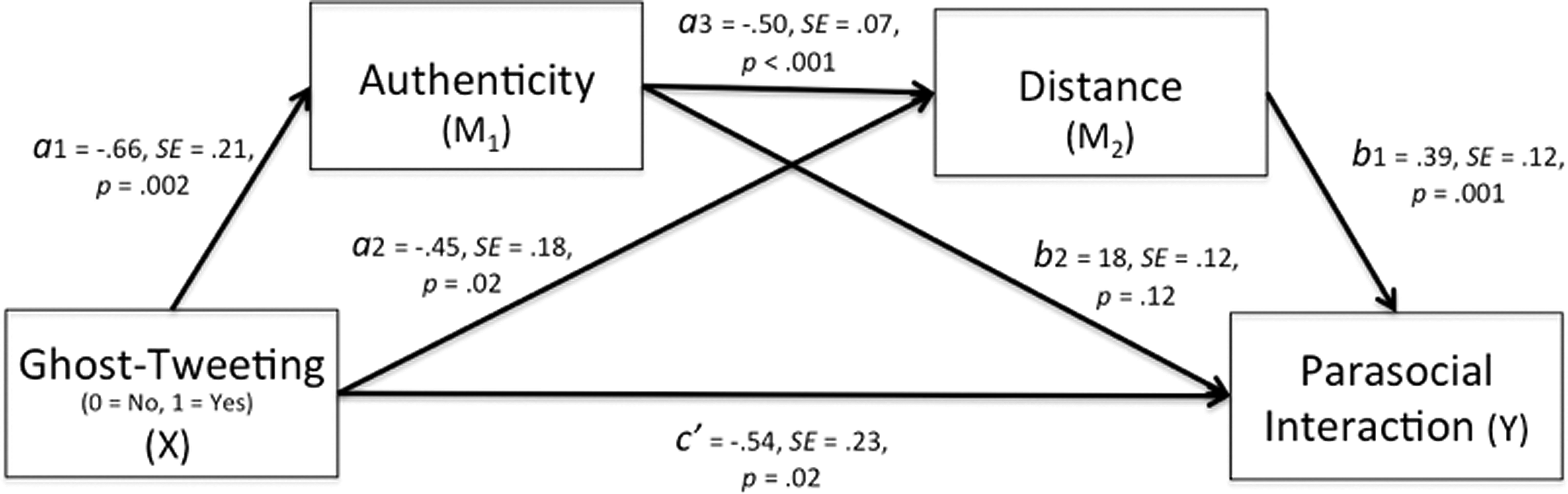
Unstandardized regression coefficients, standard deviations, and p values for the relationship between ghost-tweeting and parasocial interaction, as mediated by authenticity and distance.
Discussion
This study provides experimental evidence that the use of a ghost-tweeter can diminish SNS users’ experience of PSI with a public figure. This effect was not mediated by authenticity, but it was mediated by distance. However, authenticity did serially mediate the effect of ghost-tweeting by reducing participants’ perceptions of distance, which, in turn, increased PSI.
Practically speaking, this experiment provides causal evidence that ghost-tweeting can create intimacy barriers between media figures and their followers. Public figures should have a harder time cultivating parasocial feelings of closeness if it is known that they do not author their own social media posts. Nonetheless, it would be a mistake to presume that the use of ghost-tweeters is an unwise strategy. We suspect that in many cases, SNS users may neither be surprised nor put off to learn about their favorite public figures’ use of ghost-tweeters, but more research is needed to determine what followers expect of the media figures they follow.
From a theoretical standpoint, this research also sheds light on why ghost-tweeting can be parasocially alienating. As predicted, perceptions of distance, or social accessibility mediated the relationship between ghost-tweeting and PSI, such that use of a ghost-tweeter made the public figure seem less available for social interaction, thereby reducing parasocial processing. In the current study, ghost-tweeting was the impetus for this effect, but these findings suggest that any social media practice that gives the impression that media figures are removed or closed off to social interaction—less willing or unable to engage with others—could adversely affect the felt intimacy with the figure. More research is needed to confirm this possibility and adds to the growing body of research on PSI mechanisms in SNSs.12–16
We also extend existing conceptualizations of authenticity in PSIs17,19 to account for the role of authenticity in PSI on SNSs. Contrary to our predictions, authenticity did not directly mediate the relationship between ghost-tweeting and PSI. However, authenticity did trigger a reduction in perceptions of distance, which, in turn, had a positive impact on PSI. Believing that someone is more genuine and candid appears not to be enough to foster imagined intimacy alone, but it does trigger reduced perceptions of social distance, which facilitate parasocial involvement. Our results suggest that public figures who give the impression that they are expressing a genuine self, and not acting fake, can foster a greater illusion of closeness or intimacy with their followers, because it makes them seem more socially accessible. Future research should explore other social media strategies that could enhance authenticity and reduce distance perceptions.
As previously mentioned, although a handful of public figures have either admitted to or been discovered using a ghost-tweeter, it is unclear how widespread the practice is. However, the fact that approximately three times as many participants who did not recall the instructions incorrectly reported that a ghost-tweeted newsfeed was authored by the public figure herself at least suggests that regardless of how common the practice actually is, SNS users do not expect public figures to use ghost-tweeters. This pattern hints at the possibility that SNS users tend to believe that public figures are managing their own accounts as a default assumption. It also underscores the need to use stronger manipulations to counter this assumption in future experimental investigations of this practice.
One notable limitation with this research is that the safeguards on experimental control in this study likely weakened the realism of participants’ SNS experience, compromising the findings’ external and ecological validity. On the one hand, the fact that clear differences in responses to the two Twitter feeds emerged despite the artificial nature of the study speaks of the findings’ robustness. In natural settings that permit greater interactivity and investment with public figures, we might expect the results to be even more pronounced. On the other hand, this study's artificiality makes it difficult to generalize these findings to other social media contexts, including different brands of SNSs (e.g., Facebook or Instagram) that are characterized by varied types of users and information-sharing practices, 24 different types of newsfeed content shared by public figures (e.g., promotional content or interactions with followers), 25 and different types of media figures. For example, because audiences develop different relationship expectancies for different categories of public figures, 26 it stands to reason that Twitter users could respond to the ghost authorship of another type of celebrity differently than they would respond to a former university mascot. Additional research in more natural and varied settings is needed to investigate how people detect and respond to ghost-tweeting or other practices in SNSs that impact parasocial involvement with public figures.
Endnotes
a. The inequality in the number of participants in each condition is largely attributable to the number of participants in each group omitted in the final analysis. Three times as many participants in the ghost-tweeted condition incorrectly identified the author of the public figure's tweets and they were removed from the sample.
b. This experiment originally had a 2 × 2 factorial design where the extent that the celebrity interacted with other Twitter users was manipulated in addition to the ghost-tweeting manipulation. A manipulation check revealed that this second manipulation was unnoticed by participants, so the variable was dropped from consideration in this research. To account for any potential differences between participants assigned to the interaction conditions, this variable was entered as a control variable in the current mediation analysis.
Footnotes
Author Disclosure Statement
No competing financial interests exist.