




Abstract
Abstract
The studies reported analyze the factorial structure of Facebook Addiction Italian Questionnaire (FAIQ), a variant of 20-item Young's Internet Addiction Test (IAT). In Study 1, we tested FAIQ psychometric properties using exploratory factor analysis (EFA). In Study 2, we performed a confirmatory factor analysis (CFA) to verify the FAIQ factorial structure identified through EFA. Results from CFA confirm the presence of a four-factor model accounting for 58 percent of total variance, plus a general higher order factor that best fits the data. Further relationships between FAIQ factor scores, personality, and Facebook usage have been explored.
Introduction
A
Studies on individual differences revealed that heavy Facebook users13,14,22 are mainly male, higher educated, 22 and more inclined to social interaction, passing time, entertainment, companionship, and communication. 23
Further FA variables are number of daily accesses24–28 and daily usage. 24 Differences in daily/nightly usage have been considered criteria for measuring FA.28,29 There is a relationship between FA and users' poor quality of sleep explained by daytime dysfunctions 30 : FA sufferers tend to access for several hours, and due to massive and late night usage show heavy dysfunctional sleep patterns. 31 The impact of technological devices such as personal computers, smartphones, or tablets on Facebook usage was studied with reports of increased smartphone use as related to various disturbances 32 and FA in countries as different as Taiwan, 33 Korea, 34 India, 35 and United States of America.36,37
Despite the growing body of research, there are still few factorial studies on FA dimensionality, as researchers focused on broad descriptive measures. Using an eight-item FA Scale, Koc and Gulyagci 14 found that social motives, depression, anxiety, and insomnia positively correlate with FA. Andreassen et al. 38 proposed the Bergen Facebook Addiction Scale (BFAS), an 18-item scale aimed at measuring the six core features: salience, mood modification, tolerance, withdrawal, conflict, and relapse. Masur et al. 39 employed a modified version of Hahn and Jerusalem 40 Internet Addiction Scale (IAS), based on a one-dimensional view of FA, despite exploring five different areas. Sofiah et al. 23 implemented an ad-hoc measure of FA, identifying four motives, social interaction, passing time, entertainment, and companionship, as significant contributors. Çam and Isbulan 22 used a modified version of Internet Addiction Test (IAT) 41 with one dimension accounting for 40.93 percent of variance. Hong et al. 13 extracted from an adapted version of IAT 42 four factors, withdrawal, tolerance, life problems, and substitute satisfaction, accounting for 77.14 percent of variance.
The approaches adopted for measuring FA are still heterogeneous and may have contributed to the sense of conceptual confusion that has troubled IA research. 43
To provide more psychometrically sound measures, these studies attempt to further investigate the construct of FA and link it to individual differences in Facebook uses.
In Study 1, we analyzed the psychometric properties and the factorial structure of Facebook Addiction Italian Questionnaire (FAIQ), adapted from IAT by Ferraro et al. 44 and derived from Young's IAT. 42 FAIQ includes 20 items assessing the severity of negative consequences of excessive Facebook use. The items cover individual usage of Facebook, habits, thoughts, and problems. Items are graded on Likert scale, higher scores indicating higher levels of FA. All the original IAT items 44 were modified replacing the wording “online” and “Internet” with “Facebook.” In line with the current debate among researchers concerning the assessment of FA,45,46 terms such as “online” or “Internet” may be too generic, as specific activities that can be performed online have replaced generic web usage.
In Study 2, we performed a confirmatory factor analysis (CFA) to verify FAIQ factor structure. As suggested by Cabrera-Nguyen, 47 a good practice in scales development and validation is to start with an exploratory factor analysis (EFA) to assess the underlying factor structure and refine the item pool, followed by CFA using a different sample to evaluate the EFA-informed a priori theory about the measure's factor structure and psychometric properties.48–50 We examined how FAIQ dimensions correlate with criterion variables provided by literature. We have considered gender, age, personality traits, daily/nightly usage, and devices used.
Study 1
Methods
Participants
Italian Facebook users (N = 291; 56 percent men, 44 percent women; M age 48.9 years, standard deviation [SD] = 16.1, range 18–86) voluntarily enrolled online without compensation. Geographical distribution: 47 percent Northern, 20 percent Central, 20 percent Southern, and 13 percent Islands. Degree of education: 7 percent primary school, 46.6 percent college, and 46.4 percent graduates/postgraduates.
Materials and procedures
All participants contributed anonymous personal information (e.g., gender, age, and occupation) in accordance to the Ethical Principles for Conducting Research with Human Participants, and then described their Facebook usage (i.e., age of account, device, and daily/nightly connections). Participants were presented with FAIQ questions, each graded on a five-point Likert-like scale. FAIQ scores were computed by averaging the scores for each item.
Results
Exploratory factor analysis
In Table 1, mean scores and SDs for each FAIQ item are presented. All mean scores ranged between 1.15 (SD = 0.515) and 2.34 (SD = 1.326), in line with results from Ferraro et al. 44 Univariate normality indices (i.e., overall indices of skewness and kurtosis) are outside the −1/1 range, indicating asymmetry. This result is expected, in light of the fact that a clinical instrument has been applied to nonclinical population.
SD, standard deviation.
EFA was carried out on the original 20 items of the scale using principal axis factoring extraction with oblimin rotation, as it is reasonable to assume that all extracted factors relevant to FA should show some degree of intercorrelation. Eigenvalues and scree plot were used as criterions to determine the number of factors. Items with factor weights <0.30, >0.30 on two or more factors, or not semantically consistent with the factor were deleted. To evaluate internal consistency, Cronbach's alpha was calculated.
Table 2 shows four-factor solution with an explained total variance equal to 58 percent. All the items and their loadings, plus reliability indexes (Cronbach's α), are reported.
Note: N = 291; principal axis factoring extraction method with oblimin rotation. Kaiser-Meyer-Olkin (KMO) Test = .904; Bartlett's sphericity test = 6,169 (190), p < 0.001. Bold values are significant at p < 0.0001.
The items loading in each factor shared common characteristics, which overlap the description of FA reported by the literature1,3–9.
Each factor is composed of four items.
Interpersonal irritability (17 percent of total variance) includes items that indicate the influence of Facebook on the quality of social relationships.
Elapsed time (15 percent) includes items related to the tendency of the subjects to spend time on Facebook.
Social performance impairment (14 percent) includes items describing the negative influence of Facebook in contexts such as friendships, work, study, and so on.
Facebook anxiety (12 percent) includes items that describe tendency to show withdrawal symptoms: anticipatory thoughts, irritability, and influences on mood.
Four items were excluded from the final factorial solution, according to the previously outlined criteria:
• Item 3 (weights <0.30). The semantic content of the item, having to do with sexuality, could be biased by social desirability. • Item 4 (Factor 5 loaded, inconsistent with semantic content). The general habit of making friends online is not linked to the construct of FA. • Item 10 (Factor 1 = 0.357 > 0.30, Factor 4 = 0.424 > 0.30). Some ambiguity of the item's semantic content can cause the loading of both Facebook anxiety and elapsed time. • Item 17 (Factor 2 loaded, inconsistent with semantic content).
Cronbach's alpha values are 0.89 (overall), 0.86 (Interpersonal irritability), 0.81 (Elapsed time), 0.79 (Social performance impairment), and 0.80 (Facebook anxiety), all within a satisfactory range. 51
The correlations between the measurement model constructs were analyzed. As shown in Table 3, the four FAIQ factors had high and significant positive correlations (from 0.56 to 0.74). This may suggest a second-order overall factor of FA that can account for the covariance of the first level.
p < 0.01 (two tiles).
Study 2
Methods
Participants
Italian Facebook users (N = 300; 51 percent men, 49 percent women; M age 46.4 years, SD = 16.4, range 16–82) voluntarily enrolled online without compensation. Geographical distribution: 47 percent Northern, 20 percent Central, 20 percent Southern, and 13 percent Islands. Degree of education: 7 percent primary school, 48 percent college, and 45 percent graduates/postgraduates.
Materials and procedures
As for Study 1, all participants gave some personal information (e.g., gender, age, and occupation) in accordance to the Ethical Principles for Conducting Research with Human Participants, and then filled the Facebook usage scale (i.e., age of account, device, and daily/nightly connections) and the online FAIQ. Afterward, they were administered an online version of the self-report Personality Inventory (PI) by Caci et al., 52 a 20-item scale that shares common characteristics with those described by Five Factor Model. 53 Each item was rated on a five-point Likert scale, from strongly disagree to strongly agree. The total score was computed by averaging the scores for each item. Results from PI have significant reliability (Cronbach's α: 0.72 Openness, 0.70 Conscientiousness, 0.74 Extraversion, 0.76 Agreeableness, 0.78 Neuroticism, and 0.85 overall).
Statistical analysis
To evaluate the fitting of the theoretical models, the following indices were calculated:
Acceptance criteria are between 1 and 2 for the Carmines-McIver Index (χ2/df). We followed the general criteria for adequacy assessment proposed by Hu and Bentler 58 : CFI: >0.95, AGFI: >0.90, and RMSEA: <0.06.
Pearson's linear correlation indices and Multivariate Analysis of Variance (MANOVA) were calculated to corroborate the construct validity. Relationships between FAIQ scores, PI scores, and sociodemographic variables were analyzed. Statistical analyses were performed using both Analysis of Moment Structures (AMOS) 59 and SPSS software packages. 60
Results
To analyze the construct validity and verify the factor structure of FAIQ results, CFA by structural equation modeling was computed using the asymptotically distribution-free method (Fig. 1).
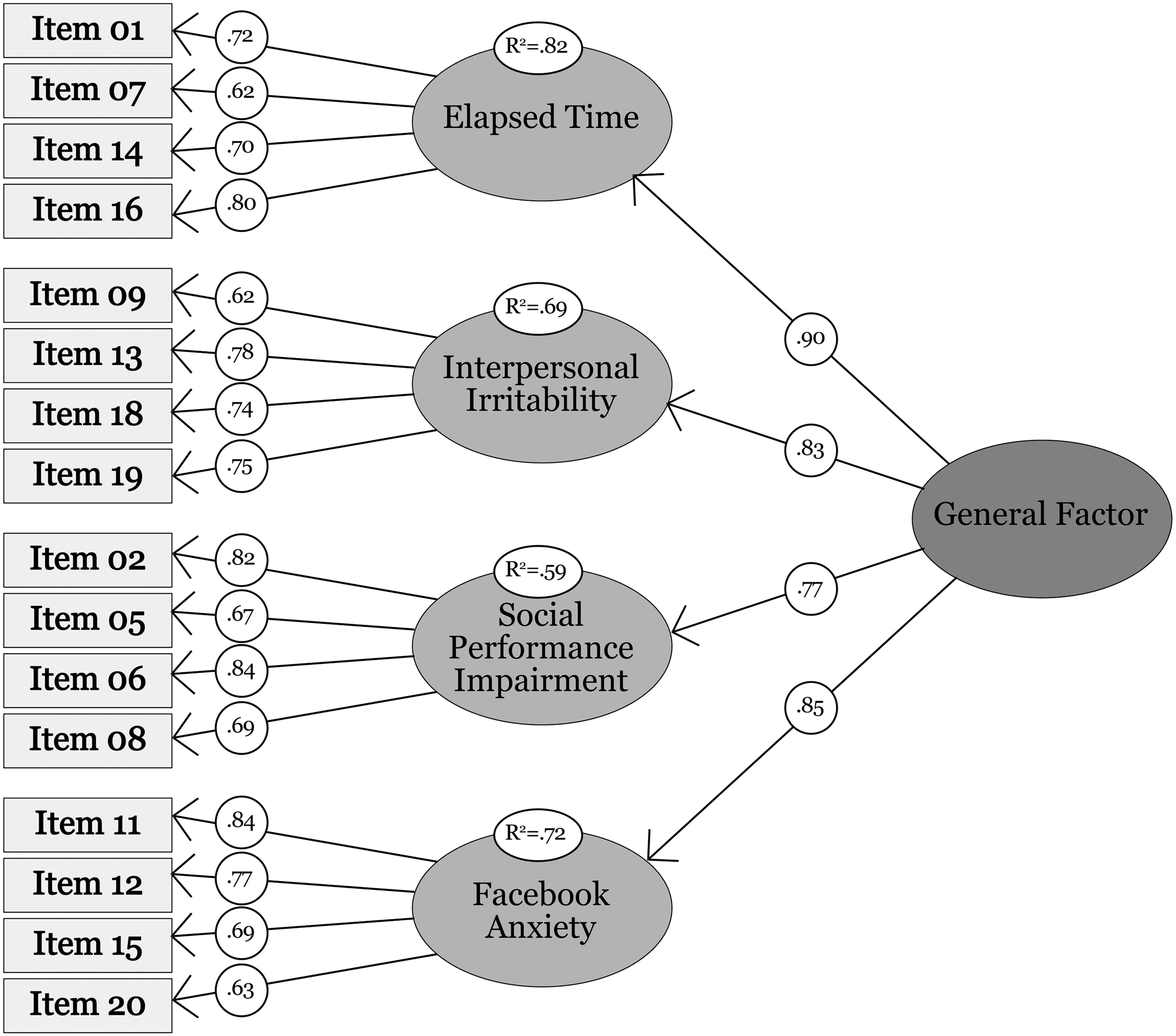
Confirmatory factor analysis by structural equation modeling of 20-item Facebook Addiction Italian Questionnaire version.
A series of plausible models, identified in the Study 1, were evaluated using CFA.
We tested Young's one-factor model 42 (Model 1), a four-factor model isomorphic to the EFA solution in Study 1 (Model 2), and a four-factor model plus a second-order general factor model suggested by the significant correlation between factors in the EFA solution from Study 1 (Model 3).
As reported in Table 4, Model 1 fit indices are not satisfactory. Model 2 and 3 show a better fitting, with a slightly improved performance for 3, as confirmed by AIC. All structural indices are significant (p < 0.001).
N = 300; model 1 is an uncorrelated four-factor model, model 2 is a correlated four-factor model, and model 3 is a model with four factors + a second-order factor. All parameters are significant for p < 0.001.
AIC, Akaike's information criterion; AGFI, adjusted goodness of fit index; CFI, comparative fit index; RMSEA, root of means square error of approximation.
To evaluate the construct validity of FAIQ, we analyzed the relationships between FAIQ factorial scores, FAIQ total score, and criterion variables such as sociodemographic variables, personality dimensions, and usage.
FA and demographic variables
A series of analyses of variance between FAIQ scores (i.e., factorial and total score) and sociodemographic variables have been performed. Results show gender differences between participants' factorial scores and total score on FAIQ (see Table 5). Females obtained higher scores than males both on FAIQ Social Performance Impairment (F = 4.570; p < 0.001) and Facebook anxiety (F = 3.741; p < 0.01) and FAIQ Total score (F = 4.022; p < 0.01). No significant differences exist between participants' factorial scores on FAIQ in education and geographical distribution.
FAIQ, Facebook Addiction Italian Questionnaire.
A correlation analysis between FAIQ scores and age distribution was performed, showing that younger subjects obtained significant higher scores on each FAIQ factorial score and on the total (see Table 6).
p < 0.05 (two-tailed); **p < 0.01(two-tailed).
FA and personality
To corroborate the construct validity, correlations between FAIQ four-factor scores and PI scores have been analyzed. To specifically evaluate the associations between FA and personality traits, correlation indexes between FAIQ four factors/total score and PI five personality traits were calculated.
High scores on PI neuroticism scale positively correlate with high scores on all FAIQ factors scores and total score (0.31 < r < 0.40); high scores on PI consciousness scale negatively correlate with high scores on elapsed time (r = −0.28; p < 0.05), social performance impairment (r = −0.38; p < 0.01), and Facebook anxiety (r = −0.23; p < 0.05); high scores on PI openness positively correlate with Facebook anxiety (r = 0.23; p < 0.05) and total scores (r = 0.32; p < 0.01). Nothing significant emerged for Extraversion and Agreeableness (see Table 6).
FA and Facebook usage
We computed correlations between FA and Facebook usage. Positive correlation between high FAIQ scores and nightly connections (0.24 < r < 0.32) emerged. Nothing emerged for Age of Facebook account and type of device (see Table 6).
Discussion and Conclusion
In our study, we have targeted two different aims: the determination of a sound measure of the dimensions of FA construct and the possible correlation with individual differences in usage.
The two studies reported here focus on the factor structure of FAIQ using both an explorative and confirmative approach. FAIQ, a new measurement instrument based on 20-item Young's IAT, explores individual usage of Facebook, habits, and thoughts, as well as related problems leading to addiction. In line with Young 5 and Griffiths et al., 6 our results show that FA can be characterized as a multidimensional construct defined by four peculiar dimensions related to users' behaviors: Interpersonal Irritability, Elapsed Time, Social Performance Impairment, and Facebook Anxiety (58 percent of total variance). Specifically, heavy Facebook users experience adverse consequences related to a tendency of organizing daily life in function of Facebook (i.e., Interpersonal Irritability). They also show altered time perception and dysfunctional time management (i.e., Elapsed Time). They find it difficult to integrate Facebook usage in their life contexts (i.e., Social Performance Impairment). Finally, they feel nervous and anxious when not connected (i.e., Facebook Anxiety). Compared to previous studies,38,40 our model is more parsimonious and accounts for a percentage of variance consistent with the explained variance in the humanities.61,62
Importantly, our psychometric scale was focused not on social network activities in a broad sense, but specifically on Facebook activities, since the pervasiveness of Facebook has recently acquired a specificity of its own. However, CFA results from Model 3 (see Study 2) corroborated the existence of a general higher order factor, which supervises the above-mentioned four factors and is consistent with the IA construct.5,13–14,22
By creating a link between FA and IA, our results have enhanced the granularity of IA construct as it was defined so far. FA affects in specific ways—ways that are different from general IA—personal and social relationships, time management, and emotions. Therefore, FAIQ captures more detailed and fine-grained information than a global measure of FA as an overall concept. Moreover, FA should be considered the expression of a more general tendency to a dysfunctional use of Internet.
In addition to measurement validation, this study has investigated how FAIQ dimensions relate to criterion variables such as sociodemographic variables, personality dimensions, and Facebook usage. Young female persons with high levels of neuroticism and openness, low levels of conscientiousness, and using Facebook nightly are characterized by high levels of FA. Specifically, female persons who make a dysfunctional use of Facebook report to be impaired in their interpersonal relationships, time management, and feel more anxious. Such results are in line with those of Thompson and Lougheed 29 who found that females reported more stress caused by Facebook, more anxiety if they cannot access it, and a higher loss of control on checking it. This can be due to well-established findings suggesting that female online behavior is more interpersonally oriented, while male behavior is more task and information oriented.63–67 Research has shown males using social networks (SNs) for forming new relationships, while females engaging in SN activities that facilitate maintenance of existing relationships. 68 As a consequence, Facebook-addicted females may be more worried for the negative consequences of using Facebook for their social activities than males and are also more anxious in controlling others' profiles to gain information and engage in social comparison. 69 In literature, personality traits of Facebook-addicted females have a role in modulating the individual differences on FA: young females with high neuroticism and low conscientiousness scores are usually addicted to Facebook where they spend a lot of time.4,25,27
Furthermore, our results show that high levels of openness are associated with high levels of FA, coherent with a previous study that demonstrated the predictive role of personality traits in a nonaddicted sample of users 52 : openness is a stronger predictor of age of account, so individuals with higher openness are usually early adopters of social technologies as a consequence of their personal attitude to be imaginative, curious, and open to a multiplicity of interests. 63 However, they may be also more prone to addiction as hereby shown.
Young female FA are depicted as people who use Facebook especially by night. We argue that Facebook itself works as a bridge between addictive activities and sleep disorders, since their sleep patterns are typically disrupted due to late-night usage.
Results from this research should be interpreted in the context of some intrinsic limitations. The data were collected from Italian people and thus the results may not be generalizable to Facebook users from other geographic groups and cultures.
Also, collecting data using a self-report questionnaire might affect participants' disclosure of some sensitive information. Thus, a social desirability scale may be added to a future version of the questionnaire to reduce this bias.
Our data were collected in a nonclinical population; further studies should involve people clinically impaired by FA to deepen the knowledge of this emerging phenomenon, and better focus on cutoff scores for each of the subscales of FAIQ, determining when a person can be considered an FA.
Despite these limitations, FAIQ could help measuring the level of FA and to improve content and structural validity of the FA construct. Based on available psychometric evidence, FAIQ can be viewed as a cost-effective questionnaire for measuring FA, with broad applicability for research and clinical practice.
Footnotes
Author Disclosure Statement
No competing financial interests exist.