




Abstract
Abstract
Each day, social networking sites become increasingly inundated with food imagery. Since many of these images are of fresh, vibrant, and healthy eats, photo sharing of food through social media should have a long-term positive effect on consumption habits. Yet, obesity rates in the United States continue to rise, suggesting that people are spending more time posting images of healthy foods and paying less attention to the actual foods they consume. This confounding relationship could be explained by consumer weight, in that overweight consumers desire to engage with social media maybe for the purpose of expressing, presenting, and identifying with a healthy lifestyle. In the context of food posts, individuals higher in body mass index may be more likely to engage in social media activity (e.g., likes, shares, comments) that validates healthy food choices to others in their online community. A between-subjects experimental design tested this proposed effect using a manipulated Instagram post of a healthy food item (i.e., black bean veggie burger). Results indicate that obese individuals are more likely to engage with healthy food posts compared with their normal weight and overweight counterparts. The effect is even more pronounced when posts are absent of prior social media activity. Based upon these results, obese individuals are encouraged to establish and maintain social network connections with others who routinely post images of healthy food in their social media feeds. Limitations and directions for future research are provided.
Introduction
S
However, there is a modest stream of recent research evidence to suggest that the use of healthy food environmental cues can exert a beneficial effect on healthy eating behavior. 8 For instance, young children like unfamiliar fruits and vegetables more after viewing their images in a picture book and photographic food diaries are shown to alter attitudes and behaviors associated with unhealthy food choices, serving as intervention points when decisions regarding what to eat are being made.9,10 Additionally, overexposure to food images can induce satiation, in turn, reducing feelings of hunger.11,12 More striking is the growing evidence that healthy food cues have a significant positive impact on eating behavior for restrained (e.g., dieters) and overweight consumers. Specifically, research has shown that healthy food items (e.g., oranges), healthy TV advertisements, and diet advertisements and recipes facilitate positive food-related behaviors among individuals who are in need of, or have a desire for, losing weight.13–18 This raises the question as to whether healthy food imagery in social media can serve as primes to exert similar positive change behavior. Thus, there is an essential need for research examining consumer reactions to healthy food posts in social media.
Consumer weight and social media activity
To help people navigate the networked world, social media provides important identity signals that serve to validate identity information.19,20 For instance, profile information (e.g., name, occupation, residential location), digital content (e.g., photos videos, music), and published communications (e.g., posts, messages, links) can validate and identify users in social media. Furthermore, users can publicly sanction and/or associate with products, brands, or images through likes, tweets, shares, and comments. These social media interactions may also function to gain approval, acclamation, and attention among network members. 21 Yet, social media signals create a virtual representation of self that has changed the traditional conditions of identity production such that individuals can interact in social situations online detached from the physical self. 22
Known as an idealized virtual reality identity, individuals may selectively post favorable information (e.g., dinner at a nice restaurant, vacation photos, luxury purchases) in an implicit attempt to enhance their image in the eyes of others in their social network. 23 For instance, social network users can selectively disclose information that may emphasize or even exaggerate one's characteristics, such as character, intelligence, and attractiveness. At the same time, they may seek to minimize aspects of self they regard as socially undesirable, such as shyness, weight, or stuttering. 24 Thus, users can keep their identity much more implicit and create signals that present their identity in a positive way. 22 This may be of particular importance to overweight consumers since it allows them to filter out negative information to present a positive view of self.25,26 For instance, an overweight individual may engage in social media activity that validates healthy food choices or proves their dedication to a weight loss program to others in an online community. In addition, the presentation of a false self is generally manifested in individuals with low self-esteem and/or a lack of self-awareness. 27 Since these psychological symptoms are prone to develop in individuals with recognized weight issues, it is expected that obese individuals are more likely to misrepresent their true identity in online environments, thereby projecting a much more positive image of self. Thus, the purpose of the current study is to assess if higher BMI leads to more positive social media activity (e.g., likes, shares, comments) toward healthy food posts.
Methods
A between-subjects experimental design manipulated social media activity (high vs. low) using the number of likes and comments associated with a post. The post for the high activity condition was given 105 likes and multiple positive comments. The post for the low activity condition was given 0 likes and no comments. These values were selected based on the results of a recent study that indicates the average number of likes for an Instagram photo is 26.19. 28 BMI was measured by gathering respondent's height and weight. Participants were grouped into the following commonly accepted BMI categories: underweight (<18.5), normal weight (18.5–24.9), overweight (25–29.9), or obese (30 or more). 29
Sample
Data were collected from subjects recruited through an online consumer panel. A total of 384 subjects were provided monetary compensation in exchange for their participation in the study. Height and weight estimates of 20 subjects resulted in a calculated BMI of <18.5 (i.e., underweight). A subsequent Levene's test for equality of variance indicated unequal variances for this group across many of the dependent measures. After removing these respondents from the analysis, all remaining BMI groups showed homogeneity of variance across analyzed dependent variables. This yielded a final sample of 364 respondents split evenly between men and women. Cell sizes for the remaining BMI groups were as follows: normal weight (200 or 54.9 percent), overweight (102 or 28 percent), and obese (62 or 17 percent). Ranging between 18 and 62, the average age of the sample was 32.1 years (s = 9.46). Approximately 79 percent of the sample self-classified as Caucasian.
Stimuli
The social media posts used in this study were created using a working Instagram account. For the high activity condition, comments were generated using fictitious Instagram users and the number of likes was manipulated using editing software. Using pretest results from the most commonly posted food items on Instagram, a photo of a black bean veggie burger was selected to best represent a healthy food choice. The picture of the black bean veggie burger used in this study was carefully selected to pass as a picture that could have been taken by a regular Instagram user or a company posting to their corporate Instagram account. Screenshots of post were taken and used as manipulation stimuli, as presented in Figures 1 and 2.
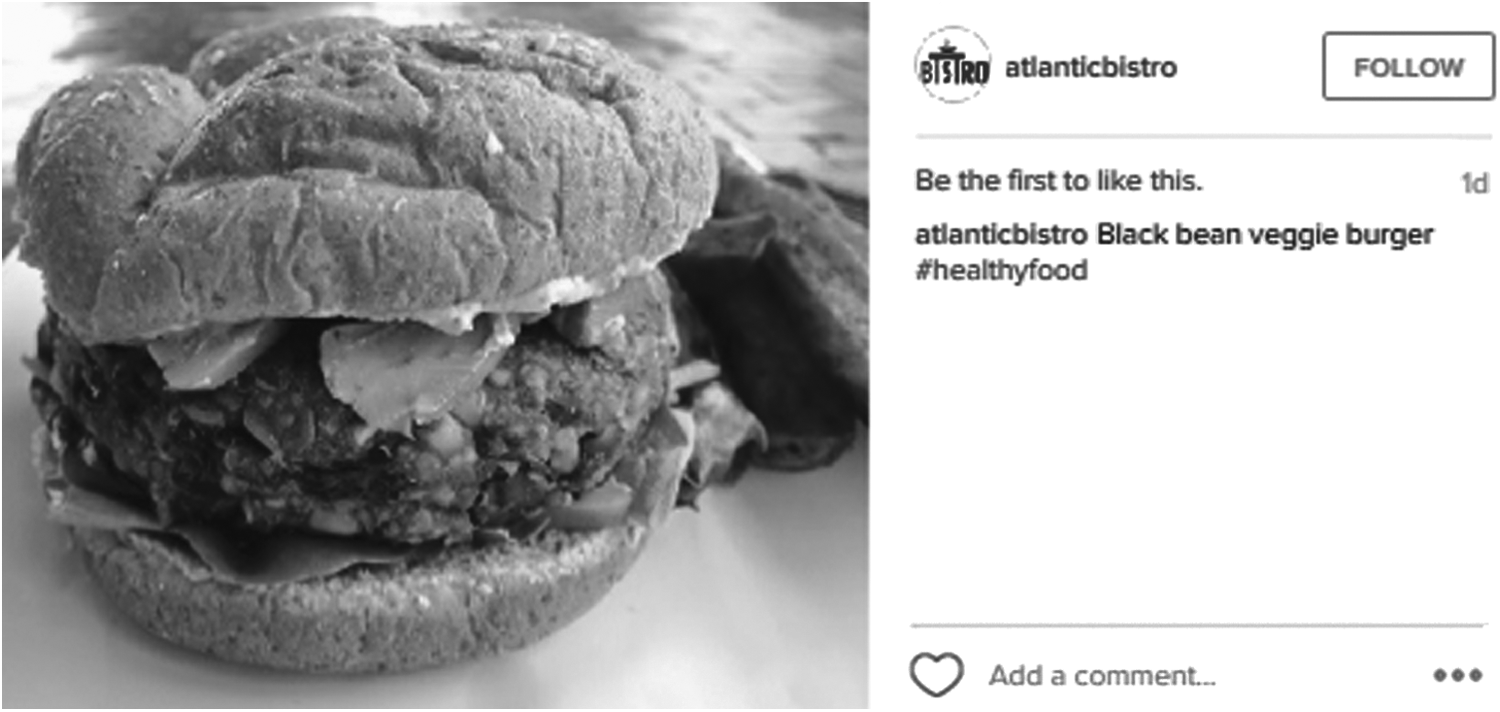
Instagram stimuli for the low post activity condition.

Instagram stimuli for the high post activity condition.
Procedure
Experimental conditions were assigned randomly so that high (n = 184) and low (n = 180) post activity stimuli appeared to a similar number of individuals. For both conditions, participants were first instructed to imagine that they were browsing their Instagram account and came across a picture of a black bean veggie burger posted by a fictitious restaurant (Atlantic Bistro). They were then instructed to view the post and read comments (if any) related to the image. After viewing the post, participants were asked to rate social media behavioral intentions in response to the post and the degree to which they found the post believable. Next, participants were asked questions specific to health consciousness and social media usage. Finally, participants reported basic demographic information and height/weight estimates.
Control variables
Health consciousness (α = 0.856) describes an attitude in which one has awareness of the healthiness of their own diet and lifestyle. 30 The degree of importance one places on a healthy lifestyle can significantly influence food-related decisions, particularly social media activity related to food posts. While health consciousness is expected to be highly correlated with respondent BMI, an individual's subjective perception of health could significantly differ from the objective reality of their physical well-being. This could lead to response bias from those with distorted views of one's health. As expected, there was a significant negative relationship between health consciousness and BMI (r = −0.103, p < 0.05). However, subsequent analyses revealed health consciousness to be an insignificant moderator for BMI and post activity across all dependent variables.
The degree to which social media incorporates into one's life can also influence the impact of online posts. In particular is the desire to use social media sites for information specific to the purchase and consumption of food. It is expected that if a respondent typically uses social media to make food-related decisions, it would significantly influence their responses to the post in this study. Thus, social media usage specific to food decisions (α = 0.880) was treated as a covariate in the study. Initial linear regression analysis revealed a significant relationship between social media usage and all analyzed dependent variables. Moreover, analyses revealed that social media usage significantly moderated the effects of BMI for liking the post (t = 2.28, p < 0.05) and the effects of post activity for following the source of the post (t = 2.30, p < 0.05). Specifically, normal weight individuals who engage regularly with social media are more prone to liking a healthy food post and following the source of the post compared with those who use social media less often. Yet, irrespective of general social media usage, overweight and obese individuals are equally susceptible to liking a healthy food post and following the source of the post. This appears to provide initial evidence that the nature of the post (i.e., healthy food) serves as an indicator signal to higher BMI individuals to engage in post activity, particularly for less frequent social media users.
Dependent variables
Dependent variables in this study assessed social media activity intentions related to the post/poster. The five items include “I would ‘like’ this post on my social media account,” “I would share this post on my social media account,” “I would comment on this post on my social media account,” “I would follow this restaurant on my social media account,” and “I would view other posts from this restaurant on my social media account.”
Results
Initial analysis of demographic effects revealed a significant relationship for gender. Specifically, females were more likely than males to engage in social media activities. Thus, gender was retained as an additional covariate for the main effect tests. Analyses also revealed that gender significantly moderated the effects of BMI for viewing other posts from the source (t = 2.79, p < 0.01) and the effects of post activity for viewing other posts from the source (t = 2.20, p < 0.05). The results suggest that women are more likely than men to view other posts from the source if the healthy food post has received a lot of initial attention. Moreover, overweight and obese women are more likely to view other posts from the source compared with their male counterparts. The remaining demographic variables (i.e., age, income, ethnicity, and education) were not significantly related to any of the analyzed dependent variables.
Main effects were analyzed using a two-way MANCOVA test with respondent BMI and the degree of post activity as grouping variables. MANCOVA revealed significant main effect differences for BMI on two dependent measures: comment on the post [F(2, 355) = 4.72, p < 0.01] and follow the restaurant on social media [F(2, 355) = 9.87, p < 0.001]. Post hoc multiple comparisons indicate that obese respondents were significantly more likely than normal weight respondents to comment on the post (p < 0.05) and more likely than both normal weight and overweight respondents to follow the restaurant on social media (p < 0.05). There was no significant difference in responses between normal weight and overweight individuals on any of the dependent measures.
Main effect analysis of post activity revealed no significant difference between responses to high and low activity posts. However, results indicate a significant interaction effect between BMI and post activity for all of the dependent variables. In each case, the pattern of the interactive relationship is consistent. Obese respondents are more eager to like the post [F(2, 355) = 10.65, p < 0.001], share the post [F(2, 355) = 5.83, p < 0.01], comment on the post [F(2, 355) = 7.09, p < 0.01], follow the restaurant on social media [F(2, 355) = 8.46, p < 0.001], and view other social media posts by the restaurant [F(2, 355) = 7.27, p < 0.01] when post activity is low compared with high. There was no significant difference in social media activity between normal weight and overweight respondents given prior post activity. Condition means for each dependent variable are provided in Table 1. In addition, reported interaction effects are illustrated in Figure 3.
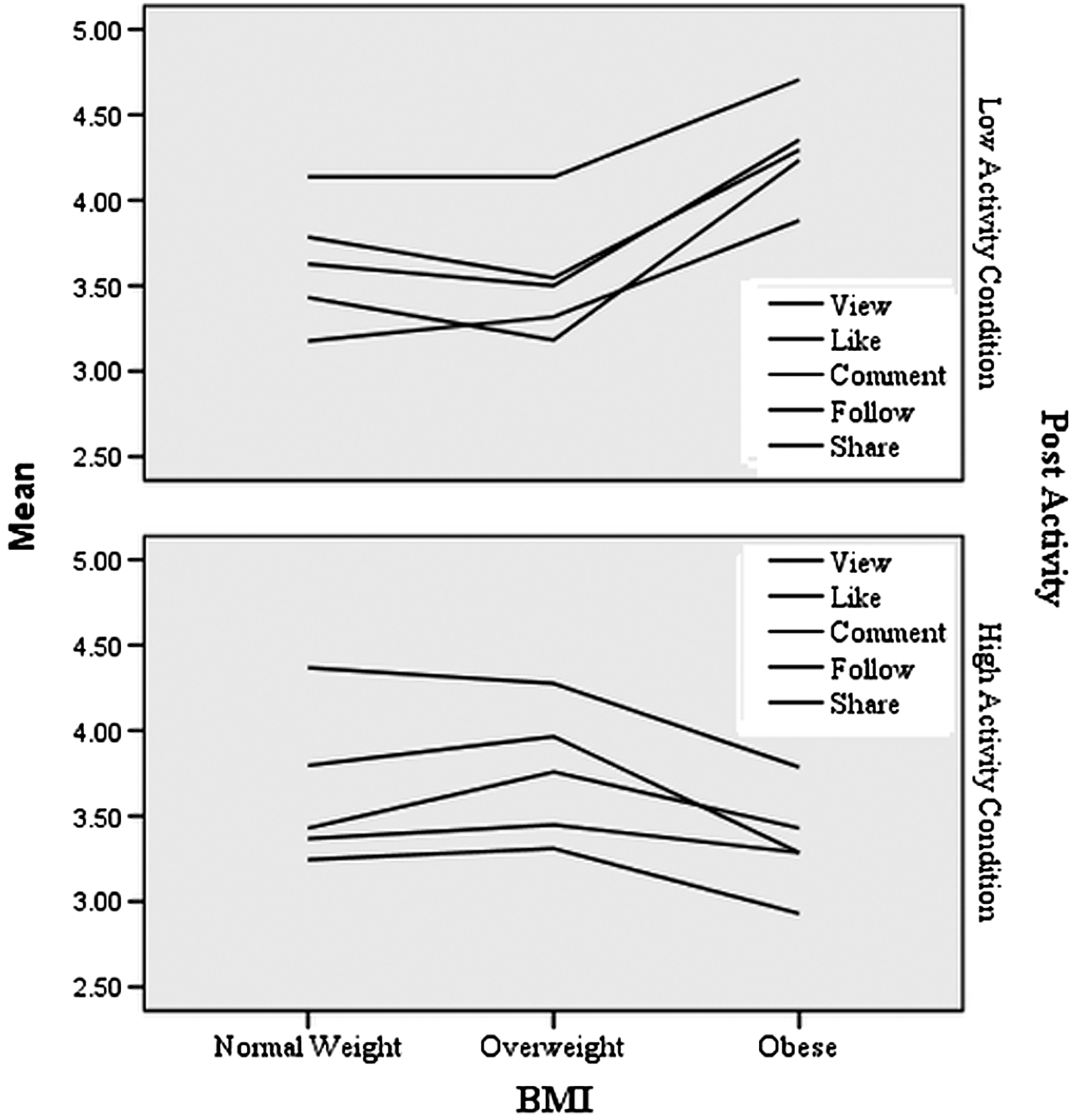
Illustration of interaction effects.
BMI, body mass index.
Discussion
With three of four Americans expected to be overweight by 2020, insight aimed at reducing the prevalence of adult and adolescent obesity is welcomed by educators, policy makers, and consumers alike. 31 Results from the present study suggest that BMI plays a significant role in an individual's response to a healthy food post. In particular, the findings indicate that individuals classified as obese (i.e., BMI >29.9) are significantly more likely to react positively to a healthy food post compared with their normal weight and overweight counterparts. This appears to support the psychological theory that an individual with a recognized weight issue may desire to project an image associated with a healthier lifestyle. In addition, obese individuals who are highly conscientious of their body may be resistant to dietary and weight loss programs that require personal interaction, Instead, they may feel more comfortable receiving support and motivation in the virtual environment provided by social media. Therefore, it seems appropriate to encourage obese individuals to establish and maintain social network connections with others who routinely post images of healthy food in their social media feeds. This helps to provide constant exposure to images that reinforce a lifestyle change. Furthermore, constant engagement with social media can increase feelings of connectedness that abate feelings of loneliness and depression that typically accompany obesity.
Moreover, responses from obese individuals are more pronounced when posts contained no prior likes or comments. Often, sharing helps to cultivate an idealized persona that necessitates a strong desire for validation. So, for a post with hundreds or even thousands of likes and/or comments, the act of liking or commenting on that post may go unnoticed by others. For example, on Instagram, the likes appear as a total number rather than a list of names after 11 people like the picture. In addition, comments appear chronologically from oldest to newest. Thus, an additional comment on a photo that already has a lot of comments will be placed at the bottom of the list and, more importantly, off the screen. Therefore, it is not surprising that obese respondents in this study were more eager to be the first to like, share, and comment on an image. This increases the probability that their activity will be noticed and, in turn, help to validate their lifestyle change. This suggests frequently posting new images of healthy food or restricting users from liking or commenting on a post would constitute a best practice.
Limitations and future research
Although BMI is the most commonly used metric by health practitioners to assess whether a person has too much body fat, it is not without limitation. While shown to be an effective measure among groups, it may be much less accurate in assessing body fat on an individual basis, especially for people who are very muscular. In fact, recent research highlights the unintended consequences of relying solely on BMI rather than new and improved diagnostic tools that more accurately measure metabolic health. 32 In the future, researchers examining the effects of consumer weight on health are advised to use alternative forms of measurement, such as the body adiposity index, the body shape index, bioelectrical impedance analysis, and water and air displacement weighing. 33
A number of characteristics inherent to the stimuli used in this study were constrained. For instance, this study used a close-up image of a black bean veggie burger. However, images of food are rarely viewed in isolation. That is, they are typically presented against a certain backdrop of other food items, food packaging, or plateware. Recent research suggests that the amount of attention given to food images depends on item saliency.34,35 Thus, future research should assess the impact of foreground/background images on social media behavior. Moreover, the image used in this study was of a single food type. Varying the degree of perceived healthiness by using other photo-friendly food categories, such as ice cream, pizza, cocktails, pasta, and salads, could influence the results. In addition, comments used in the post stimuli were generally balanced in terms of focus and structure, but are healthy comments more influential than those that mention taste? Do comments with hashtags or contain an emoji attract more attention? Are comments with corresponding replies given more weight? Changes to any of these factors could influence the strength and/or direction of the results reported in this study.
While the results provide support for intentions to engage in social media activity related to healthy food posts, they do not generalize to the actual consumption of healthy food. While beyond the scope of the present study, future research should measure actual food consumption across BMI categories in hopes that our findings from social media translate to healthier food consumption decisions. Given these promising initial findings, continued research is needed to determine if social media can be utilized as an effective tool for promoting healthy eating habits and lifestyle choices.
Footnotes
Author Disclosure Statement
No competing financial interests exist.