




Abstract
Abstract
HIV/AIDS is an important public health issue in China. The number of people living with HIV/AIDS (PLWHA) has been increasing since the introduction of highly active antiretroviral therapy. PLWHA's life quality is becoming an important issue, with lack of research in China. In this study, a group of PLWHA (n = 663) was identified using HIV/AIDS relevant usernames on a Chinese social networking site (Weibo) to study their daily living situations. We found that more than 99.10% of PLWHA were male, among whom 90.80% turned out to be homosexual. They had significantly more fans and followees, but fewer postings compared to the general population. The mean age of the PLWHA was 28.96 (SD = 5.05) years old, and southwest and northwest China had a high prevalence of HIV/AIDS. In addition, PLWHA's postings were coded and we found that more than half of the postings (n = 769, 51.03%) contained strong emotions. Less than one-fifth of the postings were directly related to HIV/AIDS topics (n = 269, 17.85%), while seeking emotional support, such as looking for stable partnership, was ranked as the first priority of support seeking. In summary, we found that the majority of the self-labeled PLWHA were likely to be men who have sex with men. They used Weibo to share their daily life events and seek emotional support. Implications for promoting HIV/AIDS education and prevention through Chinese social networking sites were also discussed.
Introduction
H
However, knowledge on PLWHAs' living status and daily requests that is important for guiding such service transition has been less explored in China. This may be because PLWHA generally prefer not to be involved in surveillance studies due to the discrimination and stigma toward HIV/AIDS, 8 which are prevalent in China.9,10 Social networking sites such as Facebook have become a well-known global platform for self-expression among several hundreds of users all over the world.11,12 It has been recognized as a platform for health communication and promotion in a less expensive and more efficient way, 13 especially for “hard to reach” subpopulations such as PLWHA 14 as it provides an anonymous environment to generate, share, and receive information with less exposure to stigma. 15
Weibo, a popular microblogging network in China, containing millions of users, has become a platform for people to gather information and to make friends with like-minded individuals. Self-expression turns out to be the main usage of Weibo among Chinese users, 16 which enables lots of studies on public health-related topics such as air pollution, 17 infectious diseases, 18 and suicide attempts. 19 However, there are limited studies on Chinese PLWHA. To our knowledge, there is only one study investigating the types of social support among Chinese PLWHA within a specific HIV/AIDS Weibo group. 20 Little attention was given to the daily message production of general PLWHA. Such studies are important, as they will contribute to the knowledge of PLWHA's well-being and, thus, provide guidance for the service transition in China to better satisfy PLWHA's new emerging needs.
In this study, we identified a group of PLWHA on Weibo, who have self-labeled their HIV identity using specific letters such as “A-” or “ ”- (“A-” standing for AIDS, and “H-” standing for HIV). Using the social media data from this group, we explored PLWHA's daily life status and requests after they were diagnosed with HIV/AIDS. This study could enrich our knowledge on Chinese PLWHA's living status and inform the use of social networking sites to reach and engage people who are affected by HIV/AIDS.
Methods
The data used in this study are publicly available. To protect the privacy of individuals involved in this study, information that could be used to track them down was removed before the data analysis.
Data collection
Data used in this article were collected from Sina Weibo between January 31 and May 22, 2015 through its API. A small group of self-labeled PLWHA was identified by specific letters in IDs such as “A-,” “”-, or “H-.” Then, this group was used as a seed to generate a candidate set by including the users whose postings are reposted by the user in this group. The users in the candidate set were further selected by checking if: (1) any posting contained information that could be validated as HIV/AIDS diagnosis or treatment and (2) username contained HIV/AIDS-specific letters. Three researchers undertook the labeling independently. The majority rule was applied to determine the labeling results. There were 665 self-labeled PLWHA selected at this stage. Two celebrities were identified as outliers due to the prodigious fans they have and, thus, were excluded. As a result, 663 users were included in the current analysis. They were further independently coded by two researchers to check if the person was homosexual based on the users' self-identification as homosexual or mentioned that he wanted a boyfriend or was in a relationship with a man. Coding results were discussed between the researchers until an agreement was reached. A third researcher was introduced to code a sample of 100 users that were randomly selected from the 663 users. Intercoder reliability for MSM is: percent agreement 87%, kappa 0.446. Finally, 933,119 users were randomly selected from Weibo to enable the comparison on the demographic information, including username, gender, age, geographical location, the number of fans, the number of followees, the number of postings, and the type of users, which was gained by a crawler developed by the researchers.
21
Age information was only filled in by 350 of the PLWHA, covering 52.8% of the total sample. Age below 10 and above 80 was labeled as invalid input and, thus, excluded. This resulted in 273 users being analyzed on the age distribution.
Coding categories
For each self-labeled PLWHA, the 1,000 latest postings were crawled. All the postings were obtained if the total number of the postings was fewer than 1,000. We randomly sampled 1,678 (Confidence level 95%, Margin of error 2.39%) postings, 171 of which were excluded due to being identified as advertisements. Two researchers with extensive public health research experience read the postings to determine the categories. Categories were defined as topics that occur or reoccur. 22 Postings were coded for the presence of the following categories: (1) sharing information about HIV/AIDS illness and treatment; (2) sharing information about daily life; (3) expressing emotions toward HIV/AIDS topics; (4) expressing emotions toward life and death; (5) expressing emotions toward relationships; (6) expressing emotions toward daily life; (7) seeking information about HIV/AIDS topics; (8) seeking emotional support; and (9) seeking other types of support on Weibo.
Two trained researchers coded 1,507 randomly sampled postings based on the above codebook. They coded the postings independently and discussed the posting where there was disagreement until a census was reached. A third member with extensive mental health experience was introduced to code a sample of 200 postings randomly selected from the 1,507 postings. Interrater reliability for each theme was as follows: (1) sharing information about HIV/AIDS illness and treatment: percent agreement 97.5%, kappa 0.787; (2) sharing information about daily life: percent agreement 82%, kappa 0.535; (3) expressing emotions toward HIV/AIDS topics: percent agreement 95%, kappa 0.661; (4) expressing emotions toward life and death: percent agreement 96%, kappa 0.743; (5) expressing emotions toward relationships: percent agreement 90%, kappa 0.534; (6) expressing emotions toward daily life: percent agreement 82.5%, kappa 0.468; (7) seeking information about HIV/AIDS topics: percent agreement 98%, kappa 0.79; (8) seeking emotional support: percent agreement 98.5%, kappa 0.72; and (9) seeking other types of support on Weibo: percent agreement 96%, kappa0.315. Some postings may cover more than one topic. For postings of this kind, we determined the theme of a posting by the major proportion. According to the magnitude guidelines proposed by Landis and Koch, 23 all the kappa values in the study were acceptable.
Data analysis
The difference in the median of the number of fans, followees, and postings was measured by Wilcoxon Rank Sum and Signed Rank Tests. 24 The geographic distribution of PLWHA was presented by calculating the ratio of PLWHA to the number of the general population in each province. The diurnal pattern of the postings was presented by ggplot2 (version 2.0.0). All the analyses were operated by R (version 3.2.3).
Results
Characteristics of PLWHA
There was a total 663 self-labeled PLWHA identified on Weibo. Six hundred fifty-seven (99.10%) of the PLWHA were male, which is significantly higher (p < 0.001) compared with the general population (43.37%) on Weibo. The mean age of the PLWHA was 28.96 (SD = 5.05) years old, with individuals aged from 25 to 28 covering more than 50% of the total sample. In addition, 602 of the PLWHA were further identified as homosexual, accounting for 90.80% of the total sample.
The PLWHA group had significantly more fans (p < 0.001) and followees (p < 0.001) compared to the general population (Fig. 1a, b), but fewer postings (p < 0.001, Fig. 1c). This suggests that PLWHA may have a relatively larger social network size but with less activity. Geographical distribution of PLWHA is shown in Figure 2. The data suggest clear difference in HIV/AIDS epidemics across China. Southwest and northwest China were the two regions with a great prevalence of HIV/AIDS in the provinces of Chongqing (0.17%), Sichuan (0.16%), Shaanxi (0.14%), Yunnan (0.12%), and Qinghai (0.11%). In addition, Beijing (0.17%) and Liaoning (0.12%) in north China also had high HIV/AIDS prevalence (Appendix 1). This geographical distribution pattern is similar to the previous study among MSM who lived with HIV/AIDS in China. 25
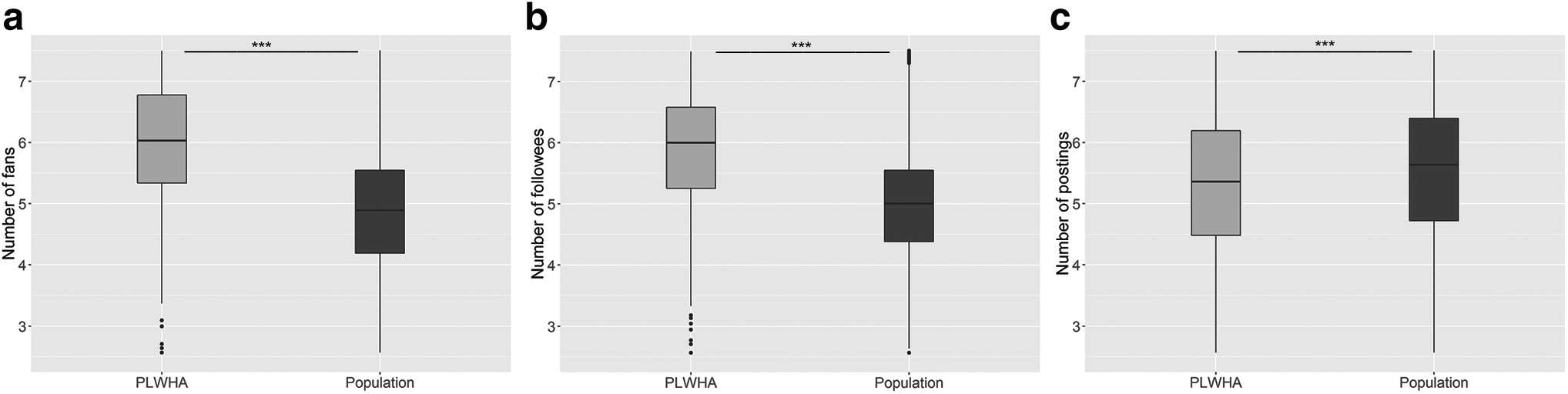
Distributions of fans, followees
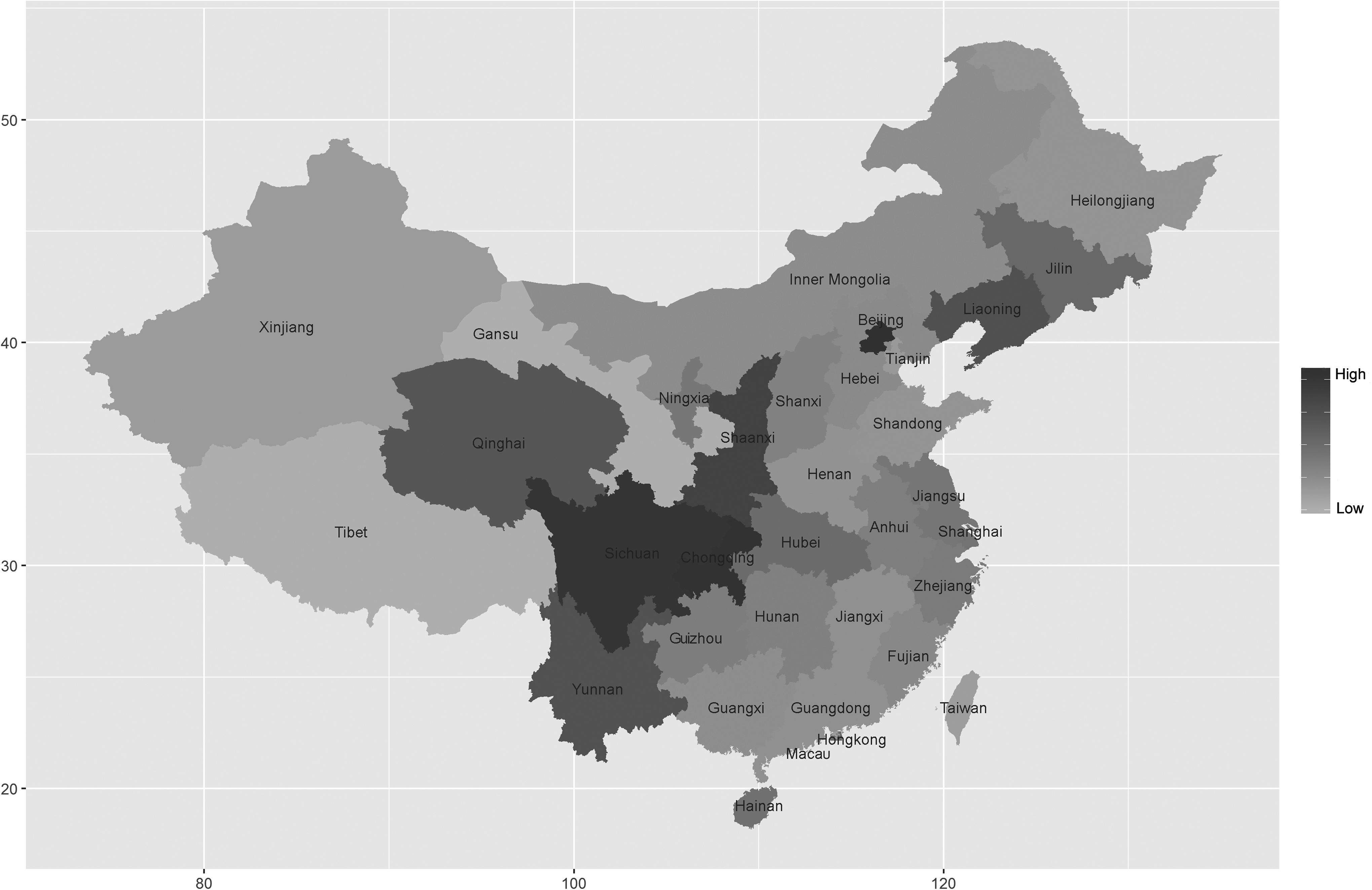
Geographical distribution of PLWHA in China.
Daily living status of PLWHA
To investigate the daily living status of PLWHA, the diurnal pattern of postings was analyzed in a comparison with the general population (Fig. 3). The general pattern between the two groups is similar. This is different from the previous report on the depressed individuals, 26 who have significantly higher activity late in the night. This result suggests that the majority of the PLWHA may live a relatively healthy life style.
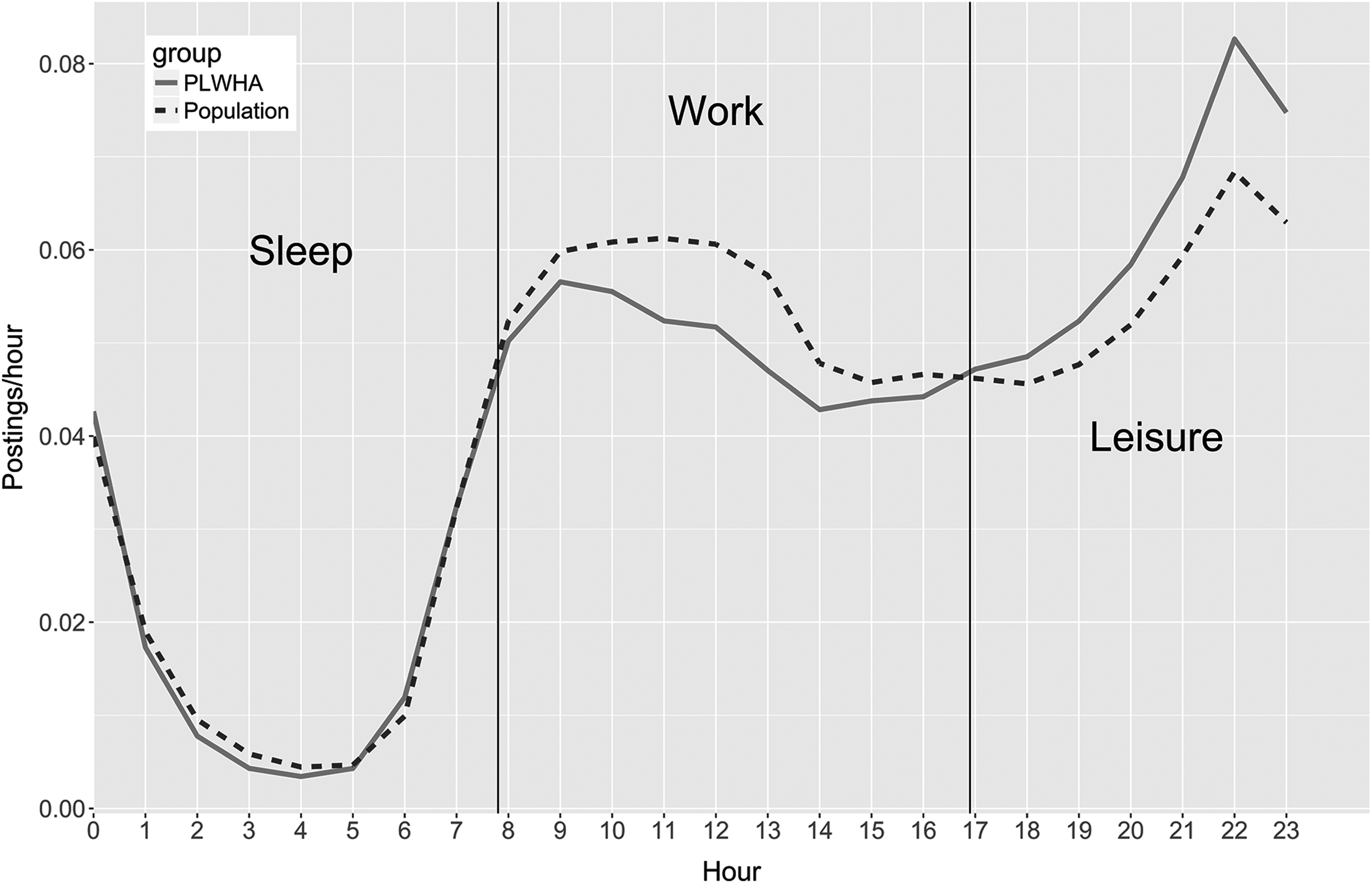
Diurnal activity of PLWHA and the general population.
In addition, the content of the PLWHA's postings was analyzed according to the coding framework listed in Appendix 2 to identify their needs and daily living status (Table 1). Results showed that less than one-fifth of the postings are directly related to HIV/AIDS topics (n = 269, 17.85%), among which 52 (19.33%) are on seeking support, 104 (38.66%) on sharing HIV/AIDS relevant information such as new HIV/AIDS medicine and the records of CD4 test results, and another 113 (42.01%) on expressing their personal feelings on this topic. Seeking support accounted for 8.96% of the total postings (n = 135), while seeking emotional support such as looking for partnership was the first major request (n = 57, 42.22%), followed closely by seeking information support related to HIV/AIDS (n = 52, 38.52%). More than half of the postings (n = 769, 51.03%) contain strong emotions. Topics vary from daily life events such as work, weather, and food (n = 348, 45.25%), feelings toward family members and partnerships (n = 202, 26.27%), and HIV/AIDS-related topics (n = 113, 14.69%), to philosophy of life (n = 106, 13.78%).
PLWHA, people living with HIV/AIDS.
Discussion
In this study, we identified a group of PLWHA on the Chinese social networking site, Weibo, who had self-labeled their HIV serostatus. To our knowledge, this is the first study to report the daily living status of PLWHA under a nonexperimental condition using social media data. As a result, we identified that the majority of the self-labeled PLWHA were male in their late twenties with homosexual behaviors. They did not show a distorted diurnal pattern of postings, but had a clear tendency to seek emotional support, which may be part of their motivation for self-labeling.
In China, both HIV/AIDS and homosexuality are discriminated and stigmatized, which may prevent them from discussing their personal needs and feelings in real life. 27 Social media such as social networking sites offer an anonymous environment for MSM PLWHA to exchange and share information. This may explain why PLWHA tended to express their feelings and seek help on social media. 28 In the current study, we found that only a small proportion of the postings made by PLWHA were about seeking instrumental support or medical suggestions. The major postings were focused on expressing emotions and requests on seeking stable partnership. These findings highlight the unmet emotional request of PLWHA, which was further indicated by a larger but less active social network. The underlying mechanism has not been examined. One possibility is that they use social media popularity to compensate for inadequate offline communications.29,30 Considering the fact that the number of sexual partners who met from online social networking sites was associated with increased sexual risk behaviors, 31 special attention should be given to the safe-sex education targeting MSM who live with HIV/AIDS on social media.
Currently, China has encountered a dramatic increase in the HIV prevalence of MSM and young people.32,33 The HIV prevalence of the age group from 15 to 24 has been doubled from 0.9% (2008) to 1.7% (2012) with seventy of these infections from MSM population. 34 More alarming is that the epidemic is not contained within the homosexual community, as 31% of MSM had heterosexual behaviors in the last 6 months. 35 Targeted prevention programs are warranted to curb this tendency to spread. However, MSM living with HIV/AIDS are reported as hard to reach. 36 The current study suggests the possibility of Weibo as a platform to deliver the tailed programs to this marginalized key affected population in a geographically borderless and economically effective way.
Nevertheless, it is important to notice the limitations of the current study. First, our findings may have limited generalizability, as the online sample may be different to the community sample. A previous comparison study between an Internet and community sample of Chinese MSM found that the Internet sample was significantly younger, more educated, and more likely to accept their homosexual identity. 37 Further studies among HIV community who have publicly exposed their HIV identity are warranted to validate our findings. Second, the users from Weibo may be different from those of other online platforms, and the HIV serostatus and homosexual identity of the users recruited in this study were identified by their postings and self-claims, which may limit the validation of this study.
Despite these shortcomings, this study represents the first social media study on the living status and requests from a key HIV/AIDS affected group in China, with a good consistency with the previous findings using traditional research methods. This suggests the feasibility of using social media as a tool to study the PLWHA's real-time behaviors under nonexperimental conditions. In addition, our findings also highlighted the potentially important role of social media in delivering tailed programs to the targeted MSM population.
Footnotes
Acknowledgments
The authors acknowledge the support from the Harbin Institute of Technology's Visiting Scholar Program and the National Natural Science Foundation of China (grant no. 71171068 & 71531013).
Author Disclosure Statement
No competing financial interests exist.