




Abstract
Abstract
This study explores whether screen shape influences smartwatch adoption by proposing an extended technology acceptance model that integrates an empirical comparison between round and square screens with utilitarian and hedonic motivations for higher usage intention. To verify the statistical validity of the proposed model, a structural equation modeling analysis is conducted on data collected from a between-subjects experiment (N = 200) in which participants trialed a smartwatch with either a round or square screen to retrieve health information cumulated from the physical activity during the experiment. Results indicate that a round screen, compared with a square screen, is more effective in promoting smartwatch adoption by enhancing the device's hedonic qualities. However, a round screen is found to reduce the controllability of the device, although such a utilitarian quality still positively influences the adoption process. Implications of the study findings and directions for future research are discussed.
Introduction
W
Therefore, this study develops and validates a theoretical model (Fig. 1) that outlines the process by which round screens contribute to determining user acceptance of smartwatches by examining utilitarian and hedonic motivators that are closely associated with screen shape and integrating them with the antecedents of the technology acceptance model (TAM). Utilitarian motivation assumes that individuals’ technology use is driven by the efficiency, convenience, functionality, and performance of the technology; whereas hedonic motivation focuses on emotional and non-functional benefits derived from using the technology, such as the feelings of pleasure, happiness, enjoyment, and sensuality.2,3 Given that smartwatches are multipurpose, convergent devices that are expected to satisfy both utilitarian and hedonic needs of the users, 4 this two-dimensional approach to examining the motivations for smartwatch use can provide a more comprehensive picture of their adoption process.
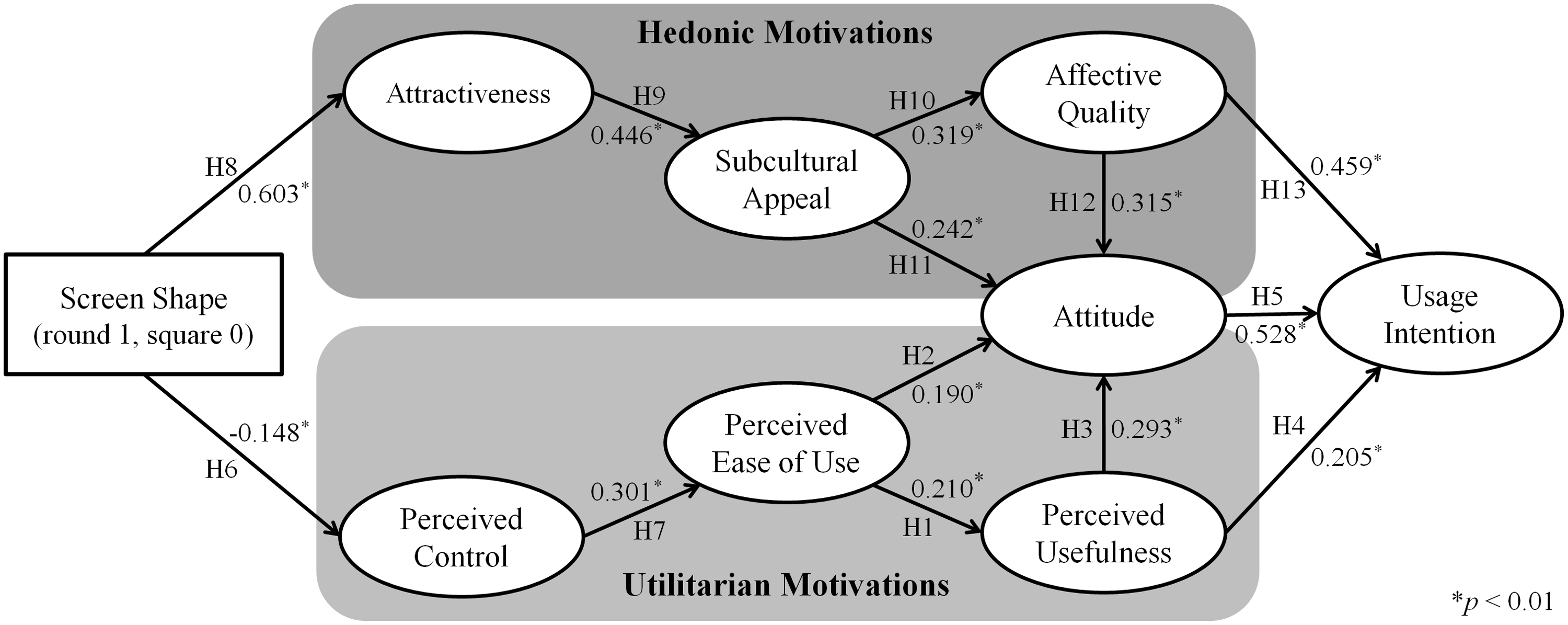
Proposed research model with standardized path coefficients.
Theoretical Background
TAM as a basic utilitarian framework
TAM is one of the most extensively used theoretical frameworks for explaining why/how individuals adopt certain technologies. The original TAM postulates that perceived ease of use (PEOU) and perceived usefulness (PU) are the two primary utilitarian determinants of user attitude (AT) and intention to use (IU) ICTs.5,6 When the operation of a particular technology is perceived to be easy and convenient, users tend to believe that the technology is useful for improving the efficiency of their jobs and completing given tasks, which elicits a favorable attitude toward it. Greater usefulness and a more positive attitude induced by perceived ease of use are then believed to increase user intention to adopt the technology for continual use. Exogenous variables (e.g., round screens as in this study) that are germane to the nature and use of the technology being studied are typically added to the original TAM to increase the model's technology-specific applicability and predictability. 7
Numerous studies have adopted this utilitarian framework of TAM and validated the model's explanatory power to predict the end-user acceptance of various ICTs, including smartphones,
8
smartwatches,
4
e-book readers,
9
and mobile-based chatting, clouding, and learning systems.10–12
Therefore, this study adopts TAM as a logical choice as the theoretical framework for investigating how screen shape affects the utilitarian domains of user perceptions, and predicts that the documented correlations among PEOU, PU, AT, and IU are also likely to play critical roles in determining smartwatch adoption. Accordingly, the following hypotheses based on the original TAM are proposed:
Effects of screen shape: from the utilitarian perspective
General consensus on shape psychology suggests that circles tend to elicit psychological responses related to affection, warmth, comfort, wholeness, and sensuality; whereas rectangles convey connotations associated with order, logic, solidity, singularity, and regularity.13,14 Such a hedonic and nonfunctional nature of circles suggests that round screens may not be as effective as square ones in promoting the utilitarian qualities of smartwatches. Specifically, round screens are not an ideal solution for providing users with a sufficient degree of perceived control (PC) over their device. PC is particularly important in interactive media because it enables users to set the pace of the interaction with the device and control information acquisition.15,16 A device with sufficient controllability tends to be perceived as more convenient and easier to operate,17,18 thereby providing a sense of self-efficacy in technology use
19
and reducing time and mental effort required to complete user tasks and reach goals.
20
As smartwatch designers from Samsung acknowledge, however, round screens not only offer less space to display information but also make control of the touch-based interface more difficult compared with square screens.
21
This is also why smartwatches with round screens are often equipped with additional control features such as a rotating bezel, which “enables users to navigate menus using the outside of the watch like a pre-touchscreen iPod.”
21
Therefore, this study proposes the following hypotheses to examine the role played by round screens and PC in influencing the utilitarian motivations for smartwatch adoption:
Effects of screen shape: from the hedonic perspective
Round screens may share the emotive elements of circles (i.e., affection, warmth, comfort, wholeness, and sensuality13,14) that positively influence the hedonic motivations to adopt smartwatches. Specifically, round screens may be perceived as more attractive (ATT) in appearance than square screens. Users purchase smartwatches not only as time-telling tools but also as fashion items to express their personalities and aesthetic values, 22 suggesting that the physical attractiveness of smartwatches is an integral factor when making purchase decisions. Given that products with stylish designs, cutting edge features, and intuitive interfaces are perceived to be attractive,23,24 round screens (as advertised by the manufacturers) are likely to be one of these new, hip features that bring about an enhanced “look and feel” and serve as a salient attractive element of smartwatches. Therefore, this study predicts that the affective connotations and the visual appeal as a stylish feature associated with circles may enable smartwatches with round screens to be perceived as more attractive than those with square screens.
Subsequently, owning something beautiful satisfies the innate human desire for social distinction
25
by allowing its owners to feel unique. Through the acquisition and utilization of consumer goods, individuals try to develop their ideal self and social images that assign them a distinctive social status and increase their self-esteem.26,27 Possessing an attractive product helps enhance such images by transferring aesthetic values associated with the product to its users
28
and by alleviating potential threats to one's identity caused by having a product similar to others.
29
Sundar et al.
23
argue that this sense of being different from others, or the subcultural appeal (SA) of a digital device, is an important psychological component of coolness. SA not only induces a more favorable attitude toward the device but also increases the overall affective quality (AQ) that positively influences user affect, feelings, and moods associated with the device. These correlations among ATT, SA, AT, and AQ have been consistently observed in both mobile and wearable technology adoptions. For example, Kim and his colleagues4,24 found that the SA of smartphones and smartwatches plays an integral role in shaping positive user perceptions of the technology. In accordance with this literature and documented findings, the current study proposes the following hypotheses:
A digital device's ability to elicit positive AQ is particularly important for its success in the market because user evaluations of a product are often based on the extent to which it can induce positive feelings, emotions, and pleasantness.
30
Moreover, users tend to think of a device's AQ as its central characteristic even though the AQ may not accurately represent its true nature and quality.
31
Therefore, AQ is increasingly being emphasized as a key hedonic motivator for technology adoption, and accordingly, studies have continually shown that AQ indeed evokes positive reactions toward popular ICTs such as mobile communication devices,4,24 websites, and web-based applications.32–34
Extending this literature to smartwatches, the current study predicts positive correlations between AQ, AT, and IU and proposes the hypotheses given next:
Methods
Two hundred students (93 men, 107 women) from a large East Asian university volunteered to participate in a between-subjects experiment, with two conditions representing two screen shapes (round vs. square). Their age ranged from 18 to 32 years, with a mean age of 23.61 years (SD = 2.40). A power analysis using online R software 35 for the not close model fit (α = 0.05, null root mean square error of approximation [RMSEA] = 0.05, alternative RMSEA = 0.01) 36 confirmed that the current sample size was sufficient for testing the hypotheses, with a strong statistical power (0.97). Preliminary analysis on data abnormality revealed no missing data or outliers.
On arrival at the lab for the experiment, participants were asked to sign an informed consent form and randomly given a smartwatch with either a round or square screen whose brand logos were masked to avoid potential influence of brand reputation or familiarity. Participants were then asked to don the smartwatch and told that their experimental task was to test the overall usability of a newly developed wearable device. They were given several minutes to become familiar with the smartwatches, and then asked to leave the lab and walk around the lab building for 15 minutes following a route explained by the experimenter. When participants returned, messages containing information on their physical activity and condition (i.e., skin temperature, heart rate, and number of steps) were sent remotely to the smartwatches. Health-related messages were specifically chosen because one of the primary purchase reasons for smartwatches was to monitor health. 37 After viewing the messages, participants were asked to complete an online questionnaire on a desktop computer that elicited their assessment of the measured variables included in the proposed research model.
Participants responded to the questionnaire items by indicating their agreement on a 7-point Likert scale, ranging from 1 (strongly disagree/not at all) to 7 (strongly agree/very much so). Items for assessing ATT and SA were adapted from measures validated by Sundar et al. 23 Items for assessing AQ were adapted from measures developed and modified by Ryu and Smith-Jackson 38 and Kim and Sundar. 8 Items measuring PC were adapted from Kang and Sundar. 16 Lastly, items for measuring PEOU, PU, AT, and IU were adapted from previously validated TAM studies.5,6,8 The wording of the original items was modified to specifically reflect the context of the experiment and smartwatch usage. A complete list of the questionnaire items used in this study is provided in the Appendix 1.
Results
Measurement model
Normality tests were conducted to screen the abnormal distribution of the data by examining the values of skewness, kurtosis, and Mardia's normalized multivariate kurtosis. 39 In sum, the results indicated no deviation from normality. In addition, the internal reliability and convergent and discriminant validities of the measurement model were found to be satisfactory. As reported in Tables 1 and 2, the Cronbach's alphas and factor loadings were well above the recommended value of 0.7. The average variance extracted (AVE) of each construct was higher than the recommended value of 0.5, and the square roots of the AVEs were larger than the correlations between the variables. Further, given that the correlation coefficients were lower than the recommended threshold of 0.7, 40 no significant multicollinearity problems appeared in the data.
AVE, average variance extracted.
Diagonal elements in boldface represent the square roots of the AVE.
Next, a confirmatory factor analysis (CFA) using the AMOS 22 statistical software with a maximum likelihood estimation method was conducted to examine the validity of the measurements adopted for the factor structure. As summarized in Table 3, the CFA results indicated that the fit indices of the measurement model were above the minimum values recommended by prior studies41–45 : ratio of χ2 to the degrees of freedom (χ2/df) = 1.957, comparative fit index (CFI) = 0.972, goodness-of-fit index (GFI) = 0.883, normed fit index (NFI) = 0.936, incremental fit index (IFI) = 0.961, Tucker-Lewis index (TLI) = 0.979, and RMSEA = 0.044.
χ2/df = ratio of chi-square to the degrees of freedom.
CFI, comparative fit index; GFI, goodness-of-fit index; IFI, incremental fit index; NFI, normed fit index; RMSEA, root mean square error of approximation; TLI, Tucker–Lewis index.
Structural model and hypothesis tests
Structural equation modeling (SEM) analysis using AMOS 22 was conducted to validate the strength and directions of the hypothesized correlations among the constructs. The SEM results indicated that the overall fit indices of the structural model were satisfactory (Table 3): χ2/df = 2.365, CFI = 0.925, GFI = 0.855, NFI = 0.906, IFI = 0.925, TLI = 0.933, and RMSEA = 0.057. As depicted in Figure 1, the results also validated the proposed correlations among the constructs, thereby supporting all hypotheses.
As predicted by H6 and H8, a round screen reduced PC (H6, β = −0.148, SE = 0.033, CR = −2.889) but enhanced ATT (H8, β = 0.603, SE = 0.050, CR = 8.977) of the smartwatches. H7 and H9 were also supported; PC and ATT led to greater PEOU (H7, β = 0.301, SE = 0.067, CR = 4.121) and SA (H9, β = 0.446, SE = 0.063, CR = 6.963), respectively. Next, PEOU was found to increase PU (H1, β = 0.210, SE = 0.079, CR = 3.423), while SA promoted AQ (H10, β = 0.319, SE = 0.082, CR = 5.350). Therefore, both H1 and H10 were supported.
Consistent with H2, H3, H11, and H12, attitude was positively influenced by PEOU (H2, β = 0.190, SE = 0.077, CR = 3.683), PU (H3, β = 0.293, SE = 0.068, CR = 4.744), SA (H11, β = 0.242, SE = 0.089, CR = 4.088), and AQ (H12, β = 0.315, SE = 0.080, CR = 5.021). Lastly, H4, H5, and H13 were also supported by the results; PU (H4, β = 0.205, SE = 0.073, CR = 4.175), AT (H5, β = 0.528, SE = 0.024, CR = 8.019), and AQ (H6, β = 0.459, SE = 0.075, CR = 6.584) had direct positive effects on IU.
Discussion
This study empirically investigates whether screen shape indeed plays an integral role in smartwatch adoption by developing and validating a user acceptance model that integrates the original TAM constructs with utilitarian and hedonic factors related to screen shape. Specifically, this study demonstrates that round screens, despite their negative effect on perceived control, can lead to a greater acceptance of smartwatches by promoting their hedonic qualities. Although the utilitarian and usability factors in TAM have been predominantly studied as the foci of technology adoption, 46 hedonic factors of technology such as attractiveness, 24 coolness,23,24 and affect30,33 are now increasingly being regarded as equally important predictors of adoption, especially since Apple has started emphasizing the aesthetic value of their products as key selling points. 47 This is particularly true for smartwatches because they are considered not only mere time-telling tools but also individualized fashion items that reflect the values and identities of the users, 4 as demonstrated by the positive correlations between the hedonic qualities of smartwatches and greater usage intention.
On the other hand, round screens are found to be an ineffective solution for providing sufficient device controllability, but they are still favored over square screens. This suggests that manufacturers should continue to strategically plan the enhancement of controllability of round screens, as Samsung has attempted with their rotating bezel, rather than neglecting the utilitarian elements and focusing solely on the hedonic qualities of smartwatches. For example, given that large screens yield greater positive effects on both affective and cognitive domains of user perceptions than small screens,8,48 designers and engineers would do well to consider increasing the size of round screens, without jeopardizing the mobility and attractiveness of smartwatches. From a software aspect, developing applications specifically for round screens may serve as another solution to greater controllability, since the ways in which information is presented on digital media are predominantly optimized for screens with rectangular shapes.
Theoretically, the finding that round screens lead to greater acceptance of smartwatches, despite their weak controllability compared with square screens, indicates that the enhanced hedonic qualities of smartwatches (i.e., ATT, SA, and AQ) provide a way to circumvent the primary utilitarian antecedents of TAM (i.e., PEOU and PU) and still positively influence the outcome of the adoption process. This further suggests that hedonic qualities of technology are likely to play a more influential role in technology adoption, especially in the mobile context, than utilitarian qualities, as demonstrated by prior research. 8 This is perhaps because the heuristic, immediate, and expedient (or simply wearable) nature of mobile technology enables its users to be more receptive to the hedonic qualities and less prone to emphasize the utilitarian ones. 48 From a consumer perspective, these findings suggest a trade-off between the hedonic and utilitarian values of smartwatches, calling for a more conscious purchase decision based on functional, social, and/or psychological needs of consumers.
The absence of investigations into the potential moderating effects of individual differences is a key limitation of this study. For example, gender, race, and technological efficacy and exposure are found to influence the intensity and quality of ICT usage.49,50 Thus, incorporating such individual differences into the proposed research model could have increased its explanatory strength and theoretical value. Alternatively, recruiting a more diverse sample could have somewhat balanced out the unexamined role played by individual differences, but the current sample consisting only of college students not only fails to do so but also limits the generalizability of the findings to other age groups. Therefore, future studies should take these limitations into consideration and attempt to finesse and extend the study findings by either incorporating or controlling for individual differences and collecting more representative data from diverse demographic samples.
Footnotes
Acknowledgment
The work described in this article was fully supported by a grant from City University of Hong Kong (Project No. 7200509).
Author Disclosure Statement
No competing financial interests exist.
| Attractiveness 23 |
| ATT1: The smartwatch was stylish. |
| ATT2: The smartwatch was hot. |
| ATT3: The smartwatch was hip. |
| Subcultural appeal 23 |
| SA1: This smartwatch differentiates its users from other people. |
| SA2: If I use this smartwatch, it will make me stand apart from others. |
| SA3: This smartwatch helps its users stand apart from the crowd. |
| SA4: People who use this smartwatch are unique. |
| Affective quality8,38 |
| PAQ1: I felt excited when using the smartwatch. |
| PAQ2: I would miss using a smartwatch if I no longer had it. |
| PAQ3: The smartwatch I used today was pleasing. |
| Perceived control 16 |
| PC1: I was able to control my interaction with the smartwatch. |
| PC2: I felt in charge of my experience with the smartwatch. |
| PC3: I was able to influence how the smartwatch worked. |
| Perceived ease of use5,6,8 |
| PEOU1: Using the smartwatch was easy for me. |
| PEOU2: I found the smartwatch easy to use. |
| PEOU3: I found it easy to get the smartwatch to do what I wanted it to do. |
| Perceived usefulness5,6,8 |
| PU1: Using the smartwatch helped me effectively complete the task. |
| PU2: I found the smartwatch to be useful for completing the task. |
| PU3: Using the smartwatch improved my ability to complete the task. |
| Attitude5,6,8 |
| AT1: Using a smartwatch is a good idea. |
| AT2: I have a generally favorable attitude toward using a smartwatch. |
| AT3: Overall, using a smartwatch is beneficial. |
| Intention to use5,6,8 |
| IU1: I predict I will use a smartwatch in the future. |
| IU2: I plan to use a smartwatch in the future. |
| IU3: I expect my use of a smartwatch to continue in the future. |