




Abstract
Abstract
Video games have a wide variety of benefits for players. The current study examines how video games can also increase players' willingness to internalize important but threatening self-information. Research suggests that negative information regarding a valued self-image evokes defensive strategies aimed at dismissing or discrediting the source of information. Self-Affirmation Theory proposes that affirming or bolstering an important self-image unrelated to the previous threat can be an effective strategy for reducing defensiveness. Participants in the current study completed a fictitious intelligence test and received negative or no feedback, followed by 15 minutes of video game play that resulted in positive or no feedback. Results suggest that participants who valued video game success as part of their identity exhibited less defensive strategies in the form of increased test credibility ratings and lower self-perceptions of intelligence. This suggests that performing well on a video game is an affirmational resource for players whose identities are contingent upon such success. However, results also indicate that players who did not value video game success but received positive video game feedback exhibited more defensive reactions to the negative intelligence test feedback. This suggests that while players who value video game success as part of their identity may reap benefits from video game play after a self-threat, those who do not value such success may experience more harmful effects.
Introduction
R
Although mitigating or reversing the effects of negative events is an important benefit and appeal of video game play, there are circumstances in which it is more beneficial for players to address the antecedents of a negative event instead of solely addressing its consequences. For instance, if a student performs poorly in an examination, then it is more beneficial for the student to consider why s/he performed poorly (e.g., improper study habits) in an effort to avoid reoccurring failures. On the other hand, it will be harmful if the student attempts to avoid dealing with poor scholastic achievement by becoming immersed in video games or substituting a poor test performance for a strong video game performance. However, a large body of research suggests that people react defensively when faced with information that challenges their positive self-images by avoiding or dismissing the information, as discussed, or discrediting the source of information to render it irrelevant or innocuous. 5
Self-Affirmation Theory (SAT 6 ) provides guidelines for reducing people's self-defensiveness. SAT proposes that negative self-relevant information can threaten a positive aspect of our identity, which evokes a basic need to defend our global integrity, broadly defined as self-conceptions of being “competent, good, coherent, unitary, stable, capable of free choice, [and] capable of controlling important outcomes.” 6 (p262) An effective method proposed by SAT for encouraging people to engage with negative but useful self-relevant information is to affirm or bolster important aspects of an identity unrelated to such information. This affirmation of an unrelated but important part of an identity buffers one's global integrity against threatening self-relevant information and thus allows the person to engage and learn from the information.5,6
Conventionally, affirmation manipulations have allowed participants to choose a valued identity aspect to bolster. Some studies have affirmed participants by providing bogus performance feedback on predetermined but still commonly valued attributes (e.g., personality traits, social perceptiveness or ambition, and social skills). 7 The current study examines whether positive feedback relative to video game performance can serve as an affirmation that reduces players' self-defensiveness to threatening test feedback (e.g., a poor test score on an ostensible intelligence test). However, video game feedback is not a universally valued aspect of identities, and thus, only players who report video game success as an important aspect of their identity should demonstrate decreases in self-defensiveness to threatening information after receiving positive video game feedback. Specifically, these players should be more accepting and less critical of a negative intelligence test score.
Overview
Research suggests that people react defensively to a threatening upward comparison (e.g., an attractive person) by denying the comparison target's attractiveness and increasing self-ratings of attractiveness in an attempt to reduce the threat. However, those affirmed by bogus positive feedback on a social skill and ambition test provided more accurate ratings of the target's attractiveness and, as a result of acknowledging the attractiveness of the comparison target, reported decreases in self-ratings of attractiveness. 8 Relevant to the current study, players who receive positive video game feedback and value video game success as an important identity aspect will react less defensively toward negative intelligence test feedback by rating the test as more credible (H1a) and acknowledging their poor test performance as reflected in lower self-ratings of intelligence (H1b). In addition, among participants who value video game success as part of their identity, receiving negative intelligence test feedback and the subsequent affirmation, will result in higher test credibility ratings compared to those who receive the self-threat but not the affirmation (H2). Because decreases in intelligence self-ratings should only be visible in affirmed participants, those who receive and value positive video game feedback after the self-threat should report lower intelligence self-ratings compared to participants who also receive the affirmation but not the self-threat (H3).
As mentioned, less is known about how receiving unvalued but positive performance feedback after a self-threat will influence defensive reactions. Thus, the current study asks the following research question: How will positive video game feedback influence participants' self-defensive reactions (i.e., test credibility ratings, RQ1a; intelligence self-ratings, RQ1b) to a self-threat among those who do not value video game success as part of their identity?
Methods
Participants
Undergraduate students from a university in the United States (N = 81, 46 percent women; Mage = 20.5, SD = 2.6) participated in the study for credit toward a class requirement. The 7-point Likert Gaming Motivation Scale was used to better understand the sample's previous motivations with video games (Table 1). 9
SD, standard deviation.
Design
This study used a 2 × 2 (Intelligence test feedback: Negative [n = 44] vs. None [n = 37] × Video game feedback: Positive [n = 38] vs. None [n = 43]) factorial experimental design.
Procedure
Participants entered the laboratory and completed an online survey assessing their motivations for video game play and the importance of video game success to their identity. Participants then completed an ostensible intelligence test adapted from a previous manipulation of threatening self-information and were told the test was a validated measure of intelligence. 10 Participants received negative intelligence test feedback or no feedback and then played a video game developed for the current study that randomly gave participants positive feedback or no feedback after 15 minutes of game play. Participants were told the video game was a validated assessment of video game skills. Participants then completed an online survey containing ratings of the intelligence test and a self-rating of intelligence.
Measures
All response options ranged from 1 (Strongly Disagree) to 7 (Strongly Agree).
Video game success importance
The four-item identity subscale of the Collective Self-Esteem Scale 11 was modified to examine the importance of video game success to participant's identity (e.g., “Video game success is an important reflection of who I am,” M = 2.55, SD = 1.11; α = 0.76).
Intelligence test credibility
Two items were created to assess participants' credibility evaluations of the intelligence test (e.g., “The intelligence test was a valid measure of intelligence” and “I would recommend taking this intelligence test to my friends,” M = 2.84, SD = 1.25; r = 0.76).
Intelligence self-rating
One item (M = 4.27, SD = 1.59) was used to assess participants' self-ratings of intelligence (e.g., “I feel as smart as others”) from the State Self-Esteem Scale 12 similar to previous research 9 assessing self-ratings of attractiveness with a single item. However, participants completed the entire State Self-Esteem Scale, which consists of performance, social, and appearance self-esteem subscales in an effort to disguise the true purpose of the study.
Stimulus
Intelligence test
The fictitious intelligence was an adapted version of a previous bogus intelligence test 10 used to present participants with negative self-relevant information regarding a commonly valued aspect of students' identity. The test consisted of four sections: verbal reasoning, syllogisms, sentence completions, and analogies. Participants were told that the type of intelligence measured by the test was a strong predictor of future collegiate and career success. Participants assigned to the negative feedback condition were presented a graphic after completing the test indicating they scored in the 21st percentile of previous students at the same university (Fig. 1). Many of the questions were purposefully unsolvable to ensure the test was challenging and to justify the negative feedback for those who received it.

Negative test feedback.
Video game
A first-person shooter video game was created using the game development software FPS Creator. Players attempted to progress through four levels as fast as possible in 15 minutes; however, none of the participants reached the end of the game. Players defeated various enemies using weapons (e.g., guns, knives, or grenades). Participants assigned to receive positive feedback were presented a graphic after 15 minutes of game play indicating they scored in the 93rd percentile of previous students at the same university (Fig. 2). There were no other quantitative on-screen indicators of participants' performances such as accumulation of points or kill count.
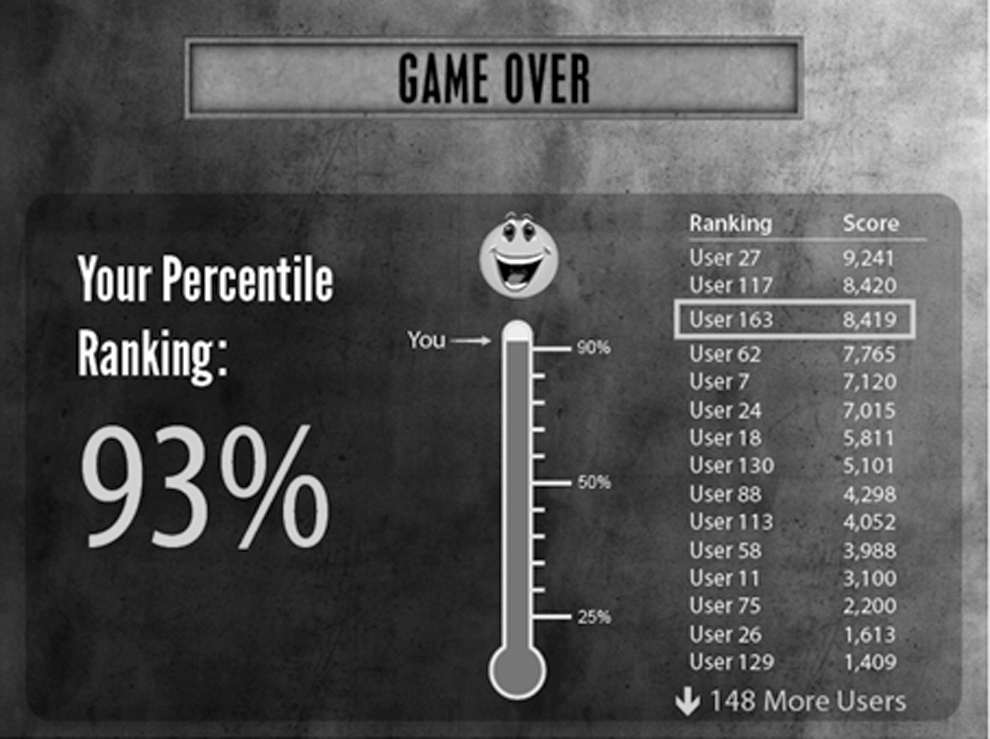
Positive video game feedback.
Results
Manipulation check
The intelligence test credibility ratings of participants who received negative test feedback were compared to those who did not receive test feedback to examine whether the current study's self-threat manipulation evoked defensive reactions. The results of an Analysis of Covariance (ANCOVA) examining the influence of intelligence and video game feedback while controlling for participants' value of video game success indicated a main effect for intelligence test feedback such that credibility ratings of the test were lowest for those who received negative feedback (M = 2.55, SE = 0.19) compared to those who did not receive feedback (M = 3.15, SE = 0.20), F(1, 75) = 4.72, p < 0.05, η p 2 = 0.06 (Table 2).a
p < 0.05.
ANCOVA, Analysis of Covariance; FB, feedback.
Intelligence test credibility
The first hypothesis examined if participants in the main treatment condition (i.e., those who received negative test and positive video game feedback) who valued video game success had higher test credibility ratings after receiving an affirmation compared to those who place less value on video game success. To examine participants in the main treatment condition but avoid the drawbacks of subgroup analyses, 13 a moderation analysis was conducted in the macro PROCESS,13,b in which participants' ratings of video game success importance were entered as the independent variable and the four conditions were entered as a multicategorical moderator. The resulting conditional effects indicated that participants who placed greater value on video game success reported higher test credibility ratings (b = 0.95, SE = 0.25, t = 3.78, p < 0.001, confidence level = 95%, lower level confidence interval [LLCI] = 0.45, upper level confidence interval [ULCI] = 1.46) when receiving positive video game feedback after the self-threat. Participants' value of video game success did not moderate intelligence test credibility ratings in the other three conditions (n.s.). Thus, H1a was supported.
The second hypothesis and research question examined participants who value or do not value video game success as part of their identity (respectively) and how receiving such an affirmation influenced intelligence test credibility ratings (i.e., self-defensiveness). To examine intelligence test credibility ratings, the macro PROCESS individually compared participants who received negative intelligence test feedback and positive video game feedback (i.e., the main treatment condition) to all other conditions using an indicator coding method (e.g., created three dummy variables for each pairwise comparison). The interactions between these comparisons and participants' value of video game success were probed with the Johnson–Neyman Technique when applicable or at three values of the video game success importance scale (e.g., the mean and ±1 SD) for exploratory purposes.
As predicted by the second hypothesis, the results indicated a significant interaction between video game success importance and the dummy variable representing the comparison between those who received a self-threat but differed on whether they got the subsequent affirmation, b = −1.03, SE = 0.36, t = −2.88, p < 0.01, 95% LLCI = −1.73, ULCI = −0.32. The Johnson–Neyman Technique indicated significant interactions for the top 17.28 percent of participants who placed great value on video game success (e.g., indicated a value of 3.72 or higher), suggesting such feedback successfully affirmed these participants. Thus, H2 is supported.
With regard to the research question, the same analysis indicated significant interactions for the lower 23.46 percent of participants who placed little value on video game success (e.g., indicated a value 1.75 or lower), suggesting such feedback increased these participants' self-defensiveness (i.e., lower test credibility ratings; see Fig. 3). Indeed, participants in the main treatment condition and valued video game success at one standard deviation (SD) below the mean reported significantly lower test credibility ratings than all other conditions (D1: b = 1.24, SE = 0.55, t = 2.27, p < 0.05, 95% LLCI = 0.15, ULCI = 2.32; D2: b = 1.87, SE = 0.51, t = 3.63, p < 0.001, 95% LLCI = 0.84, ULCI = 2.89; D3: b = 1.17, SE = 0.47, t = 2.50, p < 0.05, 95% LLCI = 0.24, ULCI = 2.10).c Thus, RQ1a was answered (Table 3).

Moderation of video game success importance on participants' test credibility ratings for those who received negative test feedback but differed on whether they received the affirmation. Shaded areas represent areas of significant difference (p < 0.05) between conditions as indicated by the Johnson–Neyman Technique.
p < 0.05, **p < 0.01, ***p < 0.001.
Feedback conditions: D1 = negative test/positive video game versus negative test/no video game; D2 = negative test/positive video game versus no test/positive video game; D3 = negative test/positive video game versus no test/no video game.
LLCI, lower level confidence interval; MSE, Mean Standard Error; ULCI, upper level confidence interval.
Intelligence self-ratings
The first hypothesis also examined if participants in the main treatment condition and valued video game success had lower intelligence self-ratings after receiving an affirmation compared to those who place less value on video game success (H1b). The same type of analysis for H1a indicated that participants who placed greater value on video game success reported lower intelligence self-ratings (b = −0.91, SE = 0.33, t = −2.80, p < 0.01, 95% LLCI = −1.56, ULCI = −0.26) when receiving positive video game feedback after the self-threat. Participants' value of video game success did not moderate defensive reactions in the other three conditions (n.s.). Thus, H1b was supported.
Results indicated a marginally significant interaction between video game success importance and the dummy variable of interest for the third hypothesis, b = 0.84, SE = 0.47, t = 1.78, p = 0.079, 95% LLCI = −0.10, ULCI = 1.78. For example, among participants who value video game success (e.g., 1 SD above the mean), receiving positive video game feedback after the self-threat marginally decreased participants' intelligence self-ratings (ŷ = 3.21) compared to those who did not receive the self-threat but received the affirmation (ŷ = 4.63), b = 1.41, SE = 0.74, t = 1.92, p = 0.058, 95% LLCI = −0.05, ULCI = 2.88 (Fig. 4). Thus, H3 was partially supported.
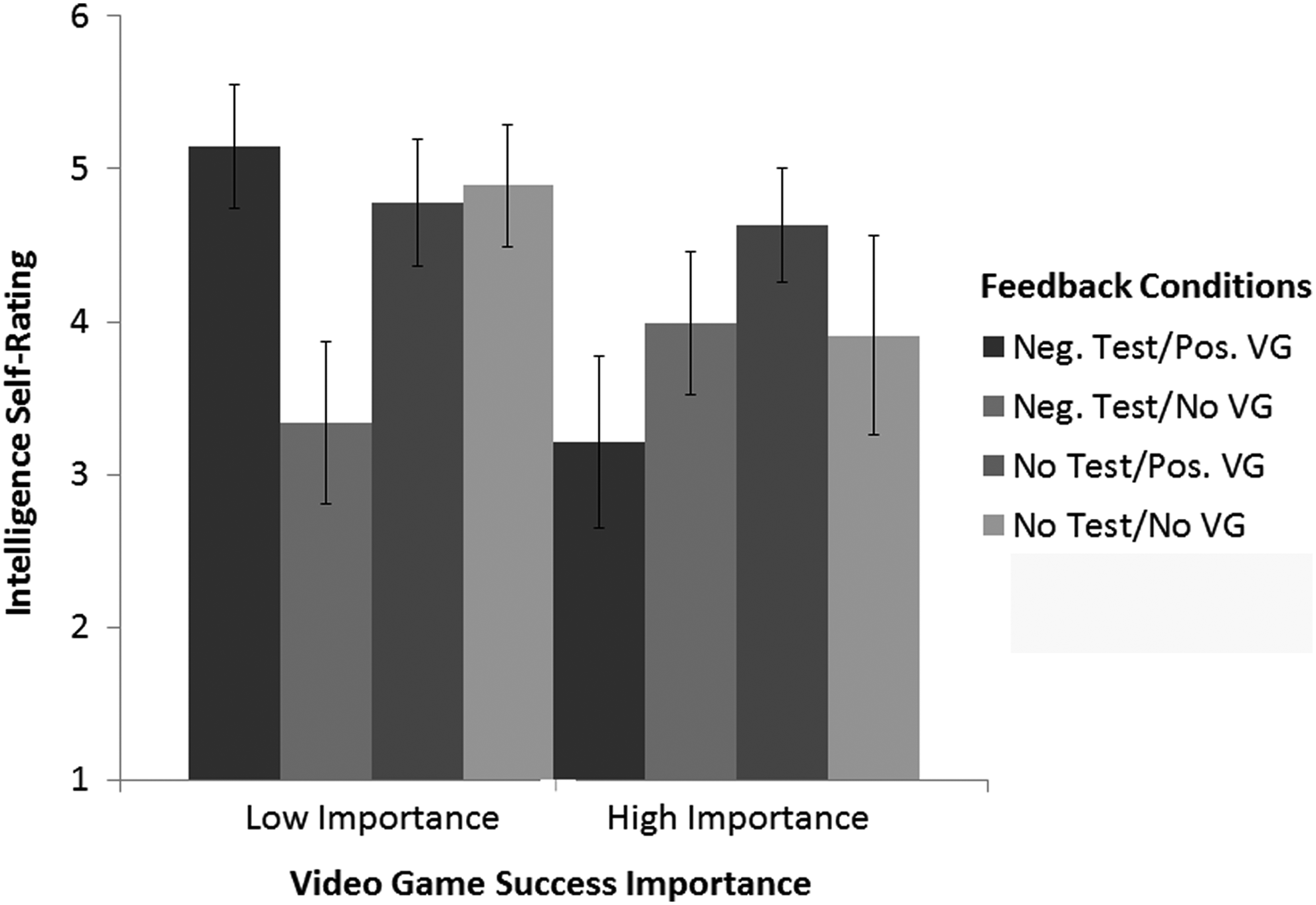
Moderation of video game success importance (±1 SD) on participants' self-ratings of intelligence. SD, standard deviation.
Among participants who place little value on video game success (1 SD below the mean), those in the main treatment condition reported the highest intelligence self-ratings (ŷ = 5.15). They only differed from those who also received negative intelligence test feedback but did not receive the subsequent affirmation (ŷ = 3.34), b = −1.80, SE = 0.70, t = −2.56, p < 0.05, 95% LLCI = −3.21, ULCI = −0.40. Thus, RQ1b was answered (Table 4).d
p < 1.0.
p < 0.01.
Feedback conditions: D1 = negative test/positive video game versus negative test/no video game; D2 = negative test/positive video game versus no test/positive video game; D3 = negative test/positive video game versus no test/no video game.
Discussion
The current study examines the capability of positive video game feedback to reduce players' self-defensiveness to negative but potentially important self-relevant information. The results suggest that players who value video game success as part of their identity can use positive video game feedback as a buffer against threatening negative test scores and thereby allow players to internalize such information. Indeed, positive video game feedback reduced players' tendency to discredit the negative intelligence test feedback and protect self-ratings of intelligence (although this specific analysis was marginally significant) when video game success was valued. Future research should examine how video game players may benefit from such affirmations in terms of implementing adaptive behaviors in response to important but threatening information. For example, in the current example, affirmed players may be more likely to adopt better study habits or be more willing to accept help to address poor academic performances.
Surprisingly, the results also suggest that players who place little importance on video game success may react more defensively (e.g., lower test credibility ratings and uninfluenced intelligence self-ratings) to negative self-relevant information after receiving positive video game feedback. Previous research suggests that defensiveness may increase if an affirmation resonates with the previously threatened self-image by reminding people of their failure to uphold a valued aspect of their identity. 14 It is possible a similar process can account for the current study's findings although the affirmation was unrelated to the threatening information. For example, performing well and succeeding at something one cares little about (e.g., receiving positive but unvalued video game feedback) likely highlights the importance placed on other aspects of one's identity such as the recently threatened image of being an intelligent student. Furthermore, being presented with favorable video game feedback after a negative test score likely leads people to weigh the importance of intelligence and video game success to one's identity and, for those who place little value on video game success, such a comparison may exacerbate the negative effects of a poor test score.
Limitations
Although the current manipulation check indicated that receiving negative intelligence test feedback successfully elicited defensive responses, the effect size was relatively weak (e.g., η p 2 = 0.05) and the mean score for perceived test credibility was low overall (e.g., 2.84 out of 7). This suggests participants felt defensive about the feedback but may not have been substantially threatened by an unknown intelligence test, particularly considering defensive reactions are an indirect measure of self-threat. However, future research may find markedly greater self-affirmation effects with more effective self-threatening manipulations.
Future research should also measure players' mood in conjunction with defensive reactions given the potential of positive or negative moods to influence players' willingness to internalize negative self-information. To this end, future research should use more in-depth self-assessments to examine affirmational processes compared to the one-item measure of intelligence self-ratings in the current study.
Conclusion
The current experimental design resembles previous studies demonstrating that video game play and performance feedback can be an effective coping strategy when facing negative emotions and diminished positive self-perceptions (see Refs.1–4 ). The results suggest that researchers should also focus on how video game play can affirm the identities of players who value video game success. Although players' subsequent coping strategies were not measured in the current study, the results suggest that affirmational processes may lead them to engage in healthier and more adaptive strategies when dealing with negative self-relevant information. However, players who did not value video game success in the current study exhibited increased defensive reactions, suggesting that future research must consider the importance of video games to players' identities when determining their potential benefits and disadvantages as a coping strategy. Moreover, the current study suggests researchers should further differentiate between the theoretical processes occurring when players cope with various negative events evoked by arousal,1,2 frustration, 3 or self-threats, 4 given that latter manipulations involve the self (e.g., similar to the current study) and the others do not.
Notes
a. The manipulation check for intelligence self-ratings is the same as the third hypothesis and thus was not reported twice in an effort to save space.
b. Each analysis using the macro PROCESS used 10,000 bootstrap samples.
c. Feedback conditions: D1 = negative test/positive video game versus negative test/no video game; D2 = negative test/positive video game versus no test/positive video game; D3 = negative test/positive video game versus no test/no video game.
d. See Table 5 for correlations of all relevant variables.
N = 81. For the test feedback condition, negative test feedback was coded as 0 and no test feedback as 1. For the video game feedback condition, positive video game feedback was coded as 0 and no video game feedback as 1.
p < 1.0.
p < 0.05.
Footnotes
Acknowledgment
The authors want to acknowledge the assistance of Dr. Hyunjin Song (University of Vienna, University Assistant) with the statistical analyses.
Author Disclosure Statement
No competing financial interests exist.