




Abstract
Abstract
Recently, WeChat has been widely used in China. The positive and negative effects of WeChat on users have received attention from researchers gradually. Using the questionnaire method, we recruited 339 undergraduates and graduates as participants, and tested the effects of WeChat on their subjective well-being (SWB) in terms of intensity. In addition, we confirmed the mediating effects of WeChat with respect to motivation. The results showed that the participants’ WeChat use intensity was at a mid-level, 85.3 percent of them spending no more than 2 hours on WeChat every day. Furthermore, there have been no demographic differences in the variables of gender, place of residence, or grade. Participants’ WeChat use intensity can significantly predict their use motivation and life satisfaction, and intrinsic use motivation was the mediator between the use intensity and SWB, while the other three types of motivation (external, introjection, and identification) cannot predict SWB significantly. The user's ultimate emotional experience is primarily derived from why and how they use it. We also tested whether the use motivation can be shaped.
Introduction
W
WeChat has many general and special characters. For example, WeChat enables users to send messages (text and real-time voice). Similar to Facebook's activity feed, users can share photos, articles, and information with WeChat contacts (friends circle), who can post comments regarding the content. 4 Individuals and corporations can create a public account on WeChat and send mass texts and voice recordings through Tencent. WeChat has the functions of payment and red envelope at the same time. Thus, WeChat has combined the functions of an instant messaging platform, such as QQ, and a social networking site (SNS), such as Weibo.
With the widespread use of WeChat in China, now an increasing frequency of Phubbing (the activity of people constantly looking down and ignoring family and friends in front of them) occurred. With respect to the use of WeChat, we should guard against mobile phone addiction, while it is important to develop and maintain information media and technology skills, as argued in 21 Century Skills.5,6 Although WeChat has previously been used widely, few studies have focused on the effects of WeChat use and use motivation on people's well-being. Based on the current situation of WeChat use in China, the purpose of this study is to examine whether the use of WeChat will lead to people's subjective well-being (SWB). Also, does a user's use motivation influence their happiness?
SNS use and SWB
Previous studies have tested that SNS use had relationship with people's well-being, such as the use of Facebook,7–9
Myspace,
10
Qzone,
11
and blog.12–14
The previous studies gained a mixed result regarding the relationship between people's SNS use and well-being, several studies reported a positive relationship,
15
and the others reported a negative relationship.
7
However, most of the previous studies indicated that the SNS use may affect well-being indirectly; this relationship may be mediated or moderated by other variables, such as personality,
16
self-disclosure,
14
and social support.
8
In addition, the users’ well-being may be affected by their use motivations.
11
In conclusion, for WeChat, which is one type of SNS, the first hypothesis is stated as below:
WeChat use intensity, use motivation, and SWB
Motivations drive people's activities. However, there is little knowledge about the reason of using WeChat. Why do people use WeChat? What is the motivation for people to use it? These questions will drive future research. With respect to the reasons for using Facebook, Nadkarni and Hofmann concluded that demographics, personality characteristics, self-esteem, and self-worth were all the factors that influenced people's Facebook use. 17 Entertainment, self-expression, professional advancement, passing time, communication with family and friends, and trends are six types of motives for using SNSs (Cyworld mini-homepage) in Korea. 13 Do different types of SNS use motivation affect people's SWB? The social-interactive use was positively related to SWB, but the entertainment was not. 11 Thus, another hypothesis is suggested below.
In general, motivations are stimulated by person's needs and later acted out. 18 Motivations are always the antecedents of the behavior. In fact, motivations can also be shaped. Brian has tested that students who participate in dual enrollment (an accelerated program that allows high school students to take university courses for college credit) have higher levels of academic motivation than nonparticipants; this motivation has a positive influence on academic performance. 19 The inspiration of this study is that active participation can increase motivation. Jimmi has tested that self-motivation is a mediating variable between the relationship of a teacher's readiness and the applying ITC in teaching and learning. 20 Elwick demonstrated that teaching pupils about the brain had an effect on their motivation to learn. 21 All of these studies illustrated that motivation can be shaped and behaviors can change motivations. Thus, one more hypothesis is proposed below.
The theory model of this study is shown in Figure 1.
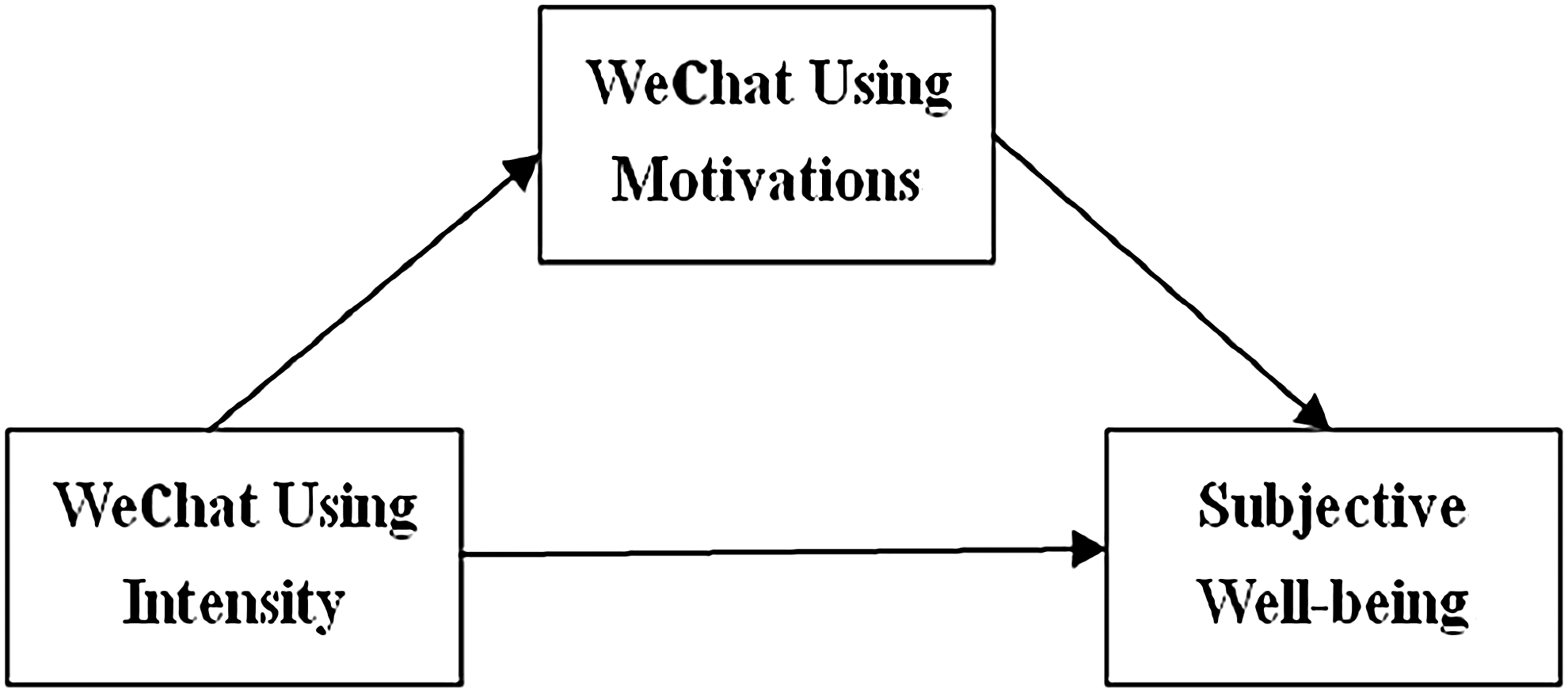
Theory model.
Methods
Sample and procedure
A total of 339 undergraduate and graduate students participated in this study (the recruitment process is described below in the Procedure section). The participants (75 males and 264 females) came from six different universities in China. Among the participants, 54 were graduates and 285 were undergraduates; 135 lived in the city and 204 lived in the countryside. The participants’ majors included education, chemistry, art, and architecture. The average age of the participants was 20.74 years old (SD = 2.13).
Measures
This study uses four questions to investigate the current use status of WeChat in China, which includes a participant's general WeChat use purpose, information-posting preferences, information-reading preferences, and learning or nonlearning use purposes of WeChat. Subsequently, participant's WeChat use motivation, use intensity, and life satisfaction were measured.
WeChat Using Motivation Questionnaire
Based on the self-determination theory, Ryan and Connell defined four types of reasons for behaviors: external reasons (external authority or fear of punishment), introjected reasons (internal, esteem-based pressure, e.g., shame), identification reasons (values or goals), and intrinsic reasons (enjoyment or fun inherent to the behaviors). 22 They also provided examples of these four categories of reasons. We developed the WeChat Use Motivation Preliminary Questionnaire largely based on these examples, and the preliminary questionnaire included 23 items. We divided the samples in half randomly and conducted exploratory and confirmatory factor analyses. Four factors (with 12 items) were extracted and explained 66.43 percent of the total variance in exploratory factor analysis; and 11 items were deleted for their low factor loading. These items included the following: “Because I'll get in trouble if I don't use WeChat (External),” “Because I'll feel bad about myself if I don't use WeChat (Introjection),” “Because I want to learn new things (Identification),” and “Because WeChat is fun (Intrinsic).” The items were measured on a five-point Likert scale ranging from 1 (disagree) to 5 (strongly agree). The results of confirmatory factor analysis supported a four-factor model of this scale with good fit indices: χ 2 /df = 2.08, goodness-of-fit index (GFI) = 0.911, Tucker-Lewis index (TLI) = 0.931, incremental fit index (IFI) = 0.950, and root mean squared error of approximation (RMSEA) = 0.080; Cronbach's alpha was 0.87 (external = 0.80; introjection = 0.90; identification = 0.80; intrinsic = 0.92).
WeChat Use Intensity Questionnaire
In this study, the scale developed by Ellison et al. was used to measure participants’ WeChat use intensity, with slight alterations. 23 The original scale was used to measure individuals’ use intensity for Facebook, but we used it to measure participants’ use intensity for WeChat. This questionnaire consists of three parts: the number of WeChat friends, the amount of time spent on WeChat on a typical day, and a series of Likert-scale attitudinal questions to tap users’ emotional attachment to the tool. The same scale was used by Valenzuela et al. in 2009 (Cronbach's α was 0.89). 24 The response choices and descriptive results are shown in Table 1.
Notes. (a) An individual's items were standardized before calculating the scale mean; (b) they were measured on a five-point Likert scale ranging from 1 (disagree) to 5 (strongly agree).
Satisfaction with Life Scale
Developed by Diener, Emmons, Larsen, and Griffin, the Satisfaction with Life Scale consists of five items and was measured on a rating scale ranging from 1 (completely disagree) to 7 (completely agree). 25 The average score on the five items is taken as the overall life satisfaction score. 25 In this study, we used this scale to measure participants’ SWB, with no modification. Cronbach's alpha was 0.820.
Procedure
The research participants were drawn from the university undergraduates and graduates who use WeChat in China. We collected the data through an online data collection platform, namely, SOJUMP. All the participants were informed that their participation was both voluntary and anonymous.
SPSS version 17.0 and AMOS version 5.0 were used for data analysis. Descriptive statistics, demographic difference analysis, correlation analysis, and testing of the research theory model were completed as follows.
Results
Current use status of WeChat in China
With respect to the question, “How long have you used WeChat?,” 59 reported they have used WeChat within 1–6 months, 25 reported 6–12 months, 121 reported 1–2 years, and 134 reported more than 2 years.
According to the general use purpose of WeChat, most participants use WeChat for sending messages, getting public information, and sharing photos and articles. The specific results of the general use purpose inquiry are shown in Figure 2.

The general use purpose of WeChat.
With respect to information posting, 261 participants post their personal information and 78 forward and share others’ links about social news. Two hundred fifty participants were interested in others’ personal information, and 89 were interested in others’ shared links.
With respect to the learning and nonlearning use purposes of WeChat, 23 participants use WeChat mainly for study, and 316 use it mainly for social interaction and entertainment.
Descriptive and correlation results
Descriptive and correlation results of each research variable are shown in Table 2.
P < 0.05; **P < 0.01 (two-tails).
As shown in Table 2, participant's WeChat use intensity is positively correlated with their use motivations and life satisfaction. The main motivation of using WeChat was intrinsic (M = 3.30), followed by identification (M = 2.96). Participant's life satisfaction is in the middle level (M = 4.12).
We then compared the WeChat use intensity between male and female and rural and urban participants by using independent t test, and also compared the use intensity among different grades by using F test. The results showed there were no statistically significant differences between these demographic variables, such as whether they were male or female, rural or urban, or were in a particular year of study at college; however, the one exception is that freshmen had lower scores than students from other grades in WeChat use intensity.
Mediating analysis
In general, three conditions must be met for mediation: (a) predictive and mediating variables have significant effects on the outcome variable; (b) predictive variables have significant effects on mediating variables; and (c) the effect of predictive variables on the outcome variable tends to be weakened when mediating variables are added.
Predictive effect of predictive and mediating variables on the outcome variable
We adopted structural equation modeling approaches to explore the effects of WeChat use intensity on use motivations and life satisfaction. Two models were established, and the fit indices and standard regression coefficients of these two models are shown in Table 3. Fit indices of these two models were high, indicating that the two theoretical models were reasonable. Regarding the regression results, we observed that use intensity (β = 0.126*) and intrinsic motivation (β = 0.281***) significantly predicted life satisfaction, whereas the other three types of motivation had no significant effects on life satisfaction.
AGFI, adjusted goodness-of-fit index; GFI, goodness-of-fit index; IFI, incremental fit index; NFI, normed fit index; RMSEA, root mean squared error of approximation.
P < 0.05; ***P < 0.001.
Predictive effect of predictive variable on mediating variables
We then tested the effect of WeChat use intensity on the four types of use motivation. The fit indices of this model were high (χ 2 /df = 3.818, GFI = 0.829, TLI = 0.860, IFI = 0.880, and RMSEA = 0.090), indicating that the theoretical model is reasonable. The standard regression coefficients are shown in Table 4.
β
P < 0.001.
Mediating analysis of use intrinsic motivation
Based on the above regression analysis results, the effect of use intensity on life satisfaction, the effect of intrinsic motivation on life satisfaction, and the effect of use intensity on intrinsic motivation were all significant. Thus, we believed that using intrinsic motivation might be a mediating variable in the relationship between WeChat use intensity and life satisfaction. We constructed the mediating model for this analysis. The fit indices of this model were as follows: χ 2 /df = 3.341, GFI = 0.883, TLI = 0.906, IFI = 0.921, and RMSEA = 0.080, indicating that the theoretical model was reasonable as well. The mediating models are shown in Figure 3.
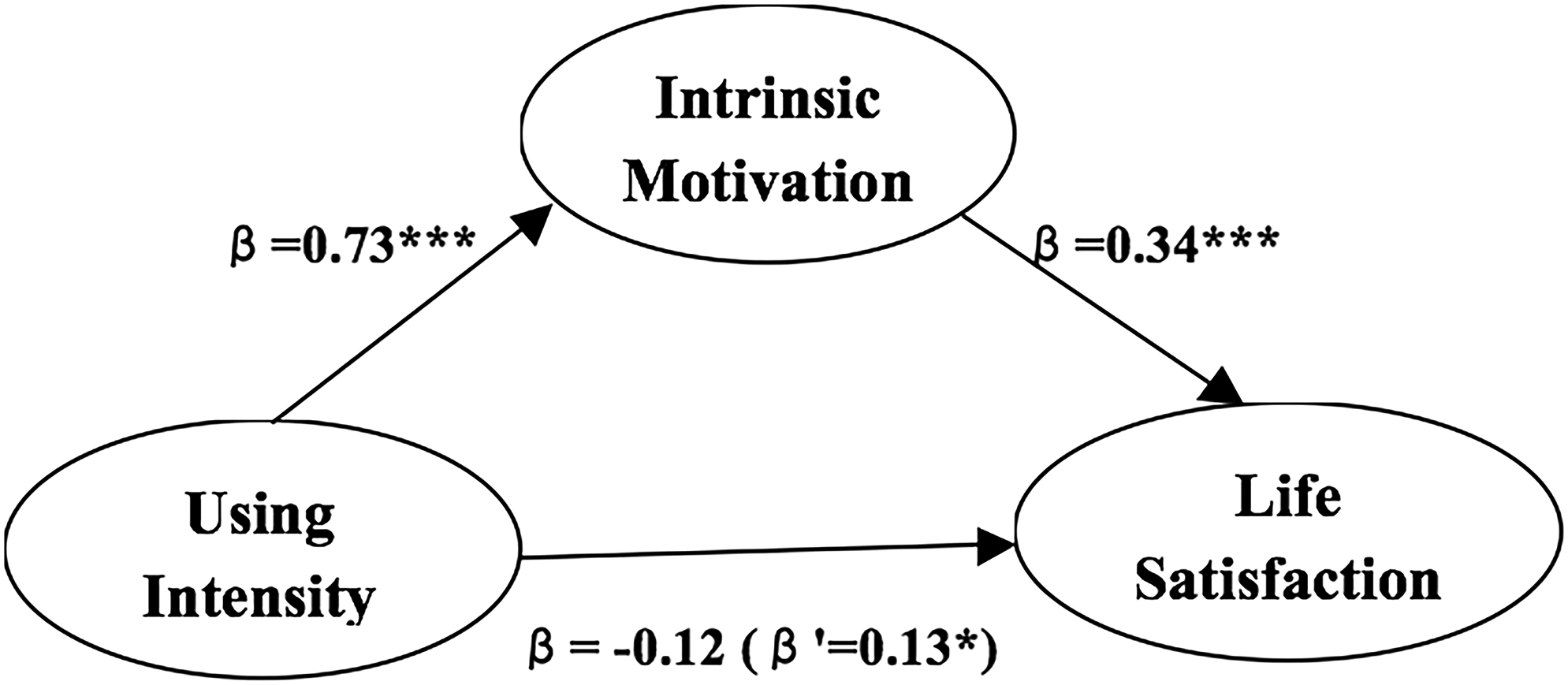
Mediating model “β′” refers to the single predictive value of independent variables on the dependent variable.
As shown in Figure 3, the effect of use intensity (predictive variable) on life satisfaction (result variable) becomes not significant when the intrinsic motivation (mediating variable) is added to the analysis; at the same time, the effect of intrinsic motivation on life satisfaction remains significant. These results demonstrate that intrinsic motivation has a complete mediating effect on the relationship between use intensity and life satisfaction.
Discussion
Summary and implications
As a free and convenience platform of communication and information, WeChat is widely used in China. At the same time, people's daily life is entwined with the main carrier of WeChat—the mobile phone. According to The Fingertips of Netizens (2014), among Chinese citizens, 20 percent checked their mobile phone more than one hundred times every day, 23 percent felt nervous without their mobile phone, and the first activity of daily life for 34 percent of participants was to check their information through WeChat. 26 WeChat shares common characteristics with the Internet; moreover, it shows unique traits, such as the excessive virtual-social, which can lead to life disorders and spiritual emptiness. 27 Therefore, WeChat addiction may become a serious social and personal issue. The more frequently WeChat is used, the more anxious and apathetic the users will be, and the user's real-life relationships will become increasingly distant. 27 In this study, the participants are all undergraduates and graduates, most of them (77.6 percent) had 10–150 WeChat friends, and 85.3 percent of them spent no more than 2 hours on WeChat every day. The use purpose of 93.2 percent participants was sending messages, 52.8 percent for getting public information, and 48.1 percent for sharing personal photos and articles. Although it is difficult for us to conclude whether WeChat addiction exists among college students, the fact is that WeChat has become the main self-expression platform for students, as 77 percent of participants use WeChat to post their personal information. Furthermore, students spent considerable time and energy on WeChat, primarily for social interaction and entertainment (93.2 percent), but not for study. Overall, WeChat addiction needs to receive substantial attention from researchers.
No demographic difference was shown in the variables of gender, place of residence, or grade. The results were consistent with the study of Li et al. in 2015 and confirmed that in some respects, Chinese university environment influences the usage of WeChat, while in other respects, WeChat use will be determined by its own traits. 5 Participants’ WeChat use motivation and life satisfaction can be predicted by their use intensity effectively; the higher scores of participants’ WeChat use intensity, the higher their use motivation and life satisfaction will be. The results are inconsistent with the study of Kraut et al. 28 and Valenzuela et al. 24 In fact, whether the Internet has a positive or negative social effect may depend on the quality of people's online relationships and what people give up to spend time online. 28 WeChat use itself does not bring happiness or unhappiness to people, while user's ultimate emotional experience mainly comes from the reason and method of use. Use motivation plays an important role in use behaviors and the overall emotional experience.
Participants’ life satisfaction can be predicted by their intrinsic use motivation effectively, that is to say, WeChat use for fun or interests may enhance people's life satisfaction; the other three types of motivations have not exhibited this effect. This study also demonstrates that WeChat use intensity has a positive effect on a user's motivations, which agrees with the mechanism, “more use produces more preference and fun (more motivation).” The effects of motivation on behavior have been tested by many studies, such as the study of improving temporal cognition by enhancing motivation by Avlar et al. 29 We pay more consideration to the shaping of the motivation by behaviors. In fact, only intrinsic motivation has a positive effect on a person's SWB. Thus, the most important enlightenment of this study occurs in two aspects: (a) WeChat use motivation can be cultivated; frequent use will not necessarily increase a user's feeling of boredom, however, it will enhance a user's use motivation and positive feelings; (b) mobile phone addiction, primarily caused by WeChat use, should receive wide concern. The more we use cell phones, the more possibility that relationship damage will occur. For example, ∼10.6 percent of Chinese college students are addicted to their smart phones. 5
Limitations and future research
This study is limited in the following aspects: in traditional motivational theory, motivation is the antecedent of the behavior and affects an individual's behaviors. This study discussed the effects of WeChat use intensity on use motivation. Although these hypotheses were supported by some related studies,19,21 we cannot confirm it, even if supported by mature theory. In addition, the external validity of the WeChat Use Motivation Questionnaire developed in this study must be tested again in future research.
Based on this research, we will focus on the effects of parent WeChat use on parent–child relationships in future research, as well as the influence of these effects on children's mental development.
In conclusion, although WeChat use intensity can enhance an individual's SWB by motivating a user's intrinsic use motivation, similar to any tool, WeChat use carries complications in addition to its effectiveness. As stated earlier, WeChat use itself does not necessarily bring people happiness or loneliness—the key is how we use it. We need to keep alert of WeChat addiction and its negative effects on our real-life relationships.
Footnotes
Acknowledgments
This study was supported by the Humanities and Social Sciences Foundation of Ministry of Education of China (Grant No. 12YJCZH256), “QianJiang Talent Plan (QJC1402003)”, National Natural Science Foundation of China (Grant No. 71401068).
Author Disclosure Statement
No competing financial interests exist.