




Abstract
Abstract
With the inclusion of Internet Gaming Disorder (IGD) in the fifth edition of the Diagnostic and Statistical Manual of Mental Disorders comes the need for a reliable and valid questionnaire to assess the diagnosis. The Internet Gaming Disorder Questionnaire (IGDQ) is a short tool that measures IGD. Our study aimed at investigating its psychometric properties in a sample of German gamers. Eight hundred ninety-four Internet game players (mean age: 26.5 ± 8.5 years, range: 18–75 years, 87.36% male) completed an online version of the IGDQ and the Compulsive Internet Use Scale (CIUS) and provided information on their Internet and gaming use. Item and reliability analyses were computed. To investigate the component structure, the sample was randomly divided into two subsamples. A maximum likelihood factor analysis was conducted for one subsample and a confirmatory factor analysis (CFA) for the other subsample. The IGDQ had a Cronbach's alpha of 0.70. The IGDQ score correlated with the CIUS score (r = 0.59) and the time spent playing (r = 0.24). The maximum likelihood factor analysis extracted one component, explaining 30.26% of the variance, which was confirmed by the CFA. The correlation of the IGDQ score with the CIUS score is a first indicator that the IGDQ allows for valid interpretations. In all, 7.94% of the gamers met the criteria for IGD.
Introduction
I
Internet Gaming Disorder (IGD) has been included in the appendix of the fifth edition of the Diagnostic and Statistical Manual of Mental Disorders (DSM-5) 6 as a tentative diagnosis. The accompanying hope was that standardized criteria will lead to more consistency in studies researching symptoms, underlying mechanisms, comorbidities, and treatments of the condition. Ultimately, it may help to clarify whether IGD is an independent psychiatric disorder. Furthermore, it will enable practitioners to give a diagnosis to excessive Internet gamers seeking treatment.
IGD consists of nine criteria that have to be fulfilled for the duration of the last 12 months: preoccupation with gaming, withdrawal when unable to game, tolerance, failure to stop or to reduce the amount of gaming, giving up other hobbies or activities, continuing to play despite problems, deceiving others about the amount of gaming, gaming to escape adverse moods, and jeopardizing or losing an important relationship, one's occupation, or one's education because of gaming. Gamers have to fulfill at least five criteria to be diagnosed with the disorder.
The criteria are based on those for Substance Use Disorders and Gambling Disorder. Several studies point to similarities between IGD and the disorders it is modeled on. 7 However, there is an ongoing debate on whether classifying IGD as a behavioral addiction and whether basing its criteria on those for Substance Use Disorder and Gambling Disorder might lead to a depreciation of the concept of “addiction.” 8
Petry et al. 10 developed a questionnaire that provides one item for every criterion of IGD. The Internet Gaming Disorder Questionnaire (IGDQ) has been translated from English into Chinese, Dutch, French, German, Italian, Japanese, Korean, Portuguese, Spanish, and Turkish. The authors followed the World Health Organization's 9 recommendations for translating questionnaires. One native speaker translated the IGDQ into his or her respective language, and at least one additional native speaker, who was unfamiliar with the original English version, independently back-translated it into English. 10 Discrepancies were discussed before selecting the final wording. The psychometric properties of the IGDQ have not yet been evaluated.
Our aim was to investigate the factorial structure, reliability, and validity of the IGDQ in a broad sample of adult German-speaking gamers playing different types of Internet games. To explore the concurrent validity, we correlated it with the commonly used German version of the Compulsive Internet Use Scale (CIUS). 11 The scale was developed by Meerkerk et al. 12 and has good internal consistency.11–13 The CIUS is a short tool and according to Brand, 14 conceptually sound.
Methods
Sampling
The local ethics committee approved the study. An invitation to participate in the study and a link to the web-based questionnaire (LimeSurvey, Hamburg, Germany) were placed in gaming forums and social network sites. On the first page of the survey, the participants were informed that their answers would be anonymous; by clicking on a button, they provided informed consent. The participants could discontinue the survey at any time by leaving the website. As an incentive, the participants had the chance to win one of ten gift vouchers for a popular online store (voucher value: 20 €). To ensure anonymity, at the end of the questionnaire, the participants received a link to a second, unrelated web-based survey to provide their e-mail addresses for the draw.
A total of 1,966 people provided informed consent. Of these, 630 (32.04%) failed to fulfill the inclusion criteria (337 were excluded because they did not play computer games for at least 30 minutes per week, 84 because their native language was not German, and 209 because they were younger than 18 years). Of the remaining 1,336, 437 (22.23% of the total sample) dropped out before finishing the survey. Another five (0.25%) were excluded because they failed to provide serious information (e.g., by stating that they played computer games for 168 hours a week).
Participants
The data from 894 gamers were analyzed. According to Bühner, 15 this is a very good sample size for conducting a factor analysis. Of those, 781 (87.36%) were male, 113 (12.64%) female. On average, the participants were 26.49 ± 8.46 years old, ranging from 18 to 75 years.
The participants played Internet games for 18.4 ± 16.1 hours per week, with individual gaming sessions lasting 2.9 ± 2.0 hours. In addition to their gaming, they spent 14.8 ± 18.3 hours every week privately on the Internet engaged in other activities, such as social networking, visiting forums, surfing websites, online shopping, or consuming online pornography. On average, they had played computer games for 13.6 ± 6.3 years.
Procedure
The participants filled in their demographic information (age, sex, native language) and information concerning their gaming and Internet use. In addition, they answered the German versions of the IGDQ 10 and the CIUS. 11
Materials
Internet use and gaming
The participants were asked which game they played most, which additional games they played, the number of years they had played computer games, the number of hours per week they played Internet games, how long a typical gaming session lasted, and how many hours per week they spent doing other things online (e.g., social networking, visiting forums, surfing websites, online shopping, or consuming online pornography).
Internet Gaming Disorder Questionnaire
The German version of the IGDQ 10 consists of nine items, for example, “Do you lose interest in or reduce participation in other recreational activities (hobbies, meetings with friends) due to gaming?” The items reflect the nine DSM-5 criteria for IGD. The IGDQ has a dichotomous response format, with 0 (no) and 1 (yes). The cutoff for receiving a diagnosis of IGD, as defined in the appendix of the DSM-5, is five points.
Compulsive Internet Use Scale
The German version of the CIUS 11 measures excessive Internet use with 14 items, for example “Do you prefer to use the Internet instead of spending time with others (e.g., partner, children, parents)?” The participants were asked to refer to their Internet gaming when answering the questionnaire. The CIUS has very good internal consistency, with a Cronbach's alpha ranging from 0.86 to 0.90.11–13 The scale has a unidimensional structure.11,12 The items are rated on a five-point scale from 0 (never) to 4 (very often), with higher scores indicating more use. Participants were asked to refer to their gaming use when answering the questions.
Data analysis
SPSS and SPSS AMOS (version 21; IBM) were used for statistical calculations. A standard item analysis computing internal consistency (standardized Cronbach's α), item difficulties, and corrected item-total correlations of the IGDQ was conducted. To investigate the factor structure, exploratory and confirmatory factor analyses (CFAs) were used. For this purpose, the sample was randomly divided into two subsamples (A and B). Independent t-tests were computed to assess whether there were any differences in the two subsamples regarding age, weekly gaming time, duration of gaming sessions, IGDQ and CIUS scores, and additional recreational Internet use time. The number of men and women in both subsamples was compared using a χ2 test.
Since the IGDQ has a dichotomous response format, tetrachoric correlations (cosine phi formula) were calculated as input for the factor analysis. 16 The Kaiser-Meyer-Olkin (KMO) measure of sampling adequacy and Bartlett's test of sphericity were calculated to test whether the data set was suitable for factor analysis.
A maximum likelihood (ML) factor analysis was conducted for subsample A. Velicer's Minimum Average Partial (MAP) Test 17 was used to determine the number of components to be extracted. For subsample B, a CFA was computed to test the fit of the component structure that resulted from the ML. As goodness of fit measures, the χ2 test, root mean square error of approximation (RMSEA), standardized root mean squared residual (SRMR), and comparative fit (CFI) are reported. According to Schreiber et al., 18 the thresholds for an acceptable fit are a ratio of the χ2 to the degrees of freedom of ≤2 or 3, a CFI of ≥0.95, an RMSEA of <0.06–0.08 (including confidence intervals), and an SRMR of ≤0.08.
Gender differences in IGDQ scores were tested using an independent t-test. Pearson correlations of the IGDQ and CIUS scores, the time spent playing computer games per week, and the time spent for each computer gaming session were calculated. Gamers with and without a diagnosis of IGD (as determined by IGDQ cutoff) were compared using independent t-tests with regard to age and overall weekly gaming time, their favorite game, the duration of individual gaming sessions and their recreational Internet use. The significance value was set at p < 0.05, and Cohen's d is reported as a measure of effect size where appropriate.
Results
Gaming and Internet use
The game genres that were played were MMORPGs (36.4%) such as World of Warcraft (Blizzard Entertainment, 2004), FPS (19.6%) such as Counter Strike (Sierra Studios, 2000), and MOBAs (9.2%) such as League of Legends (Riot Games, 2009), strategy games (7.8%) such as Age of Empires II: The African Kingdoms (Ensemble Studios, 2015), action adventure games (7.2%) such as The Legend of Zelda: Twilight Princess (Nintendo, 2016), sport games (4.9%) such as FIFA 16 (Electronic Arts, 2015), online skill and parlor games (3.6) such as Bubble Shooter (Absolutist LTD, 2002), simulation games (2.3%) such as The Sims 4 (Electronic Arts, 2016), Massively Multiplayer Online First-person Shooter Games (2.0%) such as Firefall (Red 5 Studios, 2014), adventure games (1.8%) such as Minecraft (Mojang, 2011), and others (5.2%) such as Trine 2 (Frozenbyte, 2011).
The mean IGDQ score across all participants was 1.70 ± 1.86. There was no significant difference in the IGDQ scores between men (1.7 ± 1.9) and women (1.4 ± 1.8), t(892) = 1.339, p = 0.18. A total of 71 participants (7.94%) fulfilled at least five IGD criteria (see Fig. 1 for details).
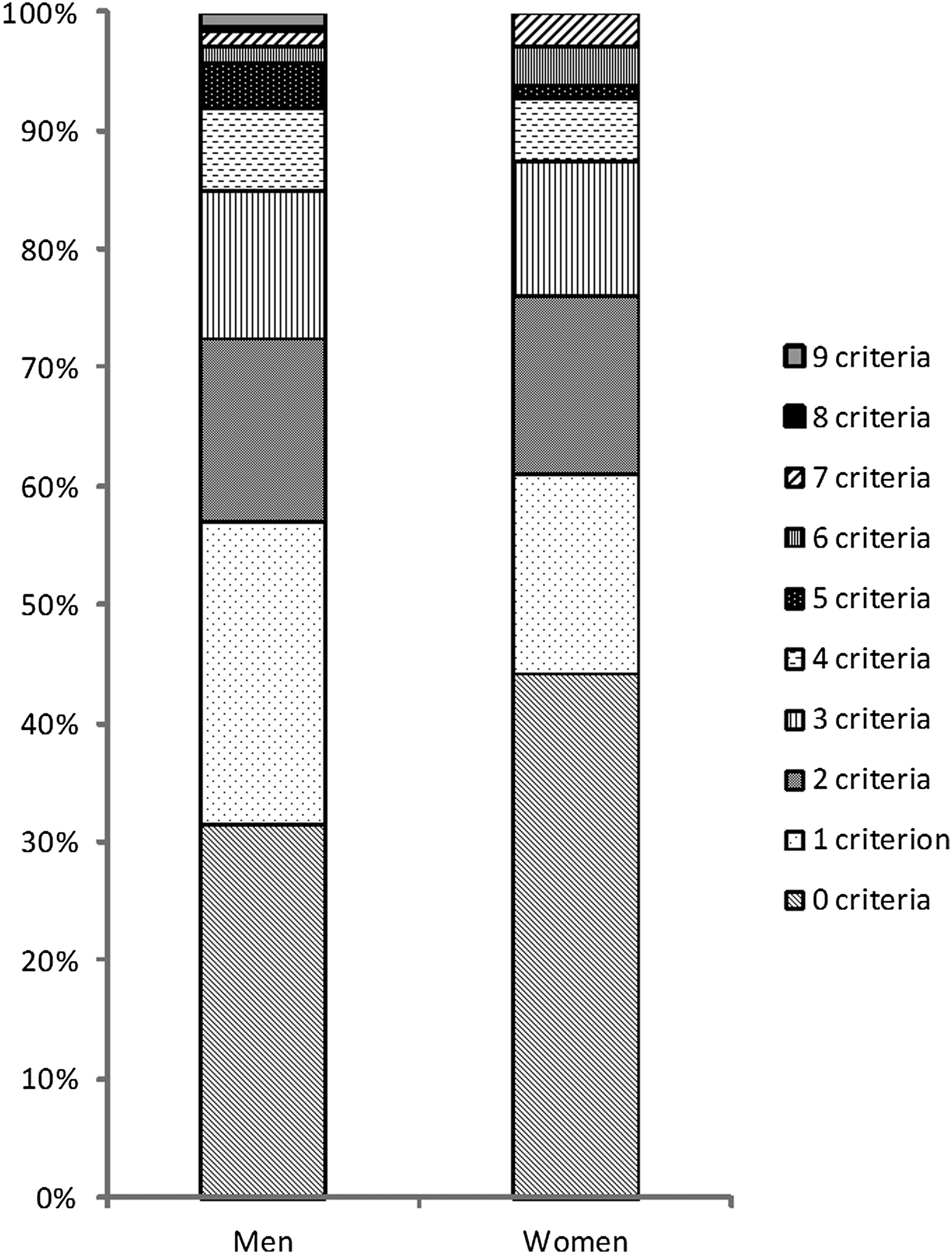
Percentage of men and women fulfilling different numbers of Internet Gaming Disorder (IGD) criteria.
Internet Gaming Disorder Questionnaire
Item analysis and internal consistency
The IGDQ had an internal consistency of Cronbach's alpha = 0.70. The item with the highest endorsement was item 1 (324 people) and the item with the lowest endorsement was item 2 (57 people). The mean item difficulty was pi = 0.19, with difficulties ranging from pi = 0.06 (item 2) to pi = 0.36 (item 1). Item 5 had the largest number of missing answers (8) and items 7 and 9 had the fewest (none). The corrected item-total correlations ranged from ritc = 0.28 (item 1) to ritc = 0.49 (item 9), with a mean item-total correlation of ritc = 0.39. See Table 2 for details.
Factor structure
The two subsamples A and B resulting from the random division of the sample for the purpose of the ML and the CFA did not differ regarding age, sex, years that the game had been played, gaming hours per week and per session, recreational Internet use apart from gaming, IGDQ scores, and CIUS scores. See Table 1 for details.

Path diagram for the confirmatory factor analysis with the standardized path coefficients for subsample 2 (n = 427). All path coefficients are statistically significant at p < 0.001.
CIUS, Compulsive Internet Use Scale; IGDQ, Internet Gaming Disorder Questionnaire; n.s., not significant (p > 0.05).
For subsample A, Bartlett's test of sphericity (χ2 = 488.19, df = 36, p < 0.001) indicated that correlations between the items were sufficiently large for an ML. The KMO criterion was 0.79, demonstrating good suitability of the data for the analysis. The ML extracted one component that was retained by Velicer's MAP Test. 17 It explained 30.26% of the variance. Factor loadings were between 0.34 (item 1) and 0.64 (item 9). See Table 2 for details. The CFA calculated on the basis of subsample B confirmed the extraction of one component (see Fig. 2 for the path diagram using standardized path coefficients). The χ2 was significant, χ2(27) = 70.193, p < 0.001, and the χ2/df ratio was 2.6. The CFI was 0.915, the RMSEA was 0.061 (0.044–0.079), and the SRMR was 0.047.
Correlation with CIUS scores and gaming time
IGDQ scores correlated with CIUS scores, r = 0.59, p (one tailed) <0.001. Furthermore, IGDQ scores correlated with the number of hours spent gaming per week, r = 0.24, p (one tailed) <0.001 and the duration of a gaming session, r = 0.26, p (one tailed) <0.001.
Comparison of persons fulfilling the diagnostic of IGD with persons not fulfilling the criteria
The gamers with IGD were younger compared to those without it and had played games for a shorter period of time. Their CIUS score was higher, they played more overall, and their playing sessions lasted longer. In addition to their gaming, they also spent more time online for other recreational purposes. See Table 3 for details.
p < 0.01, **p < 0.001.
IGD, Internet Gaming Disorder.
Discussion
This study was the first to investigate the reliability and the validity of the German version of the IGDQ, a self-report questionnaire that uses the DSM-5 criteria to assess for IGD.
The IGDQ had a moderate-to-good internal consistency with a Cronbach's alpha of 0.70 that would not have benefitted from discarding any item. On average, the endorsement of the items was low. This is to be expected of a questionnaire whose items represent the criteria for IGD. The majority of gamers play recreationally and should not display the symptoms represented by the criteria; otherwise, there would be an overassessment of the diagnosis. Item 1 had the highest endorsement and item 2 had the lowest. Since the majority of players are very engaged in their gaming without being classified as addicted, 19 it is conceivable that many would confirm their preoccupation with gaming. Item 2 asks whether participants feel withdrawal when they are unable to game. In a broad sample of players, it is plausible to assume that only a few would experience withdrawal.
The corrected item-total correlations of the items were above the threshold of 0.30, 20 indicating moderate discriminatory power. The only exception was item 1 (ritc = 0.28), which asks about preoccupation with the game when the person is not actually playing. It seems plausible that the discriminatory power of item 1 would be rather low because persons with and without IGD can be preoccupied with gaming—a preoccupation with gaming acquires meaning for IGD only if additional criteria are fulfilled. Kardefelt-Winther 21 argues that preoccupation is not a suitable criterion to diagnose IGD because gaming has become such a regular leisure activity for the majority of adolescents and that thinking about one's leisure activities is just a natural aspect of their importance.
However, one could object that nicotine and alcohol consumption are regular in adolescents as well and although preoccupation with the substance would not be sufficient to diagnose an abuse, in combination with other criteria, continuing preoccupation may well be regarded as an indication of a disorder. The preoccupation criterion needs to be investigated further with studies comparing the symptoms of gamers with and without IGD. Furthermore, qualitative and quantitative research could investigate the motives of gamers that lead to a preoccupation with gaming. Knowing about the motives behind the symptoms may prove especially helpful when it comes to the treatment of the disorder.
The ML extracted one component, which explained 30.26% of the variance. The CFA, using a second, independent sample, also confirmed the extraction of one component. The fit indices were all satisfactory, except for the CFI, which was slightly below the threshold for an acceptable fit of the model. 18 Overall, the results point to the extraction of one underlying component, namely IGD. The variance explained by this is comparably low because IGD is composed of nine criteria all belonging to one diagnosis but correspond to conceptually different problematic behaviors and symptoms.
IGDQ scores were compared to external criteria. According to Cohen, 22 they showed a large correlation with CIUS scores, a medium correlation with the hours spent gaming per week, and a medium correlation with the duration of a gaming session. Other studies also found medium correlations between pathological gaming and weekly gaming time.12,13,23 As previously stated, players can be very engaged in their gaming and thus spend a lot of time playing, without displaying pathological behavior. 19 The correlation of the IGDQ score with the CIUS score is a first indicator that the IGDQ is a valid questionnaire for assessing IGD.
The differentiation between gamers with and without IGD according to the IGDQ seemed to yield reasonable results. The CIUS score of the participants with IGD was higher than was the CIUS score of the participants without it. On average, the participants with IGD played for 26 hours per week and those without it for 15.3 hours per week. This is comparable to what previous studies found.24,25 In addition, playing sessions lasted longer for the gamers who met criteria for IGD.
This study is not without limitations. The study was restricted to adult German-speaking participants. Different results may occur for children and adolescents. Using online surveys has several advantages, such as providing large and heterogeneous samples and being economic to administer. 26 However, participants might feel freer to drop out before finishing an online survey. In this study, 22.23% of the participants fulfilling the inclusion criteria dropped out, which is below the average rate of 34% previously reported for Internet-based studies. 27 However, the influence of this dropout rate on the final results cannot be ruled out. Some gamers might have stopped filling in the questionnaire because they felt uneasy when asked about their problems with gaming.
In conclusion, the German version of the IGDQ can be used to assess IGD. Further studies should follow up on these findings by including participants from other countries, in addition to children and adolescents. Field trials and diagnostic interviews with excessive Internet gamers could further investigate the clinical validity of IGD and the practical utility of the IGDQ. In addition, it would be interesting to investigate the relationship of the IGDQ with a questionnaire that measures not only the IGD-criteria but also relevant constructs for cognitive behavioral therapy such as the Generalized Problematic Internet Use Scale 2.28,29
Footnotes
Author Disclosure Statement
Prior to their affiliation with Philipps-University, Marburg, F.J. and A.B. worked at Georg-August University, Goettingen, where the data were collected.