




Abstract
Abstract
Games are one of the fastest growing and most exciting forms of entertainment. Whether casual mobile game playing has a cognitive, physiological, or behavioral effect on players whose game use is not pathological is unknown. Here we explored whether preattentive auditory processing is linked to the behavioral inhibition system (BIS) in frequent and infrequent game players. A total of 74 subjects who were enrolled in our study were divided into two groups, 40 subjects were frequent gamers and 34 subjects were age-, gender-, IQ-, and education-matched infrequent gamers. All participants underwent a passive auditory oddball paradigm and completed the behavioral inhibition/behavioral activation system scales. The mismatch negativity (MMN) latency was shorter for the frequent gamers relative to the infrequent gamers, whereas no difference in MMN amplitude was found between groups. MMN amplitude was negatively associated with the degree of behavioral inhibition in the frequent and infrequent gaming group. We also found that those who frequently play games show an enhanced processing speed, which could be an effect of game practice. Greater behavioral inhibition induces increased vigilance, and this may have enhanced the MMN amplitude in the infrequent gamers. This differential pattern of correlations suggests that differences in the BIS could lead to different approaches to auditory information processing.
Introduction
G
Several studies show that violent video games affect aggression, 1 desensitization to violence, 2 and addiction. 3 Moreover, some studies show that both adults 4 and child 5 gamers exhibit diminished attention. Conversely, previous studies have identified several positive effects of action games, reporting that gaming enhanced skills in domains such as visual processing, perception, attention, memory, executive function, decision-making, and hand–eye coordination.6–10 Some researchers, however, failed to identify differences between game players and controls.11,12 Oei and Patterson reported that the transfer effects of video game training might be specific rather than general. 13 These results suggest that game training might be limited to the trained task.
Researchers have argued that it is highly likely that video game players have a greater ability to control their cognition than nonvideo game players.14,15 Kühn et al. compared gray matter volume between frequent and infrequent adolescent game players and found a higher gray matter volume in the left ventral striatum among frequent players. 16 Moreover, researchers found that a lifetime amount of video game playing was associated with changes in brain structures17,18 of pre- and post-training design.9,18
Mismatch negativity (MMN) is a component of auditory event-related brain potentials. MMNs are obtained by subtracting the response elicited by the standard stimulus from the response elicited by the deviant stimulus. The peak latency of MMN occurs approximately 150–250 ms after the stimulus onset. 19 Regardless of the subject's attention, MMN is automatically generated whenever a stimulus does not coincide with the sensorial representation of the physical characteristics of a repetitive stimulus. MMN is commonly regarded as an index for a preattentive mechanism because the detection of mismatch appears to trigger an involuntary shift of attention20–22 that is thought to emerge from the frontal and temporal brain generators. MMN has been extensively used to investigate altered early auditory processing in psychiatric disorders such bipolar disorder, 23 schizophrenia, 24 and prodromal schizophrenia. 25
The behavioral activation system (BAS) and behavioral inhibition system (BIS) are central to theories of both personality and psychopathology. 26 BIS refers to a temperamental tendency to inhibit prepotent behaviors; it has been associated with the withdrawal of motivation. 27 In addition, BIS may be responsible for individual differences in trait anxiety. 28 BIS is sensitive to signals indicating punishment, nonreward, and novel stimuli, and thus inhibits behavior or even induces avoidance behavior to avoid negative or painful outcomes. 29 BIS activation is related to enhanced attention, arousal, vigilance, fear, and anxiety. An overactive BIS is associated with anxiety-related disorders,30,31 whereas low BIS activation is linked to lower anticipatory anxiety or fear of danger. In addition, an inactive BIS corresponds to primary psychopathy. 32
The aim of the present study was to examine whether casual gaming is linked to automatic auditory processing. In particular, we evaluated the effectiveness of casual gaming in frequent and infrequent game players. Our results provide information about the sensitivity of these measures to differences in an early cognitive component among game players. Moreover, we explored whether preattentive auditory processing is linked to the BIS in both groups. To our knowledge, few studies, if any, have focused on cognitive changes using a passive auditory oddball paradigm to compare infrequent and frequent nonpathological game players. Mishra et al. reported that action video game playing sharpens attentional control and resistance to distraction skills by allowing players to improve their focus on a task by ignoring other irrelevant sources. 10 Based on previous studies, we hypothesized that the cognitive changes of a nongame domain could be observed as an enhanced MMN process after repetitive playing of puzzle games. Specifically, this enhancement in frequent game players is expected to manifest as a correlation between cumulative game play and MMN processes.
Materials and Methods
Participants
A total of 74 subjects were divided into two groups: frequent game players (FG; n = 40) and infrequent game players (IG; n = 34). The demographic and clinical characteristics of the subjects are presented in Table 1. All participants who played the casual puzzle game “Pokopang” (NHN Entertainment, 2013), using their smartphones, were recruited through online bulletin boards. The game requires players to use a fingertip to draw lines connecting three or more adjoining blocks of the same color in rows, columns, or diagonals to make the blocks disappear within 1 minute of game play per game. The game is available for free and is currently played by more than 10 million players. The maximum number of levels that can be achieved in the Pokopang game is 110. The FG group comprised 40 subjects who played the game using their mobile phones for more than 1.5 hours per day and who had had game level scores of at least 65 (median game level = 96). The IG group included 34 subjects who played the game less than 0.5 hour per day and whose game levels were below 35 (median game level = 23). All subjects were assessed using the Korean version of the Mini-International Neuropsychiatric Interview (K-MINI). 33 Importantly, none of the participants in the study was pathologically addicted to games. All of the subjects reported in a supervised session that they had the ability to control their game play. The study subject exclusion criteria included any lifetime diagnosis of substance abuse or dependence, neurological disease or head injury, evidence of a medical illness with documented cognitive sequelae, sensory impairments, musical training, smoking, and intellectual disability.
p < 0.01.
p < 0.05.
Parental SES, parental socioeconomic status; IQ, intelligence quotient; BDI, Beck Depression Inventory; BAI, Beck Anxiety Inventory; cumulative play time, total time spent playing the game from the time they installed it to visiting the laboratory; cumulative visits (day), total number of times they played the game per day before the day they visited the laboratory; BAS total, sum of scores on the three Behavioral Approach System subscales, that is, reward responsiveness, drive, and fun seeking; BIS, behavioral inhibition system.
All of the participants were paid 30,000 Korean won per 1 hour for their participation in the study. The SMG-SNU Boramae Medical Center Institutional Review Board approved this study. Written informed consent was obtained from all subjects before the initiation of the study.
ERP paradigm
The stimuli consisted of 1200 binaural tones (1000 Hz, 80 dB, 10-ms rise/fall) administered via binaurally inserted earphones. These tones were differentiated by duration and consisted of infrequent (18.2%, n = 218) deviant tones (100 ms) and frequent (81.8%, n = 982) standard tones (50 ms) presented at an intertrial interval of 400 ms. The tones were presented in a pseudorandom order using STIM2 software (Neuroscan) while subjects looked at a picture book; subjects were instructed to ignore the acoustic stimulation. During the entire session, subjects searched for Wally and Wally's friends in a picture book called “Where's Wally?”
Electroencephalogram recording
Electroencephalographic activity (EEG) was recorded continuously using a Neuroscan Synamps amplifier and Curry Version 7.07 software (Compumedics; Neuroscan) in an electrically shielded and soundproofed experimental room in the Neuroscience Laboratory at NHN Entertainment Co., Ltd. The impedance of scalp electrodes was maintained at less than 5 kΩ. During the experiment, the EEG was continuously recorded at a 1000 Hz sampling rate. EEG data were recorded using a 64-electrode cap that was configured with the 10–20 system for electrode placement. In total, 64 scalp electrode sites were linked to electrodes placed on the left and right mastoids, and bipolar electrooculography (EOG) electrodes were attached above and below the left eye and at the external canthi of the eyes to monitor eye movements. Blocks of approximately 5-minute duration were recorded twice.
Electroencephalogram data processing
Trials with artifacts due to eye movement were excluded by visual inspection of the raw data. The EEG, including a 100 ms prestimulus baseline, was segmented into 500 ms baseline-corrected epochs. Data were then passed through a 60 Hz notch filter and a 0.1–30 Hz FIR Butterworth filter before artifact correction. Epochs containing EEG data that exceeded ±100 μV were considered artifacts and were excluded from further analysis. Averages were separately computed for segments with standard and deviant stimuli. MMN difference waves were obtained by subtracting individual average responses to standard tones from those to deviant tones. MMN amplitude and peak latency were analyzed at 130–260 ms.
Self-report measure
BIS and BAS scales
Two motivational systems, the BIS and the BAS, 34 underlie behavior and affect. Participants completed a 20-item self-reported questionnaire using a four-point Likert scale, where 1 indicated “totally disagree” and 4 indicated “totally agree.” The BAS scale incorporates the BAS reward responsiveness (five items), BAS fun seeking (four items), and BAS drive (four items) subscales. Items from all BAS scales were averaged to form an overall BAS index. The BIS scale has no subscales, but comprises seven items that measure reactions to the expectation of punishment. Cronbach's coefficient alpha for the BIS/BAS was estimated at 0.791 for the current sample. A sample item for each of the BIS and BAS subscales is provided as follows.
If I think something unpleasant is going to happen I usually get pretty worked up. (BIS)
When I get something I want, I feed excited and energized. (BAS Reward Responsiveness)
When I want something, I usually go all-out to get it. (BAS Drive)
I will often do things for no other reason than that they might be fun. (BAS Fun Seeking)
Statistical analyses
Statistical analyses were conducted using SPSS software. Group differences in demographic characteristics and questionnaire results were tested using chi-square and t-tests. For the EEG data, statistical analyses were performed separately on the amplitude and latency in the interval of 130–260 ms for MMN. A 2 (group; FG, IG) × 3 (electrodes; Fz, FCz, Cz) repeated-measures factorial ANOVA was used to evaluate the MMN.
BIS/BAS scores were related to frontal EEG activities; therefore, a correlation analysis was performed to evaluate the relationships between BIS/BAS scores and MMN amplitudes at FZ, F1, F2, F3, F4, FCZ, FC1, and FC2 within each group using a Pearson's correlation coefficient.
Results
Sample characteristics
Demographic, clinical, and game experience data for each group are presented in Table 1. No significant group differences were found based on gender, age, handedness, IQ, years of education, or parental socioeconomic status. However, as we expected, frequent game players visited the particular game more often and played it for longer periods of time than did infrequent game players. The mean and variance for BIS and BAS scores are presented in Table 1.
Electroencephalographic results
A robust main effect was found for electrodes [F(2, 144) = 20.933, p < 0.001,

Grand averaged

Grand averaged waveforms elicited by
Correlations among MMN, BIS scales, and game experiences
We found negative correlations between BIS scores and MMN amplitude in the frontal and frontocentral regions for the IG group (Table 2). In the FG group, however, positive correlations between BIS and MMN amplitude were found in the frontal and frontocentral regions (Table 2 and Fig. 3).
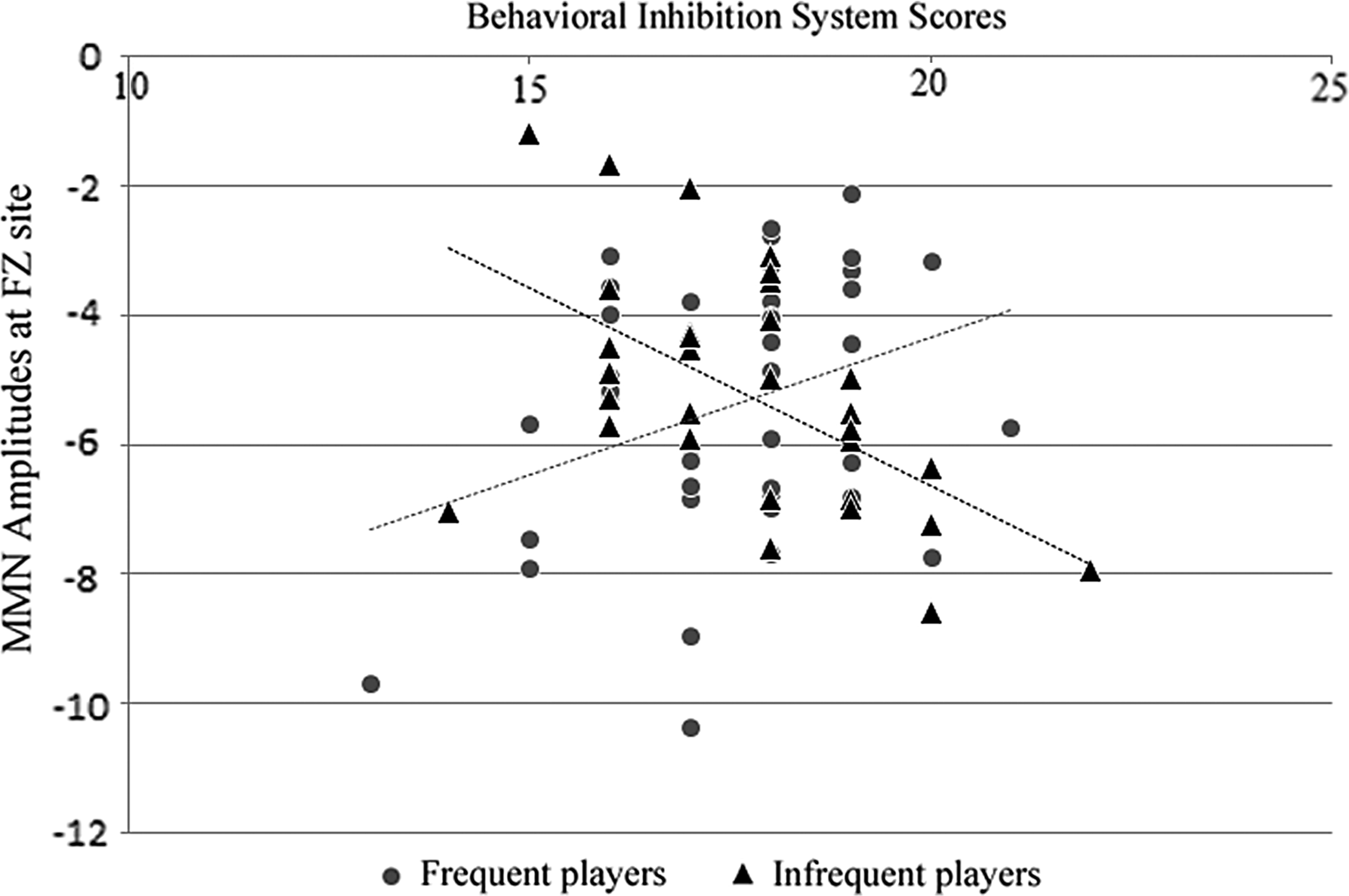
The correlation between mismatch negativity amplitude at FZ and BIS in frequent gamer players (●, r = 0.330) and infrequent game players (▲, r = −0.559).
p < 0.01.
p < 0.05.
IG group, infrequent game players; FG group, frequent game players; MMN, mismatch negativity.
We found positive correlations between BIS scores and MMN latency at some of the frontal and frontocentral electrode sites for the IG group. However, no significant correlations were found for the FG group (Table 2).
For game playing experience, correlations were found between cumulative visits per day and MMN latency at FZ (r = −0.324, p = 0.005) and FCZ (r = −0.318, p = 0.006) in all participants (Fig. 4A). Moreover, the cumulative time spent was correlated with MMN latency at FZ (r = −0.288, p = 0.013) and FCZ (r = −0.292, p = 0.012) (Fig. 4B). In addition, the achieved game levels were correlated with MMN latency at FZ (r = −0.297, p = 0.010) and FCZ (r = −0.282, p = 0.015) (Fig. 4C). According to this correlation analysis, the more time players spent on the game, the greater the decrease in MMN latency.

The correlations between mismatch negativity latency at FZ and cumulative visits by day
Discussion
We hypothesized that the cognitive changes of a nongame domain could be observed by repetitive playing of puzzle games. Moreover, these changes in frequent game players were expected to be associated with cognitive changes as indexed by MMN processing speed. To our knowledge, our study is the first to evaluate differences in auditory cognitive functioning in frequent, but nonpathological, game players compared with those who play games infrequently. Furthermore, we observed whether preattentive auditory processing is linked to the BIS in frequent and infrequent game players who played a puzzle game.
The major finding of the present study was that the cognitive functioning of FG participants, in terms of MMN amplitude and peak latency, was similar to or higher than that of IG participants during the auditory discrimination task. The MMN amplitude was not significantly different between the two groups. However, the latency of the MMN was shorter in the FG group than in the IG group, indicating that the time required for the brain to differentiate a deviant stimulus from a standard stimulus was shorter in the FG than in the IG group. MMN latency is defined as the time that passes before deviant tones can be distinguished from standard tones. A shorter MMN latency is related to enhanced processing speed or timing. Significant correlations were found in all subjects between MMN latency and game experience measures such as the cumulative number of visits per day, cumulative play time, and individual game level. These findings are in line with prior training-related studies that have reported similar findings for the latencies of other event-related potential components such as N200, 35 P300, 36 and N400. 37 Since Dustman et al. reported that frequent game playing improved efficiency of cell assembly in an elderly population, 38 not only visual processing 39 but also higher cognitive functions such as perception, attention, executive function, and memory have been shown to transfer due to the game training effect.7,8 Terlecki et al. reported that improvements were observed in mental rotation as a result of Tetris game training, and these gains were maintained for at least several months. 40 In line with these previous studies, the present results suggest broader cognitive changes from repetitive playing of puzzle games, as reflected in an improved MMN processing speed. Nonetheless, whether game experience transfers to real-world performance remains controversial. One game intervention study suggested that subject's performance on the training games improved, but transfer to untrained tasks was limited. 41 However, multitasking video game training enhanced sustained attention and working memory in older adults, and this enhancement extended to areas of cognitive control that were not part of the training games. 9
Moreover, the association between MMN amplitude and the BIS differed between the FG group and the IG group. The BIS is hypothesized to be sensitive to conditioned aversive stimuli that are related to anxiety, extreme novelty, high-intensity stimuli, and innate fear stimuli. The activation of this system would inhibit behavior. The BIS is associated with a neural circuit that is organized by monoamine neurotransmitter systems. Associated neural structures such as the amygdala and periaqueductal gray matter, 42 the anterior cingulate cortex, 31 and the dorsolateral prefrontal cortex 43 were assumed to underpin this system. A range of accumulated neuroimaging data using EEG showed that the inhibitory process was associated with the dorsolateral prefrontal cortex.43,44 In the present study, the amplitude of the frontal MMN was inversely related to BIS scores for the IG group and positively related to BIS scores for the FG group. According to Hansenne et al., harm avoidance is negatively correlated with MMN amplitude in healthy subjects. 45 Harm avoidance and BIS share a common core that appears to be related to a tendency toward avoidance, 46 a propensity for inhibitory responses to aversive stimuli, 47 and cautious and overly pessimistic behavior and thought. Previous studies are in line with the correlation between MMN amplitude and BIS that was found for the IG group. However, the pattern of correlations between MMN amplitude and BIS score differed for the FG group. This finding may be indicative of variations in other characteristics for the FG group. Although there were interesting correlations between BIS and MMN amplitude for each group, no significant difference was observed in MMN amplitude between two groups.
Several limitations of this study should be mentioned. First, the BIS/BAS scale was based on the results of self-reported questionnaires, which could cause some classification error. Second, the cross-sectional study design limits the interpretation of causal relationships between an increased MMN, an increased BIS score, and the cumulative playing time. Although we could not infer causality from a cross-sectional design, we could examine a game practice effect. The enhanced processing speed that we observed may not be the result of a game practice effect, but rather a pre-existing characteristic of those populations who become frequent game players.
In conclusion, the frequent game players show an enhanced processing speed that may transfer to a nongame domain.35,36 The altered pattern of correlations found in the frequent gamer group is suggestive of changes in the inhibitory system that lead to a different approach to automatic auditory information processing.
Footnotes
Author Disclosure Statement
No competing financial interests exist.