




Abstract
Abstract
This study comprehensively examined the effects of treatment interventions for Internet addiction among adolescents in South Korea through a meta-analysis. We analyzed 70 domestic master's theses and journal articles that reported on controlled studies and involved pre- and post-test analyses in the design. The dates of these publications fall between 2000 and 2015. The total effect size, calculated by random-effect analysis (g), revealed that interventions for the treatment of Internet addiction were effective (ES = 1.838). Meta-ANOVAs revealed differences between groups based on a theoretical model, intervention group size, and intervention duration. Integrative therapy produced larger effect sizes (ES = 2.794) compared to other treatment models such as cognitive behavioral therapy and reality therapy. Effect sizes for interventions, including nine to 12 people (ES = 2.178), were larger than those of interventions including more or fewer participants. Finally, treatment interventions that lasted 8 or more weeks revealed larger effect sizes (ES = 2.294) compared to shorter interventions. The study findings suggest directions for the development and effective operation of future Internet addiction interventions among Korean adolescents. Increasing the effectiveness of these interventions requires an integrative theoretical model, an intervention group size of nine to 12 participants, and a long-term intervention.
Introduction
A
Korean adolescents become addicted to the Internet for the following reasons: availability of broadband infrastructure, easy access to PC bangs (types of LAN gaming centers), lack of space and programs for recreation, high pressure to succeed in university entrance examinations, positive social atmosphere for computer use, and/or lack of parental supervision of Internet use.3,4 Therefore, adolescent Internet addiction is a growing concern in Korea and has become a serious social problem and public health issue. 5
Many studies have identified problems related to Internet addiction. 6 Internet-addicted adolescents are at increased risk of psychological disorders, such as aggression, 7 depression,8,9 loneliness, 10 physical health problems,11,12 social problems,11,13 and academic problems.11,14 Problematic Internet users tend to spend less time with their families than individuals without Internet-related addiction, and experience family discord. 15 In addition, adolescents who use the Internet addictively are more likely to commit cybercrimes 16 and experience suicidal ideation. 17
To solve the problem of adolescents' Internet addiction, the Korean government has established a network of more than 190 counseling centers and has trained 1,043 counselors to assist problematic Internet users. 18 Furthermore, the Korean government has created a variety of programs designed to treat teenagers' Internet addictions.19,20 In addition, the government has developed a Korean version of the Internet addiction measurement scale. 21 Using the scale, the Korean government conducts an annual national survey on Internet addiction. 19
Because the prevalence of Internet addiction is higher in teenagers than in other age groups, and because the Korean government has tried to establish treatment systems for adolescents with Internet addiction, various new adolescent Internet addiction programs have been developed and implemented. Therefore, the current study focuses solely on treatment interventions for adolescent Internet addiction in Korea.
Although there is a growing body of research on the determinants of Internet addiction22,23 and the negative effects of Internet addiction on adolescent development,9,12,16 little is known about the effectiveness of intervention programs for Internet addiction in Korea. 24 Several studies have provided evidence of the effectiveness of group-counseling programs.25–27 However, the question of how best to intervene has not yet been answered.
Meta-analysis enables us to synthesize the treatment outcomes reported in various studies and provide summary statistics. 28 Little research has examined the effectiveness of Internet addiction treatment interventions through meta-analysis. To our knowledge, three meta-analyses, which focused only on Korean studies, have examined the effectiveness of Internet addiction interventions. Park 29 found that both prevention and treatment interventions were effective in decreasing Internet addiction. He also found that the effectiveness of interventions in high school students was greater than in elementary or middle school students and that interventions involving 10 sessions had a greater effect size than short-term interventions. Lee and Kang 30 showed that the effect sizes for all outcome variables were robust, indicating that both prevention and treatment interventions were effective in decreasing Internet addiction. They also reported that the effect of intervention in high school students was greater than that in elementary and middle school students and that long-term intervention was more effective than short-term intervention. In addition, Kim and Cho 31 found that the effectiveness of treatment interventions in high school students was greater than in elementary or middle school students. The greatest effect size was found in treatment programs based on reality therapy and in programs that lasted for more than 10 sessions.
Although several studies have conducted meta-analyses of the effectiveness of Internet addiction intervention programs in Korea, little is known about the moderating effects of program characteristics such as the frequency of sessions per week, program duration, hours of intervention, and number of participants. That is, previous studies did not examine various characteristics together in their analyses and analyses were limited to a circumscribed number of moderating effects.
In addition, previous studies have produced contradictory findings regarding the effects of interventions depending on the theoretical model of the therapy. Park 29 found differences between intervention programs based on reality therapy, cognitive behavioral therapy, and other types of therapy. Lee and Kang 30 found that cognitive behavioral therapy was the most effective type of program, followed by reality therapy, and art therapy. In contrast, Kim and Cho 31 found no differences in effect sizes among various therapeutic approaches.
Because culture influences motivation and Internet use behaviors,32,33 it is particularly important to examine the effectiveness of treatment interventions that were implemented in Korea with a focus on the Korean cultural context. Therefore, the purpose of this study was to examine the effectiveness of various treatment interventions for Internet addiction among adolescents in Korea through a meta-analysis. This study assessed the effectiveness of treatment interventions by analyzing the various moderating effects of gender, age of participants, intervention group size, theoretical model, number of sessions, hours in each session, frequency of sessions per week, and intervention duration.
Methods
Data sources
The present study used data from Korean master's and doctoral theses, as well as articles published in academic journals from 2000 to 2015. The articles were accessed through the Research Information Service System (
Study selection
The materials that were analyzed for data in the current study were reclassified using the following set of standards. First, when the master's and doctoral theses and academic articles were found to contain duplicate data, the academic article version was used. Second, as the targets of the present study were adolescents, interventions were excluded if they included children younger than 10 years, university students, parents, and teachers. Third, the present study examined the effectiveness of Internet addiction treatment interventions. According to the Mental Health Intervention Spectrum report by the Institute of Medicine, 34 preventions are interventions that are delivered before the onset of a disorder and are intended to prevent or reduce the risk of developing a behavioral health problem, such as Internet addiction. Treatment is defined as the provision of services for people diagnosed with an Internet addiction. According to these criteria, this study included only treatment interventions. Fourth, we excluded studies of programs that did not use a group-counseling format. Fifth, this study only included experimental studies that conducted pre- and post-test analyses. We excluded studies that did not provide quantitative, statistically analyzed data, and studies without a control group, even if they qualified as experimental studies. All articles were reviewed according to the inclusion and exclusion criteria listed above. Finally, a total of 70 articles were included in the meta-analysis (Fig. 1).
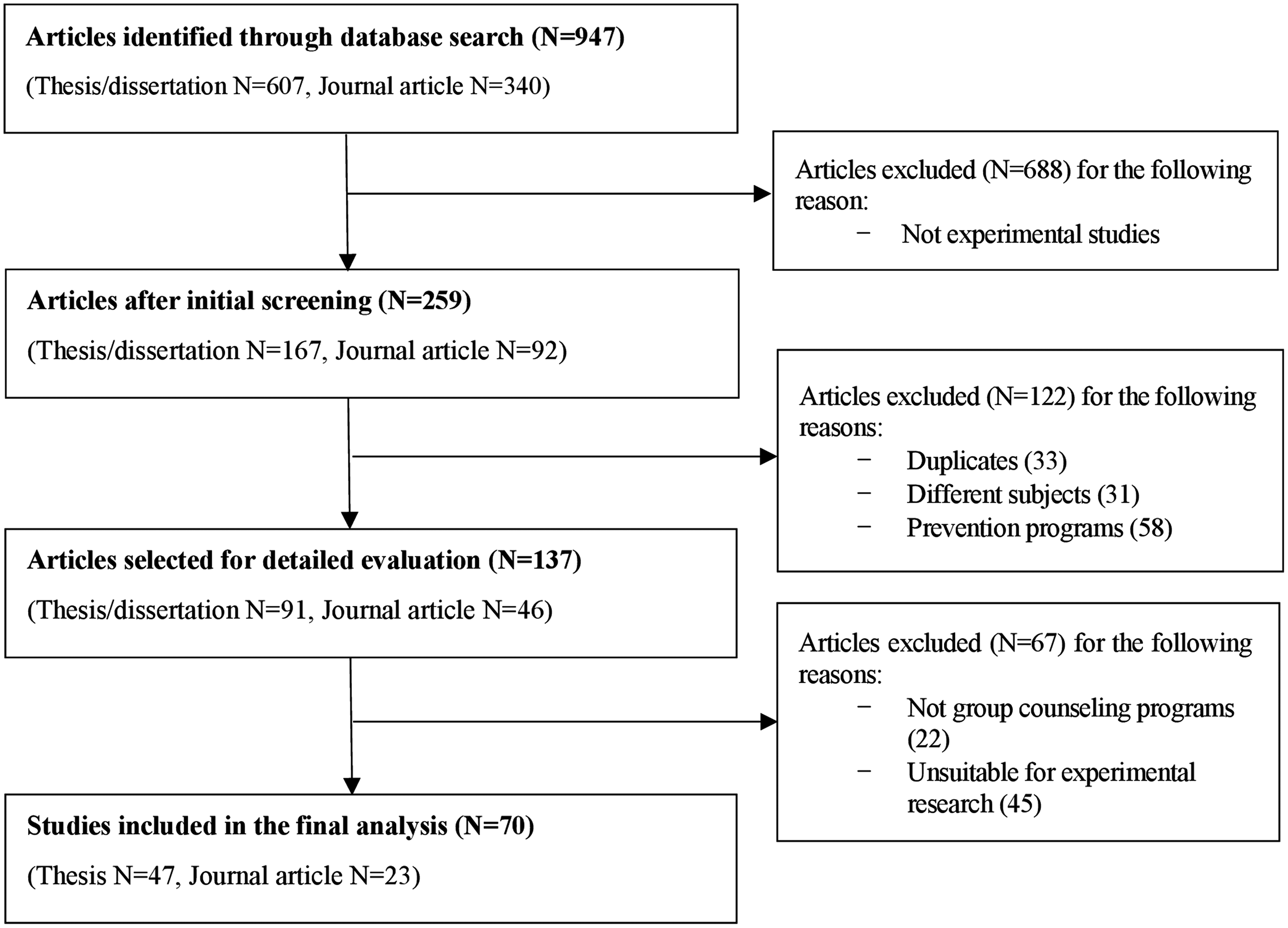
PRISMA Flowchart.
Data extraction
To determine the effect sizes of the treatment interventions reported, the sample sizes of the experimental and control groups and the averages and standard deviations of Internet addiction-related pre- and post-tests were coded as dependent variables.
Publishing formats were divided into thesis and academic journals. Research on Internet addiction began in 2000, and the publications were grouped by the following years: 2000–2005, 2006–2010, and 2011–2015. The target population was divided into elementary school, middle school, and high school students, and gender was classified as male focused, female focused, or both. The theoretical models were coded as cognitive behavioral therapy, reality therapy, art therapy, motivational interviewing, integrative therapy, solution-focused therapy, and others. Data on the number of sessions, intervention group size, intervention frequency, hours in each session, frequency of sessions per week, and intervention duration were entered as continuous variables and grouped. Three researchers coded the target studies, and the results of their coding were subsequently compared. The independent coding of the data showed a match of 96% on individual items, and in cases of mismatch, each item was revisited and resolved after sufficient discussion.
Data analysis
The analyses were performed through total effect analysis and meta-ANOVA using the Comprehensive Meta-Analysis (CMA) software version 3.0.
First, the individual effect sizes of each study were calculated as the Hedges' g effect size, which is a modified Cohen's effect size (d) based on the standardized difference for small samples. 35 Moreover, we assumed that heterogeneity would exist between the studies; thus, the random-effects model was used as it assumes that the true effect sizes differ across studies. The total average effect size was calculated by combining the effect sizes of all studies.
To test for heterogeneity, we calculated the Q-statistic, which considers the degrees of freedom. For the null hypothesis (which posits that all effect sizes are equal) to be rejected, the Q-statistic must be statistically significant; and the proportion of the error variance among the total variance observed from the effect sizes must be significantly higher than expected, given sampling errors. 36 To verify heterogeneity among target studies, the I2 statistic was used in addition to the Q-statistic: the I2 indicates the true effect size variance as a proportion of the total variance. 37
Publishing bias was assessed by calculating how many studies would be required to make the results of the meta-analysis nonsignificant using Rosenthal's 38 fail-safe N method. 36 Rosenthal 38 asserted that this figure (N) does not need to be very large to be credible and suggested 5k+10 as the standard for N. As 5 × (70) +10 = 360, the fail-safe N is 360 or greater. This indicates that the data used in this study are generally stable.
Results
Characteristics of studies
There were 47 master's theses and 23 academic articles (Supplementary Table S1; Supplementary Data are available online at
The theoretical models applied to Internet addiction treatment interventions were as follows: cognitive behavioral therapy in 12 articles, reality therapy in eight, art therapy in six, motivational interviewing in four, and integrative therapy in four articles. The number of participants in the intervention group was most frequently between 9 and 12 people (39 articles). The number of intervention sessions was most frequently 10–12 (39 articles). Forty-seven articles involved session lengths of more than 1 hour and 19 involved sessions lasting less than 1 hour. The intervention frequency was twice per week in 41 articles. The intervention duration was 5–7 weeks in 29 articles (Table 1).
Effect sizes of interventions
The total effect size, calculated by random-effect analysis (g), was 1.838, with a 95% confidence interval (CI) of 1.564–2.112. This effect was statistically significant. Moreover, Q = 404.229 (df = 69, p < 0.001), which indicated that the effect sizes were not equal. The I2 value was 82.930, indicating a high level of heterogeneity (Table 2). 37
Effect sizes according to intervention characteristics
The difference between groups according to the theoretical model was statistically significant (Qb = 16.068, dfb = 6, p < 0.05). The effect sizes of each theoretical model were as follows: integrative therapies, such as art-cognitive behavioral therapy and integrative art therapy, had a significantly large effect size of 2.794. Next, reality therapy had an effect size of 2.231. For art therapy, solution-focused therapy, and cognitive behavioral therapy, the effect sizes were 2.043, 1.999, and 1.841, respectively.
There was a significant difference in the effect size according to the intervention group size (Qb = 6.461, dfb = 2, p < 0.05). When the number of people in the intervention group was between 9 and 12, the effect size was high, at 2.178. When the group included fewer than nine people, the effect size was 1.613. When the group included 13 or more people, the effect size was 1.385.
In addition, the effect size based on the intervention duration was statistically significant (Qb = 10.194, dfb = 2, p < 0.01). When the intervention duration was 8 or more weeks, the effect size was high, at 2.294. Interventions with a duration of 5–7 weeks had an effect size of 2.079; interventions that were less than 5 weeks in duration had an effect size of 1.294 (Table 3).
Discussion
Korea has high prevalence of adolescent Internet addiction, and the Korean government plays a leading role in developing and providing Internet addiction treatments. Evaluation of Internet addiction treatment interventions for Korean adolescents is needed within their cultural context. Therefore, the present study confirmed the effectiveness of adolescent Internet addiction treatment interventions, which were developed and executed to date in Korea through a meta-analysis of effect sizes based on intervention characteristics.
The total effect size of the Internet addiction treatment interventions was 1.838. This is similar to Oh and Kim (ES = 1.89), 39 and Kim and Cho (ES = −1.90). 31 The current results present larger effect sizes than in Park's meta-analysis, 29 in which the effectiveness of treatment programs was 1.10, and in Lee and Kang's meta-analysis, 30 which reported an effect size of −1.314. Consistent with the previous studies, the results of the current study indicate that Internet addiction programs are effective for treating Internet addiction in high-risk groups.
The results of this study, which showed that the effects of integrative therapy including art-cognitive behavioral therapy, integrative arts therapy, and motivational interviewing and cognitive behavioral therapy were substantial, indicate that a comprehensive and diverse approach that accounts for adolescent characteristics is necessary. Park 29 reported the following effect sizes in decreasing order: integrated approach, reality therapy, cognitive behavioral therapy, and other therapy types. That is, they found significant differences according to the theoretical model used. Oh and Kim 39 revealed effect sizes in decreasing order of art therapy, therapy with parents, and integrated approaches.
In addition, there were differences among groups according to the intervention group size. As group interventions are most effective when the total number of subjects is between nine and 12, it may be that members of these groups mutually interact and develop a sense of belonging to the group. Interventions that lasted 8 or more than 8 weeks were most effective, followed by those lasting 5–7 weeks, and then by those lasting less than 5 weeks. Such results are generally consistent with those of Lee and Kang 30 (more than 9 weeks >6–8 weeks > less than 5 weeks), although Lee and Kang's investigation involved both prevention and treatment interventions. Recovery from addiction is not evaluated by simply ceasing the problematic activity. It is a developmental process that requires time, and the difference in effect sizes based on intervention duration can be regarded as reflecting the importance of long-term programs and consistent efforts. It is likely that group members who work together for a long-term intervention develop a therapeutic relationship with one another, which might include a sense of belonging, acceptance, commitment, and allegiance to the group, resulting in long-lasting behavioral changes and symptomatic improvement.
Evidence-based practice is understood as the optimal intervention process that considers the characteristics of the clients, and is based on scientific evidence. 40 For a policy or practice to be effective, it should integrate the results of previous studies, and rely on the results of meta-analysis. 41 High-quality meta-analysis can provide the most persuasive scientific evidence 42 and contribute to evidence-based practice. Therefore, the findings of the present study illuminate the potentially effective treatments for Internet addiction. To treat adolescent Internet addiction, relevant interventions should be actively developed and implemented based on the findings of this meta-analysis. Increasing the effectiveness of these interventions requires long-term intervention and a diverse and integrative theoretical model. Furthermore, interventions involving between nine and 12 participants are recommended for future programs.
Because culture influences the motivation and Internet use behaviors, it is very important to develop and implement treatment interventions that include cultural considerations. Na and colleagues 32 found that Korean adolescents showed lower belongingness and higher loneliness compared to Australian adolescents. Moreover, Korean adolescents used online media for companionship, in contrast to Australian adolescents, who did so to seek information. That is, Korean adolescents tend to use online media to resolve their belongingness and loneliness issues. This result supports that promoting positive peer relationships offline and decreasing loneliness should be addressed in intervention programs for Internet addiction among Korean adolescents.
In addition, one of the factors that influence adolescent Internet addiction in Korea is the educational environment, which focuses on university entrance examinations and which produces high levels of academic stress. 4 Reflecting this aspect of Korean culture, school-based interventions could be considered. Since a lack of parental supervision is also one of the risk factors among Korean adolescents, 3 parental education is needed to help parents to learn appropriate parental supervision for their children.
Despite its strengths, the analyzed interventions lacked basic data on the qualifications of the counselors, intervention location, or detailed statistics. To improve the meta-analysis, future intervention-related studies should include this basic information in a detailed, quantifiable manner. In addition, medium- and long-term effectiveness analyses are required.
As Internet addiction arises from a myriad of simultaneous factors, rather than from a single factor, society urgently needs various interventions that consider addiction levels and influential factors, as well as the distribution of information on treatment interventions that have been proven effective. To intervene in adolescent Internet addiction, methods for maintaining and maximizing the effectiveness of these interventions should be continuously studied.
Footnotes
Acknowledgments
This work was supported by the Ministry of Education of the Republic of Korea and the National Research Foundation of Korea (NRF-2015S1A5A2A01009674).
Author Disclosure Statement
There are no conflicts of interest by any author.
References
Supplementary Material
Please find the following supplemental material available below.
For Open Access articles published under a Creative Commons License, all supplemental material carries the same license as the article it is associated with.
For non-Open Access articles published, all supplemental material carries a non-exclusive license, and permission requests for re-use of supplemental material or any part of supplemental material shall be sent directly to the copyright owner as specified in the copyright notice associated with the article.
