




Abstract
Abstract
Ever since the emergence of social networking sites (SNSs), it has remained a question without a conclusive answer whether SNSs make people more or less lonely. To achieve a better understanding, researchers need to move beyond studying overall SNS usage. In addition, it is necessary to attend to personal attributes as potential moderators. Given that SNSs provide rich opportunities for social comparison, one highly relevant personality trait would be social comparison orientation (SCO), and yet this personal attribute has been understudied in social media research. Drawing on literature of psychosocial implications of social media use and SCO, this study explored associations between loneliness and various Instagram activities and the role of SCO in this context. A total of 208 undergraduate students attending a U.S. mid-southern university completed a self-report survey (Mage = 19.43, SD = 1.35; 78 percent female; 57 percent White). Findings showed that Instagram interaction and Instagram browsing were both related to lower loneliness, whereas Instagram broadcasting was associated with higher loneliness. SCO moderated the relationship between Instagram use and loneliness such that Instagram interaction was related to lower loneliness only for low SCO users. The results revealed implications for healthy SNS use and the importance of including personality traits and specific SNS use patterns to disentangle the role of SNS use in psychological well-being.
Introduction
Social networking sites and loneliness
L
Scholars' interests in the relationship between technology use and loneliness can be traced back to the pre-SNS era. For instance, Kraut et al. 3 studied Internet use in U.S. households and found that more time spent using the Internet was related to an increase in loneliness. This attention to the impact of overall technology use (e.g., amount, frequency, or intensity of use) has been carried over to research on SNSs. However, findings on the relationship between overall SNS use and loneliness have been mixed. While some studies show that SNS use is related to lower loneliness 4 and more social capital, 5 others find that SNS users are more lonely than nonusers. 6 Still others suggest that social media use is irrelevant to users' offline network size and does not make users feel emotionally closer to their offline contacts. 7
The inconclusive results suggest that it would be necessary to study more than just overall SNS usage. Indeed, Kraut and Burke 8 proposed what could be viewed as an activity-audience framework, which suggests that to advance our understanding of the implications of communication technologies, scholars need to move beyond overall usage and attend to what users do online and with whom they interact in cyberspace. The dimension of activities, in particular, has gained increasing attention in recent years (see below), and yet findings of many activities remain ambiguous.
SNS usage/activities can be roughly divided into three categories: passive, active, and interactive. In general, interactive usage, defined as using SNSs to interact and socialize with others (e.g., commenting, sending an SNS message), is related to lower loneliness.6,9–11 On the contrary, passive activities in which users simply consume or browse the SNS content are typically related to higher loneliness and lower well-being,9,12 although a null relationship has also been reported. 11 The third type, active usage, involves actively producing content on SNSs, but the content is not directed to specific individuals (e.g., updating status or broadcasting information on SNSs without tagging specific viewers), and thus, the activity is not necessarily interactive in nature. This last category has been largely understudied, but an example of this type of activity, Facebook status update, has been found to be associated with both higher and lower loneliness.11,13 It appears that except for interactive usage, the associations between other types of SNS activities and loneliness remain unclear, which hinders scholars from concluding specifically how SNS use would influence users' psychological well-being.
Social comparison orientation
It is noteworthy that the relationship between SNS use and loneliness should be more sophisticated than what can be summarized with simple direct associations. After all, SNS use and its implications vary by users' personality traits.14,15 While most studies on SNS use and personality focus the Big Five model, 16 social comparison orientation (SCO), 17 an important personality construct, has not been thoroughly studied.
SCO refers to “the inclination to compare one's accomplishments, one's situation, and one's experiences with those of others.” 18 (p16) The SCO theory is established based on Festinger's theory of social comparison. 19 Festinger proposes social comparison as a natural process for self-evaluation when individuals lack objective criteria to assess their abilities and opinions. To make their self-evaluation accurate, individuals tend to choose those who are perceived to be similar to themselves as the targets for comparisons. Later, scholars expand Festinger's theory, arguing that individuals can perform different types of social comparison to achieve goals other than self-evaluation. For instance, they can engage in upward social comparison, or comparing themselves with superior others, to improve themselves; they can also conduct downward social comparison, or comparing themselves with inferior others, to enhance their subjective well-being.20,21
According to the SCO theory, people vary in their tendencies of making comparisons with others. Those who have a strong orientation for social comparison have three characteristics. First, they have a high chronic activation of the self, meaning they have a high level of both public and private self-consciousness. Second, they are socially oriented, reflected by their interest in, empathy for, and sensitivity to others' needs and feelings. Third, they tend to have negative affectivity and uncertainty of the self and thus often have low self-esteem and high neuroticism. 18
SCO is particularly important in the social media context because SNSs provide rich opportunities for social comparison, which can influence one's psychological well-being. Specifically, on SNSs, individuals engage in more upward social comparison than downward social comparison. 22 It is likely because most users present highly positive self-images on SNSs, 23 and thus, SNS platforms are filled with targets for upward social comparison, which often leads to envy 24 and low self-esteem. 22
It appears that users of high SCO may have different experiences using SNSs, compared with users of low SCO. To date, however, there has been little research exploring this possibility. Only one study (by Vogel et al.) shows that SCO is correlated with greater overall Facebook use, and people of high SCO experience poorer self-perceptions, lower self-esteem, and a more negative affect after viewing a Facebook Friend's profile. 25 While this study focused on self-related outcomes, it is curious how SCO may moderate associations between SNS use and psychological variables involving social components, such as the feeling of loneliness. After all, SNSs are social platforms and high SCO individuals are socially oriented. In addition, Vogel et al. 25 only studied a passive activity (viewing a Friend's profile), and the moderating role of SCO for other SNS activities has not been examined. These gaps need to be filled to better understand what kind of users may benefit from or be harmed by their SNS use.
Current study
This study had two goals. First, it aimed to clarify the associations between loneliness and specific SNS activities. Second, it explored how SCO would moderate the relationships between SNS activities and loneliness. Although existing literature offers some clues to these relationships (e.g., interactive SNS use is likely to relate to lower loneliness), most associations of interest are unclear (e.g., those between loneliness and active or passive activities and how they would vary by one's SCO level). Thus, the study is exploratory in nature. Two research questions were proposed:
To address these research questions, a survey study sampling college students was conducted. Findings of the study were expected to expand our understanding of the implications of SNS use by presenting a sophisticated picture of how specific SNS activities would relate to users' psychological well-being and how these associations would vary by individual differences in the orientation for social comparison. The purpose of the study is in line with Kraut and Burke's 8 advocacy of moving beyond the oversimplified depiction of SNS impact. The more sophisticated picture may provide a ground for future researchers to continue investigating the nuances of SNS use in relation to users' well-being.
Method
Participants
Participants were 208 undergraduate students between the ages of 18 and 25 (Mage = 19.43, SD = 1.35) attending a U.S. university in the mid-south (78 percent female; 57 percent White, 27 percent Black). Research information was announced through e-mail to all freshmen and face-to-face in various courses involving students of different years across departments. Compared with the university undergraduate population (59 percent female, 51 percent White, 34 percent Black), female was slightly overrepresented while the ethnic distribution was similar. This study focused on Instagram, a popular SNS among young people. 26 As part of the research requirement, all participants had to use Instagram for at least a few times a week. All of them filled out an online self-report survey after informed consent.
Measures
Control variables
Participants reported their sex, ethnicity, year in college, and numbers of Instagram followers and followees. To increase the accuracy of their report, participants were instructed to check their Instagram page before reporting the numbers.
Instagram activities
Our research team designed a five-point Likert scale (1 = Never, 5 = A lot) measuring participants' frequency of engaging in various Instagram activities. Exploratory factor analysis (EFA) was performed, with principal factor axis being the extraction method and promax the rotation method. Items with low loadings on all factors (loadings <0.30) or with close loadings on multiple factors (the difference between the absolute values of the two largest loadings <0.10) were eliminated. Factor loadings of the final items ranged from 0.62 to 0.98. Cross-loading was not a concern in the final scale as all loading differences were greater than 0.55. More details of the analytical procedure and factor loadings of each item are available in another report using the same sample. 27 Factor loadings are also accessible at Open Science Framework. 28
Results of EFA suggested that there were three types of Instagram activities. IG interaction (two items; α = 0.79; r = 0.66, p < 0.001) included communication directly involving other people (“Comment on or reply to others' posts,” “Tag others in your posts or comments”). IG browsing (two items; α = 0.77; r = 0.63, p < 0.001) measured users' frequency of reviewing the newsfeed/home page and checking out others' profiles (“Browse the home page/newsfeed without leaving comments,” “Check out others' profiles without leaving comments”). IG broadcasting (two items; α = 0.60; r = 0.43, p < 0.001) focused on activities of sharing information that was not directed to specific individuals (“Post/Upload on your profile without tagging anyone,” “Post something that is not directed to specific people”). These three subscales corresponded to the interactive, passive, and active (but noninteractive) SNS use previously identified in literature, respectively.
Social comparison orientation
Eight items from the Iowa-Netherlands Comparison Orientation Measure 17 were adopted to measure SCO (α = 0.83). Participants indicated how well each statement applied to them on a five-point Likert scale (1 = Not at All, 5 = Very Well). Sample items included “I compare what I have done with others as a way to find out how well I have done something” and “I compare how I am doing socially with other people.” Higher scores reflected higher SCO.
Loneliness
The 20-item UCLA Loneliness Scale Version 3 29 was used. Participants indicated how often they felt in the way described by the survey items on a four-point Likert scale (1 = Never, 4 = Always). Sample items included “You lack companionship” and “You are isolated from others.” Higher scores reflected greater loneliness (α = 0.93).
Results
Descriptive statistics and correlations of the major variables are available in Table 1.
Note: Loneliness was measured on a four-point Likert scale; others were measured on a five-point Likert scale.
*p < 0.05, **p < 0.01, ***p < 0.001.
SD, standard deviation; IG, Instagram; SCO, social comparison orientation.
SCO was related to more Instagram interaction (r = 0.25, p < 0.001) and Instagram browsing (r = 0.22, p = 0.002), but was not associated with Instagram broadcasting (r = 0.01, p = 0.85).
Loneliness was regressed on the three Instagram activities, SCO, and the moderation terms, controlling for users' sex, year in college, ethnicity, and numbers of Instagram followers and followees. The three Instagram activity variables and SCO were all centered before being entered into the model. The moderation terms were created by multiplying the centered independent variables (Instagram activities) by the centered moderator (SCO). All variance inflation factors of the variables of interest were below 1.31, suggesting that multicollinearity was not a big concern.
In response to RQ1, both Instagram interaction (β = −0.18, p = 0.018) and Instagram browsing (β = −0.17, p = 0.023) were related to lower loneliness, whereas Instagram broadcasting was associated with higher loneliness (β = 0.21, p = 0.006). Regarding RQ2, SCO moderated the relationship between Instagram interaction and loneliness (β = 0.17, p = 0.018) such that Instagram interaction was related to lower loneliness, but only for users who were less inclined to compare themselves with others (see Table 2; Fig. 1). Moderation effects for neither Instagram browsing nor broadcasting were significant (βs = −0.02 to −0.04, ps = 0.55–0.74).
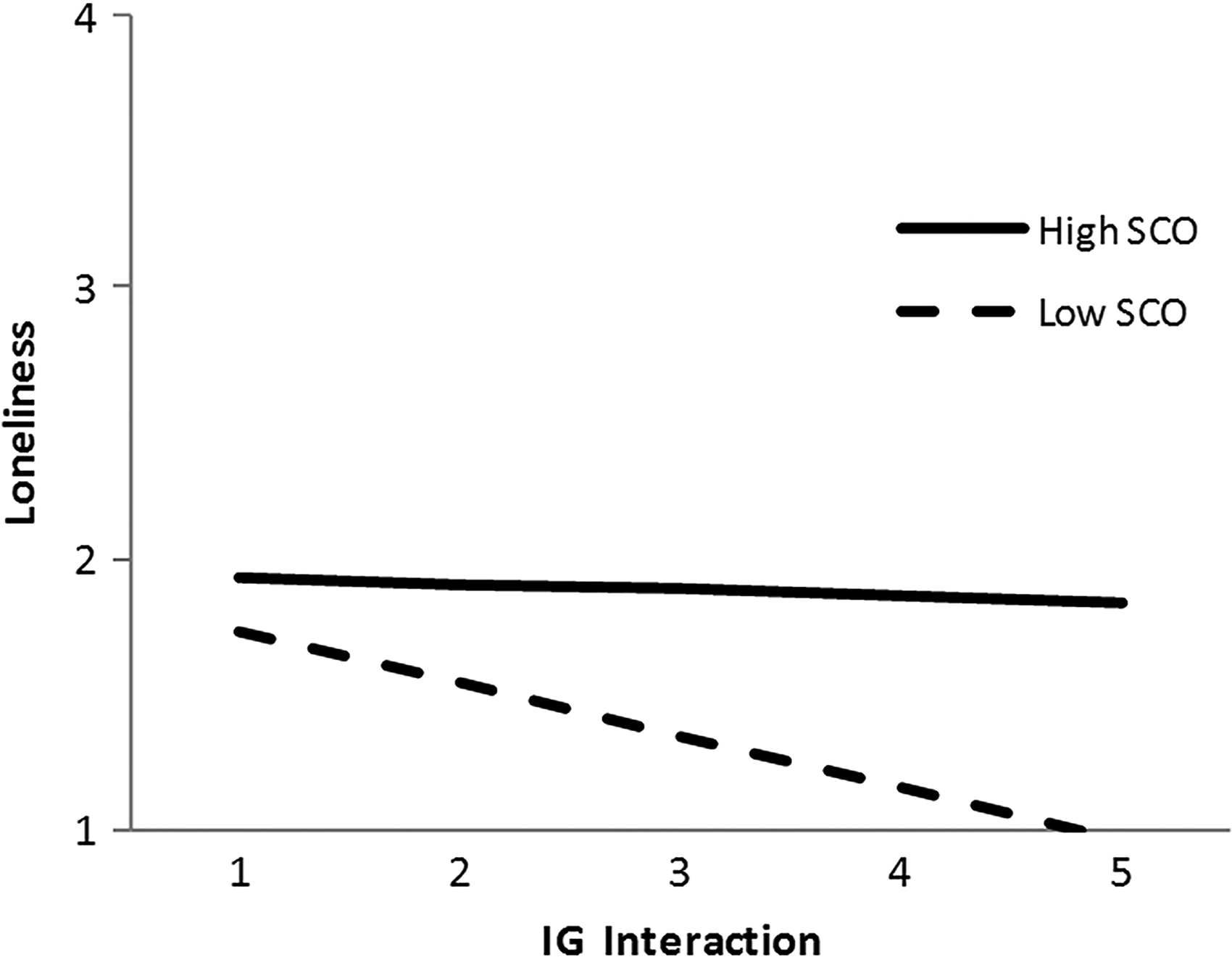
SCO moderating the association between Instagram interaction and loneliness. SCO, social comparison orientation.
Note: The reference group of ethnicity was White. The following variables were centered: IG interaction, IG browsing, IG broadcasting, SCO; the moderation terms were created by using the centered variables.
p < 0.05, **p < 0.01, ***p < 0.001.
SE, standard error.
Discussion
Instagram activities and loneliness
The first research question explored how different SNS activities would be related to loneliness. Results showed that the activities typically regarded as interactive (interaction) and passive (browsing) were both related to lower loneliness, whereas broadcasting, an active (but noninteractive) type of activity, was related to higher loneliness. It appears that some activity labels may not be accurate enough (e.g., Is browsing really that passive? See below). To avoid confusion, specific activity names (interaction, browsing, and broadcasting) instead of the category labels are used in the following passages.
The observed relationship between Instagram interaction and lower loneliness was consistent with previous findings showing that using social media to interact with others is related to greater psychosocial well-being.6,9–11 It may suggest that online interaction makes users feel more connected and less lonely. Alternatively, it could reflect the fact that less lonely users are more social and thus engage in more online interactions.
It was unexpected, however, that Instagram browsing was also associated with lower loneliness, given the research documenting negative relationships between passive use of social media and psychosocial well-being.9,10,12 A possible explanation is that Instagram browsing may not be as passive as it appears. Many college students rely on SNSs to learn about their peers, 30 and thus, Instagram browsing could be a prelude to actual social interaction. From this perspective, “content consumption” may be a less misleading label than “passive use” for online browsing. In addition, it is speculated that the mere presence of social media devices can remind individuals of the large network they have, even when people are not actively using them. 31 Instagram browsing may thus reduce loneliness by bringing to users' attention the potential contacts they have. It is, however, noteworthy that some types of SNS content consumption may be more detrimental than beneficial. For instance, SNS surveillance has been found to relate to envy, which leads to higher depression. 32 Therefore, future research should differentiate among different types of browsing or SNS content consumption.
Instagram broadcasting was related to higher loneliness. This pattern has also been identified in previous research studying loneliness and a comparable SNS activity, Facebook status updating. 11 SNS postings can be a channel for support seeking, but such support seeking messages are sometimes vague. 33 It is possible that frequent Instagram broadcasters are seeking attention or support through this undirected communication. And yet, if their followers fail to recognize the intention or do not feel motivated to respond, it could make the broadcasters feel unsupported and isolated. Future researchers should study whether the relationship between broadcasting and loneliness is contingent upon the quality and quantity of feedback received by the broadcaster.
SCO as a moderator
The second research question focused on how SCO further moderated the relationship between Instagram activities and loneliness. One moderation effect was identified: Instagram interaction was related to lower loneliness only for people who were less inclined to perform social comparison. In other words, the potential benefit of Instagram interaction was suppressed among high SCO users. It is likely because users of high SCO engage in upward social comparison, the more common form of social comparison on SNSs, 22 during the interaction. When high SCO users tag their friends and comment on or reply to friends' messages, they may notice how many comments their friends have already received or how many social events their friends seem to have attended. Exposure to such information could make users of high SCO feel that their social connectedness is not as satisfactory as others', thus cancelling out the potentially positive impact of SNS interaction. Even when the information encountered does not imply one's social connectedness, people of high SCO can still generate poor self-perceptions due to negative affectivity and uncertainty of the self. 18 This sense of inferiority may lead to social disengagement (to avoid further upward social comparison and threat to self-esteem), which again suppresses the positive association between SNS interaction and well-being. Intriguingly, the moderation effect of SCO was significant only for Instagram interaction, but not for browsing or broadcasting, suggesting that the tendency of social comparison may be particularly activated or influential in active interpersonal transactions.
The first glance of the null effect of SCO as a moderator in the browsing–loneliness association may seem contradictory to previous research findings. In particular, Vogel et al. 25 found that people of high SCO reported poorer well-being after viewing another person's Facebook profile. A closer investigation of the seemingly inconsistent findings, however, suggests that the attention devoted to the SNS content may be key to whether actual social comparison is triggered. Vogel et al. 25 adopted an experimental design, in which participants were instructed to evaluate a casual friends' or acquaintance's posting habits and personality traits after viewing the person's Facebook profile for five minutes. To accomplish the evaluation task, the participants were likely to pay close attention to what was posted on the acquaintance's profile. In addition, given the short amount of time required, the participants could be fully committed to the task (i.e., browsing) without distraction. When people browse Instagram in real life, however, even users of high SCO may not read others' posts as carefully, and thus, SCO does not sour the impact of browsing. This finding expands our understanding of how SCO operates in social media use outside of an experimental setting.
Contributions, Implications, and Limitations
Findings of this study clarified the relationships between loneliness and several SNS activities. In particular, the benefits of Instagram browsing rarely discussed in previous literature were identified. While some types of SNS content consumption, such as surveillance, are detrimental to one's psychological well-being, 32 SNS browsing in general may actually facilitate social connectedness. The implications of Instagram broadcasting were also illuminated, which could expand the literature of both psychological well-being in relation to social media use and online self-presentation. In addition, this study included SCO, an understudied personality trait that is highly relevant in the social media context. Previous research shows that SNSs provide rich opportunities for social comparison and are particularly appealing to users of high SCO.22,27 Findings of this study further revealed that SCO was correlated with SNS interaction and browsing (but not broadcasting), but high SCO users did not benefit much from SNS interaction.
SNS users and mental health professionals may consider these findings and promote healthy SNS use among themselves or their clients who suffer from lack of satisfactory social connectedness. In general, using SNSs to interact with others or browsing SNS content may reduce the feeling of loneliness. On the contrary, frequent SNS broadcasting could be a sign of loneliness, and the broadcasted messages may be a call for support. Increasing such awareness among mental health professionals and general social media users would allow them to offer timely assistance. For SNS users who have a strong inclination for social comparison, they may need to be more mindful of their SNS use, trying not to compare themselves with others when performing SNS interaction so that the activity could be more beneficial for their well-being.
Despite the contributions and implications, this study had several limitations. First, it was based on data collected at a single time point, and thus, the causal directions were not confirmed. Longitudinal designs are required to ascertain the directionality. Second, the participants were recruited from a public university, which was a unique setting with its own culture, and thus, the readers need to be cautious not to overgeneralize the results to younger and older SNS users or even college students attending other types of university. Finally, because loneliness results from dissatisfaction with one's own social connectedness, 1 a comprehensive study of loneliness should include indicators of one's interaction with others. As mentioned above, future researchers may consider investigating how many and what comments SNS users receive in response to their own posts and how those indicators influence the users' psychological well-being. It should also be noted that as an exploratory study, its findings were not meant to be taken as definitive answers to the question of how SNSs influence users' well-being. Rather, they should be viewed as a reminder of the diverse implications SNSs can have and probably serve as a foundation for future research that adopts an explanatory or meta-analytical approach.
In sum, this study showed that SNS use could be related to both higher and lower loneliness, depending on how the platform was used, and that the relationship was further moderated by users' tendency for social comparison. The diverse associations echo researchers' call for including personal attributes, specific SNS use patterns, and psychosocial outcomes in a given study to better understand the implications of SNS use. 34
Footnotes
Author Disclosure Statement
No competing financial interests exist.