




Abstract
Abstract
The present study explored social and psychological predictors of social networking site (SNS) and mobile phone dependency in a sample of emerging adults (ages 18–25, n = 159, M = 21.87, SD = 2.08) and young adults (ages 26–40, n = 97, M = 31.21, SD = 4.11). Path analysis revealed that SNS dependency mediated the relationship of social comparison, SNS support, and impulsivity on mobile phone dependency. Impulsivity also showed direct links to mobile phone dependency. The present findings suggest that individuals with a strong orientation toward social comparison, who perceive a strong sense of support through SNS networks, or who show difficulty with self-regulation may be at risk for SNS and mobile phone dependency.
Introduction
E
Impulsivity, difficulty with self-regulation, is a defining feature of behavioral dependency,3,4 including SNS5,6 and mobile phone dependency.7,8 A related concept, sensation seeking, the drive to seek novelty, 9 has also been implicated in SNS 10 and mobile phone dependency 11 and other addictive behaviors. 12 SNS and mobile phone dependency may be fueled by a desire to experience new exciting stimuli, coupled with poor impulse control.
Social factors play an undeniable role in mobile phone and SNS use. For example, getting support from others is the most important reason young people list for using SNSs. 13 Communicating with friends and family on SNSs is associated positively with perceived social support.14,15 SNSs offer the unique opportunity to seek social support from people who are known only virtually and who are otherwise strangers, as well as to maintain contact with faraway friends and acquaintances. Similar to findings regarding social support, perceived support received through online social relationships is associated with self-esteem and reduced feelings of depression and loneliness. 16 Individuals who are lonely and find face-to-face interaction challenging may be more likely to use online means of communication, perhaps viewing it as easier. 17 They may find social support online, devote more time to SNS interactions, and may find it difficult to regulate their use.18–20 Perceptions of social support through SNSs may uniquely predict problematic SNS use, apart from traditional measures of social support.
Participation in SNSs offers opportunities for social comparison. Individuals are naturally driven to compare themselves with others to understand themselves and their place in the world. 21 SNSs promote social comparison as they enable users to create profiles and view others' profiles, allowing the comparison of experiences. SNS participation involves exploring and presenting different aspects of the self 22 and may play a role in how people understand and define themselves.23,24
To date, research on SNS and mobile phone dependency has focused nearly exclusively on samples of high school and, more often, college students.6,25 Although recent prevalence surveys show that adults of all ages use mobile phones and SNSs,26,27 it is unclear whether the research findings based largely on college students, emerging adults, can be extended to adults of other ages. Emerging adulthood is a unique period of development spanning roughly from age 18 to 25, distinct from young, middle, and older adulthood and characterized by exploration, self-focus, and the subjective sense of being in-between, neither adolescent nor adult.28,29 Some of the predictors of mobile phone and SNS dependency show developmental changes during emerging adulthood. For example, sensation seeking and impulsivity tend to decline over adolescence into emerging adulthood, 30 potentially influencing patterns of SNS dependency. Emerging adults may show a distinct pattern of predictors of SNS and mobile phone dependency compared with young adults over the age of 25, who may, in turn, show greater psychosocial maturity. Research has shown that adults show lower rates of SNS and phone use and dependency than adolescents.2,31 However, it is unclear whether predictors and patterns of SNS and mobile phone dependency vary among adults, whether the likelihood of dependency shifts from emerging adulthood to young adulthood. The purpose of this study was to examine predictors of SNS and mobile phone dependency in a sample of emerging adults, aged 18–25 years, and young adults, aged 26–40 years. The present study addressed two broad research questions.
Prior research would suggest age differences in nearly all of the variables, with emerging adults also reporting higher rates of SNS and mobile phone use and dependency.
Figure 1 illustrates the proposed relationships among age, psychological and social variables, and SNS and mobile phone dependency. Age is expected to predict impulsivity, sensation seeking, and self-esteem. Social comparison is a means of learning about oneself, a task of emerging adulthood 29 ; therefore, age is expected to predict the use of social comparison. The few studies to date that have examined SNS and mobile phone dependency together have suggested that it is a dependence on SNSs that drives mobile phone dependency.32,33 SNS dependency, therefore, is proposed to mediate the relationships between both social and psychological variables and phone dependency. Specifically, social comparison, social support, and SNS support are expected to positively predict SNS dependency, extending prior findings.14,15,18–20,34,35 Similar to prior work, impulsivity and sensation seeking are expected to positively predict SNS dependency5–8,10 and are also permitted direct links to mobile phone dependency. 11

Hypothesized relationships among age and social and psychological predictors of SNS and mobile phone dependency. SNS, social networking site.
Methods
Participants
Three hundred ten U.S. adults aged 18–68 years were recruited through Amazon Mechanical Turk (MTurk). Given our interest in examining distinctions among emerging and young adults, who comprised 83 percent of the sample (51 participants were between the ages of 41 and 64 and 3 were over the age of 65), the analyses included only adults age 40 and under. The resulting sample consisted of 256 U.S. adults ranging in age from 18 to 40 (M = 25.41, 62 percent female). Sixty-seven percent identified as white, 14 percent black/African American, 8 percent Asian/Pacific Islander, 7 percent Hispanic/Latino, and 4 percent other. Nearly all participants reported having a cell phone (98 percent) and using SNSs (98 percent). Participants were divided by age group to represent emerging adults (ages 18–25, n = 159; M = 21.87, SD 2.08) and young adults (ages 26–40, n = 97, M = 31.21, SD 4.11).
Measures
SNS and mobile phone use
Participants reported daily mobile phone use on a 5-point scale representing usage of less than 1 hour each day, between 1 and 2 hours, between 3 and 4 hours, or 5 hours or more each day, including an option to indicate if they did not own a phone. SNS use was rated on the same scale. Table 1 presents the response scale, sample items, means, standard deviations, and Cronbach's alpha for all measures.
SNS, social networking site.
Mobile phone dependency
Participants responded to 8 items from the Mobile Phone Problem Use Scale. 2
SNS dependency
Seven items from the Social Media Addiction Scale 36 measured SNS dependency.
Impulsivity
Participants responded to 7 items from the Barratt Impulsivity Scale. 37
Sensation seeking
A short 6-item version of the Zuckerman Sensation Seeking Scale 30 measured sensation seeking.
Self-esteem
Self-esteem was measured with 7 items from the Rosenberg Self-Esteem Scale. 38
Social support
Seven items from the Multidimensional Scale of Perceived Social Support 39 measured perceived social support.
SNS support
A 4-item scale measured the degree of support participants perceive from their SNS networks. 40
Social comparison
A shortened 6-item version of the Social Comparison Orientation Scale 41 examined participants' orientation toward social comparison.
Procedure
Participants were recruited online through the Amazon Mechanical Turk (MTurk) Web site, completed the survey on Survey Monkey, and received a small monetary compensation (10 cents) upon completion. MTurk is a platform through which registered users can complete computerized tasks, including surveys, for a nominal financial incentive. Research has suggested that samples recruited by MTurk yield data comparable with traditional samples of college students and community members.42,43 MTurk workers show similar patterns of responses to measures of personality characteristics,44,45 political orientation, 46 risk behavior, 47 and body image 48 and responses to classic psychological experiments such as the prisoner's dilemma 49 and measures of basic biases in decision-making. 50
Results
Table 2 lists the bivariate correlations. A 2 × 2 (gender × age group) multivariate analysis of variance (MANOVA) explored age and gender differences in each of the variables. There was a main effect on gender, F(10, 243) = 3.166, p = 0.001. Table 3 presents the significant gender differences as per the univariate analyses. There was no main effect of age, F(10, 243) = 1.385, p > 0.05. The interaction was not significant, F(10, 243) = 0.790, p > 0.05.
p < 0.01; *p < 0.05.
A path model tested the proposed relationships described in Figure 1. Initial analyses suggested that non-normality and multicollinearity were not a concern. Given that the MANOVA indicated a nonsignificant main effect for age, it was excluded from the path model. Amos 23 was used to obtain maximum likelihood estimates of the model parameters. 51 The path model's goodness of fit was judged with the following criteria: comparative fit index (CFI) of 0.95 or greater, adjusted goodness-of-fit index (AGFI) of 0.90 or greater, root mean squared error of approximation (RMSEA) of less than or equal to 0.08, and standardized root mean square residual (SRMR) of less than 0.05.52–55 The results of this analysis are shown in Figure 2. The χ 2 global fit index was significant, meaning that the sample data are a poor fit to the theoretical model (χ 2 = 9.88, df = 3, p = 0.02). Other indices also suggest an inadequate fit (CFI = 0.98; AGFI = 0.89; RMSEA = 0.10; SRMR = 0.02).

Path analysis testing the hypothesized relationships among SNS and mobile phone dependency. **p < 0.001; *p < 0.01.
As suggested by Jöreskog and Sörbom, 53 the model was adjusted by removing nonsignificant paths. Although this method is data driven, it remains theoretically meaningful and is consistent with the hypothesized model. Figure 3 illustrates the final model. The χ 2 global fit index was not significant, suggesting good model fit (χ 2 = 5.35, df = 2, p = 0.07). Given that chi-square estimates are sensitive to sample size, Hu and Bentler 52 suggest a χ 2 /df ratio of 5 or less as indicating good model fit (χ 2 /df = 2.58 for the present data). Other indices suggested a good fit (CFI = 0.99; AGFI = 0.94; RMSEA = 0.08, SRMR = 0.02). As hypothesized, SNS dependency predicted phone dependency; SNS dependency mediated the relationship of SNS support, social comparison, and impulsivity on phone dependency; and impulsivity showed direct links to phone dependency. The model accounted for 35 percent of the variance in SNS dependency and 61 percent of the variance in mobile phone dependency.
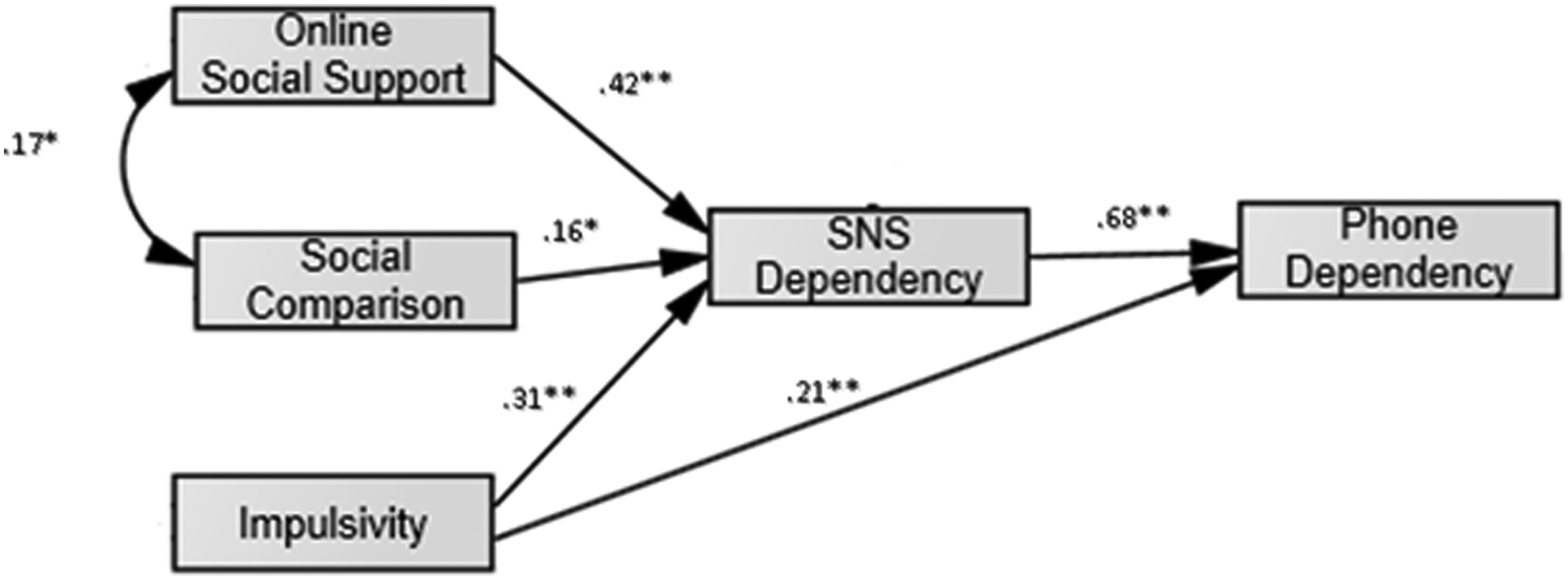
Final path model illustrating mediational relationship of SNS and mobile phone dependency. **p < 0.001; *p < 0.01.
Discussion
The present study examined psychological and social predictors of SNS and mobile phone dependency in a sample of emerging adults and young adults. Although prior research has suggested that with age, adults are less likely to display symptoms of SNS and phone dependency, 2 the present findings indicate no age differences. Prior studies sampled a wider age range of adults than the present sample, spanning from emerging adulthood (age 18) to older adulthood (up to 85 years of age). The lack of age differences in the present sample may be due to the smaller age range examined, emerging adults and young adult ages, and who tend to share similarities in social technology use. For example, in 2009, 73 percent and 72 percent of adolescents, age 12–17, and adults, age 18–29, (who today are emerging and young adults, respectively) reported participating in SNSs. 56
The present findings of no age differences in self-esteem, sensation seeking, and impulsivity contrast with prior research, indicating that all three show substantial development from adolescence to emerging adulthood.30,57 However, developmental changes from emerging adulthood to young adulthood, as examined in this study, may be smaller in magnitude and more gradual. Future research should sample a wider age range to examine patterns of change in SNS and mobile phone dependency and their predictors over the course of adulthood rather than emphasizing differences between adolescents and adults, or emerging adults and young adults.
As hypothesized, SNS dependency predicted mobile phone dependency and mediated relationships among the psychological and social predictors and mobile phone dependency. Specifically, impulsivity, social comparison, and perceptions of SNS support predicted SNS dependency, which, in turn, predicted mobile phone dependency. Impulsivity also showed a direct link to mobile phone dependency, suggesting that difficulties in behavioral regulation may place individuals at risk for problematic use of social technology. This is consistent with findings that impulsivity is a feature in common with behavioral addictions, such as gambling and Internet use. 58
Unique to this study are findings regarding the predictive value of social comparison for SNS dependency. Individuals with a strong orientation toward social comparison tend to be highly sensitive to others and may experience more uncertainty and instability in their self-concept, determining their self-worth through comparisons with others.35,41 Individuals with a strong orientation toward social comparison may turn to SNSs to explore their emerging selves, share their profiles, and draw comparisons with others, similar to the offline experimentation essential to establishing a sense of identity.23,24 The present findings suggest that individuals with a strong orientation toward social comparison may be at risk for SNS dependency, and in turn, mobile phone dependency, relying on SNSs to satisfy their drive to learn about and evaluate themselves through comparisons with others. Further research is needed to understand this process by gathering information about the nature of SNS participation and consumption, how these interactions reflect and contribute to self-conceptions, and what role SNS participation plays in identity development. Are individuals with strong orientations toward social comparison more likely to explore through SNS use? Do patterns among social comparison, SNS sharing, and SNS dependency change with age as identity issues are revisited?
Prior research has suggested that those who lack social support in everyday life tend to turn to online sources of support to replace contact with family and friends.17,19 The present findings are inconsistent with this perspective as SNS dependency was predicted only by perceptions of social support received through SNSs, not everyday social support from family and friends. Individuals may not necessarily trade one type of support for the other.59,60 For example, in one study, despite substantial overlap between college students' online and offline friends, many indicated that their closest SNS friends were different than their closest offline friends. 61 Individuals may use SNSs to maintain and strengthen connections with offline friends that they do not encounter often in their day-to-day lives. Further research should examine the degree and nature of support that places individuals at risk for SNS dependency. What types of interactions and relationships pose risks for problematic SNS use? When does perceived social support through SNSs cross the threshold from predicting well-being to SNS dependency?
Several limitations must be considered in drawing conclusions from the present study. Participants were solicited from an online job board and therefore may be more technologically savvy than, and not representative of, their peers. According to the Pew Research Center, SNS use is ubiquitous with 90 percent of adults, age 18–29, reporting using SNSs 27 compared with 99 percent in our sample. The use of community samples can improve the generalizability of future work. A second limitation concerns the use of self-report measures, which are sensitive to biases such as social desirability that may influence participants' disclosure. Future research might pair self-report measures with other methods, such as observations of SNS behavior. Third, conclusions about development in this study were based on cross-sectional data. Longitudinal data are needed to determine whether our inferences about development, in this case, the lack of age differences, are supported. Finally, although path analysis permitted us to examine proposed relationships among the variables, causality cannot be inferred as the data are correlational. Future research might experimentally manipulate variables, such as priming social comparison tendencies, to determine their influence on SNS and mobile phone dependency.
In conclusion, the present study offers several unique contributions to understanding SNS and mobile phone dependency. First, emerging adults and young adults report similar levels of SNS and mobile phone dependency. Second, difficulties in self-regulation predict mobile phone dependency directly and indirectly, through SNS dependency. Finally, SNS dependency motivates mobile phone dependency and mediates the effects of social comparison and perceived SNS support on mobile phone dependency. That is, the tendency to engage in social comparison, to self-evaluate in reference to others, and perceiving supportive SNS relationships predict problematic use of SNSs and, in turn, mobile phone dependency. Further work is needed to understand how patterns of interactions on SNSs (what is shared and consumed and by whom) influence users' sense of support and how support, along with tendencies toward social comparison, relates to problematic use of SNSs.
Footnotes
Author Disclosure Statement
No competing financial interests exist.