




Abstract
Abstract
With the increased adoption of mobile devices, mobile communication is all around us and we are connected anywhere, anytime. Mobile communication in general and mobile messenger service in particular make interpersonal communication in Korea so frequent and convenient. However, being connected too much anywhere and anytime via mobile messenger service appears to lead an increasing number of people to feel fatigue and to decrease mobile communication under some conditions. Based on a sample of 334 respondents, this study empirically investigated the relationships among commercial, noncommercial mobile messenger overload, mobile messenger fatigue, relational self-concept, and mobile shunning behavior. The findings show that (a) the effect of noncommercial mobile messenger overload is stronger than that of commercial mobile messenger overload in increasing mobile messenger fatigue although both positively affect mobile messenger fatigue, (b) relational self-concept has moderating effects on the relationship between mobile messenger overload and mobile messenger fatigue, and that (c) mobile messenger fatigue triggers mobile communicators' shunning behavior through which the communicators increase their intention to avoid mobile communication, to change their mobile phone numbers, and to subscribe to dual number service on one mobile device. When confronted with mobile messenger fatigue caused by mobile messenger overload, mobile messaging service users are likely to shun their mobile communication. Being constantly and conveniently connected appears to be a blessing in disguise.
Introduction
R
As the amount of commercially or socially oriented mobile communication increases, however, there is mounting evidence of the negative effects of mobile communication on mobile communication users.3–5
Consistent with this observation, in a recent survey in Korea on the use of smartphones/mobile communication, 60 percent of the respondents said that they feel uncomfortable with the “anytime anywhere connected” feature of smartphones. 6 According to the survey, more than 57 percent of the respondents attributed their discomfort with mobile communication to mobile messenger services. At the heart of this phenomenon in Korea is the rapid diffusion of a mobile messenger service named Kakao Talk. It is the Korea's number one mobile messaging service app with group chats, photo sharing, mobile call, advertising, game, commerce, payment features, and the like. A mobile messenger service in general refers to an instant messaging service utilizing a variety of technologies. Since you can send and receive instant messages basically free of your mobile carrier's extra charges, mobile messenger apps serve as the most convenient and powerful means of mobile connection. In this context, Shin and Kim 7 showed that the more time you spend on your mobile messaging services, the less time you spend on your mobile calls and texts. Thus, it seems that mobile messenger services are behind the increased traffic of mobile communication in Korea.
Although Kakao Talk and a social networking service (SNS), such as Facebook, have something in common, it is crucial to note that mobile messaging services are “closed,” whereas typical SNSs, such as Facebook and Twitter, are “open.” These “closed” communication services differ from “open” services in that they let only the user and “invited” family and friends to communicate via messages and photos. These services give users the benefits of deeper communication and better protection of their privacies. 8 However, the “closed” nature of a mobile messaging service, such as Kakao Talk, appears to increase the stress or fatigue of the users.
In line with Lazarus and Folkman's stress-coping model, 9 people cope when confronted with stress or fatigue. That is, when faced with undesirable situations, people are likely to either change the way they evaluate the situation, change their behavior, or attempt to change their environment. 10 The negative effects associated with the overuse or misuse of mobile communication in general and mobile messaging service in particular may range from increased levels of stress and fatigue to addiction. The negative effects appear to be further amplified by the “closed” nature of mobile messenger services and by the way people perceive themselves relative to others. To cope with this stress or fatigue, mobile messenger users are either likely to change the evaluation of stress or fatigue, change their mobile communication behavior, or try to change their mobile communication environment.
Mobile messenger overload
The number of instant messages sent via mobile messenger services in 2013 amounts to 10.3 trillion exceeding the 6.5 trillion short message service (SMS) messages by far. The number of instant messages in 2018 is expected to reach 37.8 trillion. 11 In Korea, mobile messaging is the number one reason behind the use of smartphones, 12 and more than 95 percent of smartphone users use mobile messenger services. 13 Thus, mobile messaging services may represent mobile communication in Korea. Mobile communication refers to “information exchange between a sender and a receiver on wireless mobile devices.”14–15
Overload has been one of the big issues with regard to the negative consequences of information and communication technology. 16 Communication overload can be defined as “difficulty in understanding an issue and making decisions caused by too much communication.” That is, communication overload can be experienced when communication demands exceed the communication capacities of the users. 17 Similarly, mobile messenger overload refers to “communication overload via mobile messaging.”
In this context, Moon 18 maintains that consumers in an information society live unintendedly in the environment of over communication of commercial information and that an increasing amount of uncalled for advertising messages are behind this phenomenon. Thus, unsuspecting mobile communicators are highly likely to experience commercial messenger overload when businesses send too much commercial messages for them to handle.
Commercial communication is defined as “any form of communication designed to promote the goods, services, or image of a company.” 19 Commercial mobile communication can be achieved via mobile “push” messaging or/and mobile “pull” messaging. 20 Mobile push messaging refers to “any content sent by or on behalf of advertisers and marketers to a wireless mobile device at a time other than when the subscriber requests it.” 21 Pull messaging refers to “any content sent to the wireless subscriber upon request.” 22 Kakao Talk in Korea sends pulled messages to the messenger users on a permission basis. However, the time, the frequency, or the content of permission-based advertising messages are not under the users' control. Kakao Talk users may not always welcome commercial messages even though they have given permission for businesses to do so.
In contrast, noncommercial communication can be defined as “any form of communication not related to commercial interests.” Thus, noncommercial communication overload is experienced when too much noncommercial communication is sent by friends, acquaintances, and colleagues. Noncommercial communication enables users to have effective mobile communication with broad audiences. 23 In Korea, the use of SNS is on the decrease. 24 Thus it is highly likely that the better part of social communication is done via mobile messenger services in Korea. Accordingly, mobile messenger users are highly likely to experience noncommercial messenger overload when they receive too much noncommercial messages via mobile messenger services.
Mobile messenger fatigue
Since fatigue is concerned with an individual's subjective feelings/experiences either psychologically or physically, it has been variously defined and researched in many contexts.25–27 This study defines mobile messenger fatigue as “a subjective feeling of tiredness from the use of mobile messenger service.” The intensity of mobile messenger fatigue experienced in the same mobile communication overload situation is likely to vary across different users of a mobile messenger service. Mobile messenger fatigue and SNS fatigue 4 have something in common in that both concepts are related to “digital fatigue,” which deals with the concept of fatigue mediated by digital devices. 28
An instant message via a mobile messenger service such as Kakao Talk is typically from someone that you are familiar with. You are not supposed to neglect any message from them. In addition, Korea's gregarious culture may bring other problems to mobile communication users. Some workers feel obligated to respond to the SNS posts of their workplace superiors. 8 This rather cultural obligation may not only increase the amount of mobile messaging but increase the level of stress or fatigue at the same time.
SNS information and communication overload were found to increase SNS fatigue. 4 People are getting more involved with a mobile messenger service than with a SNS as noted above. Moreover, the “closed” nature of a mobile messaging service appears to increase the fatigue of the users because a typical user is not supposed to neglect messages from those invited members that he or she is familiar with. Thus, when faced with mobile messenger overload, users are more likely to experience mobile messenger fatigue.
Relational self
It is well known that people seek to increase the fit between their self-concept and their behavior. Self-concept in general refers to a set of beliefs about oneself. Since an individual functions in relation to others, self-concept is of interpersonal nature. 29 Self-concept can be classified into three fundamental self-representations: the collective self, the relational self, and the individual self. That is, people try to achieve self-definition in terms of (a) group membership, (b) dyadic relationships, and (c) their unique traits. Specifically, the collective self is attained by inclusion in big groups (i.e., in-group) and differentiating the in-group from relevant out-groups, while the relational self is attained by assimilating oneself with significant others. The individual self is attained by making oneself differentiated from others in terms of unique traits. The three representations of self may coexist within the same person. 30
Relational self seems to be appropriate in explaining mobile communication behavior arising from various dyadic relationships. In Korea, more emphasis is laid on collectivism than on individualism. Korea can also be characterized by high-context culture, where “social self” is more important than “private self.” Thus, saving face is emphasized.31–34 In this context, demand for instant reply to a message and “anytime anywhere” mobile communication is strong. 35 Koreans tend to keep their relationship with others even though the relationship is less than satisfactory. 36 Koreans are also likely to have a high level of need to achieve their personal goals via their social networks. 37 Considering the role of culture in shaping the concept of relational self in Korea, two of the seven dimensions of relational self-concept 38 appear to be appropriate in examining the moderating effects of relational self on mobile messenger overload. Specifically, instrumentational relational self is concerned with “assimilating oneself with significant others to achieve his or her objectives.”39,40 Other-directed relational self has to do with “differentially assimilating oneself with significant others depending upon who the significant others are.” A higher level of relational self may be associated with more tolerance with and fatigue from mobile messenger overload based on dyadic relationships even when the communication is no longer welcomed.
Mobile shunning
Behavioral changes in the stress-coping model have been understood primarily in terms of substitution. Shelby and Vaske 41 proposed a two-by-two “substitution typology.”
When faced with mobile messenger overload and fatigue, a mobile messenger user may substitute one or more of the behavioral choices in the typology for his or her current mobile messaging behavior. Thus, in order for a mobile messenger user to cope with mobile messenger fatigue, he or she may (a) be engaged in mobile messaging at a different (i.e., delayed) time using the same mobile device to reduce mobile communication (temporal substitution), (b) be engaged in mobile messaging with a smaller number of invited subscribers using a new mobile device/number in hopes of decreasing mobile communication (resource substitution), (c) decrease, or stop mobile messaging, or even use a different type of mobile communication, if needed, on the same mobile device (activity substitution), or (d) combine (b) and (c) using a new mobile device/number to avoid mobile communication (resource and activity substitution).
In this respect, it is interesting to note that “shunning” in a religious sense has been associated with “excommunication” which consists of a prefix “ex” plus “communication.” In line with this observation, the concept of mobile shunning is proposed and defined in this study as “behavioral intention to avoid mobile communication.” The findings of an online survey 6 are consistent with type (1) mobile shunning (i.e., temporal substitution) in that 74.9 percent of mobile messenger users surveyed intentionally delay confirming incoming instant mobile messages. Type (2) mobile shunning in the related context of intention to discontinue SNS42,43 has been investigated. However, type (3) or type (4) mobile shunning has not been studied in any context yet. Mobile shunning in this study was operationalized in three different alternatives to capture type (2), (3), and (4). First, mobile communication avoidance was defined as the intention to decrease mobile messaging. Second, dual-number service was defined as the intention to subscribe to “two number service on a single mobile device.” That is, this refers to the intention to add a new number on the same mobile device. Third, phone number change was defined as the intention to change mobile phones (thus numbers). That is, this refers to the intention to quit using the current phone number and get a new phone number.
Based on the above observations, this study attempts to explain under what conditions the increase in mobile messaging paradoxically leads to the decrease in mobile communication. Specifically, this study empirically examines the (a) relationships among different types of mobile messenger overload, mobile messenger fatigue, and mobile shunning behavior and the (b) moderating effects of relational self on the relationship between mobile messenger overload and fatigue.
Methods
Research design and data collection
Nonexperimental research design was utilized to accomplish the purpose of this study. To empirically examine the relationships among mobile messenger overload, mobile messenger fatigue, relational self-concept, and mobile shunning behavior, the structural equation modeling (SEM) approach was used. SEM allows for a simultaneous test of the psychometric properties of each measurement scale and for an analysis of the direction and the strength of the structural relationships among multiple constructs effectively. To this end, online survey was carried out by a professional marketing research firm and 334 responses were input for the final statistical analysis. The data were collected from Kakao Talk users in 13 regions across the country, including Seoul, the political and economic capital of Korea. Online surveys were conducted during a 4-day period in March 2016. Table 1 summarizes the demographics of the respondents.
Measurement development and instrument validation
In developing the measurement instruments, all the constructs were measured on a 7-point Likert scale with anchors of “strongly disagree ( = 1)” to “strongly agree ( = 7).” Commercial messenger overload (e.g., “I receive more commercial messages through mobile messenger service than I can process.”), noncommercial messenger overload (e.g., “I receive more noncommercial messages through mobile messenger service than I can process.”), and mobile messenger fatigue (e.g., “After a session of mobile messaging, I feel really fatigued.”) scales were adapted from Lee et al. 4 Two dimensions of relational self, instrumental relational self (e.g., “When I am with someone competent, I feel strong.”), and other-directed relational self (e.g., “I care about how other people think about me.”) were adapted from Bang et al., 44 which proposed a Korean version of relational self. Mobile communication avoidance (e.g., “I intend to reduce the use of mobile communication”) and dual number service (e.g., “I want to subscribe to dual number service”) scales were adapted from Lee 45 and Hong et al., 46 and phone number change (e.g., “I am likely to change my mobile phone number”) scale was adapted from Cho and Kim. 47
Four steps were followed when evaluating the validity of the measurement model. First, Cronbach's alpha was used to examine the internal consistency of the measurement constructs. The test resulted in Cronbach's alphas >0.7 for all constructs, supporting the reliability of the measurement constructs. 48
Second, exploratory factor analysis (EFA) using varimax rotation via SPSS 18 was conducted to check for additional evidence of measurement validity. All the items were loaded on their intended factors and their factor loadings were above the cutoff value of 0.5. 49
Third, a confirmatory factor analysis (CFA) via AMOS 18.0 was conducted to examine the convergent validity of the constructs. The standard deviation, loading, composite reliability (CR), average variance extracted (AVE), and Cronbach's alpha of the measurement items are presented in Table 2. Each item loading lower than 0.5 squared multiple correlation was eliminated to meet the overall CFA model fit. 50 All standardized factor loadings were >0.6. CR and Cronbach's alpha for all constructs exceeded 0.7, and the AVE for each construct was >0.5 except noncommercial messenger overload ( = 0.492). Since AVE of noncommercial messenger overload was close to the threshold, noncommercial messenger overload did not appear to be problematic.
AVE, average variance extracted; CMO, commercial messenger overload; CR, composite reliability; DNS, dual number service; IRS, instrumental relational self; MCA, mobile communication avoidance; MMF, mobile messenger fatigue; NMO, noncommercial messenger overload; ORS, other-directed relational self; PNC, phone number change.
Fourth, as shown in Table 3, the discriminant validity of the constructs was assessed, via AMOS 18.0, by comparing the AVE of each construct to the “interconstruct” correlations. The AVE of each construct was larger than the squared root of all the related interconstruct correlations and thus the discriminant validity of all scales was established. 51 Overall, enough evidence was gathered for the validity of the measurement model.
The main diagonal shows AVE.
Results
The results of the analysis of structural and measurement relationships in the research model are presented in Table 4 and Figure 1. Table 4 presents the overall model fit indices. As the table shows, good model fit indices were obtained; all the indices except the adjusted goodness of fit index (AGFI) met the relevant criteria. Since the AGFI is very close to the threshold level, the model fit indices suggest that the research model is valid in general.
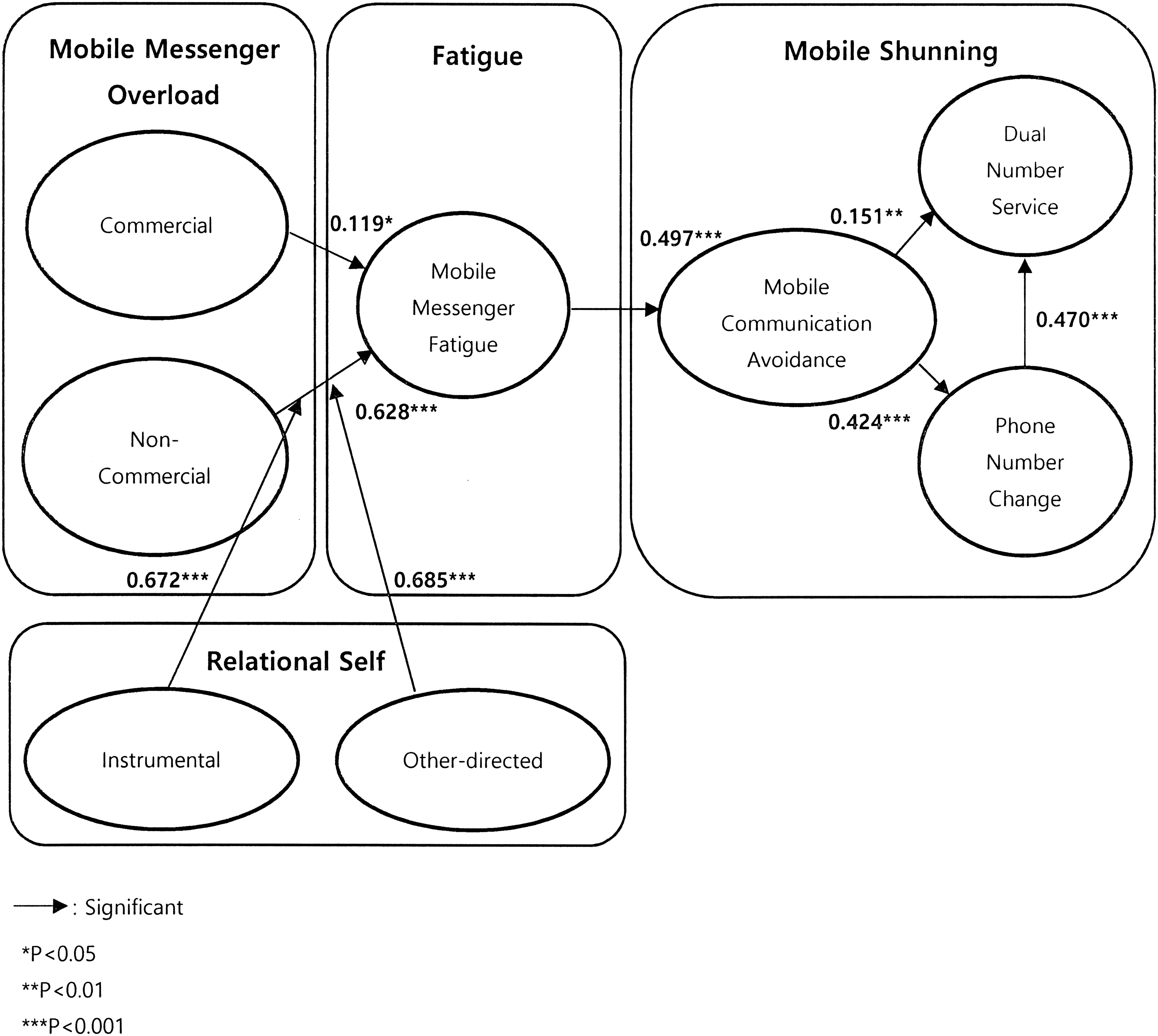
Structural model.
AGFI, adjusted goodness of fit index; CFI, comparative fit index; GFI, goodness of fit index; IFI, incremental fit index; NFI, normed fit index; RFI, relative fit index; RMSEA, root-mean-squared error of approximation; TLI, Tucker–Lewis index.
Figure 1 shows the results of the analysis of structural relationships. First, commercial messenger overload and noncommercial messenger overload were found to increase mobile messenger fatigue with statistically significant coefficients of 0.119 (p < 0.05) and 0.628 (p < 0.001), respectively. Next, mobile messenger fatigue was found to have a significant positive effect on mobile communication avoidance with a coefficient of 0.497 (p < 0.001). The effect of mobile communication avoidance on dual number service was found to be significant with a coefficient of 0.151 (p < 0.01), and the effect on phone number change was also significant with a coefficient of 0.424 (p < 0.001). Phone number change was found to significantly increase dual number service with a coefficient of 0.470 (p < 0.001). Meanwhile, the moderating effects of instrumental dimension of relational self-concept and other directed dimension of relational self-concept on the relationship between noncommercial messenger overload and mobile messenger fatigue were found to be significant with coefficients of 0.672 (p < 0.001) and 0.685 (p < 0.001), respectively.
Discussion
Both commercial messenger overload and noncommercial mobile messenger overload were found to increase the level of mobile messenger fatigue. A cursory look at Table 3 and Figure 1 shows that mobile messenger users experience slightly more commercial messenger overload (i.e., mean of 3.90) than they experience noncommercial messenger overload (i.e., mean of 3.46). However, the effect of noncommercial messenger overload (i.e., coefficient of 0.628) on mobile messenger fatigue is bigger than that of commercial messenger overload (i.e., coefficient of 0.119). Commercial messages on Kakao Talk are permission based. The permission can be withdrawn at any time. The locus of control by the mobile messenger users with regard to commercial messaging may be relatively high. Thus, the users are likely to feel less fatigue. 52 In comparison, when coupled with the closed nature of mobile messaging, it may be harder to disregard noncommercial messages than to disregard commercial messages. Contrary to a common sense expectation that commercial messenger overload may be the key to increased mobile messenger fatigue, 18 noncommercial messenger overload appears to play the major role in increasing the fatigue.
The moderating effects of the two dimensions of relational self on the relationship between noncommercial messenger overload and mobile messenger fatigue were found to be significant. The more an individual wants to assimilate oneself to significant others and achieve his or her goals, or to differentially assimilate oneself with significant others depending upon who they are, he or she is more likely to put up with noncommercial messenger overload, thereby leading him or her to experience a higher level of mobile messenger fatigue. It is rather ironic that a higher level of relational self may be associated with more tolerance with mobile messenger overload and with more fatigue as a result. Thus, if an individual hopes to achieve his or her goals via assimilating with significant others, he or she is supposed to pay a price.
Consistent with Lazarus and Folkman's stress-coping model 9 and the findings of research on the consequences of SNS fatigue,42,53 a higher level of mobile messenger fatigue would lead a person to avoid mobile communication. He or she would decrease or delay mobile messaging/communication. It is somehow counterintuitive that the beauties of mobile messaging lead a person to experience messenger overload and eventually to avoid mobile communication. A person with a higher level of intention to avoid mobile communication is also likely to change numbers and/or subscribe to dual number service on the same mobile device. Changing (cell phone) numbers is clearly different from changing mobile messenger services using the same device. This shunning alternative needs more resources and run the risk of excluding (or being excluded by) part of significant others. Subscription to dual number service requires less resource. This shunning behavior is preferred by those who are willing to classify significant others into “private versus public group.” This way, subscribers may cut down on mobile messaging with the public group. Those who intend to avoid mobile communication appear to prefer “changing phone numbers (i.e., coefficient of 0.424)” to “subscribing to dual number service (i.e., coefficient of 0.151).” Again, those who intend to change phone numbers are more likely to subscribe to dual number service as an affordable shunning alternative.
The findings of this research are qualified by some limitations. Although every effort was made to increase the representativeness of the research sample, the sample suffers from the disadvantages of nonprobability sampling, which reduces the external validity of the research findings.
All things considered, this study offers some insight into the paradoxical nature of mobile messaging. People may want to communicate anytime anywhere via mobile messaging, but they do not seem to enjoy “being communicated with” anytime anywhere. A growing number of people shun mobile communication when they feel fatigue caused by overuse of commercial and noncommercial messages. These mobile shunning alternatives may serve as a wake-up call for mobile messenger service providers to find ways to reduce communication overload and as an ironic but new market opportunity for mobile service providers to capitalize on. Overall, coupled with the evidence that mobile communication may negatively affect relationship quality, 1 anytime anywhere feature of mobile messaging appears to be a blessing in disguise.
Footnotes
Acknowledgment
This research was financially supported by Hansung University.
Author Disclosure Statement
No competing financial interests exist.