




Abstract
Abstract
Through social media and camera phones, users enact selective self-presentation as they choose, edit, and post photographs of themselves (such as selfies) to social networking sites for an imagined audience. Photos typically focus on users' physical appearance, which may compound existing sociocultural pressures about body image. We identified users of social networking sites among a nationally representative U.S. sample (N = 1,686) and examined women's and men's photo-related behavior, including posting photos, editing photos, and feelings after engaging in upward and downward social comparison with others' photos on social networking sites. We identified some sex differences: women edited photos more frequently and felt worse after upward social comparison than men. Body image and body comparison tendency mediated these effects.
Introduction
C
Objectification theory 2 and social comparison theory 3 serve as frameworks for exploring self-presentation and social comparison using photographs on social media. Affordances of SNSs, especially photo sharing features, promote objectification of the self and others. Previous studies have associated Internet use 4 and specifically SNS use with body image issues.5–8 Images on SNSs and the visibility of social feedback among one's social network (e.g., comments, “likes”) may encourage social comparison. The goal of this study was to examine variables that influence users' photographic self-presentation and comparison to others' photographs on social media.
Photographic self-presentation on social networking sites
Self-presentation involves a conscious effort to enact behaviors to create a desired persona for an audience.9,10 Individuals use impression management strategies to present themselves in positive ways and achieve social goals. 9
Affordances featured on SNSs are optimized for forming and managing impressions. Like most computer-mediated communication, SNS interactions are asynchronous, which promotes editability. 11 SNS users can actively choose how to portray themselves and revise information that they share. 12 This capability is important, given one's self-presentation is visible to a broad interconnected network of users, which may include friends, family, romantic interests, or the general public,13,14 and SNSs enable network members to post social feedback that is visible to others. 15 As such, SNS users typically have the experience of feeling monitored by this imagined audience.13,16 According to objectification theory, this experience of objective self-awareness has implications for one's self-image, particularly among women.
Objectification and social media
Objectification theory states that women are socialized to take an outsider's perspective of themselves and critically evaluate their worth based on societal standards, such as prioritizing one's appearance. 3 As women are socialized in an objectifying culture by interpersonal ties and media, they begin to self-objectify, internalizing this perspective and learning to value themselves based on appearance. 3 Self-objectification has been tied to several detrimental outcomes, including depression, body shame, and disordered eating.3,17
Although objectification theory is rarely used in SNS research, studies comparing men's and women's self-presentation on SNSs support the theory's claims that women experience greater social pressure about their physical appearance. Compared to men, women demonstrate a greater focus on their appearance on their SNS profiles, 18 sexualize themselves more often, 19 and post more selfies. 20 Furthermore, women report greater self-presentational concerns than men regarding the pictures they post 18 ; women and girls feel pressured to conform to gender and beauty norms and post attractive pictures.21,22 These findings indicate the pressure for females to focus on their appearance carries over to online networks. Thus, we expect that women will report posting pictures of themselves more frequently (H1) and editing these pictures more frequently (H2) than men will.
Although objectification theory has noted that women are typically under more societal pressure, recent work indicates that men's appearance concern has grown over time. Men also experience body dissatisfaction, and this influences the way they present themselves to others. 23 One study found that a negative body image predicted the likelihood of misrepresenting one's appearance to others for both men and women. 24 Thus, we hypothesize that body image may play a key role and mediate the relationship between sex and photo posting (H1a), as well as photo editing (H2a).
Social comparisons and body image on social media
Social comparison theory suggests that people evaluate themselves by judging similar others (e.g., similar age or sex) and identifying favorable and unfavorable discrepancies. 3 Physical appearance comparisons are common. As objectification theory posits, these comparisons are often driven by pressure from peers and media to adhere to societal beauty ideals.25,26 Notably, appearance comparisons are more prevalent among females than males.27–29 Such comparisons have important implications for individuals' psychological and physical well-being as body comparisons and surveillance have been linked to body dissatisfaction 27 and disordered eating. 30
Several studies have associated body dissatisfaction with comparisons to media, 27 and these comparisons are more impactful for females.31,32 Given that social media provide instantaneous and widespread access to photos, they may be a particularly pervasive source for mediated body comparison. One study found that, for women who tend to socially compare, Facebook consumption triggers a worse mood and greater body dissatisfaction compared to viewing a control Web site. 33 At this time, however, the role of social comparison tendency has not been clarified in terms of how users choose to self-present online. We expect that body comparison tendency will mediate the path between sex and photo posting (H1b), as well as photo editing (H2b).
In addition to trait social comparison tendency, there are also the outcomes of such comparisons to consider. Downward social comparisons, which involve evaluating people thought to be inferior to the self, can lead to self-enhancement and boosts in self-esteem.34–36 Women are more likely than men to downwardly compare to others of the same sex to feel better about themselves.37–39 One study found that women who viewed photographs promoting downward social comparison reported higher levels of body satisfaction and self-confidence compared to those who engaged in upward or no comparisons. 40 As such, we expect that women will report feeling better than men will after engaging in downward social comparison on social media (H3). We anticipate that body image (H3a) and social comparison tendency (H3b) will mediate this relationship.
Alternatively, upward social comparison occurs when an individual identifies someone of higher status or other desirable traits and then reflects on one's own shortcomings in contrast. Upward social comparisons can be detrimental to well-being, causing negative emotions and self-doubt. 3 Upward body social comparison has been associated with anxiety 41 and eating disturbance. 42 Women are more likely than men to engage in upward body social comparison and also more likely to be self-critical based on those comparisons. 43 SNSs are a common context for upward social comparisons, and they have been associated with detrimental outcomes, including diminished self-perceptions, negative emotions, depressive symptoms, lower life satisfaction, and disordered eating.5,7,44–48 We predict that women will report feeling worse than men will after engaging in upward social comparison on social media (H4). Again, we expect body image (H4a) and social comparison tendency (H4b) to mediate this relationship.
Methods
Sample
A nationally representative sample of 1,000 men and 1,000 women aged 18–40 was obtained through Qualtrics as part of a larger data gathering initiative by a U.S. magazine. 49 Fidelity checks were incorporated in the survey; if participants did not pass these checks, their data were removed and sampling continued until the quota was reached. For this analysis, we examined data only from individuals who indicated they were social media users.
Participants (N = 1,686) included 908 women and 778 men ranging in age from 18 to 40 (M = 29.31, SD = 6.34). They identified as 72.9% White/Caucasian/European, 11.5% Black/African/African American, 5.5% Latina/o/Hispanic, 5.2% Asian/Asian American, 3.2% multiple races or ethnicities, and 1.7% other. Four did not report race/ethnicity.
Measures
Body image
Participants were asked the degree to which seven adjectives (proud, content, pleased, sad, disgusted, anxious, and distressed) described how they felt about their body (1 = Not at all; 5 = Very much so). Negative items were reverse coded so that higher scores reflect more positive feelings about one's body (Cronbach's α = 0.87).
Body social comparison
To assess the general tendency to compare one's body with others, participants were asked a single item: “How often do you compare yourself with other [men's or women's] bodies?” Participants responded on a 5-point scale (1 = Never; 5 = All of the time).
Photo posting behavior
Participants were asked how often they posted pictures of themselves to social media (1 = Never; 8 = More than once a day).
Photo editing behavior
Participants' editing behavior was assessed by asking how frequently they used three methods of improving one's appearance: cropping or cutting parts of yourself out of pictures; using photographic filters; and using Photoshop or other picture editing software or applications. Participants who reported posting pictures on SNSs (n = 1,425) responded on a 5-point scale (1 = Never; 5 = Often; α = 0.86).
Effects of SNS body social comparison
To assess the effects of downward and upward social comparison on social media, respectively, participants were asked, “When you're on social media sites and see unflattering photos of other [men or women], how do you feel about your own body?” and “When you're on social media sites and see photos of other [men or women] where they look great, how do you feel about your own body?” Participants were given an option to indicate if they did not look at pictures of other people on social media. Participants who did (n = 1,391) responded to these items on a 5-point scale (1 = Worse; 5 = Better).
Body mass index
We included body mass index (BMI) because it has been shown to be linked to body-related perceptions and behaviors among both men and women.50–52 Participants reported their height and weight; this information was used to calculate BMI. Insufficient data were provided for 18 participants; of the remaining participants, 4.6% were underweight, 39% normal weight, 25.5% overweight, and 30.8% obese.
Time spent on social networking sites
Participants estimated how much time they spend on Facebook, Twitter, Instagram, Tumblr, and Pinterest, five of the most popular SNSs, 53 each day. An open-ended item was provided to list any other SNSs and time spent on each. Values were summed (M = 134.07, SD = 156.60). Because some participants indicated very high numbers of hours spent on SNSs (e.g., 16 hours a day), we winsorized data points beyond three standard deviations from the mean and used these for analysis. The significance of predictors did not vary whether the nonwinsorized or winsorized variable was used.
Demographics
Given that age and level of education are associated with social media use, 53 we included these as predictors. Participants reported their highest level of completed education (1 = Did not complete high school; 6 = Earned a graduate degree).
Results
Means and standard deviations can be viewed in Table 1; correlations are reported in Table 2. Sex was dummy coded (men = 0; women = 1). BMI, social media use, age, and education were incorporated as covariates in all analyses. Mediation analyses were run using PROCESS. 54 Figure 1 illustrates the general parallel mediation model.
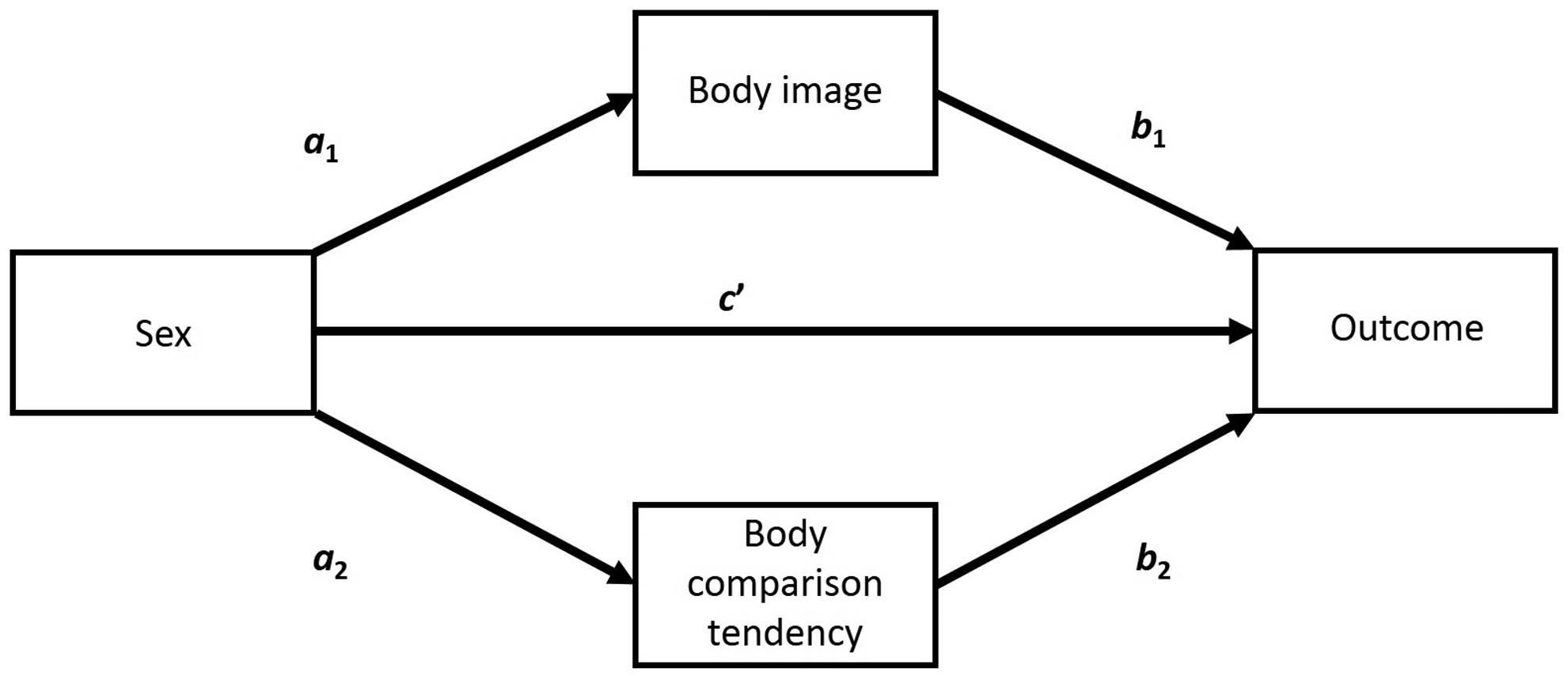
The parallel mediation model. Outcomes for the study: frequency of posting photographs of oneself to social media (H1); frequency of editing photographs posted to social media (H2); effects of downward body social comparison (H3); and effects of upward body social comparison (H4).
BMI, body mass index; SD, standard deviation; SNS, social networking sites.
p < 0.05, **p ≤ 0.01, ***p ≤ 0.001.
An ANCOVA tested H1, which predicted that women would post more pictures than men. BMI, F(1, 1662) = 17.81, p < 0.001, partial η2 = 0.01, social media use, F(1, 1662) = 128.04, p < 0.001, partial η2 = 0.07, and education, F(1, 1662) = 10.41, p = 0.001, partial η2 = 0.01, were significant covariates. Age was not significant, F(1, 1662) = 2.63, p = 0.11, partial η2 = 0.002. Counter to predictions, men reported posting pictures of themselves more frequently than women, although this effect was rather small, F(1, 1662) = 4.60, p = 0.032, partial η2 = 0.003. PROCESS model 6 then tested the parallel mediation model suggested by H1a and H1b. With the mediators incorporated, the direct effect of sex disappeared. Rather, the indirect effects of body image and body comparison tendency were both significant (Table 3).
BI, body image; BSC, body social comparison; SE, standard error.
To test H2, which predicted that women would edit pictures more frequently than men, an ANCOVA was run. Only participants who reported posting pictures on social media were included in this analysis. Social media use, F(1, 1419) = 48.23, p < 0.001, partial η2 = 0.03, age, F(1, 1419) = 16.29, p < 0.001, partial η2 = 0.01, and education, F(1, 1419) = 8.92, p = 0.003, partial η2 = 0.01, were significant covariates. BMI was not significant, F(1, 1419) = 1.28, p = 0.26, partial η2 = 0.001. Supporting H2, women reported editing pictures more frequently than men, F(1, 1419) = 36.63, p < 0.001, partial η2 = 0.03. PROCESS model 6 tested H2a and H2b. The direct effect of sex and both indirect effects with body image and body comparison tendency were significant (see Table 4).
To examine H3, which predicted that women would feel better than men after downward body social comparisons on social media, an ANCOVA was run. Only participants who reported viewing pictures of same-sex others on social media were included in this analysis. BMI, F(1, 1385) = 8.25, p = 0.004, partial η2 = 0.01, and age, F(1, 1385) = 6.78, p = 0.009, partial η2 = 0.01, were significant covariates; social media use, F(1, 1385) = 0.11, p = 0.742, partial η2 = 0.001, and education, F(1, 1385) = 1.63, p = 0.20, partial η2 < 0.001, were not significant. As hypothesized, women reported feeling better than men did after downward body social comparison, F(1, 1385) = 9.86, p = 0.002, partial η2 = 0.01. To address H3a and H3b, PROCESS model 6 was run. Once the mediators were included, no direct effect of sex was observed. Both indirect effects with body image and body comparison tendency were significant (Table 5).
For H4, which predicted that women would feel worse than men after upward body social comparisons on social media, an ANCOVA was run. Only participants who reported viewing pictures of others of their own sex on social media were included. BMI, F(1, 1385) = 56.50, p < 0.001, partial η2 = 0.04, social media use, F(1, 1385) = 8.29, p = 0.004, partial η2 = 0.01, age, F(1, 1385) = 4.44, p = 0.035, partial η2 = 0.003, and education, F(1, 1385) = 4.34, p = 0.037, partial η2 = 0.003, were significant covariates. Supporting H4, women felt worse than men did after upward body social comparison, F(1, 1385) = 54.28, p < 0.001, partial η2 = 0.04. PROCESS model 6 then tested H4a and H4b. The direct effect of sex remained significant. Both indirect effects with body image and body comparison tendency were also significant (see Table 6).
Discussion
In this study, we examined men's and women's photographic self-presentation and social comparison on social networking sites. In some cases, the assertions of objectification theory were supported; in other cases, men and women did not differ. Body image and social comparison tendency emerged as important variables in this context.
Our findings indicate that, compared to men, women put more effort into cultivating a socially desirable physical appearance online by editing photos. Body image and social comparison tendency also drove this behavior. It is possible that editing allows those with a negative body image to restore self-esteem or elicit positive feedback from peers. Another possibility is that those who tend to socially compare feel a need to maintain or exceed beauty standards set by others, or to attain the same level of attention as their perceived competitors (e.g., earning “likes” on a photo).
Consistent with previous research, women were also more negatively affected than men were by checking out attractive pictures of others. As objectification theory would predict, women in our study were also already more likely than men to feel negatively about their body and to socially compare their bodies to others, and this in turn predicted negative effects of upward social comparison. Because of societal pressures associated with appearance, women may be particularly vulnerable to the negative effects of such comparisons. These feelings may be compounded by the other information made visible on social media interfaces, such as complimentary comments or who “liked” another's picture. In this way, it is not just the images but also the accompanying social feedback that may trigger social comparison.
When accounting for body image and social comparison tendency, however, men and women did not differ in posting frequency or the effects of downward social comparison; both felt better about themselves after seeing unflattering pictures of others. Although root differences persist in terms of men's and women's body image and social comparison tendencies, men who have a negative body image and tend to socially compare demonstrate outcomes more similar to women.
Our findings parallel previous research that suggests mediating variables may illuminate the nature of sex and gender similarities and differences regarding body-related attitudes and behaviors. 55 Although current research in the domain of social media generally suggests that girls and women remain under more appearance pressure than boys and men,18,19,22 it is possible that both groups' appearance-related concerns are growing and that the gap may be narrowing. 56 Social networking sites and online dating sites focus on photographs and visual self-presentation, and both provide opportunities for individuals to receive feedback on their appearance, 57 which may promote more appearance-related concerns and social comparison for both women and men over time. 58 Emerging studies have shown that the frequency of site use,6,52,59 and particularly the use of these sites for purposes likely to promote appearance concerns,7,8,60 is associated with troubling outcomes such as body dissatisfaction and disordered eating. Our findings indicate that assessing important intervening variables such as body image and appearance concerns is necessary to clarify sex and gender similarities and differences in photographic self-presentation on social media. For example, these variables may explain why women engage in more frequent social comparison on SNSs 18 and are more likely to post favorably inaccurate photographs on online dating sites 61 compared to men.
One limitation of this study is the use of self-report data. Individuals may have responded with more socially desirable responses such as underreporting how frequently they post or edit pictures of themselves. Content analysis could provide an alternative way of investigating how frequently people post pictures of themselves, although it is difficult to determine whether these are edited. Another limitation is that actual body comparison behavior on SNSs was not measured; rather, we used a general measure of body comparison tendency and then assessed how people felt after engaging in upward and downward comparisons on SNSs. Future research should parse out the frequency of body comparison behavior on SNSs as well as the conditions under which upward or downward body comparisons occur.
Although a nationally representative U.S. sample was incorporated, social media practices 60 and body-related attitudes 17 vary across cultures; this study should be replicated outside of the U.S. Given prevalent use of social media by children and teens 62 and the salience of body image in adolescence,29,63 it is also important to expand this research to investigate younger individuals, particularly girls.21,64
The emergence of social technologies will continue to shape how individuals craft their public personae. Users will continue to capitalize on the affordances of computer-mediated communication to achieve their impression management and relationship goals.11,15,16,65 Our findings demonstrate, however, that existing cultural norms do not necessarily dissipate or diverge in these environments. Researchers must continue to probe how evolving technologies are shifting or replicating our experiences with media regarding our self-image.
Footnotes
Acknowledgments
The authors would like to offer their thanks to Liz Brody, Shaun Dreisbach, and Glamour magazine for providing the data used in this study. They would also like to thank affiliates and members of Ohio Roller Derby for their assistance in testing the survey before launch.
Authors' Note
This is the second article published from this data set. The first article examined trait predictors that were only available for male participants: Fox J, Rooney MC. The Dark Triad and trait self-objectification as predictors of men's use and self-presentation behaviors on social networking sites. 49
Author Disclosure Statement
No competing financial interests exist.