




Abstract
Abstract
Previous studies have reported conflicting results regarding the relationship between individuality and social identity, indicating this area requires further examination. This study constructed a research model to help understand the positive role of individualized behavior and social identity in virtual communities. The results of an online survey conducted to assess our theoretical research model indicated that social identity can be expressed in two ways: self-categorization and social identification. Furthermore, we found individualized behavior was positively related to social identification, while self-categorization was directly derived from social identification.
Introduction
I
In a VC context, individuality might contribute to a member's sense of uniqueness and autonomy, thereby strengthening member entertainment experiences and continued participation.3,4 While individualized posting can help VCs attract more visitors, 5 it also produces some negative effects. Many new VC members are considered to have little or no social identity, 6 but possess a passion for individuality. Without social identity, individuality may lead to overemphasis of individual opinions and goals, and result in group disorder or the initiation of antinormative and potentially antisocial behaviors.7,8 Wall and Williams 8 argued that VCs should implement policies, such as virtual police services and vigilante groups, which employ “online shaming,” to maintain order. However, implementation of these strategies may damage the “free” atmosphere in the VC, resulting in many members leaving. Therefore, VCs should strive to produce self-regulating mechanisms. When social identity is significant, individuals can automatically assimilate into a group-specific prototype and treat the group's collective aims and thoughts as their own. 9 Thus, if individuality does not impede the formation of one's social identity, but instead helps promote it, the VC will spontaneously become more orderly. 10
Social identity theory emphasizes similarities among individuals, 11 whereas individuality underlines their differences; therefore, it may be difficult to form a shared social identity in the context of individuality. It is widely accepted in social psychology that heterogeneity undermines social cohesion and communion. 12 Some previous research suggests that individuality tends to have a negative impact on affective outcomes 13 and can erode social identification.14,15 On the other hand, recent studies have indicated that outcomes related to individuality in groups are mixed 16 and individuality can be a profound basis upon which to form a social identity.17,18 Although these studies proposed a positive relationship between individuality and social identity, they described social identity as merely social identification and did not include self-categorization. Moreover, some studies have even confused the meaning of these two concepts. In addition, those studies were conducted in experimental settings. However, the subjects evaluated might have been active in VCs for years without restraints, causing their psychological processes and benefits related to individuality to differ greatly from those induced in experimental settings. Therefore, the relationship between individuality and social identity in the context of VCs requires further study.
Individuality is a very common phenomenon in VCs, and the formation of social identity in the context of individuality plays an important role in the development of VCs. Unfortunately, little research has focused on individuality, particularly the relationship between individuality and social identity in VCs. Because individuality mainly manifests as individualized posting in VCs, this study used an empirical methodology to examine the relationship between individualized posting and social identity in terms of social identification and self-categorization, and also identifies the differences and relationship between self-categorization and social identification.
Theoretical Background
Two forms of social identity
Social identity, as first outlined by Tajfel, 19 refers to “the individual's knowledge that he belongs to certain social groups together with some emotional and value significance to him of this group membership.” By reviewing the related literature, we found that social identity is expressed in two distinct ways: self-categorization and social identification. Self-categorization refers to an individual's cognition regarding the extent to which a group-specific prototype can reflect their self-conception, and the similarity between themselves and other members.9,20 Social identification describes the cognitive and perceptual awareness that the self constitutes a part of the group, along with the emotional significance of this identity. 17 Self-categorization might emerge through a deductive path in depersonalization contexts, whereas social identification might develop by an inductive path in individuality contexts.
The deductive path is a top-down process through which superordinate categories can shape a social identity. In depersonalization contexts, group-specific properties are highlighted and serve as situational cues of a deductive identity. Individuals may cognitively assimilate themselves into a social category by depersonalizing their personal conceptions. 20 In contrast, the inductive path is a bottom-up social identity-shaping process based on social interactions in the individuality context. Unlike the deductive path, an inductive identity is not shaped by a supraindividual-level feature that is significant in a temporary environment, such as intergroup comparison and depersonalization. Instead, it can be derived from an individual's perceptions of their membership based on social interactions. 21
Research Model and Hypotheses
Research model
Previous studies have suggested that social identification may emerge within individuality contexts, such as in VCs, without identifying whether self-categorization can also emerge in the same context or the relationship between individualized behavior and self-categorization. This study aimed to fill in these gaps. First, we connected individualized posting with the two forms of social identity in our model to identify their relationship. Since social identification easily emerged through an inductive path in the individuality context, 21 it may influence self-categorization. Hence, we proposed that social identification plays a mediating role between individualized posting and self-categorization, and constructed the theoretical model shown in Figure 1.

Research model.
Self-categorization
According to the theory of inductive formation of social identity, individuality fosters a shared identity in two ways. First, individuality might serve as a shared group feature and, therefore, contribute to the formation of a shared identity.
18
Individualized posting is a common feature among VC members. Thus, members classify themselves as a category based on the common posting feature. Second, one reason VC members post individualized content is to attract attention and replies from others.
5
Consequently, individualized posting may serve as an efficient channel for information flow and exchange among group members
22
by promoting communication. Postmes et al.
21
and Jans et al.
18
suggested that in individuality contexts, sharing opinions and thoughts allows members to reach an agreement on the group's tasks and goals, facilitating perceptions of similarity among them.
23
Therefore, we formed the following hypothesis:
Social identification
VC members are usually anonymous and geographically separate from each other. VCs reduce that sense of distance, and integrating themselves into a collective plays an important role in the formation of social identification in this context.
24
The best way to achieve a sense of integration is by participating in VC interactions (e.g., posting) because interactions help form a sense of familiarity and community between members,
25
thereby narrowing psychological distance.
26
In addition, group members generally have uniqueness
27
and accomplishment28,29 needs. Individualized posting enhances the behavioral differences among members, and at the same time, members create novel content by individualized posting. Therefore, individualized posting can directly meet members' needs of uniqueness and accomplishment. Need gratification in a group contributes to member satisfaction with and dependence on the group. As a result, members are more willing to join a group and may even generate emotional connections with it. Finally, posting in VCs may serve as a sign of membership.
22
Posting in VCs is a main way to participate in the community and, therefore, might contribute to an individual's perceived membership (i.e., sense of belonging). Based on the above, we formed the following hypothesis:
Relationship between self-categorization and social identification
Recent studies have begun to recognize the distinction between self-categorization and social identification. Postmes et al. 30 argued that self-categorization is more situationally and contextually determined and may be imposed in many cases, even when the individual challenges a category membership or the meanings attributed to it. On the other hand, social identification is more enduring and often involves emotional connections with the group. Although previous studies have proposed differences between self-categorization and social identification, no previous study has indicated that they are completely separate forms of social identity.
Both self-categorization and social identification may comprise an individual's cognizance of group membership, which implies a tie between self-conception and the group; this often causes confusion between these two forms of social identity. 22 In fact, there are obvious distinctions between these concepts. Self-categorization describes the way in which people cognitively categorize themselves into a group (as a social category) based on the salience of specific group features. 20 For example, when a work team in an enterprise wears a uniform that is distinct from other teams in the same enterprise, the uniform serves as a clear feature that members can use to assign themselves into a common category. Social identification describes a member's cognizance of belongingness to and emotional connection with a group. 17 However, this group may not possess a clear, specific feature that distinguishes them from other groups. Consequently, social identification with the group implies that members are cognizant of belonging, but do not necessarily have a clear sense of categorization (i.e., belonging to a category). The above example of the work team uniform also fits here. When a work team wears the same uniform as that of other teams in the enterprise, it cannot be used to differentiate them from other groups. Moreover, if the characteristics and behavior of each member of this team are very diverse, it will be difficult to perceive similarity among the members. Therefore, although the members of the team can perceive that they are members and generate affective commitment toward the team, they cannot assign themselves into a clear category. In this case, members may produce a vague self-concept connected with the team as a brand or a symbol, but not a group category of common features.
Social identification can easily form in individuality contexts through an inductive path. Moreover, social identification includes a member's affective connection with the group (i.e., the affective consequences of group membership),
17
which may serve as a link between them, enhancing and highlighting the group's place and image in the member's heart and mind. Therefore, social identification may contribute to a member's cognitive assimilation to the group prototype, thereby increasing perceived consistency and similarity among themselves and facilitating the formation of self-categorization.
31
Accordingly, we formed the following hypothesis:
Methods
Samples and sample collection
To test the research model and above hypotheses, we conducted a survey through Baidu Post Bar, an online “community of common interest or information exchange,” 32 where people spontaneously gather and discuss a topic of common interest. As the most popular and comprehensive online forum in China, data collected from Baidu Post Bar possess great research value and are highly generalizable. We obtained permission from the moderators of Baidu Post Bar to post a link to our online questionnaire. To avoid self-selection bias, we randomly posted the link in 30 groups, covering all main group types. Data collection began in December 2015 and lasted 1 month (until January 2016), and 349 valid questionnaires were collected. Table 1 describes respondent demographics.
Measures
The measurement items (i.e., survey questions) for all variables are shown in Table 2. All items were measured using a 5-point Likert scale, with response options ranging from “strongly disagree” to “strongly agree.”
Reverse-scored items.
Data analyses
Structural equation modeling was used to test the research models shown in Figure 1, and we employed AMOS 21.0 for this purpose.
Results
Measurement model
All of the overall fit indices of the measurement model reached acceptable levels (χ2/df = 1.725; goodness of fit index [GFI] = 0.953; adjusted goodness of fit index [AGFI] = 0.926; comparative fit index [CFI] = 0.981; [TLI] = 0.974; root mean squared error of approximation [RMSEA] = 0.045). Construct reliability and validity were examined using confirmatory factor analysis. Construct reliability was measured using Cronbach's alpha and composite reliability, and convergent validity was assessed using the average variance extracted from the constructs (Table 3). Finally, discriminant validity was evaluated by contrasting the square root of the average variance extracted for the individual constructs (diagonal of Table 4) with the shared covariance corresponding to the individual constructs. As shown in Tables 3 and 4, all of the test values are acceptable. 6
AVE, average
IP, individualized posting; SC, self-categorization; SI, social identification.
Data collected solely by self-report are susceptible to common method variance (CMV). To avoid this, we used a one-factor model approach to test the CMV 35 by connecting all items to one latent variable and constructing a one-factor model, and then testing this model with confirmatory factor analysis. The overall fit indices of the one-factor model were below the acceptable range and showed a very poor level of fit (GFI = 0.614; AGFI = 0.485; CFI = 0.586; TLI = 0.517; χ2 = 1297.933; df = 90; χ2/df = 14.421). These results suggest that CMV did not significantly affect the interpretation of our findings. 35
Structural model
We also used AMOS version 21.0 to test the research model. All of the hypotheses were examined, and the findings are shown in Figure 2.
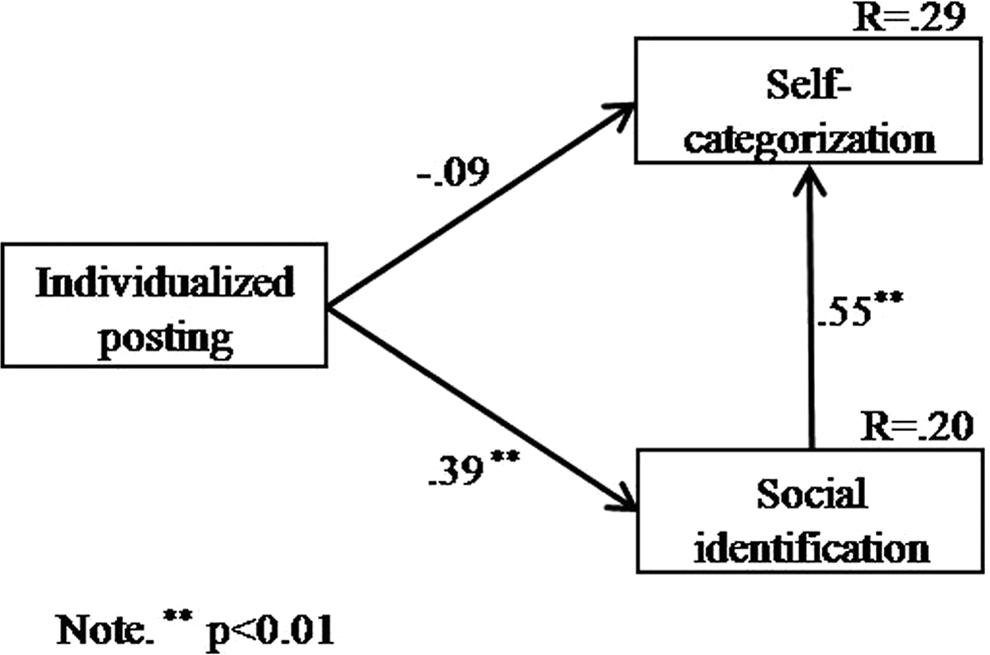
Model testing results.
H2 and H3 were supported since their coefficients were significant (p < 0.01). However, H1 was not supported (p > 0.05), indicating that social identification plays a complete mediating role between individualized posting and self-categorization.
Discussion
Relationship between individualized posting and two forms of social identity
We found a positive relationship between individualized posting and social identification. This finding is consistent with the inductive formation path theory proposed by Postmes. 21 However, our study expanded this by dividing social identity into two forms and focusing on a VC context. As shown in Figure 2, when the mediating role of social identification between individualized posting and self-categorization was considered, the direct influence of individualized posting on self-categorization was not significant, which is inconsistent with H1. This indicates that social identification completely mediates between individualized posting and self-categorization and in individuality contexts, self-categorization may largely emerge directly from social identification rather than individuality. Individualized posting facilitates increased communication among the members of a VC. Some studies have argued that group members can perceive their similarity, such as common goals, in the individuality context by frequent communication. 21 However, because members pursue the novelty and diversity of content posted in VCs, frequent communication may also lead to the members' perception of their differences in behavior, not just their consistency in group goal. Therefore, individualized posting and communication may not directly lead to a unified and clear sense of similarity among group members, but rather foster members' affective commitment to the group based on the satisfaction of their social needs. Thus, individualized posting can directly affect a member's social identification in a VC, not their self-categorization.
Mediating role of social identification
Because self-categorization cannot directly derive from individualized posting in individuality contexts, social identification may exert a stronger influence on self-categorization than vice versa. This finding is inconsistent with that of previous studies indicating that self-categorization emerges first and has a stronger influence on social identification. 28 Bergami and Bagozzi 36 indicated that in small groups, self-categorization appears first and contributes to formation of social identification. Ashforth et al. 22 also suggested that after induction, individuals might first assimilate the self into the group stereotype and then generate social identification. Indeed, individuals tend to like groups and/or group members who are similar to themselves. Self-categorization implies similarity between a member and the group, which is conducive to the development of a member's affective commitment to the group. However, the results of those studies were obtained from deindividuation contexts, wherein depersonalization occurs and the similarities among group members are highlighted. In contrast, in individuality contexts, such as interest-based VCs, the differences between members' behaviors are significant and individualization is highlighted, adversely affecting self-categorization. Therefore, it is difficult for self-categorization to emerge directly from individuality contexts.
Some studies consider the VC context to be deindividualized because members are anonymous, visual cues are not available, and personal information is often not revealed. In this case, it is easy to generate self-categorization when individuals are participating in a VC, especially when they use the same avatar or possess a significant common feature (e.g., ethnicity, gender, and political position). 3 This phenomenon has been labeled the social identity model of deindividuation effects. 14 It should be noted that VCs in those studies were under researcher control, and common features among members were artificially and purposefully strengthened so that they became salient in members' minds. However, in the real VC context, and especially in the case of integrated and interest-based VCs, there is no uniform avatar, and other common features, such as ethnicity and gender, are not always of concern to members. Rather, group members pay more attention to intense discussions or debates and present more personal opinions, which make different responses highly significant in VCs. Hence, in VCs, rather than forming directly from member participation, self-categorization may develop after social identification. Social identification describes a member's belongingness, which can be seen as an ambiguous form of self-categorization and can lead to unambiguous self-categorization based on the member's affective connection with the group.
Conclusions and Implications
Our study revealed a theoretically positive relationship between individuality and social identity in the context of VCs. Previous studies have proposed that the social identity model of deindividuation effects 14 indicates that group members can deduce a shared identity based on their similarities. In reality, individuality, rather than similarity, is significant in VCs. Our study suggests that VC members can also produce significant social identity inductively in individuality contexts. Based on previous studies of social identity30,22 and the inductive formation path theory,18,21 our study divided social identity into two forms, self-categorization and social identification, and further clarified the differences and relationship between these forms in VCs. This study also established positive direct and indirect relationships between individuality and the two forms of social identity.
Practically, the transition from individuality to social identity reflects the self-regulation or self-organization of VCs. Since individualized posting is conducive to attracting more visitors 5 and can significantly facilitate the emergence of social identity, VC operators should encourage rational individualized behaviors. Moreover, because social identification can easily form in individuality contexts and contributes to self-categorization, VC operators should focus on creating favorable conditions for the formation of social identification.
Footnotes
Author Disclosure Statement
No competing financial interests exist.