




Abstract
Abstract
Social networking sites (SNS) are a popular form of communication among undergraduate students. Body image concerns and disordered eating behaviors are also quite prevalent among this population. Maladaptive use of SNS has been associated with disordered eating behaviors; however, the mechanisms remain unclear. The present study examined if body image concerns (e.g., appearance and weight esteem) mediate the relationship between excessive time spent on SNS and disordered eating behaviors (restrained and emotional eating). The sample included 383 (70.2 percent female) undergraduate students (mean age = 23.08 years, standard deviation = 3.09) who completed self-report questionnaires related to SNS engagement, body image, disordered eating behaviors, and demographics. Parallel multiple mediation and moderated mediation analyses revealed that lower weight and appearance esteem mediated the relationship between excessive time on SNS and restrained eating for males and females, whereas appearance esteem mediated the relationship between excessive time on SNS and emotional eating for females only. The study adds to the literature by highlighting mediational pathways and gender differences. Intervention research is needed to determine if teaching undergraduate students more adaptive ways of using SNS or reducing exposure to SNS reduces body dissatisfaction and disordered eating in this high-risk population.
Introduction
S
Body image concerns, such as negative attitudes and/or feelings related to general physical appearance or body weight and shape, 6 are viewed as quite normative in western society7,8; as many as 80 percent of college-age females report dissatisfaction with their bodies. 9 This is concerning given that negative body image is a potent risk factor for clinical eating disorders 10 and disordered eating behaviors. 11 Emotional eating includes overeating or bingeing as a result of negative emotional states 12 and difficulty deciphering between hunger sensations of emotional arousal. 13 Restrained eating involves inhibiting dietary consumption to maintain a lower body weight 14 and has been associated with binge eating. 15 According to restraint theory, the constant restriction of food to achieve weight loss will eventually result in disinhibited eating and subsequent weight gain. 16
Concerning is that as many as 49 percent of college-age students report disordered eating behaviors. 7 Although the majority of research in this area has focused on females, body dissatisfaction among males is also problematic.17,18 For males, however, emphasis is placed on achieving the societal ideal characterized by an exceptionally lean and muscular somatotype, often only attainable by resorting to unhealthy means (e.g., strict dieting, anabolic steroid or ephedrine use 19 ).
Long-standing evidence links media content to body dissatisfaction and disordered eating for females20,21 and males. 22 With the abundance of emphasis placed on societal standards for female beauty,23,24 it is not surprising that females report higher levels of body dissatisfaction 6 and perceive themselves as overweight25,26 at much higher rates than their male counterparts. Given the increasing popularity of SNS, recent research has examined how maladaptive SNS use, often involving a social comparison element and excessive time, is associated with body image and disordered eating behaviors among females. Most studies indicate that Facebook use is associated with body dissatisfaction and disordered eating for females.27–29
Some research has also identified a positive relationship between SNS use and eating behaviors, but only in the absence of social comparison. This could be due to greater feelings of social support and reduced loneliness, consistent with its intended purpose. 29 There is limited research examining possible body image mechanisms linking SNS use and eating pathology. In one study, body dissatisfaction mediated the relationship between maladaptive Facebook use and overeating episodes, as well as bulimic symptoms for college women. 30
Although epidemiological research shows that males spend almost as much time on SNS as their female counterparts, 31 the majority of research excludes males. A few studies, including both male and female college students, have shown that maladaptive SNS use, such as sharing negative status updates and making appearance comparisons, is associated with body dissatisfaction and disordered eating (e.g., dietary restraint, weight/shape concerns).32,33 Regarding gender differences, females engage in more social comparison, whereas males show a stronger preference for using SNS to discover friends. For self-presentation, females share portrait-style photos, whereas males tend to share full-body photos. 34 One study found females' psychosocial health may be more negatively affected by SNS use compared to males. 35
Despite these different patterns and negative sequelae of SNS use, little is known about the relationship between SNS use, body image concerns, and disordered eating behaviors, and whether these relationships differ by gender. Given that negative body image has been identified “essential precursor” for eating disorders, 36 the present study aimed to examine the degree to which body image concerns (e.g., weight and appearance esteem) mediate the relationship between excessive time on SNS and disordered eating behaviors among undergraduate students.
Given that females experience a higher rate of body image concerns and emotional and restrained eating behaviors,37,38 are more susceptible to beauty standards conveyed by the media,23,24 spend greater time engaged in maladaptive SNS behaviors, and are more negatively affected by SNS 35 compared to males, we hypothesized that weight and appearance esteem would mediate the relationship between excessive SNS use and disordered eating more strongly in females than in males.
Methods
Participants and procedure
The sample consisted of 383 (70.2 percent female) undergraduate students (mean age = 23.08, standard deviation [SD] = 3.09, mean body mass index [BMI] = 22.65; SD = 3.78) from Introductory Psychology classes at the University of Ottawa. Of the participants, 52.2 percent identified as North American, 12.9 percent European, 11.3 percent Asian, 8.4 percent Middle Eastern, 5.2 percent African, 3.7 percent Caribbean, 1.8 percent Central/South American, <1 percent Aboriginal, and 4.2 percent as other. Consenting participants completed an online battery of questionnaires for course credit.
Measures
Demographics
Participants completed a demographic information questionnaire, including gender, age, ethnicity, and height and weight to compute BMI (kg/m2).
Excessive time on SNS
Because SNS use is an emerging area of research, a “gold standard” measure is yet to be identified. The current study used an adapted version of the Generalized Problematic Internet Use Scale (GPIUS 39 ); “Internet use” was replaced with “Computer-mediated social networking.” The adapted version has been used successfully in previous research.5,40,41 The GPIUS is a 29-item self-report questionnaire that is based on a cognitive behavioral model of problematic Internet use. 42 Items are rated on a 5-point Likert scale, with higher scores indicating more problematic computer-mediated social networking.
The present study used the Excessive Time Online subscale, which comprised four items and measures an individual's subjective feeling of spending an excessive amount of time online (e.g., “I lose track of time when I am online”). A total score for Excessive Time Online was created by summing scores on each of the four items. This subscale is reliable, with a reported Cronbach's alpha level of 0.83, 39 and 0.87 in the present study.
Disordered eating behaviors
The Dutch Eating Behavior Questionnaire (DEBQ 12 ) is a 33-item self-report measure assessing types of disordered eating behaviors. Two of the three subscales were of interest in the current study. The Restrained Eating subscale includes 10 items (e.g., “Do you deliberately eat foods that are slimming?”) and is used to measure the extent to which individuals restrict their food intake. The Emotional Eating subscale includes 13 items (e.g., “Do you have a desire to eat when you are feeling lonely?”) and is used to measure the extent to which one will eat to obtain comfort and/or cope with emotions. Items are rated on a 5-point Likert scale, and higher scores indicate more disordered eating.
Both subscales are reliable in the undergraduate population. 43 The DEBQ has strong reliability and validity data, with Cronbach's alpha coefficients ranging from 0.79 to 0.95. 12 In the current study, Cronbach's alpha was 0.93 and 0.94 for emotional and restrained eating, respectively.
Body image: appearance and weight esteem
The Body Esteem Scale for Adolescents and Adults (BESAA-236) is a 23-item self-report questionnaire measuring body image. Items are rated on a 5-point Likert scale, and higher scores indicate more positive body esteem. The two subscales used in the present study are the Appearance Esteem subscale (e.g., “I like what I see when I look in the mirror”), which measures feelings and emotions people have about their body, and the Weight Esteem subscale (e.g., “I really like what I weigh”), which measures satisfaction with one's current weight.
The subscales have excellent levels of internal consistency (α = 0.92 for appearance esteem; α = 0.94 for weight esteem), 6 and the BESAA-23 has been validated with individuals aged 12–25. 44 In the present study, Cronbach's alpha for the appearance esteem and weight esteem subscales was 0.92 and 0.93, respectively. Appearance esteem and weight esteem, two salient components of body image, were examined as mediating variables.
Data analytic strategy
The statistical package for the social sciences (SPSS, Inc.) version 23.0 was used to conduct analyses. Correlation analyses were conducted to examine relationships between variables, and an independent samples t-test was conducted to examine gender differences across variables. Two multiple parallel mediation analyses were conducted to test appearance esteem and weight esteem as mediating variables in the relationship between excessive time on SNS and restrained eating, and between excessive time on SNS and emotional eating.
Bootstrapping was used to assess the total and specific indirect effects using 5,000 samples with replacement. 45 Ninety-five percent bias-corrected and accelerated confidence intervals (BCa 95% CI) are reported. Gender was tested as a moderating variable, and BMI was included as a covariate because of its significant correlation with outcome and mediating variables. Age and ethnicity were not included as covariates; age did not correlate with outcome or mediating variables, and ethnicity (dichotomized as North American and all other ethnicities) only weakly correlated with one outcome variable.
Results
Descriptive characteristics and results of the independent samples t-test examining gender differences are presented in Table 1, and bivariate correlations are presented in Table 2. All correlations were in the expected direction. Participant age did not differ significantly across genders. Females endorsed significantly more restrained and emotional eating, significantly poorer appearance and weight esteem, and significantly more perceived excessive time spent on SNS.
BMI, body mass index; SD, standard deviation; SNS, social networking sites.
Gender (1 = female; 2 = male); Ethnicity dichotomized (1 = North American; 2 = all other ethnicities).
p ≤ 0.05, **p ≤ 0.01, all tests two tailed.
Parallel multiple mediation and moderated mediation analyses
Bootstrapped estimates for the total indirect effect and specific indirect effects of excessive time on SNS on restrained (model 1) and emotional (model 2) eating through appearance and weight esteem, controlling for BMI, and the BCa 95% CIs are displayed in Table 3.
Analysis based on 5,000 bootstrap samples with replacement. Control variables include age and BMI. Sample size, Model 1 N = 351; Model 2 N = 346. Bold font indicates significance at 0.05.
BCa, bias corrected and accelerated; SE, standard error.
Results from the multiple mediation analyses reveal that the total indirect effect of excessive time on SNS on restrained eating through appearance and weight esteem was significant (B = 0.0404, SE = 0.0074 [BCa 95% CI 0.0264–0.0558]; Fig. 1). Both appearance esteem and weight esteem significantly mediated the relationship between excessive time on SNS and restrained eating (Table 1; model 1). More specifically, excessive time on SNS was associated with lower appearance esteem (B = −0.06), which was related to higher restrained eating (B = −0.18). Excessive time on SNS was also associated with lower weight esteem (B = −0.18), which was related to higher restrained eating (B = −0.41). Moderated mediation analyses revealed that gender did not significantly moderate the pathways in model 1.

Model 1: Excessive time spent on SNS predicting restrained eating through appearance and weight esteem. N = 351. Multiple parallel mediation model examining appearance esteem and weight esteem as mediating mechanisms between perceived excess time spent on SNS and restrained eating. BMI was included as a covariate. N = 351. Unstandardized regression coefficients (B values or slopes) generated using bootstrapping with 5,000 samples with replacement are presented, and standard errors are presented in parentheses. *p ≤ 0.05; *** p ≤ 0.001. BMI, body mass index; SNS, social networking sites.
Similarly, results from the multiple mediation analyses reveal that the total indirect effect of excessive time on SNS on emotional eating through appearance and weight esteem was significant (B = 0.0231, SE = 0.0056 [BCa 95% CI 0.0137–0.0358]; Fig. 2). Unlike for restrained eating, only appearance esteem emerged as a significant mediator between excessive time on SNS and emotional eating (Table 1; model 2). Excessive time on SNS was associated with lower appearance esteem (B = −0.06), which was related to higher restrained eating (B = −0.26). Excessive time on SNS was associated with lower weight esteem (B = −0.07), but weight esteem was not related to restrained eating (B = −0.09).
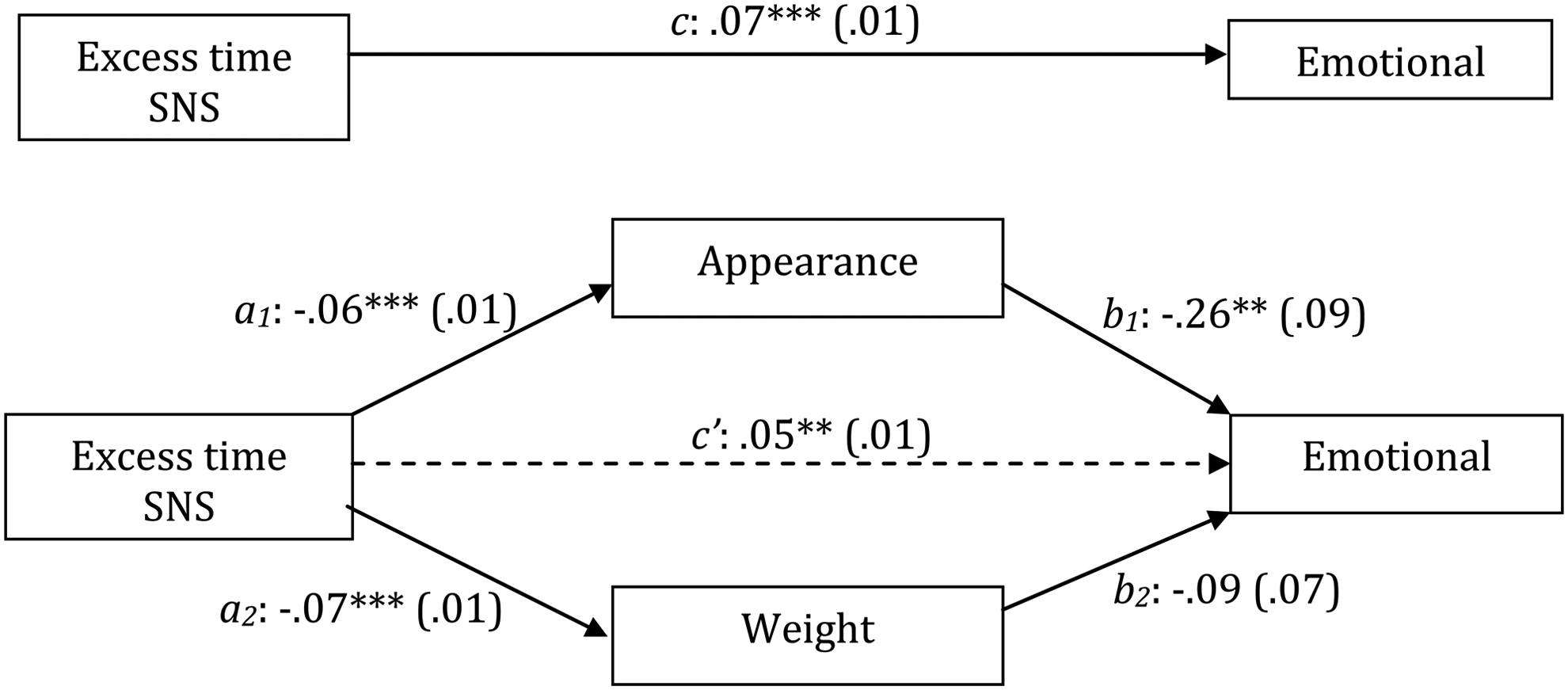
Model 2: Excessive time spent on SNS predicting emotional eating through appearance and weight esteem. N = 346. Multiple parallel mediation model examining appearance esteem and weight esteem as mediating mechanisms between perceived excess time spent on SNS and emotional eating. BMI was included as a covariate. N = 346. Unstandardized regression coefficients (B values or slopes) generated using bootstrapping with 5,000 samples with replacement are presented, and standard errors are presented in parentheses. **p ≤ 0.01; ***p ≤ 0.001.
The specific indirect effect of excessive time on SNS on emotional eating through appearance esteem was significantly moderated by gender while controlling for BMI, t(337) = 2.00, p = 0.047). More specifically, the b1 pathway (appearance esteem predicting emotional eating) was significant for females (B = 0.0240, SE = 0.0085 [BCa 95% CI 0.0089–0.0428]) but not for males (B = 0.00151, SE = 0.0083 [BCa 95% CI −0.0132 to 0.0198]).
Discussion
Our findings show that body esteem indicators mediate the relationship between SNS use and disordered eating. That is, greater use of SNS was associated with more severe weight and appearance dissatisfaction, which was in turn associated with more severe disordered eating. More specifically, lower weight and appearance esteem mediated the relationship between excessive time on SNS and restrained eating for males and females, whereas appearance esteem mediated the relationship between excessive time on SNS and emotional eating for females only. Our study adds to the literature by highlighting mediational pathways and gender differences.
Results from model 1 identifying appearance and weight esteem as mediating variables in the relationship between excessive time on SNS and restrained eating may be explained in relation to previous research. SNS provide a virtual platform exposing individuals to countless images28,29 that are often perceived as far from attainable. 46 Making comparisons to attractive individuals results in more negative mood and increased dissatisfaction with one's own physical appearance.28,46
Our findings are consistent with previous research, 30 which revealed that maladaptive Facebook usage characterized by seeking negative social comparisons resulted in greater body dissatisfaction, which in turn was associated with greater bulimic symptomatology in females. Relatedly, female university students report making appearance comparisons via Facebook to peers or celebrities, and these social comparisons mediated the relationship between Facebook engagement and body image dissatisfaction. 28 As such, it seems plausible that dissatisfaction with appearance or weight is elicited or exacerbated by comparing one's general physical appearance or body shape and weight to others' on SNS, and this process results in using dietary restraint in an attempt to achieve a slimmer physique.
Regarding results for males, previous research has found that media content depicting “ideal male images” is associated with significantly higher levels of body dissatisfaction.45,47 Accordingly, spending excessive time on SNS, where males are not only exposed to popular iconic male images but also to unrealistic and unattainable photos, may result in viewing their own appearance and weight less favorably. This is in line with previous research that identified a relationship between specific Facebook activities and increased drive for thinness among males. 33 Results from the current study extend these findings by demonstrating that, males too use restrained eating behaviors in relation to excessive SNS use and body dissatisfaction. However, males may engage in restrained eating not necessarily to slim their bodies to the same extent as females, but to achieve a leaner physique with defined muscle shape. 48
Model 2 identified appearance esteem as a mediating variable in the relationship between excessive time on SNS and emotional eating, which was moderated by gender; the pathway was significant for females but not for males. Emotional eating is often conceptualized as a maladaptive coping strategy involving the use of food to deal with unpleasant emotions 12 and has been found to be more prevalent among females.37,38,49 Given the repeated exposure to unrealistic and digitally edited ideal standards of female beauty on SNS, it is not surprising that females experience negative thoughts and emotions related to their own appearance and seek out a means to address their negative emotions via eating.
Previous studies demonstrate that being exposed to advertisements portraying thin females is associated with body dissatisfaction and negative mood.50,51 Emotions associated with these images include anger, depression, and anxiety, 52 emotions that have also been linked to emotional eating.53,54 Results from the present study are in line with research which found that “maladaptive Facebook usage” (e.g., engaging in social comparisons and evoking unfavorable feedback) predicted bulimic symptomatology for females 1 month later, and this relationship was mediated by body dissatisfaction. 30
Our hypothesis is partially supported by the current findings: the relationship between excessive time on SNS and emotional eating was mediated by decreased appearance esteem for females but not for males, whereas appearance and weight esteem mediated the relationship between excessive time on SNS and restrained eating, and this was not moderated by gender. However, these findings are consistent with other research showing that females may be more negatively affected by SNS use than males on several noneating-related mental health indicators. 35
It is possible that males may be somewhat protected from the exposure to unrealistic images on SNS because they process information differently than females. For example, females have been found to engage in more social comparison activities when using SNS, whereas males tend to use SNS to discover friends and expand their social network. 34 However, based on results from model 1, males' body image and eating behaviors also appear to be influenced by SNS. Further research is needed to build on these initial findings to clarify how SNS use impacts body image and disordered eating in young adults.
Limitations
The first limitation is the use of a convenience sample from undergraduate psychology classes, limiting the generalizability of the findings. Second, the cross-sectional nature of the study prevents causal inferences. Of note are potential bidirectional relationships between excessive time on SNS and disordered eating behaviors. Given that individuals with reported eating pathology and body dissatisfaction have been found to engage in social comparison, 54 it is also possible that these individuals are more inclined to spend excessive time on SNS. Future longitudinal or experimental studies would provide a clearer temporal understanding of these relationships.
Another limitation is the use of self-report measures. To date, no other study has used objective measures to quantify the use of SNS, making our results comparable to the broader literature. Future research should aim to use objectively measured BMI. Future studies may also wish to include more gender-balanced samples to build on our findings of gender differences in the observed relationships.
Although this study was not designed to examine content or type of SNS, previous research has shown that specific SNS activities are associated with body image concerns and disordered eating among women.27,29,30 Future research could examine these specific activities to gain a better understanding of which SNS activities (e.g., social comparison and internalizing body ideals) pose the greatest risk to appearance and weight esteem and disordered eating for undergraduate students. While preliminary research indicates that females engage in social comparison behaviors on SNS, this should be more thoroughly examined across genders, as well as other cognitive processes, behaviors, and emotions that influence body image and disordered eating behaviors.
The present study has several strengths, which include recruiting male and female participants, examining two specific forms of body image and disordered eating behaviors, and using a well-established approach to multiple moderated meditation analyses.
Conclusions
Body dissatisfaction mediated the relationship between SNS use and disordered eating in young adults. Given the high prevalence of both SNS use 2 and body dissatisfaction7,8 in this population, combined with body image disturbances being predictive of eating disorders,10,36 our findings highlight the need for future intervention studies to determine if reducing time on SNS or teaching undergraduate students more adaptive ways of using SNS results in reduced body dissatisfaction and disordered eating.
Footnotes
Author Disclosure Statement
No competing financial interests exist.