




Abstract
Abstract
Previous work has examined whether immersive technologies can benefit learning in virtual environments, but the potential benefits of technology in this context are confounded by individual differences such as spatial ability. We assessed spatial knowledge acquisition in male and female participants using a technology not previously examined empirically: the digital fulldome. Our primary aim was to examine whether performance on a test of survey knowledge was better in a fulldome (N = 28, 12 males) relative to a large, flat screen display (N = 27, 13 males). Regression analysis showed that, compared to a flat screen display, males showed higher levels of performance on a test of survey knowledge after learning in the fulldome, but no benefit occurred for females. Furthermore, performance correlated with spatial visualization ability in male participants, but not in female participants. Thus, the digital fulldome is a potentially useful learning aid, capable of accommodating multiple users, but individual differences and use of strategy need to be considered.
Introduction
A
Spatial learning in virtual environments
Spatial learning has been a prominent focus in IVE and computer display research, with visual immersion being a primary focus for many IVEs.2–7 Research in to spatial learning has been prominently influenced by a model formulated by Siegel and White, 8 which identifies three components of spatial knowledge: landmark knowledge, which concerns key points in the environment, route knowledge, which concerns the transition between two or more locations in the environment, and survey knowledge, which concerns abstracted knowledge of the overall layout of an environment, typically contained in the form of a map. It was originally suggested that these three components reflected the development of spatial knowledge, and that the individual begins by learning landmarks and their associations in a list-like manner, and, with experience, develops a richer, allocentric map of the environment. However, the time scale of this progression is unclear, and further work has shown that some individuals acquire survey knowledge with minimal exposure. 9
The utility of IVEs in spatial learning relies on identifying the ways in which features of the environment relate to models of spatial knowledge. Two features of the fulldome are notable in this regard, namely first, the size of the display and second, the way in which it surrounds the viewer. Previous research has shown that display size can influence spatial learning, for example, improved landmark localization performance has been observed in participants having explored a virtual city environment on a 72" monitor compared to a 25" display. 2 Similarly, improved landmark knowledge resulted from viewing a virtual theme park on large displays compared to a small screen. 10 Field of view (FoV), the extent to which the display fills the viewers' visual field, has also been highlighted as a feature of IVEs that is relevant to spatial learning. Related to this is field of regard, which refers to the extent to which the display surrounds the viewer. Environments that surround the viewer allow the presentation of elements and their relationships in three-dimensional (3D) space, as opposed to these relationships being inferred through a flat screen presentation. In laboratory-based spatial tasks, restricting participant's FoV leads to increased errors in navigation and spatial learning tasks, 11 suggesting that peripheral information plays an important role in the formation of spatial representations. Based on these features, we propose that the fulldome would provide an advantage on tests that rely on a representation of the spatial structure of the environment, as studied in tests of survey knowledge.
The role of individual differences
Research on individual differences in navigational ability suggests that there may be several moderators of IVE contribution to spatial learning. 12 First, sex differences have been a prominent factor in individual differences studies of wayfinding.13–15 Notably, males self-report relying on strategies prioritizing cues related to the geometry and structure of the environment, whereas females focus on landmark-based strategies.16,17 A second factor that may potentially mediate or moderate spatial learning is that of spatial ability, although there are differing perspectives on the nature of this relationship. Some authors have suggested that, with computer-mediated learning of environments in contrast to real-world experience, learning will depend on the user's ability to extract and utilize visual–spatial information from the display.18,19 Alternatively, it has been suggested that IVEs could compensate for lower spatial ability by assisting with this visualization, for example, by providing viewers with the spatial relationships in 3D instead of them having to infer them themselves.20–23
The current study
Drawing on the previous literature on spatial navigation in IVEs, we conducted the first empirical study to examine whether spatial learning is enhanced in a digital fulldome relative to a large, flat screen display. Specifically, we predicted that the fulldome would enhance performance on a test of survey knowledge, which reflects individuals' knowledge of the spatial structure of the environment. For completeness, we also assessed landmark and route knowledge in separate tests. Given the emphasis on individual differences highlighted previously in the literature, we also examined the role of gender and spatial ability as measured using the Differential Aptitudes Test (DAT). 24 In addition, we assessed two constructs that have featured prominently in the IVE literature: presence and simulator sickness. Presence refers to the subjective experience of “being in” an environment, 25 and was assessed using the Presence Questionnaire (PQ). 26 Simulator Sickness concerns negative symptoms (e.g., motion sickness) experienced in virtual environments and was assessed using the Simulator Sickness Questionnaire (SSQ). 27
Method
Participants
Fifty-five participants recruited from Plymouth University took part to fulfill a psychology course requirement, or for payment of £6. Males and females were separately randomly assigned to conditions, with 27 (13 males, 14 females) in the flat screen condition and 28 in the fulldome condition (12 males, 16 females).
Virtual environment
The digital fulldome used in this research was a 40-seat tiered theater surrounded by a 9-m tilted screen with a 1,400 × 1,050 fisheye lens projector. The flat screen condition took place in an ∼40-seat tiered lecture theater, with a 1,280 × 768 digital projector.
The environment consisted of a virtual recreation of one floor of a building on the Plymouth University campus, as if walking along a specific route, which lasted 5 minutes and 33 seconds. The environment contained eight colored landmarks, represented as large spheres at fixed points in the route (Fig. 1).
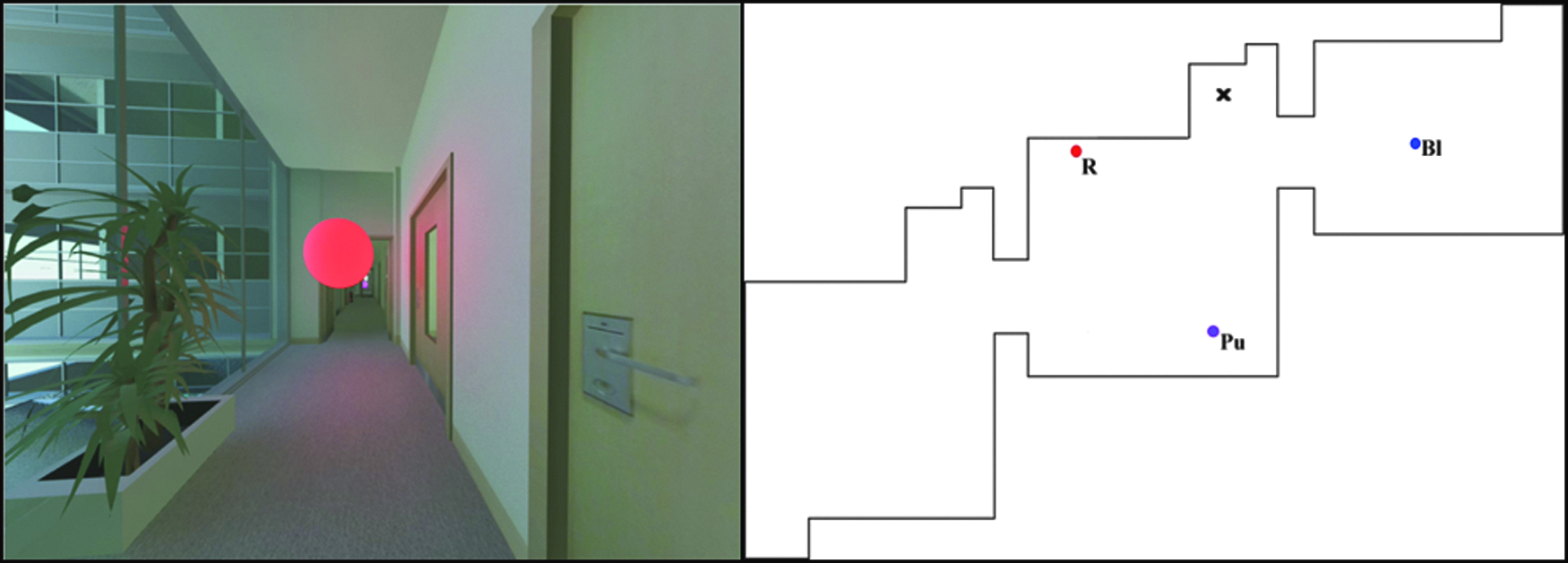
Left panel, screen capture of virtual environment. Right panel, example of possible layout of landmarks on route. Color images available online at
Measures
Survey knowledge
Participants were shown eight questions consisting of an array of four schematic diagrams of the floor containing possible layouts of three of the colored markers. For each question, participants indicated the layout that matched the clip they had seen.
Photograph recognition
Participants rated 18 photographs taken from the real environment on whether they matched perspectives viewed on the route, from 1 (I am sure this was not part of the route) to 5 (I am sure it was in the route). Nine photos involved perspectives featured on the route, whereas nine others were taken from elsewhere in the same building.
Photograph order
Participants were shown the nine photographs that were on the route from the previous test, and asked to put them in the order in which they had been encountered in the route shown.
Spatial ability
Participants performed the space relations subtest from the DAT, 24 which assesses the ability to mentally visualize 3D spatial relationships. The task consists of 50 items, in which the participant is shown an image of an unfolded two-dimensional (2D) pattern that can be folded to make a 3D shape (e.g., a cube with a black spot on one face and a square on another). Each 2D pattern is presented with four 3D objects; the participant must select which of the four objects can be formed from the pattern shown. The task had a fixed time limit of 25 minutes, with scores reflecting the total number of items answered correctly.
Feedback questionnaires
Participants completed the SSQ27,28 and the PQ, 26 to assess participants' subjective experience of the environment. Items from the PQ that were not relevant were omitted (e.g., those concerning sound). This left 11 of the original 32 items, which concerned the fidelity of the visual environment and how engaging the presentation was. Participants also were assessed for familiarity with the floor and building on which the virtual environment was based.
Procedure
Participants were recruited via an online advertisement for a study examining the use of technology and spatial learning, and were tested in groups. On arrival, participants were informed that they would initially be shown the prerendered clip and were told to pay close attention, because they would be asked questions about it subsequently. Participants then completed the tasks and questionnaires in the order listed above. Immediately preceding each task, detailed instructions were given to the group. We waited for all participants to complete each task before commencing the next. Finally, participants were debriefed as to the nature of the study. The study lasted ∼45 minutes in total.
Data analysis
Before analyzing data for each test, we removed outlying data points (>2.5 standard deviations from the means for the flat screen and dome condition, respectively). Exclusions for each test are reported in the Results section.
We performed preliminary t-tests to establish that participants in flat screen and fulldome conditions did not differ regarding pre-existing knowledge of the testing environment. For our focal hypothesis on survey knowledge, we had originally intended to analyze the data using an analysis of covariance, which used spatial ability as a covariate, but initial examination indicated that the assumption of homogeneity of regression slopes was violated. The data were instead analyzed using multiple regression, with sex and condition as categorical predictors, and spatial ability as a continuous predictor. Spatial ability scores were centered to aid the interpretability of interactions. All other dependent variables, for which spatial ability was not a relevant factor, were analyzed using a 2 × 2 (condition × sex) analysis of variance (ANOVA). We also report Cronbach's alpha, a measure of internal consistency, for the self-report measures.
Results
Background knowledge
Independent t-tests showed that participants in the flat screen and dome conditions did not differ significantly in their familiarity with the building, t(53) = 0.64, p = 0.53, or with the specific floor on which the virtual environment was based, t(53) = 1.28, p = 0.21. There were also no differences in spatial ability between flat screen and dome conditions, t(53) = 1.53, p = 0.13, or between males and females, t(53) = 0.12, p = 0.91.
Survey knowledge
One participant was excluded for not completing the task. Another participant in the flat screen condition was excluded as an outlier. This participant's performance was at ceiling (responding correctly to eight out of eight items), and therefore much higher than the condition mean (flat screen: M = 2.68, SD = 1.74 before outlier exclusion). This was also an outlier with respect to the overall mean (M = 3.11, SD = 1.83).
As noted in the Data analysis section, spatial ability correlated positively with performance for males (r = 0.49, p = 0.016), but no association was found for females (r = −0.035, p = 0.86). Therefore, the model was run as a multiple regression with this interaction term included (Table 1).
Note: F(5, 47) = 3.944, p = 0.005, R2 = 0.296. If the outlying data point is not excluded, the effect of condition is marginally significant (p = 0.098).
Because coefficients reflect effects when all other predictors are constant (i.e., 0), in a dummy coded regression, simple effects equate to contrasts against the reference category (i.e., males in the flat screen condition with average spatial ability). The effect for condition in the table indicates that males in the dome condition performed better than males in the flat screen condition. The marginally significant condition × sex interaction indicates that the dome benefit was reduced for females, to the point where little benefit is seen (Fig. 2). The spatial visualization and visualization × sex interaction reflect the relationship noted previously; visualization ability showed a positive relationship with task performance in males, but not for females.

Mean performance on survey knowledge task as function of presentation condition and gender. Error bars indicate ±1 SEM. SEM, standard error of the mean.
Photo recognition
For each participant, an average rating was calculated separately for pictures that were present and those that were not present. For pictures of scenes that were present in the environment, we found no significant effect of condition, F(1, 51) = 1.22, p = 0.28, or of sex, F(1, 51) = 0.024, p = 0.88. The interaction also did not reach significance, F(1, 51) = 0.0, p = 0.99. For pictures of scenes that were not present in the environment, we also found no significant effect of condition, F(1, 51) = 1.82, p = 0.18, of sex, F(1, 51) = 0.47, p = 0.49, nor any interaction, F(1, 51) = 0.20, p = 0.65). For both categories, average ratings were close to 3 (present: mean = 3.78, SD = 0.47; not present: mean = 2.91, SD = 0.52). This value corresponded to being unsure about whether the pictured scene had been included on the route, which suggests that participants found the task difficult.
Photo order
For each participant, a correlation was computed between the order participants reported and the true order. Results indicated no significant effect for condition, F(1, 51) = 0.68, p = 0.41, although a significant effect for sex was shown, F(1, 51) = 5.44, p = 0.024; males' (M = 0.20, SD = 0.38) order correlated more positively with the true order than females' (M = −0.05, SD = 0.42). The interaction did not reach significance, F(1, 51) = 0.008, p = 0.93. Again, note that the average correlations were close to zero, suggesting a difficult task with a possible floor effect.
Simulator sickness
Separate scores for each scale of the SSQ were calculated, in addition to a total score. 27 The values for each of these can be seen in Table 2. Separate ANOVAs on each subscale and the total score revealed no significant effects or interactions. Cronbach's alpha values were good, with the exception of the nausea scale.
Note: Degrees of freedom are 1 and 51 for all F tests.
ANOVA, analysis of variance.
Presence
An average of the 11 items included from the PQ was computed, although these had a relatively poor internal consistency (Cronbach's α = 0.59). The ANOVA revealed a significant effect of condition, with participants in the dome condition (M = 4.58, SD = 0.60) reporting higher levels of presence than those in the flat screen condition (M = 4.00, SD = 0.65), F(1, 51) = 12.00, p = 0.001. The effect of sex, F(1, 51) = 0.03, p = 0.86, and the interaction, F(1, 51) = 0.25, p = 0.62, did not reach significance.
Discussion
This experiment corroborates previous work proposing that immersive environments can provide benefits to spatial learning using a novel IVE: the digital fulldome. However, the relationship between performance and measures of spatial ability highlights the need to consider individual difference factors in how IVEs are assessed.
The specificity of benefits to spatial learning
We observed a benefit for survey learning in our study, but not for other aspects of spatial learning. However, this is not to say that any advantage of IVEs is restricted to this type of test or task. We prioritized the test of survey knowledge due to the theoretical link between the way in which the fulldome represents space and spatial learning. The lack of counterbalancing the tests, and resultant gap between the learning phase and test for other measures, makes our study a weak test of performance in these domains.
Our prioritization of survey knowledge was guided by previous suggestions that IVE research should focus on specific links between distinguishable features of the environment and their potential effects. 29 Drawing on previous IVE and laboratory-based research,11,30–32 we reasoned that the large, wrap-around display of the digital fulldome would primarily facilitate the presentation of 3D spatial relationships. It is less clear how this form of presentation would facilitate the learning of other aspects of spatial knowledge, such as route and landmark knowledge, although previous research has observed such advantages using large relative to small displays. 10 While the model we adopt distinguishes between the types of spatial knowledge, 8 this is not to say that they are independent, and an enhanced representation of an environment may manifest in performance improvements on multiple measures.
The benefits afforded to the representation of space by immersive environments are not limited to navigation tasks, as previous research has suggested that tasks such as data visualization would benefit from a richer presentation of spatial relationships.30–32 This may be a key strategic avenue for research, as they are primarily used for visualizing astronomical data.
The role of individual differences in ability and strategy
Our findings show that males performed higher on the test of survey knowledge in the fulldome compared to the flat screen, but females showed no advantage. However, males and females did not differ on our measure of spatial visualization ability, and therefore, this does not appear to be attributable to females being less able to extract visual information.18,19,22 Instead, the presence of a correlation between male performances on both the survey knowledge and spatial ability tasks, absent in females, suggests different strategies in the way visual information is used. The literature on navigation has indicated that males are more likely to self-report favoring allocentric strategies, whereas females prioritize egocentric cues.16,17 Allocentric strategies refer to the use of “objective” representations of the environment, and the spatial relationship between objects within it, whereas egocentric strategies refer to self-referenced representations. However, it has been questioned whether differences arise solely from strategy selection. In a virtual water maze task, both males and females selected an allocentric strategy, but males still showed an advantage when tested on allocentric knowledge. 33 The authors suggest that, rather than an issue of strategy selection, males are more adept at using allocentric strategies, and that females are not able to use these strategies as well as they use egocentric ones. 15
Considering our findings, it is possible then that the 3D representation of space in the fulldome is an advantage in building an allocentric representation of the environment. Egocentric strategies generally rely on learned associations between directions and particular landmarks/locations (e.g., turn left when you reach x). 34 There is no intuitive reason why this kind of associative learning would benefit from an immersive display. If the females in our sample adopted this strategy, as previous literature has suggested,16,17 it follows that their visualization ability would not predict performance. Alternatively, Tan et al. 3 report that large display sizes can encourage viewers to adopt an egocentric strategy if otherwise unprompted; it is possible that this, in combination with suggestions that females are less adept at using allocentric strategies, 33 resulted in the differences observed in the current experiment. Unfortunately, feedback about strategy choice was not obtained, although we echo the recommendation that this information is important for developing our understanding of individual differences in spatial knowledge acquisition in the future, particularly in the context of IVEs.18,21,23,33,35
User experience of the fulldome environment
Presence refers to the subjective experience of being in the environment 25 and has been prominent in the examination of the qualitative experience of virtual environments. Although much work has pursued the role of higher levels of presence in task performance, reviews have noted limited and inconsistent evidence.36,37 Nevertheless, the increased level of presence reported in the fulldome is of interest to commercial applications of fulldome technology (e.g., planetariums), where audience experience and enjoyment is a key factor. Our assessment using an adapted version of the PQ 26 indicates that a higher level of presence is experienced in the fulldome environment by both males and females. However, we did observe a lower level of internal consistency in our measure relative to previous reports. 26 This may be because we removed some items from the original PQ that were not relevant to our display environment (e.g., those concerning sound), and Cronbach's alpha is noted to decrease with fewer items. 38 Some items may also have been differentially affected by the task instructions and presence of other users. This is true of both our fulldome and our control displays, so it does not alter our conclusions, although future work could consider the applicability of these measures to multiuser IVEs.
The assessment of simulator sickness using the SSQ 27 indicated no difference between the fulldome and flat screen displays. Overall, few (2%) of items were given the highest responses, indicating that our presentation was not uncomfortable for our viewers. The low internal consistency for the nausea subscale is likely because the lowest response option was indicated by almost all items for certain symptoms (e.g., burping, sweating), whereas others (e.g., difficulty concentrating) showed more variation.
Limitations and implications
A limitation of our study is that we examined learning using a spatial navigation paradigm, which differs from the typical content shown in digital fulldomes. As such, it is not clear whether the benefits we observed will also emerge for other types of data visualizations. Furthermore, as we reviewed in detail previously, 1 ideally a variety of psychological features of the fulldome should be considered beyond the ones used in the present work. Future work should examine the types of content and learning requirements typically required by fulldome users.
The display used in our control condition differs from the digital fulldome in several respects (e.g., size, FoV, resolution), which makes it difficult to fully isolate the parameters that led to the enhanced performance that we observed. However, our control display is likely representative of what is available to most potential users (e.g., in universities or schools), and therefore serves as an appropriate comparison. As we did not compare the fulldome to other IVEs, for example, head-mounted displays or cave automatic virtual environments, 39 future work will need to be done to evaluate the relative effects on performance and the subjective user experience.
There are several implications of our work, both for the use of digital fulldomes, and IVEs more generally. As has been argued elsewhere,1,32,40 such technologies may provide a fertile ground for developing empirically based recommendations for teaching and learning. We provide support for the use of IVEs in spatial learning, using a technology not previously examined in the literature. The IVE has an advantage over other display systems in that it is capable of accommodating multiple users, thus allowing efficient social interactions in addition to advantages offered by the immersive display. Our findings also add to literature emphasizing the need to consider individual differences in the users of IVEs.18–23 Indeed, we not only illustrate the critical role of individual differences in spatial abilities but also how these relate to the strategies adopted by participants.
Footnotes
Acknowledgments
The authors thank Musaab Garghouti, who designed the virtual environment used in the study. The authors also thank Daniel Zahra, Jean Roper, and Amelia Swafford for their assistance in data collection. Support for the preparation of this article was provided by a Research-Inspired Teaching Project Grant from the University of Plymouth and First Grant RES-061-25-0119 from the Economic and Social Research Council to S.S., and the Experiential Learning Centre for Excellence in teaching and learning directed by R.W.
Author Disclosure Statement
No competing financial interests exist.