




Abstract
Abstract
Medical professionals are now relying on social media platforms like Twitter to express their recommendations for the use or avoidance of products like electronic cigarettes (e-cigs), which may have long-term health consequences for users. The goal of this study is to compare how physicians from the United States and the United Kingdom talk about e-cigs on Twitter and identify the topics that these groups perceive as salient. Comparing tweets from the U.S. and U.K. will allow for a better understanding of how medical professionals from these countries differ in their attitudes toward e-cigs. This information can be also used to inform policies designed to regulate the use of e-cigs. Using a text-mining program, we analyzed approximately 3,800 original tweets sent by physicians from the U.S. and the U.K. within a 1-year time span (June 2015 through June 2016). The program clustered the tweets by topics, which allowed us to categorize the topics by importance. Both sets of tweets contained debates about the degree to which e-cigs pose a threat to health, but the U.S. tweets emphasized the dangers of e-cig use for teens, while the U.K. tweets focused more on the potential that e-cigs have to be used as a smoking cessation aid. Doctors are using Twitter to share timely information about the potential risks, benefits, and regulations associated with e-cigs. Evaluating these tweets allows researchers to collect information about topics that doctors find important and make comparisons about how medical professionals from the U.S. and the U.K. regard e-cigs.
Introduction
S
Existing work on communication about health topics on Twitter has focused primarily on public opinion. 5 Collecting this information is useful for understanding the public's attitudes toward health issues and products; however, more attention needs to be given to how care providers use social media to disseminate information about important health topics. A growing number of doctors and nurses are using social networking sites like Twitter to communicate with patient populations. 6 Having medical professionals interact with the public through forums like these can be especially beneficial for stopping the spread of misinformation. 7
Use of electronic nicotine delivery systems (i.e., electronic cigarettes) has grown exponentially in popularity in recent years throughout the United States and the United Kingdom,8–10 but because these products are relatively new and were predominantly unregulated until the United States Food and Drug Administration's (FDA) recent deeming rule took effect, 11 there are questions about the potential threats they pose to users. Both the FDA and Public Health England (PHE) have called for investigations into the long-term effects of smoking e-cigs.12,13 Even though there is still a lack of information about the long-term health consequences and inconsistent regulation of electronic cigarette (e-cig) products within the United States (U.S.) and United Kingdom (U.K.), marketers continue to push their advertisements for these products. 14 Furthermore, there are ongoing debates about the benefits and risks associated with e-cigarettes, including whether they function as cessation devices or lead to an increased likelihood for dual use, 15 if they increase susceptibility of traditional tobacco use among vulnerable populations, such as adolescents and young adults, 16 and both short- and long-term health effects of inhalation of aerosolized constituents.17–19 Given uncertainty around these issues, it is not surprising that there has been a divide among health professionals whether it is advisable to emphasize e-cigs as an alternative to cigarettes.
Public health organizations from the U.S. and U.K. have expressed conflicting attitudes toward the use of e-cigs. The Royal College of Physicians produced a report in which it recently advocated for the use of e-cigs by current cigarette smokers because of their potential to serve as aids for quitting. 20 However, the Centers for Disease Control and Prevention (CDC) maintains its stance that e-cigs should be avoided altogether and has focused its efforts on preventing e-cig use among adolescents and teenagers. 21 In addition, the uncertainty surrounding e-cig use provides ample opportunity for members of the medical community to voice their input about these products to the public. Therefore, the goal of this study is to assess how physicians from the U.S. and U.K. talk about e-cigs on a public forum (Twitter) and identify the e-cig topics that physicians from these two countries perceive to be salient. Reviewing doctors' tweets about e-cigs can have important implications for identifying what the medical community wants the public to know about e-cigs and provides a unique perspective on how social media is being used as a tool for conveying timely health information.
Methods
Data collection
The MDigitalLife Health Ecosystem database was used as a source for physicians' tweets about e-cigarettes for both U.S. and U.K markets. The MDigitalLife Health Ecosystem database catalogs online behavior, showing the digital footprints (social accounts, blogs, websites, etc.) of more than 700,000 participants (including doctors, patients, advocacy organizations, reporters, & media outlets among many others) in 157 countries. This database links physicians' online content to their national physician identifier to gain insights into the networks, relationships, and social activities of online physicians' behavior.
The dataset comprised tweets containing at least one of the following keywords: “Vaping,” “#Vaping,” “VAPE,” “#Vape,” “ecig,” “#Ecig,” “E-cigarette,” “#Ecigarette,” “E-cig,” “electronic cig,” and “electronic-cig.” Only tweets from authors identified as being U.S. or U.K. doctors in the MDigitalLife dataset were included. The U.S. data set contained 3,694 original tweets and retweets from physicians within a 1-year time period (June 1, 2015 through June 1, 2016). Approximately, half (n = 1,252) of the tweets were from female physicians. The U.K. data set contained 1,822 original tweets and retweets from physicians from the same time period (information about gender for this set of tweets was not provided). The U.S. and U.K. physicians specialized in a variety of medical fields, including allergy and immunology, anesthesiology, cardiology, dermatology, emergency medicine and critical care, endocrinology, family medicine, gastroenterology, general practice, geriatric medicine, hematology, infectious disease, internal medicine, neurology, nuclear medicine, obstetrics and gynecology, oncology, ophthalmology, orthopedic surgery, otolaryngology, pathology, pediatrics, physical medicine and rehabilitation, plastic surgery, psychiatry, public health, pulmonology, radiology, thoracic surgery, and urology.
Text mining and text analytics
The tweets' textual content was analyzed using SAS Text Miner 12.122 and followed the same analytics process used in prior studies.3,4 First, using text parsing, each message was divided into individual words. These words were listed in a frequency matrix and words that contributed little to the understanding of the topic, such as auxiliary verbs, conjunctions, determiners, interjections, participles, prepositions, and pronouns, were excluded from the analysis. Following this, a text filter was used to exclude words that appeared in less than four messages. The words initially included (and excluded) in the analysis were visually inspected to ensure accuracy and identify unrecognizable symbols and letter groups for exclusion.
With the inclusion criteria set, a text topic node was used to combine terms into ten topic groups. After visually examining each of the created topics concerning analysis of the tweets, a seven-topic solution most clearly illustrated the main themes and produced the final topic groups for the ensuing analysis. This step (text mining) involves applying data mining algorithms such as clustering, which divides the document collection into mutually exclusive groups based on the presence of similar themes. SAS Text Miner uses two types of clustering algorithms: expectation maximization (EM) and hierarchical clustering. In this analysis, EM clustering was used because it allows for and automatically selects between two versions of the algorithm, one for small data files (standard) and one for larger (scaled) data files. Since there were only 3,800 tweets, the EM option was preferred. Last, the researchers reviewed the individual tweets of the final topic groups to interpret the final themes. One of the authors evaluated the results by completing several different iterations of text miner, comparing the different results and selected what appeared to be the optimum solution (topic identification) after careful inspection of the output. The output was then shared with a different author who was tasked with writing the description of the topics. Figure 1 (adapted from Chakraborty et al.) 22 illustrates the text analytic process.
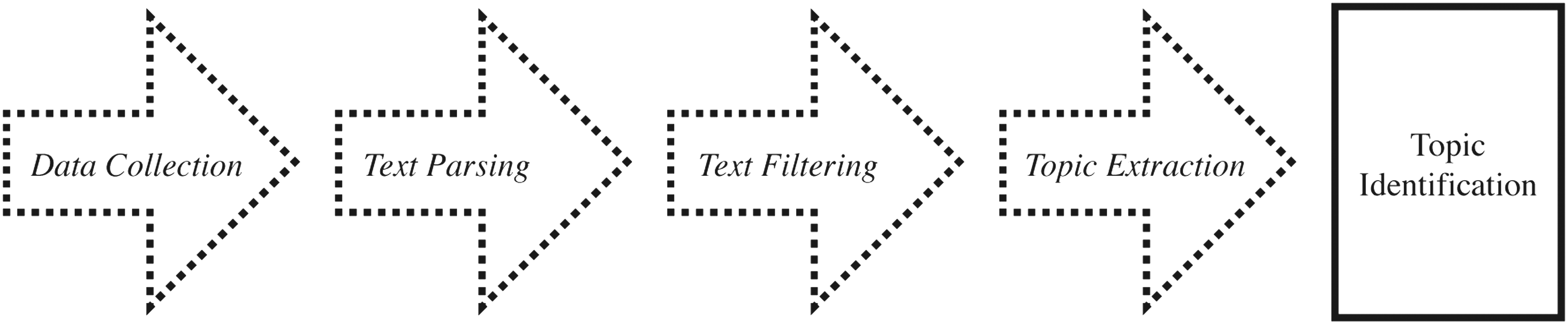
Text analytics process flow.
Results
The seven mutually exclusive topics from the U.S. physician-generated tweets addressed the likelihood of e-cig use among teenagers, FDA regulations on tobacco, the potential for e-cigs to help cigarette smokers quit, the effects of flavoring chemicals on the lungs, England's regulations on e-cigs, e-cig advertising aimed at teenagers, and support for raising the required age for purchasing e-cigs. The most common topic tweeted about among physicians from the U.S. involved concerns about e-cig use among teenagers and the potential that e-cigs have to cause tobacco addiction later in life. Table 1 shows the full list of topics, their related terms, and the number of tweets corresponding with each topic.
Note: Retweets and tweets addressing miscellaneous topics were parsed out from the final analysis.
The seven mutually exclusive topics from the U.K. physician-generated tweets focused on an ongoing debate among users about the pros and cons of e-cigs compared with those of traditional cigarettes, the need for e-cigs to be promoted because they aid with smoking cessation, measures of the source of harm inherent to any kind of tobacco use, the benefits of having general practitioners encourage their smoking patients to switch to e-cigs, references to a Harvard study on the effects of flavoring chemicals on the lungs, Public Health England's recommendation that e-cigs are safer than traditional forms of tobacco use, and the complications that e-cigs can cause for individuals who have had breast reconstruction surgery. Table 2 shows the full list of topics, their related terms, and the number of tweets corresponding with each topic.
Note: Retweets and tweets addressing miscellaneous topics were parsed out from the final analysis.
The U.K. tweets contained more nuanced views on the role that e-cigs should play compared with the U.S. tweets. While the most common topic in the U.S. tweets had to do with e-cig use among teens, there was no mention of youth e-cig use in the U.K. tweets, but there was much more emphasis on e-cigs as an effective aid for smoking cessation. Both sets of tweets referred to the danger that flavoring chemicals can cause and both were marked by discussions of whether e-cigs are more or less harmful than traditional cigarette smoking, but overall, the U.K. tweets were more “favorable” to e-cig use than the U.S. tweets were.
Discussion
These tweets reveal important topics that physicians perceive as relevant in discussions about e-cigs. Twitter serves as a helpful forum for identifying concerns among medical professionals and practitioners because it allows them to voice their concerns about new health trends to the public. 23 The focus on teens' use of e-cigs and long-term consequences associated with their use indicates that the majority of U.S. physicians on Twitter are conceiving e-cigs as a potential gateway substance that can lead to more serious and prolonged health consequences. This set of tweets also alluded to a need for better regulation of e-cig products from the FDA. Many of the tweets called for adjusting the age at which individuals can purchase ENDS and limiting the prevalence of advertisements targeting high school students.
Interestingly, the fifth most common topic tweeted about by the U.S. physicians had to do with England's regulation of e-cigs and the government's announcement decision to encourage e-cigs among current cigarette smokers. This sentiment was echoed in U.S. topic three, which contained tweets that also describe e-cigs as a possible “better” option for those who use traditional forms of tobacco. Thus, there is evidence to suggest that discussions about the pros and cons of e-cigs are present, even in medical communities, but only when talking about current, adult cigarette smokers. The tweets associated with U.S. topic one clearly indicate that physicians are concerned about e-cig usage among teenagers, while the tweets comprising topic three indicate that doctors may not be as worried about the consequences of e-cig usage for adults who already smoke. This points to a need for two different types of messaging for two different groups, teenagers who have never used tobacco products and adults who already smoke cigarettes. This is consistent with the literature on health messaging, which emphasizes that the most effective health campaigns are those that segment and target their audiences, rather than try to appeal to a general population.24,25 This finding suggests that if medical professionals want to communicate their concerns about e-cigs effectively, then they should consider the different needs of the groups they are trying to reach.
Although this study's findings are useful for understanding how medical professionals from the U.S. and U.K. regard e-cigs, there are limitations that should be noted. First, given that the analysis is based on frequency tables, it does not allow for direct comparisons between the sets of tweets. In addition, we were limited by the size of the dataset and the lack of demographic information. Future studies could benefit from stratifying the results of the analysis by such demographic characteristics as physician age, gender, and specialization.
As noted above, the U.K. tweets as a whole were characterized by a more positive regard toward e-cigs. U.K. topics two, four, and six contained tweets indicating that medical professionals should work toward informing the public of the benefits of e-cigs for those who already smoke. Unlike the U.S. tweets, the U.K. tweets also referred to the dangers of e-cig use for recipients of breast reconstructive surgery (topic seven) and emphasized the need for identifying the exact source of harm within tobacco products, whether it be nicotine, tobacco, or e-cig chemicals and that, by identifying the actual cause of harm, the public can be more informed about what is causing the health threat. Overall, the U.K. tweets put more emphasis on using e-cigs as an aid for quitting smoking, while the U.S. tweets placed more emphasis on the dangers of e-cig use among youth. The discussions within the U.S. tweets revolved more around preventing tobacco use among teenagers, whereas the discussions within the U.K. tweets had more to do with targeting existing smokers in an effort to encourage them to switch to e-cigs. This is an important distinction to make because it suggests that, while doctors from both the U.K. and U.S. are attempting to communicate with the public about e-cigs, they are focusing their efforts on different concerns, which could lead to policies and regulations, and perhaps even more importantly, public perceptions about e-cigs that vary drastically by country. The U.S. and U.K. are at the forefront of implementing policies and regulations surrounding e-cigs. Evaluating what their physicians have to say about these products can help health professionals and the public make decisions about their use.
Footnotes
Acknowledgments
This research was partially supported by W2O Group and their MDigitalLife Health Ecosystem Database. We thank our colleagues from W2O Group who provided insight and expertise that greatly assisted the research. This work was not supported by any funding.
Author Disclosure Statement
The authors have no conflicts of interest to declare.