




Abstract
Abstract
Masculinity-threatened men attempt to resolve the negative states caused by the threat through compensatory behavior such as public display of muscularity, which constitutes one way in which men physically establish masculinity. Avatars serve as a key means for self-presentation in technology-mediated environments, and compensatory motives can drive avatar customization. Noting this, the present research examined whether masculinity-threatened young men engage in compensatory avatar customization and whether such customization can be self-affirming. Specifically, we conducted a laboratory experiment to investigate the effects of masculinity threat on customization of avatar muscularity and physical endurance on a task that represents behavioral self-regulation. Data from 238 male college students revealed that masculinity-threatened young men customized their avatar to have greater muscle definition than did their nonthreatened counterparts, and greater muscle definition of the customized avatar predicted greater physical endurance on a handgrip task. Furthermore, muscle definition of the customized avatar significantly mediated the relationship between masculinity threat and physical endurance. None of these effects were moderated by masculine norm conformity, which suggested that the effects overrode individual differences in the extent to which participants conformed to masculine norms and expectations. Theoretical and practical implications of these findings are discussed.
Introduction
W
Avatars serve as a key means for self-presentation and identity construction in technology-mediated environments,7,8 and compensatory motives can drive customization of avatars.9,10 Inspired by the Proteus effect framework11–14 and the agency model of customization,15,16 we investigated whether masculinity-threatened young men compensate for the threat through avatar muscularity when customizing a self-avatar and how such compensatory avatar customization influences masculinity-threatened men's physical endurance—a behavior associated with masculinity. 1
Masculinity threat and compensatory avatar customization
Gender—one of the most prominent social categories 17 —entails distinct norms and expectations, 18 and men, compared to women, tend to experience gender identity threat more acutely.1,2 Furthermore, research on compensatory masculinity has demonstrated that masculinity-threatened men exhibit behaviors that exaggerate masculinity,5,6 including increased risk taking, 19 greater physical aggression, 20 and heightened expression of belligerence and dominance. 6
Another behavior through which men attempt to compensate for threatened masculinity is public display of masculinity through muscularity, 21 which refers to the extent to which one has well-developed muscles.22–24 Male bodies with high levels of muscle definition are generally regarded as powerful representations of embodied masculinity,25,26 and men's masculine gender role stress is associated with the drive for and pursuit of muscularity.21,27 This is particularly true in Western societies where the concept of “super-male” is embodied as highly muscular characters in action figures, 28 motion pictures, 29 and video games. 30
Avatar customization—creation and modification of characteristics associated with digital representations of human actors31,32—tends to be performed in a self-reflective manner, entailing moderate enhancements 33 or accentuation of certain positive traits over others across different interaction contexts. 7 Research further suggests that people adopt a compensatory motive to make up for what they lack when given an opportunity to freely customize a self-avatar. 34 For example, people with low self-esteem (compared to those with high self-esteem) were more likely to create an avatar that looked different from their actual self. 9 Considering that masculinity-threatened men may engage in compensation through avatar customization, we hypothesized as follows:
Avatar muscularity and physical endurance
The Proteus effect research11,12,35 has shown that physical appearance of avatars can exert significant behavioral impact on their users. For example, a tall avatar, compared to a short avatar, led its users to behave more confidently, 11 and exergame players using a normal-weight-looking avatar exhibited greater physical activity than those using an obese-looking avatar.13,14
Although the Proteus effect has largely been experimentally studied with randomly assigned avatars, a limited number of studies examined behavioral effects of user-customized avatars. Yee et al. (Study 1) 12 analyzed data from 76,843 World of Warcraft (WoW) avatars that had been customized and were being used by players; the results showed that height and attractiveness of players' avatars significantly and positively predicted the players' in-game performance. Yee et al. conducted a followup study, further examining “whether findings from randomly assigned avatars in laboratory studies generalize to natural settings.” 36 (p1) The study revealed that WoW players, in their engagement in gender-stereotypic in-game behaviors, conformed more to the gender of their avatar they had customized to use than to their actual gender. 36 These findings guide us to predict that the visual cues associated with a self-avatar customized to look highly muscular may lead the avatar user to achieve high levels of physical endurance by activating concepts such as “strong” and “tough.” 37 Therefore, we hypothesized as follows:
In addition to examining the simple relationship between customized avatar muscularity and physical endurance, we explored whether customized avatar muscularity would mediate the effect of masculinity threat on physical endurance. The agency model of customization developed by Sundar et al. posits that customization increases users' sense of engagement15,16 and that “the ability to express oneself is critical for engaging users.” 15 (p57) Kang and Sundar 38 demonstrated that customization for self-identity expression is self-affirming, and Lee and Sundar 39 showed that customization increases users' attachment to the customized product through a heightened sense of self-identity expression. These findings suggest that identity expression is an important determinant of users' psychological engagement with what they customize. These ideas could be extended to compensatory customization induced by masculinity threat—customizing a highly muscular self-avatar to express and reaffirm threatened masculine identity. Given the agency model of customization, compensatory customization that reestablishes masculine identity may heighten the users' psychological engagement with the customized avatar; this heightened engagement with the self-avatar may manifest in the amplified influence of the physical attributes (muscularity) of the avatar on the users' behavior (physical endurance). We tested this possibility with the following mediation hypothesis.
The role of masculine norm conformity
A question worth raising is whether masculine norm conformity—the extent to which men conform to the normative beliefs and expectations about how men should think, feel, and behave 40 —would moderate the effect of masculinity threat on avatar muscularity and physical endurance. Past research has demonstrated that men higher in masculine norm conformity feel dissatisfaction with their muscles and strive for muscularity to a greater extent.41,42 Given this, masculine norm conformity may moderate the effects of masculinity threat on avatar muscularity and physical endurance. However, the role of masculine norm conformity in the influence of masculinity threat has not yet been tested in virtual contexts involving avatar customization. Considering this lack of empirical evidence, we asked the following research questions.
Method
Participants and design
Upon approval from the institutional review board at the authors' institution, we recruited male undergraduate students attending a U.S. university for course credit in two phases: (1) an online pre-experiment survey for assessing masculine norm conformity (approximately 24 to 48 hours before scheduled experiment appointments) and (2) a laboratory experiment. Among 336 students who responded to the pre-experiment survey, 273 students (Mage = 20.44, SDage = 3.09; 80.1% White/Caucasian) attended the laboratory session and completed all of the experimental tasks. Participants were randomly assigned to two between-participants conditions (masculinity threat vs. no threat).
Experimental materials and procedure
At the laboratory, participants were informed that their appointment would comprise a series of unrelated short studies to fill the time slot for research participation credit.
Masculinity threat manipulation
We manipulated masculinity threat by following a bogus feedback approach used in previous research.2,3 Participants completed a computerized task disguised as a “gender knowledge test.” The “test” consisted of 30 questions on gender-related topics, including both stereotypically masculine topics (e.g., sports, auto mechanics) and feminine topics (e.g., fashion, childcare). Upon completion, “test results” were displayed on the screen. The threatening feedback condition showed participants' score close to the “average woman's score”; the nonthreatening feedback condition showed participants' score close to the “average man's score.”2,3
Avatar customization
The cover story of the alleged “second study” stated that the study aimed to understand how people create online personae. To highlight the self-presentational aspects while minimizing demand characteristics, the instructions asked participants to customize an avatar in Sims 3 as if they were to choose a social network site profile picture. After a short tutorial on the avatar customization interface (the Sim editor), participants were given 10 minutes to customize a default male avatar. On the Sim editor, participants customized physical features of their avatar along the “body modifiers” sliding scales, which included our variable of interest: muscle definition (Fig. 1). After each participant completed the task, a screenshot, which included a full-body image of the customized avatar and the sliding scales representing physical features, was taken.
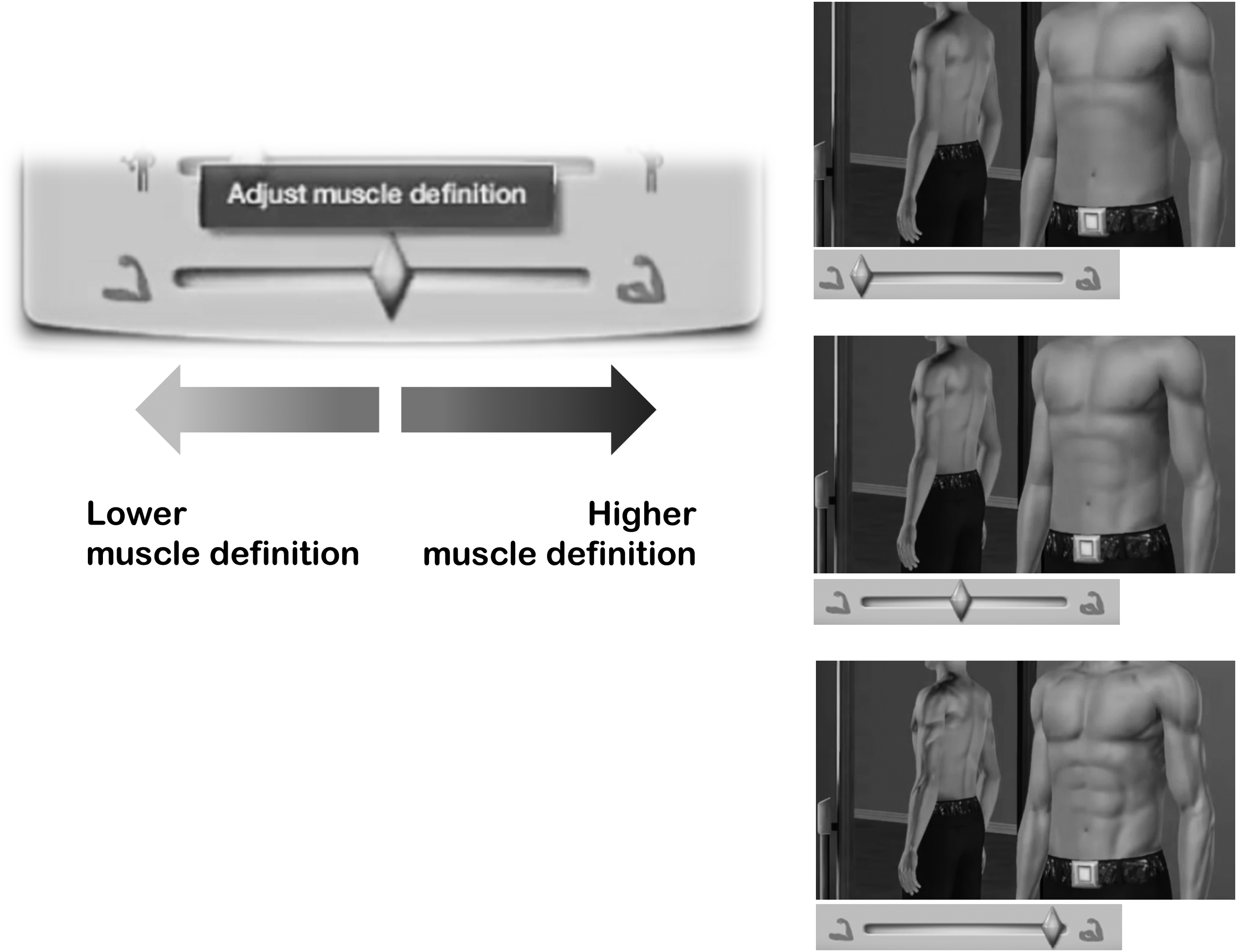
The Sims 3 sliding scale for customizing muscle definition. Moving the slider (selection point) to the right increased muscle definition; moving the slider to the left decreased muscle definition.
Handgrip task
We employed a handgrip task—a well-established measure of physical self-regulation—to measure physical endurance.43,44 Participants squeezed a handgrip device with a piece of paper held between the handles for as long as they could, using their dominant hand. Following the protocol used in past research, 45 the experimenter began timing once participants held the paper firmly with the handgrip device, and stopped timing the moment the paper slipped off.
Measures
Masculine norm conformity
The extent to which participants conformed to masculine norms was assessed with the 46-item version of the Conformity to Masculinity Norms Inventory 46 (CMNI-46; e.g., “In general, I will do anything to win”; 0 = strongly disagree vs. 3 = strongly agree). Following Parent and Moradi 46 and Parent et al., 47 we used the CMNI-46 total score by averaging the scores for all 46 items (α = 0.87).
Avatar muscularity: muscle definition
Muscle definition (i.e., the extent to which one's muscles are visible and pronounced)—a key indicator of muscularity,23,42,48—is often perceived as a representative trait of men's body ideal.24,28,49 Thus, we operationalized avatar muscularity as the level of muscle definition participants selected for their self-avatar. The Sim editor sliding scales do not display customization values on the interface. Therefore, two coders, blind to the research objectives, independently measured participants' selection point using an 11-point equal-interval scale (values ranging from 1 to 11) for each screenshot. The reliability between the two coders for muscle definition was very high (Krippendorff's α = 0.99); the values were averaged between the two coders. Figure 2 provides sample images of the avatars for different values of muscle definition.
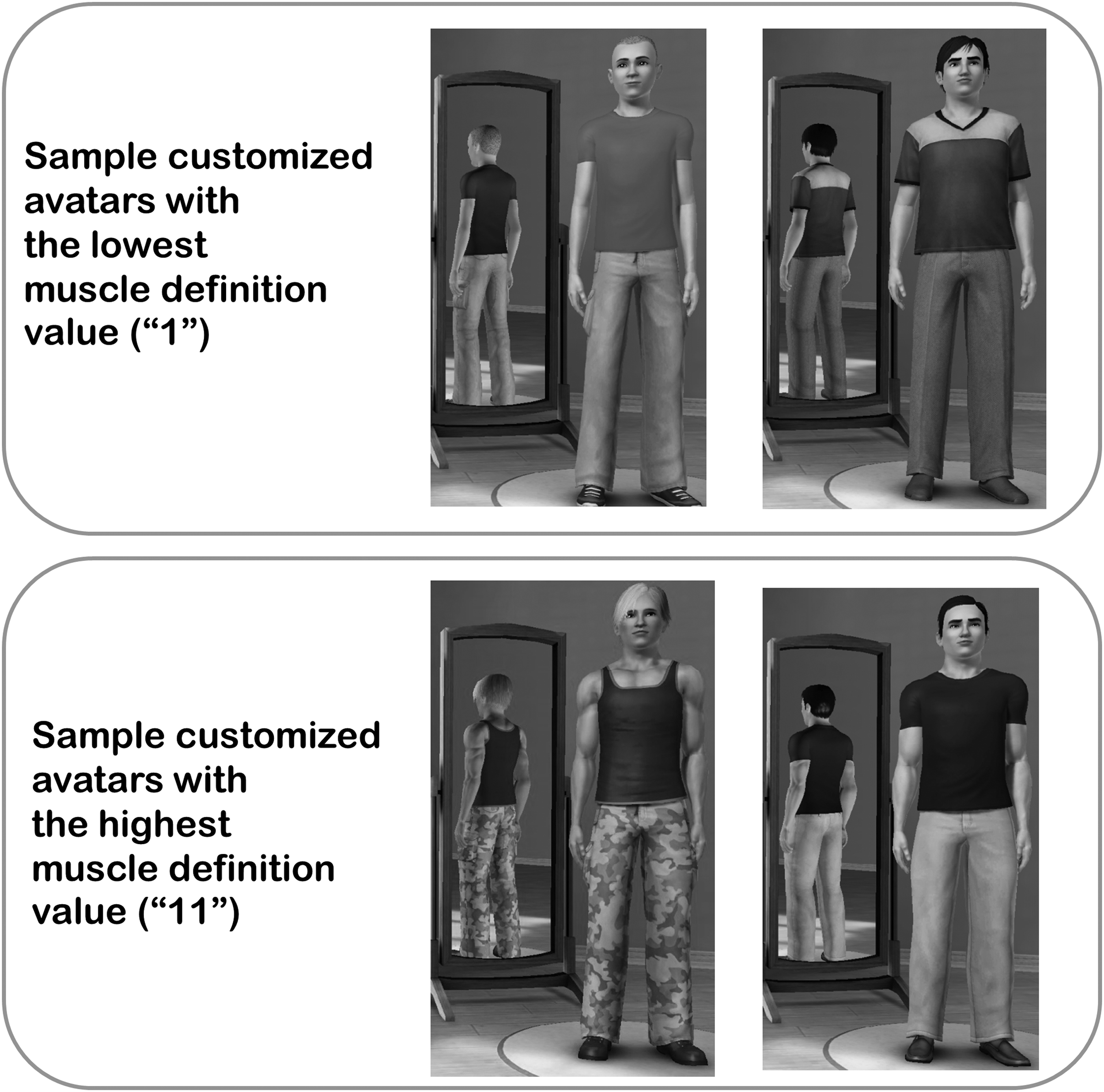
Sample images of the Sims 3 avatars customized by participants.
Handgrip task
The length of time participants squeezed the handgrip device was measured in seconds. Similar to past research, 45 there was a positive skew (skewness = 1.01, SE = 0.15). We applied a square-root transformation for normality (skewness = 0.22, SE = 0.15).
Experimenter sex
About half of the experiment sessions were run by female experimenters and the other half by male experimenters. Considering that experimenters' sex could have influenced participants' performance on the experimental tasks, 50 we controlled for experimenter sex (0 = male vs. 1 = female).
Sexual orientation
Participants' sexual orientation was measured with four categories: 1 = heterosexual, 2 = homosexual, 3 = bisexual, and 4 = other. The vast majority (82.4%) of the participants were heterosexual. Therefore, we followed past research on men's sexuality that dichotomized multiple sexual orientation categories into “nonheterosexual” (0) and “heterosexual” (1). 51
Results
Manipulation checks
At the end of the experiment session, a postquestionnaire was administered for manipulation checks. Our manipulation checks were threefold. First, an open-ended question probed participants' attention and suspicion toward the experimental procedure. Data from 35 participants who either failed to follow the instructions or did not believe the gender knowledge test results were excluded, leaving N = 238. Second, to ensure that both threatened and nonthreatened participants complied with the instruction to create a self-resembling avatar, the questionnaire asked participants to rate three items adapted from Van Looy et al. 52 (e.g., “My avatar resembles me”; 1 = strongly disagree vs. 5 = strongly agree). Masculinity-threatened participants (M = 3.68, SD = 0.68) and nonthreatened participants (M = 3.67, SD = 0.66) did not significantly differ, t(216) = 0.17, p = 0.86. Finally, we checked the masculinity-threat manipulation with an item from Vandello et al. 2 (“Would you be comfortable letting the researchers post your full name and gender knowledge test score on a public Web site?”; 1 = definitely yes vs. 7 = definitely not). Masculinity-threatened participants (M = 4.75, SD = 2.10) reported greater discomfort than did their nonthreatened counterparts (M = 3.94, SD = 2.18), t(216) = 2.80, p = 0.006, d = 0.38, indicating the manipulation was successful.
Hypothesis testing
Bivariate correlation coefficients of measured variables, along with their means and standard deviations, are provided in Table 1.
p < 0.05, **p < 0.01, ***p < 0.001 (two-tailed).
Experimenter sex and participants sexual orientation were included as covariates in the main analyses. H1 predicted that masculinity-threatened males, compared to nonthreatened males, would make their avatar look more muscular. An analysis of covariance yielded a significant effect of masculinity threat on avatar muscle definition, F(1, 234) = 5.82, p = 0.017, η2 = 0.024. Masculinity-threatened participants' avatars (n = 119, Madj = 6.54, SE = 0.26) showed greater muscle definition when compared to nonthreatened participants' (n = 119, Madj = 5.65, SE = 0.26), supporting H1.
Next, we examined the relationship between avatar muscle definition and physical endurance on the handgrip task (H2) and the mediating role of avatar muscle definition in the effect of masculinity threat on physical endurance (H3) by conducting ordinary least squares (OLS) regression (Model 4 of the PROCESS macro with 10,000 bootstrap samples). 53 Muscle definition and handgrip performance showed a significant and positive relationship, b = 0.19, SE = 0.06, p = 0.004, supporting H2. Furthermore, the indirect effect of masculinity threat on handgrip performance through muscle definition was significant, point estimate = 0.17, bootstrap SE = 0.09, 95% bootstrap confidence interval (CI) [0.0180 to 0.3794], supporting H3 (Fig. 3).
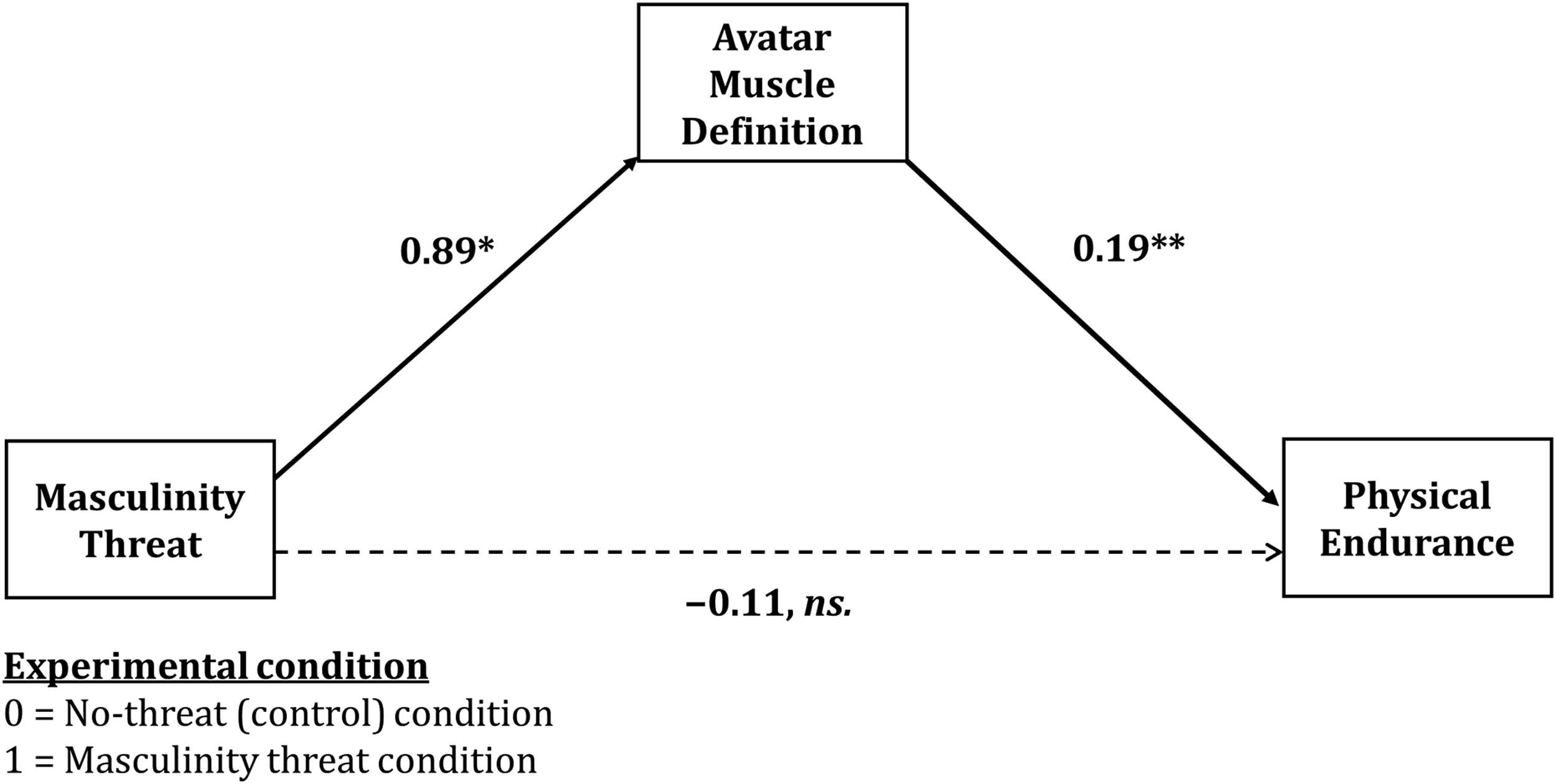
The significant indirect effect of masculinity threat on physical endurance (handgrip time) through avatar muscle definition. Path values represent unstandardized coefficients obtained from ordinary least squares (OLS) regression analysis based on Model 4 of the PROCESS macro. *p < 0.05, **p < 0.01.
Finally, we tested the moderating role of masculine norm conformity in the relationship among masculinity threat, avatar muscularity, and physical endurance (RQ1 and RQ2) with Model 7 of the PROCESS macro with 10,000 bootstrap samples. 53 Masculine norm conformity did not significantly moderate the effect of masculinity threat on avatar muscle definition (RQ1), b = 0.97, SE = 1.35, p = 0.470. We then tested moderated mediation (RQ2) by calculating the index of moderated mediation, as recommended by Hayes. 54 The indirect effect of masculinity threat on handgrip performance through avatar muscle definition was not significantly moderated by masculine norm conformity: index = 0.19, bootstrap SE = 0.27, 95% bootstrap CI [−0.3111 to 0.7875].
Discussion
Theoretical and practical implications
This research has several theoretical implications. First, masculinity threat motivated male avatar users to pursue high levels of muscularity in their virtual self-representation. Extant research on masculinity threat has demonstrated that compensation for threatened masculinity often takes the form of exaggerated masculine self-presentation.5,6 Our finding suggests that virtual muscularity 30 may serve as a means of compensation for masculinity-threatened young men to express and reaffirm their threatened gender-identity.
Second, higher avatar muscularity led participants to exhibit greater physical endurance on a handgrip task, which indicated that avatar users exhibited behaviors associated with the attributes they had chosen for their avatar through customization. This finding, extending previous Proteus effect studies on the behavioral effects of user-customized avatars in online gaming contexts,12,36 resonates with what Yee and Bailenson remarked in their seminal work on the Proteus effect: “As we choose our self-representations in virtual environments, our self-representations shape our behaviors in turn.” 11 (p287)
Our finding further showed that masculinity threat led to greater physical endurance through increases in avatar muscularity. In line with the agency model of customization,15,16 the significant mediation highlights the key role played by self-identity expression in users' psychological engagement with customized technological artifacts, which may serve to amplify behavior-level outcomes—such as those demonstrated in the Proteus effect. This mediation result also speaks to how identity enhancement needs that are triggered by situational factors may shape specific customization activities and subsequent user behaviors.
Also noteworthy is that the effects found in our experiment occurred regardless of the levels of masculine norm conformity. Compensatory avatar customization—as a response to cope with masculinity threat—seems to override individual differences with respect to masculine norm conformity.
From a more practical standpoint, the current findings suggest that technologies featuring avatars could help users cope with identity threat by providing customization options for specific attributes that are essential to reaffirming the threatened identity. As demonstrated by our results on physical endurance, such customization opportunities may allow identity-threatened users to achieve positive behavioral outcomes by fulfilling their identity needs.
Limitations and future directions
Our study has several limitations that should be discussed. First, because our primary objective was to examine the effect of masculinity threat on avatar customization patterns, all participants were instructed to customize a self-resembling avatar. More sophisticated experiment designs—such as those including conditions involving arbitrarily assigned avatars as well as no customization conditions 32 —would more clearly parse out the relative contributions of avatar appearance and customization to the behavioral effect of compensatory customization. In addition, the role of objective self-awareness (i.e., the state in which individuals become an object of their attention 55 )—known to trigger “automatic comparison of the self against standards,” 56 (p231)—merits attention. For example, Waddell et al. 31 showed that customization of a same-sex avatar led to greater self-awareness when compared to customization of an opposite-sex avatar. Varying the “sex” of the avatar to be customized could yield additional insights into the role of self-awareness in compensatory customization and its behavioral outcomes.
Second, the effect size of masculinity threat on avatar muscle definition was small in magnitude. The small effect might be due to the context of avatar customization in which participants were instructed to place themselves in a hypothetical online self-presentation context. A stronger effect might have been observed if the context of self-presentation involving avatar customization had been more public and social in nature (e.g., interacting with other avatars in a virtual world).
Future research should explore whether behavioral consequences of compensatory avatar customization triggered by masculinity threat go beyond physical endurance, such as mitigation of undesirable and antisocial coping responses (e.g., risk taking 19 and aggression 20 ) documented in the masculinity threat literature. In addition, investigating the role of compensatory avatar customization in other identity threat contexts will extend this research in meaningful ways.
Footnotes
Author Disclosure Statement
No competing financial interests exist.